A group of the world’s top ecologists have issued a stark warning about the snowballing crisis caused by climate change, population growth, and unchecked development. Their assessment is grim, but big-picture societal changes on a global scale can still avert a disastrous future.
Within the lifetime of anyone born at the start of the Baby Boom, the human population has tripled. Has this resulted in a human endeavor three times better — or one-third as capable of surviving? In the 1960s, humans took about three-quarters of what the planet could regenerate annually. By 2016 this rose to 170 percent, meaning that the planet cannot keep up with human demand, and we are running the world down.
“In other words,” say 17 of the world’s leading ecologists in a stark new perspective on our place in life and time, “humanity is running an ecological Ponzi scheme in which society robs nature and future generations to pay for boosting incomes in the short term.” Their starkly titled article, “Underestimating the Challenges of Avoiding a Ghastly Future,” reads less as an argument than as a rain of asteroids encountered in the course of flying blind on a lethal trajectory. The authors’ stated goal is not to dispirit readers. “Ours is not a call to surrender,” they write, “we aim to provide leaders with a realistic ‘cold shower’ of the state of the planet that is essential for planning to avoid a ghastly future.”
Put on your shower cap and step into the cold. Humans have altered about 70 percent of Earth’s land surface and ocean. Wetlands have lost 85 percent of their natural area; kelp forests have lost 40 percent; seagrass meadows are disappearing at 1 percent per year; the ocean’s large predatory fish are two-thirds gone; coral reefs have lost half their living mass. Agriculture has halved the weight of living vegetation on land, driving a diversity loss of 20 percent; 40 percent of extant plants are currently endangered. Farmed animals and humans now constitute 96 percent of all land vertebrates; only around 5 percent are wild, free-living animals. The world’s wild populations of birds, mammals, fishes, reptiles, and amphibians have declined by an average of nearly 70 percent in just the last 50 years, a breathtaking plummet. More than 700 vertebrate species have gone extinct over the last 500 years, an extinction rate 15 times the natural rate. Around a million species are now threatened with total extinction. These disruptions and declines have caused the deterioration of soil, air, and water quality; pollination; carbon sequestration; and human health. Other things have increased: floods, fires, the number of malnourished people, plastic pollution, general toxification, and infectious epidemics.
The point of seeing existential threats is not to face a doomsday future but to avert one.
Referring to the loss of living diversity and abundance, the authors note: “The mainstream is having difficulty grasping the magnitude of this loss, despite the steady erosion of the fabric of human civilization.” But I think the problem is that the fabric of human civilization has been built and fueled precisely by causing erosion of the living world. The pain of other living things is seldom humanly felt, their interests seldom considered, their intrinsic values discounted. (I am still asked “why we should care” about whether even iconic creatures such as right whales, for example, vanish forever.)
Worth noting is that the authors are overwhelmingly ecologists. As am I. This may account for their perceiving a grim future versus the rosy future offered by techno-optimists. Ecologists understand the world as interdependent relationships among diverse living and non-living systems. Ecologists examine feedbacks that result from, and make possible, the continuity and wondrous proliferation of life. Optimists tend to point to key human social trends such as rates of hunger and poverty. (The number of malnourished declined from 1 billion in 1990 to 800 million in 2017, a rate some well-nourished optimists feel good about. And while poverty rates also declined, population growth resulted in more extremely poor people.)
In my view and the view of others whom we might call techno-skeptics, technology alone won’t solve the accelerating collision. Any social system, any technology, delivers on its values. New technology that serves the same values that have caused the current array of problems will likely accelerate those problems. (Robots that put people out of work come to mind.) At core, optimists and ecologists are not having the same conversation. Optimists are upbeat about the way human things have been going. Ecologists see existential threats in the relational overshoots of the human footprint, strained social systems, climate feedbacks, and the extinction crisis. Ecologists understand that building an ever-larger human enterprise has resulted from putting more of the world through a macerator at the expense of the rest of life on Earth and generations unborn. On a planet that is finite, such an enterprise faces inevitable limits. We are slamming the guardrails.
A flooded street in Cali, Colombia in 2017, after heavy rains caused the overflowing of the Cauca River. LUIS ROBAYO/AFP VIA GETTY IMAGES
The point of seeing existential threats is not to face a doomsday future but to avert one. When the oil light comes on or the warning bells are insistent because you’ve fallen asleep at the wheel, it is safest to pull off the road you are hurtling along and assess your situation.
The authors of “Avoiding a Ghastly Future” highlight several main implications of our road too heavily travelled. One, current trends put the future on track to be much worse than generally appreciated. The scale of existential threats to humanity and other living things is so great as to be nearly incomprehensible. Second, humanity’s existing governments and leaders are not up to what’s needed. And mounting stresses such as managing climate refugees will perversely drive politics toward a diminishing capacity to recognize and deal with problems — as has become stunningly evident. Refugees fleeing climate-related famines or sea-level rise — in places like Afghanistan, Samoa, the Philippines, and the U.S. Gulf Coast, for example — strain politics and response systems, creating crises that dash the likelihood of diffusing underlying crisis-causing problems.
The most fundamental driver of putting more material into our enterprise, human population growth, is on track to continue at least through this century. But population growth and its effects are uneven around the globe. Some nations are stable or even declining slightly in numbers; some consume vastly less per person. But even the poorest, lightest-living people need land, food, and water, and the results are stark to anyone who has known and loved a place over several decades.
Just as population growth and consumption are not uniform, neither is the misery created. An estimated three-quarters of a billion people are slowly starving and 1 to 2 billion don’t get enough food to fully function as human beings. Population growth causes crowding, joblessness, friction, and conflict. Managing the heat of friction as population grows and the economy is under pressure to keep up makes it more difficult to cool it. It becomes less likely that leaders will recognize cooling, rather than fueling, as the more urgent need. This is evident as near-universal policies focus on getting “more” — more food for more people, for instance, rather than easing the crises by policies incentivizing population flattening and de-growth.
Most economists and politicians catastrophically confuse growth and improvement as synonymous.
But most economists and politicians and their policies catastrophically confuse growth and improvement as synonymous. The fundamental difference is that growth means getting larger by pushing more material into the system. Improvement means more effective outcomes. We all experienced a period when our bodies’ program was growth. When growth stopped, our focus could become improvement. Improved health care, education, and compassion do not require growth as a necessary condition. It seems, conversely, that a focus on growth often obstructs improvement.
Meanwhile, global economic growth will continue through this century, meaning that aggregate consumption will increase in coming decades. Fossil fuels presently enable most consumption; they’re the source of 85 percent of commercial energy, 65 percent of fibers, and most plastics. Agriculture also depends on fossil energy. Consequent to this burning, climate warming has matched or exceeded prior scientific predictions, and the most recent models predict more warming than did earlier models.
The loss of living things may mean little to most people, but climate changes are more obvious and more directly damaging to human life and investments. Perversely, atmospheric warming threatens to lower regional agricultural yields, increase mortality and morbidity, and even affect human cognitive functioning. The intensifying storms, coastal wash-overs, and fires of late might reasonably cause us pause. Such existential threats would seem likely to command the full attention of governments.
An Amur leopard, one of the world’s most endangered big cat species, at a zoo in Lyon, France. As of 2019, there were just 90 of these leopards left in the wild. JEFF PACHOUD/AFP VIA GETTY IMAGES
But national and international responses have been wholly inadequate. Nations are not meeting goals set under the Paris climate accord, the Convention on Biological Diversity, and the UN Sustainable Development Program, due mainly to the lack of governmental commitment to their success. The authors say that without fulfilling existing pledges — not to mention additional measures required — “Earth’s temperature will be catastrophic for biodiversity and humanity.”
Worsening trends should prompt positive responses from a rational being. The opposite is occurring. Worsening trends exacerbate social pathologies. Politics works short-term; changes necessary for a livable future are politically risky. Meanwhile politicians seldom get blamed for incurring the real risks and mounting costs behind catastrophic floods and fires. Conflicts, refugees, and wars are seldom understood as being partly (sometimes wholly) attributable to environmental changes. Those problems increase discord. Crises fuel the rise of extreme ideologies, terrorism, and autocratic heads of state (the U.S., Brazil, and Russia are among the examples). All this makes less likely the cooperation necessary to ease root causes, creating a perverse cycle of ecological decline, rising risks, catastrophic damages, social inequality, and dysfunctional responses.
ALSO ON YALE E360
Environmentalists at Risk: A special report on the recent rash of killings of environmental activists worldwide. Read more.
Environmentalism, rather than being regarded as a non-partisan endeavor to bring humanity together in a quest for self-preservation and planetary stabilization — as in the 1970s — is now often seen as a political ideology. As the authors of “Avoiding a Ghastly Future” point out, the Green New Deal in the U.S. has been a flashpoint for political polarization. Indeed, environmental groups are frequently labeled “terrorists.” To get a quick idea of how dangerous it has become to protect land, wild things, and wild places, search the Web for: environmentalists murdered (over 200 killings in 2019).
Big-picture solutions exist, including fundamentally tweaking global capitalism by including costs of pollution in the production of carbon and chemicals, for instance; rapidly attenuating fossil-fuel use; and ditching the delusional ideology of perpetual growth. Even the most fundamental issue, human numbers, could largely solve itself as social progress continues alleviating what might be the world’s most widespread inequity — suppression of women.
If there is one silver bullet, that bullet is full citizenship and empowerment of women.
What the solution-assigned institutions have lacked at the helm, however, is a species capable of the foresight, cooperation, and compassion that would avoid sinking the planetary ark. Whether humans could become that species remains to be seen. We are manifestly capable of creating planetary problems. We are not proving capable of fixing them.
A reckoning is coming. The authors warn that the only choice is between exiting the overshoot by design or by disaster. If we don’t get it, it will get us. There is no third way out of inevitable contractions in economic growth and human expansion.
On the positive side, many examples exist of successful interventions at smaller scales, such as the cleaner skies and waters resulting from laws and policies in the U.S. and elsewhere and the successes of the U.S. Endangered Species Act. But the authors contend that globally, only colossal international approaches to the colossal problems could let nations chart “a less-ravaged future.”
The point of “Avoiding a Ghastly Future” is that we all must recognize the enormity of these problems. But the authors believe that reality can be faced without sowing “disproportionate” fear and despair. They say the necessary choices will entail “difficult conversations about population growth” and “the necessity of dwindling but more equitable standards of living.”
Meenakshi Dewan, a solar engineer, inspects solar panels in the rural community of Tinginaput, India. ABBIE TRAYLER-SMITH / PANOS PICTURES / DEPARTMENT FOR INTERNATIONAL DEVELOPMENT
About this last conclusion, I don’t fully agree that it has to be like that. I hope the optimism bias that they warn of isn’t getting in my way. More equitable standards of living mean not dwindling standards for all, but rather, for many people, bigger and better lives than current inequities force billions to endure. Women who attain empowerment tend to seek smaller families simply as a matter of personal choice. So, what is difficult for some should hold great attraction for many now deprived of dignity, education, and equality.
In my view, if there is one silver bullet that can quell the multi-headed dragon of our looming future, that bullet is full citizenship for women — legally, financially, and culturally. Where women can enter higher education, secure bank loans, inherit wealth, own businesses, and ascend to high positions in business and government, population growth has largely tended to slow, as living becomes more equitable. Women more in control of their decisions and lives choose birth spacing and smaller family size. No discussion is necessary about the need to reckon with global population; personal decision-making suffices. The secret of those who attain more control of their own lives is that smaller families give people larger lives. The biggest slices of pie get cut at the least crowded tables.
ALSO ON YALE E360
The Real Case for Saving Species: We don’t need them, but they need us. Read more.
The cold shower outlined in “Avoiding a Ghastly Future” should motivate scientists to speak out strongly and should motivate investors and policymakers to envision and implement the many comprehensive solutions that have been charted. It’s not really a matter of “avoiding” a ghastly future; it’s whether we decide to create one. If we decide not to, we have our work — and our moral and ethical reflections — cut out for us.
BERLIN — Temperatures on Earth will shoot past a key danger point unless greenhouse gas emissions fall faster than countries have committed, the world’s top body of climate scientists said Monday, warning of the consequences of inaction but also noting hopeful signs of progress.
U.N. Secretary-General Antonio Guterres said the report by the Intergovernmental Panel on Climate Change revealed “a litany of broken climate promises” by governments and corporations, accusing them of stoking global warming by clinging to harmful fossil fuels.
“He is a war criminal,” Mr. Biden said. “I think it is a war crime. … He should be held accountable.”
The United States had already formally accused Russian forces of committing war crimes in Ukraine, and a number of national and international organizations have opened investigations, collecting evidence to build cases. But could Putin himself ever face a war crimes trial?
What are war crimes?
There are a number of international treaties — theGeneva Conventionand theGeneva Protocolbeing two of the most important — that establish international…
Trapper Ray Gall packs out a beaver from one of his traps in Ontario, CanadaCole BURSTON AFP
4 min
North Bay (Canada) (AFP) –Trying to maintain his balance on a dam, Canadian trapper Ray Gall advances cautiously as he tries to retrieve a large black beaver snared in one of his traps.
ADVERTISING
Few people in the country still manage to make a living solely in the business, which dates back 400 years to the first Indigenous trades of pelts to European explorers.
But thousands of Canadians, including Indigenous people, are still active in the now heavily-regulated industry.
“It’s the oldest profession” in Canada, says Gall, 47, a municipal water worker who traps, foxes, wolves and coyotes in his spare time in forests about a three-hour drive north of Toronto.
“There’s always gonna be a need for trappers whether the market is…
History has shown that international justice can be difficult to achieve, but that doesn’t mean Zelenskiy shouldn’t try
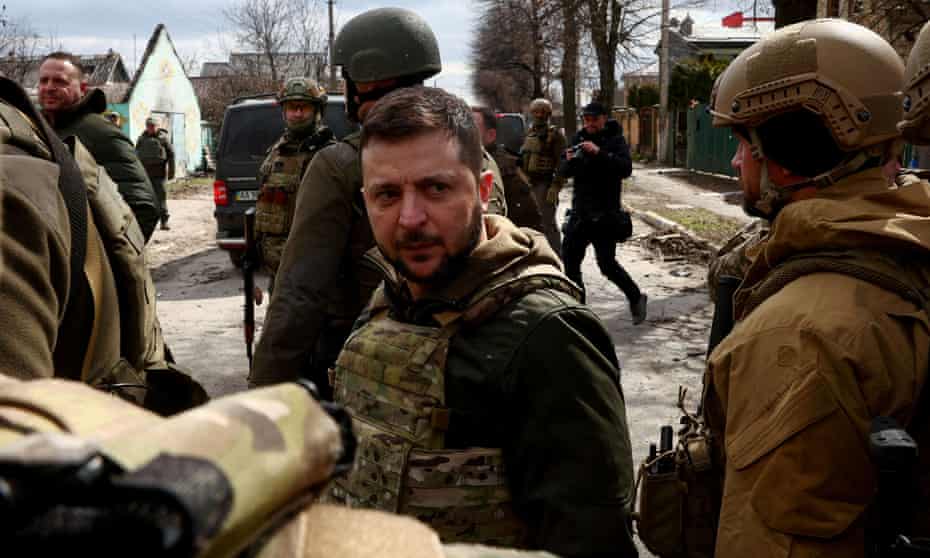
‘The cruelties of war need constant publicising and the west should offer every assistance.’ Volodymyr Zelenskiy with Ukrainian servicemen in Bucha, 4 April 2022. Photograph: Marko Đurica/Reuters
Mon 4 Apr 2022 11.07 EDT
The evidence of atrocities by Russian troops as they retreat from central Ukraine is appalling. Denials and claims of fabrication out of Moscow are worthless. Theallegedmassacres in Bucha and elsewhere cannot be put down to the indiscipline of war. After a month of targeted destruction of homes, hospitals and schools, they indicate a systematic campaign of terror against an entire population. They recall the worst depravities of the second world war.
The conflict in Ukraine is mutating from an all-embracing Russian conquest to the strategic exploiting of separatists in Donbas to strengthen Russia’s position on the Black Sea. It has become an escalation of a secessionist war that began in 2014. From that, Nato and the western world have largely, and probably rightly, held aloof.
Advertisement
But how should the outside world react to the new revelations? The suffering of peoples in conflicts far from Europe tends to pale against suffering “on our doorstep”, when screened nightly on television. Afghanistan’s two decades of western intervention have led millions of Afghans to face starvation, largely through western sanctions. Of their agony the news is silent.
That does not make Ukraine’s suffering any less real. This week the country’s president, Volodymyr Zelenskiy, set up an inquiry to collect evidence of Russian war crimes. These may include breaches of Geneva conventions on the conduct of war, acts of genocide and crimes against humanity. As the international lawyer Philippe Sands has pointed out, “the real issue that prosecutors will face” with regard to these crimes is whether they can “trace responsibility right up to the leadership”. This requires fixing responsibility for frontline behaviour on a superior authority. In Ukraine, it would require evidence that Vladimir Putin ordered or knowingly permitted atrocities. His possible defence – he could not be accountable for the fog of war or the horrors of battle – would have to be rebutted.
The first indictment of a sitting head of state before an international tribunal was Yugoslavia’s Slobodan Milošević in 1999. He was charged with counts emerging from seven massacres. His laborious trial dragged on for six years until in 2006 he died, unconvicted, in prison. By then Yugoslavia had moved on and the trial had lost retributive or deterrent impact. This illustrates Zelenskiy’s difficulty, but should not discourage him from proceeding. The cruelties of war need constant publicising and the west should offer every assistance.
Another judicial route proposed by Sands and others is a tribunal into the crime of aggression in particular. Here the argument is that all actions by soldiers result from decisions by their leaders, including unprovoked aggression against a foreign state. Putin could not wriggle off this hook. His generals, even his seemingly vanished defence secretary, Sergei Shoigu, could argue that they were obeying no orders but his.
Whether at the Nuremberg trials or with the signing of the charter of the United Nations, international action has struggled to outlaw attacks on one sovereign state by another. It concentrates responsibility at the point of authority, be it democratic or authoritarian. It seeks to bring international law and morality to the service of peace. Law-law is better than war-war.
While superficially attractive, such an approach would face uncomfortable hurdles. It would probably require UN security council initiative, which would be vetoed by Russia and possibly China. More to the point, many UN members hardly have clean hands on aggression. Western interventions in Yugoslavia in 1999 and Iraq in 2003 were of dubious legality, as have been other interventions around the world by Nato or its members, however noble the intentions.
Meanwhile, Boris Johnson and other western leaders gaze at the images from Bucha and reflexively agree that something must be done, and the only thing they can think of is “ever tougher sanctions”. Despite being the most savage ever imposed on an economy of comparable size, they have patently failed to dent Putin’s resolve. Admittedly unreliable polls indicate little domestic opposition to him, whether among the Russian people or the Moscow elite. A sense of embattlement and cultural ostracism has seen both groups hunker down in a patriotic trench. Putin’s decisions are governed by battles not sanctions, by tanks not banks. If the west wants to help Ukraine it should do so by proxy, by sending weapons.
History offers scant evidence that decisions taken in the heat of war are governed by economics. The historian Nicholas Mulder finds the US withdrawal of financial support from Britain over Suez in 1956 as one of the few examples of it having any impact on policy. Plenty of sanctions “hurt” – usually poor people – but almost none can be shown to have the slightest bearing on a victim state’s conduct of a conflict. As for driving the price of Europe’s gas, oil and grain through the roof, sanctions may make outsiders “feel Ukraine’s pain”. They will not relieve it, any more than currently traumatising Europe’s political economy for years to come will help a postwar recovery.
We should not ignore the most lasting weapon, the tribunal of world opinion. The pictures of Bucha are being seen on the streets not just of Europe and the US but across the world. Russia’s reputation is being badly damaged. There will come a point when the cries of an outraged world penetrate even Moscow’s mendacious publicity machine and set the record straight. As for Putin, he has merely assured himself of pariah status for life. His yacht will never drop anchor in a western harbour.
The Intergovernmental Panel on Climate Change on Monday released its latest report, which found that nations are falling short of their pledges to reduce greenhouse gas emissions in order to avert catastrophic climate change. While the technology exists to stay below 1.5 degrees Celsius (2.7 Fahrenheit) of average global temperature increase — the goal that virtually every nation agreed to in the 2015 Paris climate agreement and reaffirmed last year in the Glasgow Climate Pact — current policies put the world on a trajectory toward at least twice as much warming.
The YodelFree. Cancel anytime
A daily roundup of news, sports, finance, and more. See latest
United Nations Secretary-General António Guterres called the report’s conclusion “damning.” The Working Group III report marks the end of the IPCC’s Sixth Assessment, with strong words for countries that have failed to act on climate change.
“The jury has reached a verdict. And it is damning,” Guterres said in a statement. “This report of the Intergovernmental Panel on Climate Change is a litany of broken climate promises. It is a file of shame, cataloging the empty pledges that put us firmly on track towards an unlivable world.”
The IPCC report included 278 authors from 65 countries reviewing over 18,000 scientific papers.
Smoke billows from the chimneys at the coal-fired Lethabo power station in Vereeniging, South Africa, in 2018. (Themba Hadebe/AP)
According to their findings, to meet the 1.5°C target, global greenhouse gas emissions have to start dropping in 2025 and go down 43% from current levels by 2030 — and 84% by 2050. Achieving that requires ambitious actions from large emitters such as the United States, the European Union and China in the next few years. Waiting longer, the scientific consortium warned, will mean economic losses from the impacts of climate change such as drought, wildfires and sea level rise. Even limiting warming to 2°C (3.6°F) would require peaking emissions by 2025 and cutting them by roughly one-quarter by 2030.
Without a dramatic shift in policy, Guterres warned, “We are on a fast track to climate disaster: Major cities under water. Unprecedented heatwaves. Terrifying storms. Widespread water shortages. The extinction of a million species of plants and animals.”Story continues
Most of the world’s leading researchers on climate change are involved in the production of IPCC reports – their summaries of the latest science, produced every six or seven years, are used by governments in their negotiations on climate change, such as those that took place at COP26 last November.
These IPCC reports are seen as the best, if slightly conservative studies on the state of climate science.
For the past two weeks, IPCC scientists and government officials from all over the world have been locked in a virtual approval session, going through this latest report on how to stop climate change line by line.
This new study will be the third of three important documents from the IPCC issued over the past eight months.
The previous two have looked at the causes and impacts of climate change, but this one will focus on mitigation – or what we can do to stop it.
This essentially means that researchers will look at how we can reduce the amount of warming gases that are emitted from human activities.
One key part of the summary report will detail what the world can do between now and 2030 to limit heating.
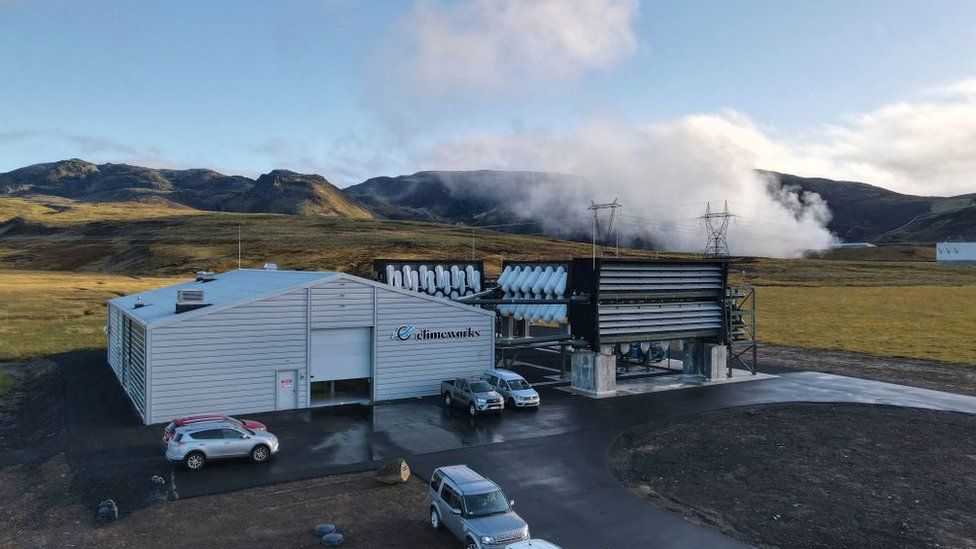
Image caption,Carbon removal technology, such as at this installation in Iceland, will be examined
IPCC scientists have previously warned that to keep the rise in global temperatures under 1.5C this century, emissions from warming gases would have to halve by the end of this decade.
In this new study, the researchers will likely be encouraging a rapid reduction in fossil fuel use, especially over the next eight years.
But this is sensitive territory – many large developing countries say that they should have the right to continue to use coal, oil and gas for longer, to help grow their economies.
Some major fossil fuel producers are also reluctant to embrace the urgency of cutting these fuels that scientists say is absolutely necessary.
Other countries have also taken issue with questions around the use of nuclear energy.
These divisions have seen the approval session continue way past its official closing time on Friday.
According to one person with knowledge of the proceedings, it is not a surprise that the talks are running late as everyone recognises the implications this report will have on decisions that will have to be taken in next few years.
Another key part of the report will be the focus on approaches to remove CO2 from the air.
Image caption,Prof Jim Skea is one of the co-chairs of the latest IPCC report
The kind of carbon removal approaches the report will consider will likely include tree planting and agriculture, as well as the more advanced technological approaches that use large machines to remove the carbon from the air.
They will also look at combined approaches, where land is used to grow crops which can be burned for energy while the carbon is captured and buried.
The use of these types of technology is controversial. Campaigners express doubts that they can be made to work economically and there are also concerns that technology could be seen as an excuse not to make the major changes in energy production that are needed.
Scientists though say that the situation is now so serious that carbon dioxide removal will be needed in addition to massive cuts in emissions.
The discussions to approve the report’s Summary for Policymakers, due on Monday, have been one of the longest in IPCC history.
Delegates worked through Saturday night and well into Sunday to finish the document.
Betelgeuse Supernova And Its Impact On Earth – Science Documentary
Were a supernova to go off within about 30 light-years of us, that would lead to major effects on the Earth, possibly mass extinctions. X-rays and more energetic gamma-rays from the supernova could destroy the ozone layer that protects us from solar ultraviolet rays.
The latest fiery exchange between the United States and North Korea has produced a new kind of threat. On Tuesday, during his speech at the United Nations, President Trump said his government would “totally destroy North Korea” if necessary to defend the United States or its allies. On Friday, Kim Jong Un responded, saying North Korea “will consider with seriousness exercising of a corresponding, highest level of hard-line countermeasure in history.”
The North Korean leader didn’t elaborate on the nature of this…
Ukrainian troops are finding brutalized bodies and widespread destruction in suburbs of the capital as Russian soldiers withdraw and Moscow focuses its attacks elsewhere, including missile strikes Sunday that targeted fuel and ammunition supplies in southern and eastern Ukraine.
Associated Press journalists in Bucha, a small city northwest of Kyiv, saw the bodies of at least nine people in civilian clothes who appeared to have been killed at close range. At least two had their hands tied behind their backs. The AP also saw two bodies wrapped…