Driving the news:TheWHOposted anewsletter on its websitethat states that it has received reports of sudden hearing problems — including tinnitus and ringing sounds — from those who received the COVID-19 vaccine.
Most people said they experienced these side effects within one day after the shot.
GRAND PORTAGE, Minn. (AP) — To administer this COVID test, Todd Kautz had to lie on his belly in the snow and worm his upper body into the narrow den of a hibernating black bear. Training a light on its snout, Kautz carefully slipped a long cotton swab into the bear’s nostrils five times.
For postdoctoral researcher Kautz and a team of other wildlife experts, tracking the coronavirus means freezing temperatures, icy roads, trudging through deep snow and getting uncomfortably close to potentially dangerous wildlife.
They’re testing bears, moose, deer and wolves on a Native American reservation in the remote north woods about 5 miles from Canada. Like researchers around the world, they are trying to figure out how, how much and where wildlife is spreading the virus.
E.J. Isaac, Roger Deschampe Jr., and Frank Manthey, who work in resource management for the Grand Portage Band of Lake Superior Chippewa, take biological samples from a deer they caught in a Clover trap in Grand Portage, Minn. on March 2, 2022. (AP Photo/Emma H. Tobin)
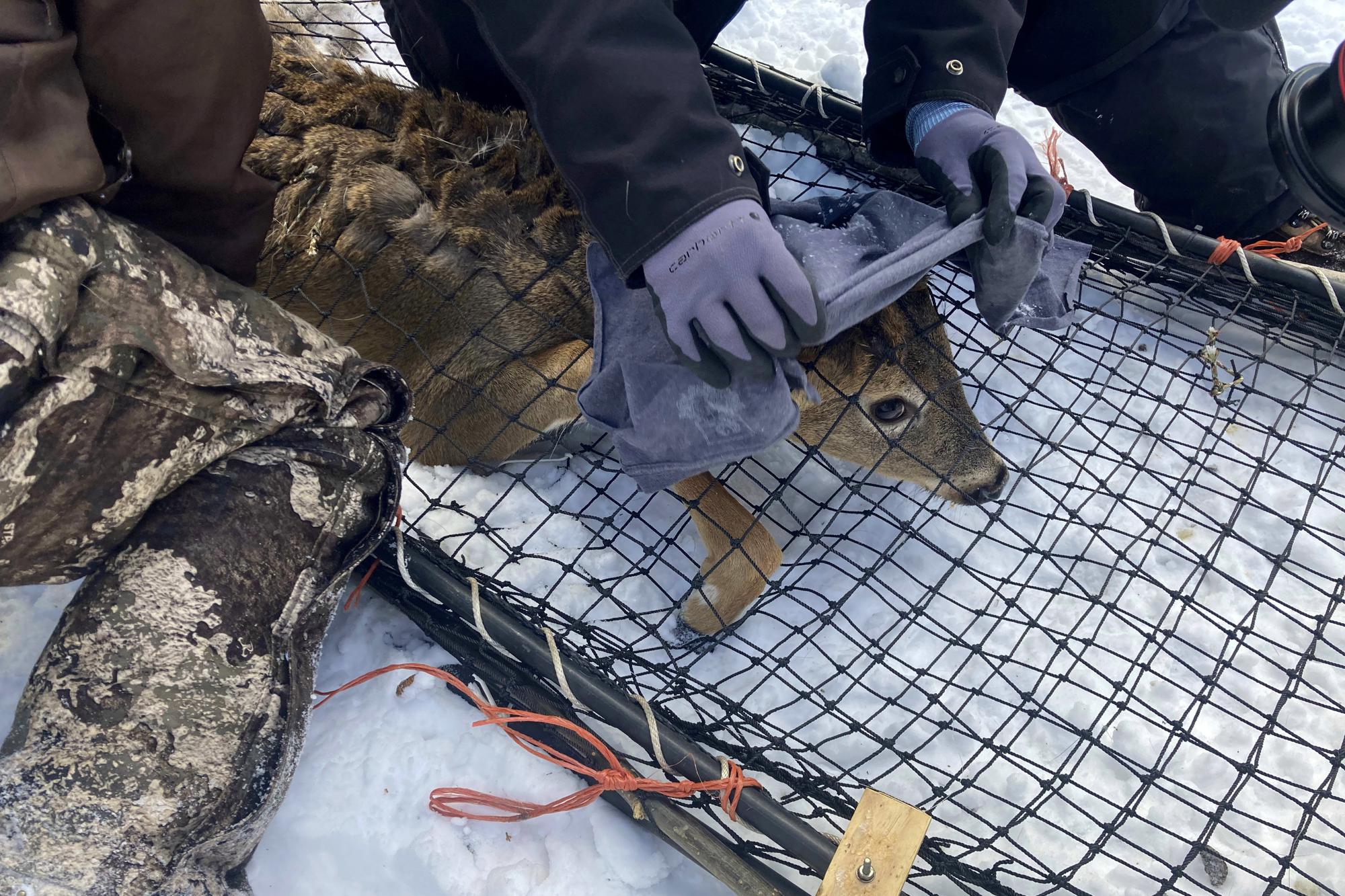
E.J. Isaac, fish and wildlife biologist for the Grand Portage Band of Lake Superior Chippewa, swabs a young buck for the coronavirus in Grand Portage, Minn. on March 2, 2022. (AP Photo/Laura Ungar)
E.J. Isaac, fish and wildlife biologist for the Grand Portage Band of Lake Superior Chippewa, places a swab into a vial after testing a young buck for the coronavirus in Grand Portage, Minn. on March 2, 2022. (AP Photo/Laura Ungar)
Scientists are concerned that the virus could evolve within animal populations – potentially spawning dangerous viral mutants that could jump back to people, spread among us and reignite what for now seems to some people like a waning crisis.
The coronavirus pandemic has served as a stark and tragic example of how closely animal health and human health are linked. While the origins of the virus have not been proven, many scientists say it likely jumped from bats to humans, either directly or through another species that was being sold live in Wuhan, China.
And now the virus has been confirmed in wildlife in at least 24 U.S. states, including Minnesota. Recently, an early Canadian study showed someone in nearby Ontario likely contracted a highly mutated strain from a deer.
“If the virus can establish itself in a wild animal reservoir, it will always be out there with the threat to spill back into the human population,” said University of Minnesota researcher Matthew Aliota, who is working with the Grand Portage Reservation team.
E.J. Isaac, a fish and wildlife biologist for the reservation that’s home to the Grand Portage Ojibwe, said he expects the stakes to get even higher with the start of spring, as bears wake from hibernation and deer and wolves roam to different regions.
“If we consider that there are many species and they’re all intermingling to some extent, their patterns and their movements can exponentially increase the amount of transmission that could occur,” he said.
Their research is meant to ward off such unwelcome surprises. But it carries its own set of risks.
Seth Moore, who directs the reservation biology and environment department, recently almost got bitten by a wolf.
And they sometimes team with a crew from the Texas-based company Heliwild to capture animals from the air. One chilly late-winter afternoon, the men climbed into a small helicopter with no side doors that lifted above the treetops. Flying low, they quickly spotted a deer in a forest clearing. They targeted the animal from the air with a net gun and dropped Moore off.
Wind whipped at his face as he worked in deep snow to quickly swab the deer’s nose for COVID, put on a tracking collar and collect blood and other biological samples for different research.
Wildlife experts are searching for the virus that causes COVID-19 in deer, bears, moose and wolves in Minnesota’s north woods. They are among researchers around the world trying to figure out how and where wildlife is spreading the coronavirus. (AP Video/Emma H. Tobin)
The men capture moose in much the same way, using tranquilizer darts instead of nets. They trap wolves and deer either from the air or on the ground, and trap bears on the ground.
They knew of the young male bear they recently tested because they had already been tracking it. To get to the den, they had to take snowmobiles to the bottom of a hill then hike a narrow, winding path in snow shoes.
When Kautz crawled part-way into the den, a colleague held his feet to pull him out quickly if necessary. The team also gave the animal a drug to keep it sleeping and another later to counteract the effects of the first.
Todd Kautz, a post-doctoral researcher from the State University of New York, lies on his belly to take biological samples from a hibernating bear in its den as a colleague holds his feet in Grand Portage, Minn. on March 2, 2022. (AP Photo/Laura Ungar)
A bear hibernates in a den in Grand Portage, Minn. on March 2, 2022. (AP Photo/Emma H. Tobin)
To minimize the risk of exposing animals to COVID, the men are fully vaccinated and boosted and get tested frequently.
The day after testing the bear, Isaac packed their samples to send to Aliota’s lab in Saint Paul. The veterinary and biomedical researcher hopes to learn not just which animals are getting infected but also whether certain animals are acting as “bridge species” to bring it to others. Testing may later be expanded to red foxes and racoons.
It’s also possible the virus hasn’t reached this remote location – yet. Since it’s already circulating in the wilderness of Minnesota and nearby states, Aliota said it’s only a matter of time.
LOOKING FOR MUTANTS
Close contact between humans and animals has allowed the virus to overcome built-in barriers to spread between species.
To infect any living thing, the virus must get into its cells, which isn’t always easy. Virology expert David O’Connor likens the process to opening a “lock” with the virus’ spike protein “key.”
ADVERTISEMENT
“Different species have different-looking locks, and some of those locks are not going to be pickable by the key,” the University of Wisconsin-Madison scientist said.
But other locks are similar enough for the virus to enter an animal’s cells and make copies of itself. As it does, it can randomly mutate and still have a key that fits in the human lock. That allows it to leap back to humans through close contact with live animals, scientists believe.
E.J. Isaac, fish and wildlife biologist for the Grand Portage Band of Lake Superior Chippewa, stands over an empty deer trap in Grand Portage, Minn. on March 1, 2022. (AP Photo/Emma H. Tobin)
A young buck peeks out from under a blanket while in a Clover deer trap. A wildlife team is testing the animal for the coronavirus and taking other biological samples in Grand Portage, Minn. on March 2, 2022. (AP Photo/Laura Ungar)
Although spillback is rare, it only takes one person to bring a mutated virus into the realm of humans.
Some think the highly mutated omicron variant emerged from an animal rather than an immune-compromised human, as many believe. Virologist Marc Johnson of the University of Missouri is one of them, and now sees animals as “a potential source of pi,” the Greek letter that may be used to designate the next dangerous coronavirus variant.
Johnson and his colleagues found strange coronavirus lineages in New York City sewage with mutations rarely seen elsewhere, which he believes came from animals, perhaps rodents.
What scientists are most concerned about is that current or future variants could establish themselves and multiply widely within a reservoir species.
One possibility: white-tailed deer. Scientists found the coronavirus in a third of deer sampled in Iowa between September 2020 and January 2021. Others found COVID-19 antibodies in a third of deer tested in Illinois, Michigan, New York and Pennsylvania. Infected deer generally have no symptoms. Testing in many other wild species has been limited or absent.
“It’s possible that the virus is already perhaps circulating in multiple animals,” said virology expert Suresh Kuchipudi of Pennsylvania State University, an author of the Iowa deer study. If unmonitored, the virus could leave people “completely blindsided,” he said.
CAN IT BE STOPPED?
Ultimately, experts say the only way to stop viruses from jumping back and forth between animals and humans — extending this pandemic or sparking a new one — is to tackle big problems like habitat destruction and illegal wildlife sales.
“We are encroaching on animal habitats like we have never before in history,” Aliota said. “Spillover events from wild animals into humans are, unfortunately I think, going to increase in both frequency and scope.”
To combat that threat, three international organizations — the United Nations Food and Agriculture Organization, the World Organization for Animal Health and the World Health Organization — are urging countries to make COVID surveillance in animals a priority.
In Grand Portage, Aliota’s collaborators continue to do their part by testing as many animals as they can catch.
The sun begins to set over Hollow Rock on frozen Lake Superior in Grand Portage, Minn. on March 3, 2022. (AP Photo/Emma H. Tobin)
Frank Manthey follows E.J. Isaac and Roger Deschampe Jr. into the Grand Portage, Minn. woods on March 2, 2022, to check traps they set to catch deer for scientific research for the Grand Portage Band of Lake Superior Chippewa. (AP Photo/Emma H. Tobin)
The sun rises over icy Lake Superior in Grand Marais, Minn., on March 3, 2022. (AP Photo/Emma H. Tobin)
With icy Lake Superior sparkling through the evergreens, Isaac slipped his hand beneath the netting of a deer trap. A colleague straddling the animal lifted its head off the snowy ground so that Isaac could swab its nostrils.
The young buck briefly lurched its head forward, but kept still long enough for Isaac to get what he needed.
“Nicely done,” his colleague said as Isaac put the sample into a vial.
When they were finished, they gently lifted the trap to let the deer go. It bounded into the vast forest without looking back, disappearing into the snowy shadows.
___
The Associated Press Health and Science Department receives support from the Howard Hughes Medical Institute’s Department of Science Education. The AP is solely responsible for all content.
Deosai Plateau in Northern Pakistan spread over 3,000 square kilometers is a place of astounding beauty, lush greenery, and biodiversity where the numbers of Himalayan bears were increasing previously, but now there’s a sharp decline in their population.
In five decades, the temperature has doubled compared to the rest of Pakistan, which is affecting not only the monsoon but also rapid changes on the plateau, making it difficult to see Himalayan brown bears.
In a documentary titled ‘Bears on the Brink- Deosai’ aired on The Express News, the filmmaker elucidated that the Himalayan brown bears are in danger of extinction, climate-changing is not only causing malnutrition but also creating human-bear conflict.
These bears have lost 98 per cent of their previous numbers worldwide. By 2050, all Himalayan brown…
The Canadian Food Inspection Agency says bird flu has been found at a poultry farm in southern Ontario.
The agency says the farm is under a strict quarantine, and the CFIA is establishing movement controls and recommending higher biosecurity at nearby farms.
It says it confirmed the presence of the highly pathogenic H5N1 strain of avian flu that is spreading around the world among wild birds.
There have been outbreaks at commercial and non-commercial farms in Nova Scotia and Newfoundland and Labrador in recent months.
WILLMAR, MINN. – Highly Pathogenic Avian Influenza (HPAI) has been confirmed in a commercial turkey flock in Meeker County, Minn., that supplies Jennie-O Turkey Store, a business unit of Hormel Foods Corp., Austin, Minn. Another case of HPAI also was found in a backyard flock in Mower County, Minn.
State officials have quarantined the affected premises and the flocks will be depopulated, according to the Animal and Plant Health Inspection Service of the US Department of Agriculture. The two confirmed cases of HPAI, which were disclosed on March 26, bring the total number of cases to 61 since Feb. 8, when a case was announced in a commercial turkey flock in Dubois, Ind.
“Jennie-O Turkey Store has been preparing for this situation and took extensive precautions to protect the health of the turkeys in its supply chain,” the company said…
Minnesota’s busiest wildlife rehabber will stop admitting and treating bird species that are susceptible to the H5N1 avian flu.
The Wildlife Rehabilitation Center of Minnesotaannounced the temporary policy change over the weekend, calling it a “grave decision” the organization will reevaluate once the Highly Pathogenic Avian Influenza (HPAI) “has run its course.”
This means that, for the time being, the rehab center will not take in:
Any ducks or diving birds
Geese
Pelicans
Raptors (including hawks, eagles, vultures and owls)
Gulls
Tundra swans
Great blue herons
“As you can imagine, this is not a decision made lightly,” said WRC’s communications director Tami Vogel on a Minnesota birding message board. “We are so sad to see HPAI moving through the wild populations this…
A U.S. official tells Fox News that “any movement of Russian forces from around Kyiv is a redeployment, not a withdrawal, and the world should be prepared for a major offensive against other areas of Ukraine.” The remark comes after Russia claimed it was withdrawing forces there in hopes of laying the groundwork for a peace deal with Ukraine.
The White House said Tuesday that President Joe Biden will “convene a call with President Macron of France, Chancellor Scholz of Germany, Prime Minister Draghi of Italy, Prime Minister Johnson of the United Kingdom to discuss the latest developments regarding Russia’s invasion of Ukraine.”
Ukraine’s military said Tuesday that Russian forces have destroyed at least 60 religious buildings since their invasion…
Hunting is France’s most popular pastime after fishing and football, but a series of recent shooting accidentshas put its many enthusiasts in the firing line themselves. As presidential candidates fish for votes, the hunters see an opportunity to go on the offensive to defend a popular tradition dating back to the revolution.
Some four million people hold alicence to hunt in France, and 1.1 million activate them each year.
“We’re a political force,” William Schraen, president of theNational Federation of Hunters(FNC), confidently told a number of presidential candidates at a meeting in Paris last week.
The hunting lobby is strongand even if the majority of French people live in urban areas, no politician with an eye on the Elysée can afford to neglect the rural vote.
If the United States and Russia were to engage in direct air, land, and sea conflict, the risk ofnuclear warwould become much more likely.
An all-out nuclear war would likely involve more than 3,000 warheads used by both sides, killing well over 100 million Americans and Russians.
Russia’s invasion of Ukraine is already one of the most destructive and lethal wars in recent memory, from the shelling of cities to the use of thermobaric“vacuum weapons.” That’s led experts and civilians, alike, to wonder what—if NATO and the U.S. become directly involved in the conflict—a nuclear war between Washington and Moscow might look like.
Here,Popular Mechanicsexamines two classic nuclear attack scenarios: a counterforce strike and a countervalue strike. The counterforce scenario…
The N.C. Wildlife Resources Commission will open more than 92,500 acres in threebear sanctuaries in Western North Carolina to hunting, after voting Feb. 24toallow permit hunting there and change thenames to “management areas.”
At its February meeting, the commission unanimously supported the rule change for the 2022-23 season after considerablepublic input and opposition, a move toward the state’s goal of managing bear populations and human-bear interactions.
The rule change received “significant public comment,” according to a wildlife commission announcement. “After careful consideration, the rule passed unanimously. The Commission also voted to amend the name of these areas from Designated Bear Sanctuaries to Designated Bear Management Areas.”
Critics have pushed back against the rule change, questioning whether there is a population or interaction problem, the data used to justify the change, and how effective the hunting will be in accomplishing the…



 This is a file photo of a hen. (Alison Burrell/Pexels)

 4 HOURS AGOLISTEN


