March 4 (Reuters) – Almost a third of people report at least one ongoing symptom between 6 and 12 months after their coronavirus infection, a survey of 152,000 people in Denmark has found.
The study includes one of the largest groups yet of people who were not hospitalised with COVID, and followed them for longer than other major studies, the researchers from Denmark’s State Serum Institute (SSI) said.
The questionnaire-based study suggested that the most commonly reported long-term symptoms were changes in sense of smell and taste, as well as fatigue.
Conducted between September 2020 and April 2021, well before the recent Omicron variant surge, the survey compared the responses of 61,002 people who had tested positive for the coronavirus six, nine or 12 months before with…
An example of a losing plant species not useful to humans is Araucaria muelleri, a New Caledonian endemic conifer threatened by habitat loss, forest fires and nickel-mining activities.Photograph: Joey Santore, (CC-BY-NC)
Researchers have categorised more than 80,000 plant species worldwide and found that most of them will “lose” in the face of humanity – going extinct because people don’t need them.
This means that plant communities of the future will be hugely more homogenised than those of today, according to the paper published in the journalPlants, People, Planet.
The findings, which paint a stark picture of the threat to biodiversity, cover less than 30% of all known plant species, and as such are a “wake-up call”, say the researchers, highlighting the need for more…
As western governments untangle themselves from Russian oil and gas, Svitlana Krakovska notes that the roots of the climate crisis and invasion are in fossil fuels
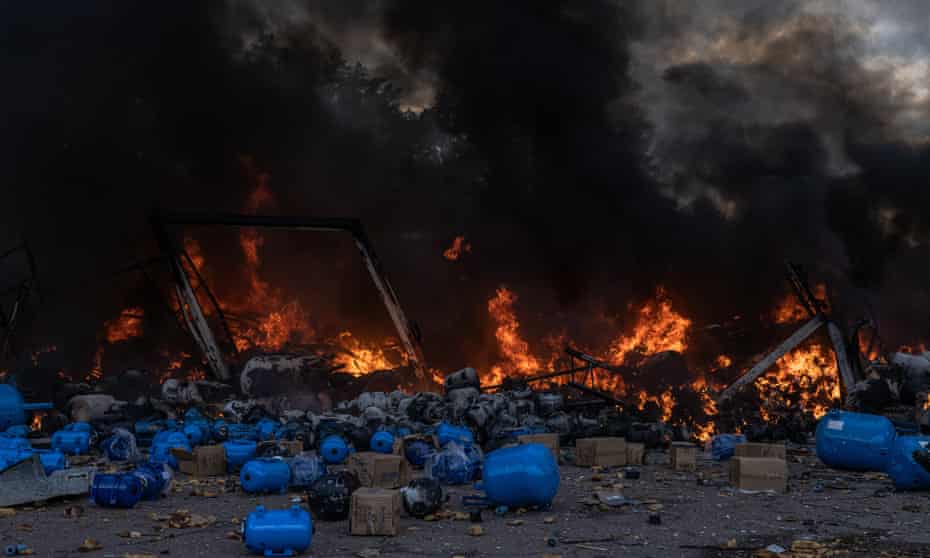
A fire at a warehouse after a Russian Kalibr missile was shot down over Kalynivka village in Ukraine on 8 March. Photograph: Roman Pilipey/EPA
For Svitlana Krakovska, Ukraine’s leading climate scientist, it was meant to be the week where eight years of work culminated in a landmark UN report exposing the havoc the climate crisis is causing the world.
But then the bombs started to crunch into Kyiv.
Krakovska, the head of a delegation of 11 Ukrainian scientists, struggled to help finalize the vast Intergovernmental Panel on Climate Change (IPCC) report ahead of its release on 28 February even as Russian forces launched their invasion. “I told colleagues that as long as we have the internet and no bombs over our heads we will continue,” she said.
But her team, scattered across the country, started to peel away – one had to rush to an air raid shelter in Kharkiv, others decided to flee completely, internet connections spluttered, one close friend of a delegate was killed in the fighting. International colleagues had to express their sympathies and press on with the report.
Krakovska’s four children sheltered with her in their Kyiv home as a missile struck a nearby building, emitting an ear-splitting roar. A fire from a separate strike sent up a plume of smoke that blotted the sky. “This blitzkrieg by [Vladimir] Putin is unbelievable, it is terrorism against the Ukrainian people,” she said.
Both the invasion and IPCC report crystallized for Krakovska the human, economic and geopolitical catastrophe of fossil fuels. About half of the world’s population is now acutely vulnerable to disasters stemming from the burning of fossil fuels, the IPCC report found, while Russia’s military might is underpinned by wealth garnered from the country’s vast oil and gas reserves.
“I started to think about the parallels between climate change and this war and it’s clear that the roots of both these threats to humanity are found in fossil fuels,” said Krakovska.
“Burning oil, gas and coal is causing warming and impacts we need to adapt to. And Russia sells these resources and uses the money to buy weapons. Other countries are dependent upon these fossil fuels, they don’t make themselves free of them. This is a fossil fuel war. It’s clear we cannot continue to live this way, it will destroy our civilization.”
The IPCC report, described by António Guterres, the UN secretary general, as an “atlas of human suffering and a damning indictment of failed climate leadership”, is the most comprehensive catalogue yet of the consequences of global heating. Extreme heat and the spread of disease is killing people around the world, about 12 million people are being displaced by floods and droughts each year and the viability of food-producing land is shrinking.
But it is the conflict in Ukraine that has caused western governments to hastily attempt to untangle themselves from a reliance upon Russian oil and gas. The EU, which gets about 40% of its gas supply from Russia, is working on a plan to rapidly upscale renewable energy, bolster energy efficiency measures and build liquified natural gas terminals to receive gas from other countries.
It’s clear we cannot continue to live this way, it will destroy our civilization
Joe Biden, meanwhile, has relented to pressure from US lawmakers to ban imports of Russian oil. The ban, the US president said on Tuesday, will deliver a “powerful blow to Putin’s war machine. We will not be part of subsidizing Putin’s war.” Biden said the US will work with Europe on a long-term plan to phase out Russian oil and gas.
The halting of imports was urged in an emotional appeal to members of Congress by Volodymyr Zelenskiy, the Ukrainian president, and is backed by a bipartisan majority of lawmakers. “It’s basically foolish for us to keep buying products and giving money to Putin to be able to use against the Ukrainian people,” said Joe Manchin, the centrist Democratic senator.
Others see the ban as a moment to decisively break from fossil fuels altogether. “This moment is a clarion call for the urgent need to transition to domestic clean energy so that we are never again complicit in fossil-fueled conflict,” said Ed Markey, a progressive Democratic senator who was a driving force behind the Green New Deal agenda.
But in a stark demonstration of how deeply embedded fossil fuels remain in decision making, Biden’s administration has awkwardly attempted to extol its efforts to confront the climate crisis while also boasting that the US is now drilling more oil than even under Donald Trump to show it is cognizant of public anguish over rising gasoline prices, a perennial political headache for presidents.
“We don’t have a strategic interest in reducing the global supply of energy,” Jen Psaki, the White House press secretary, said last week. “That would raise prices at the gas pump for the American people, around the world, because it would reduce the supply available.”
While the US takes a relatively small amount of oil from Russia – only about 3% of all oil imports – experts say it is telling that an administration vocal about the need to reduce fossil fuels has found it difficult to cut itself from its dependency on oil and gas.
“It’s a crude oversimplification to call this a fossil fuel war, that’s a little too glib,” said Jonathan Elkind, an expert in energy policy at Columbia University and a former energy adviser to Barack Obama’s administration. “But it’s an undeniable reality that Russia gets a significant share of its revenues from oil and gas and that America’s gasoline habit contributes towards the global demand for 100m barrels of oil each day.
“Do we want to find ourselves 10 years from now where we’ve bent the curve on oil consumption and emissions towards decarbonization, or do we want to sit there and think ‘where did the last 10 years go?’ If the US isn’t a part of the solution we will put in peril our influence on the world stage and the fate of everyone, both here and around the globe.”
While Europe belatedly attempts to wean itself off Russian gas, efforts to phase down fossil fuels in the US have faltered. Biden’s legislative plan to drastically ramp up renewable energy is moribund in Congress, largely thanks to Manchin, while the conservative-leaning supreme court is mulling whether to weaken the administration’s ability to regulate coal-fired power plants.
The invasion of Ukraine has also triggered a push by the US oil and gas industry and its allies in Congress to loosen regulations to allow more domestic drilling. Manchin, chair of the Senate energy committee, has said that delaying new gas pipelines when “Putin is actively and effectively using energy as an economic and political weapon against our allies is just beyond the pale”. Even Elon Musk, founder of the electric vehicle company Telsa, has said that “we need to increase oil and gas output immediately. Extraordinary times demand extraordinary measures.”
The White House has pointed out that the industry is already sitting on a huge number of idle drilling leases – a total of 9,000 unused permits covering 26m acres of American public land – while environmentalists argue the crisis highlights the dangers of being at the mercy of a volatile global oil price, now near an all-time high, rather than shifting towards solar, wind and other sources of clean energy.
“The fossil fuel industry’s so-called solution to this crisis is nothing more than a recipe to enable fossil-fueled fascists like Vladimir Putin for years to come,” said Jamal Raad, executive director of Evergreen Action. “As long as our economy is dependent on fossil fuels, we will be at the mercy of petro-dictators who wield their influence on global energy prices like a weapon.
“American-made clean energy is affordable, reliable and free from the volatility of oil and gas markets. The best way to weaken Putin’s grip on the global energy market is to get America off of fossil fuels.”
In Kyiv, Krakovska has said that she will stay in her home city as the Russian army advances, having declined offers to relocate to foreign research institutions. “I know that’s what Putin wants, for us to flee Ukraine so they can have our beautiful country,” she said.
“I have told scientists in other countries I will collaborate with them, but from an independent and free Ukraine. I couldn’t be in another place knowing that Kyiv was in the hands of those barbarians.”
Man receives pig heart in 1st successful transplant of its kind
Surgeons at the University of Maryland successfully transplanted a modified pig heart in…Read More
Byron Dillard via AP
The first person to receive a heart transplant from a pig has died, two months after the groundbreaking experiment, the Maryland hospital that performed the surgery announced Wednesday.
David Bennett, 57, died Tuesday at the University of Maryland Medical Center. Doctors didn’t give an exact cause of death, saying only that his condition had begun deteriorating several days earlier.
Bennett’s son praised the hospital for offering the last-ditch experiment, saying the family hoped it would help further efforts to end the organ shortage.
“We are grateful for every innovative moment, every crazy dream, every sleepless night that went into this historic effort,” David Bennett Jr. said in a statement released by the University of Maryland School of Medicine. “We hope this story can be the beginning of hope and not the end.”
Doctors for decades have sought to one day use animal organs for life-saving transplants. Bennett, a handyman from Hagerstown, Maryland, was a candidate for this newest attempt only because he otherwise faced certain death — ineligible for a human heart transplant, bedridden and on life support, and out of other options.
After the Jan. 7 operation, Bennett’s son told The Associated Press his father knew there was no guarantee it would work.
Prior attempts at such transplants — or xenotransplantation — have failed largely because patients’ bodies rapidly rejected the animal organ. This time, the Maryland surgeons used a heart from a gene-edited pig: Scientists had modified the animal to remove pig genes that trigger the hyper-fast rejection and add human genes to help the body accept the organ.
At first the pig heart was functioning, and the Maryland hospital issued periodic updates that Bennett seemed to be slowly recovering. Last month, the hospital released video of him watching the Super Bowl from his hospital bed while working with his physical therapist.
Bennett survived significantly longer with the gene-edited pig heart than one of the last milestones in xenotransplantation — when Baby Fae, a dying California infant, lived 21 days with a baboon’s heart in 1984.
“We are devastated by the loss of Mr. Bennett. He proved to be a brave and noble patient who fought all the way to the end,” Dr. Bartley Griffith, who performed the surgery at the Baltimore hospital, said in a statement.
Other transplant experts praised the Maryland team’s landmark research and said Bennett’s death shouldn’t slow the push to figure out how to use animal organs to save human lives.
“This was a first step into uncharted territory,” said Dr. Robert Montgomery of NYU Langone Health, a transplant surgeon who received his own heart transplant. “A tremendous amount of information” will contribute to the next steps as teams at several transplant centers plan the first clinical trials.
“It was an incredible feat that he was kept alive for two months and was able to enjoy his family,” Montgomery added.
The need for another source of organs is huge. More than 41,000 transplants were performed in the U.S. last year, a record — including about 3,800 heart transplants. But more than 106,000 people remain on the national waiting list, thousands die every year before getting an organ and thousands more never even get added to the list, considered too much of a long shot.
The Food and Drug Administration had allowed the dramatic Maryland experiment under “compassionate use” rules for emergency situations. Bennett’s doctors said he had heart failure and an irregular heartbeat, plus a history of not complying with medical instructions. He was deemed ineligible for a human heart transplant that requires strict use of immune-suppressing medicines, or the remaining alternative, an implanted heart pump.
Organ rejection, infections and other complications are risks for any transplant recipient. Experts hope the Maryland team quickly publishes in a medical journal exactly how Bennett’s body responded to the pig heart.
From Bennett’s experience, “we have gained invaluable insights learning that the genetically modified pig heart can function well within the human body while the immune system is adequately suppressed,” said Dr. Muhammad Mohiuddin, scientific director of the Maryland university’s animal-to-human transplant program.
One next question is what evidence, from Bennett’s experience and some other recent experiments with gene-edited pig organs, may persuade the FDA to allow a clinical trial — possibly with an organ such as a kidney that isn’t immediately fatal if it fails.
Twice last fall, Montgomery’s team at NYU got permission from the families of deceased individuals to temporarily attach a gene-edited pig kidney to blood vessels outside the body and watch them work before ending life support. And surgeons at the University of Alabama at Birmingham went a step further, transplanting a pair of gene-edited pig kidneys into a brain-dead man in a step-by-step rehearsal for an operation they hope to try in living patients possibly later this year.
Patients may see Bennett’s death as suggesting a short life-expectancy from xenotransplantation, but the experience of one desperately ill person cannot predict how well this procedure ultimately will work, said ethics expert Karen Maschke of The Hastings Center. That will require careful studies of multiple patients with similar medical histories.
Transplant centers should start educating their patients now about what to expect as this science unfolds, said Maschke, who with funding from the National Institutes of Health is developing ethics and policy recommendations on who should be allowed in the first studies of pig kidneys and what they need to know before volunteering.
Pigs have long been used in human medicine, including pig skin grafts and implantation of pig heart valves. But transplanting entire organs is much more complex than using highly processed tissue. The gene-edited pigs used in these experiments were provided by Revivicor, a subsidiary of United Therapeutics, one of several biotech companies in the running to develop suitable pig organs for potential human transplant.
in The southwest African country denies it violated an international wildlife treaty.
BYDINA FINE MARON PUBLISHED MARCH 9, 2022 • 5 MIN READ
Today, at a France-based global summit on the international treaty that regulates the wildlife trade, numerous countries condemned Namibia for its recent international sale and export of 22 wild African elephants.
Namibia says it has more than 24,000 elephants and that roundups of elephants are essential to alleviate potentially lethal encounters with humans and to raise money for conservation and wildlife management. Last year, elephants killed three people, and there have been numerous claims of crop damage in recent years, according to data the Namibian government shared with National Geographic.
The United Kingdom, among others, raised a number of questions about Namibia’s elephant export which appears to violate the Convention on International Trade in Endangered Species of Wild Fauna and Flora (CITES). That’s…
Most Americans view nuclear weapons as a relic of the Cold War. President Ronald Reagan and Soviet leader Mikhail Gorbachev agreed in 1985 “that a nuclear war can never be won and must never be fought.” That thinking has remained a “given” for the last 37 years. Unfortunately, Russian President Vladimir Putin may have other ideas.
Just five days before Russia invaded Ukraine, Putin personally oversaw nuclear exercises and issued subtle nuclear threats against the West should Ukraine become a part of NATO…
NEW YORK (AP) — Two years into the COVID-19 pandemic, most of the world has seen a dramatic improvement in infections, hospitalizations and death rates in recent weeks, signaling the crisis appears to be winding down. But how will it end? Past epidemics may provide clues.
The ends of epidemics are not as thoroughly researched as their beginnings. But there are recurring themes that could offer lessons for the months ahead, said Erica Charters of the University of Oxford, who studies the issue.
“One thing we have learned is it’s a long, drawn-out process” that includes different types of endings that may not all occur at the same time, she said. That includes a “medical end,” when disease recedes, the “political end,” when government prevention measures cease…
In public statements and at international summits, Chinese officials have attempted to stake out a seemingly neutral position on the war in Ukraine, neither condemning Russian actions nor ruling out the possibility Beijing could act as a mediator in a push for peace.
But while its international messaging has kept many guessing as to Beijing’s true intentions, much of its domestic media coverage of Russia’s invasion tells a wholly different story.
There, an alternate reality is playing out for China’s 1.4 billion people, one in which the invasion is nothing more than a “special military operation,” according to its national broadcaster CCTV; the United States may be funding a biological weapons program in Ukraine, and Russian President Vladimir Putin is a victim standing up for a beleaguered Russia.
To tell that story, major state-run news media outlets — which dominate China’s highly censored media space — have been largely echoing Russian state media stories or information from Russian officials.
A CNN analysis reviewed nearly 5,000 social media posts from 14 Chinese state media outlets during the first eight days of Russia’s invasion posted onto China’s Twitter-like platform, Weibo. The analysis found that of the more than 300 most-shared posts about the events in Ukraine — which were each shared more than 1,000 times — almost half, about 140, were what CNN classified as distinctly pro-Russian, often containing information attributed to a Russian official or picked up directly from Russia’s state media.
The analysis, which focused on stories that got the most play on social media, may not be representative of all posts shared by state media outlets on Weibo. But it provides a snapshot of the state media-produced information that is most visible to the more than half a billion monthly users on the popular platform.
It’s not clear the extent to which these posts may be explicitly the result of a coordinated propaganda campaign between the two countries, but it is consistent with an ongoing pattern in which Russian and Chinese media have amplified and reinforced their often-interchangeable talking points on issues such as the treatment of Russian dissidents, Hong Kong pro-democracy protests, the origins of the Covid-19 pandemic, or the supposed American role in fomenting “color revolutions” against authoritarian regimes.
Such mutual reinforcement has also spilled over into the extensive overseas and English-language propaganda operations that both countries have built to promote their views globally — a route made more important with Russia’s state media outlets being banned on air and online in parts of the West.
In China’s top-down government-controlled media environment, all state-affiliated content is vetted and issued in accordance with government directives. That China has chosen to follow Russia’s lead in deliberately mischaracterizing the war only serves to underline Beijing’s closeness to Moscow — and almost makes a mockery of China’s self-proclaimed impartiality in helping to engage with Russia and bring an end to the violence.
Russian assurances that civilian sites will not be targeted — despite extensive evidence to the contrary, descriptions of Ukrainian soldiers using “Nazi” tactics, and misinformation regarding the whereabouts of Ukrainian President Volodymyr Zelensky are all stories that have been funneled from Russian sources into China’s enclosed social media ecosystem — where many Western news outlets are blocked — by its state media outlets in recent days.
That dynamic was at play on Monday morning, when China’s state broadcaster CCTV released a package in its morning newscast highlighting Moscow’s erroneous claim that Washington had funded the development of biological weapons in Ukrainian labs. That insinuation is used to support the narrative that Ukraine — characterized by Moscow as an American puppet state — threatens Russia, and not the other way around.
The source? Russian Defense Ministry Spokesman Igor Konashenkov, who on Sunday said Russian forces uncovered “evidence” of the “hasty measures to conceal any traces of the military biological program finance(d) by the US Department of Defense,” and referenced documents he said detailed the destruction of hazardous pathogens at these facilities on the order of the Ukrainian Health Ministry.
In a statement on Twitter Wednesday, White House press secretary Jen Psaki pushed back on “Russia’s false claims about alleged US biological weapons labs and chemical weapons development in Ukraine” and noted the “echoing” of those “conspiracy theories” by Chinese officials.
“This is preposterous. It’s the kind of disinformation operation we’ve seen repeatedly from the Russians over the years in Ukraine and in other countries, which have been debunked, and an example of the types of false pretexts we have been warning the Russians would invent,” Psaki said, adding that the US was “in full compliance” with its obligations under the Chemical Weapons Convention and the Biological Weapons Convention and “does not develop or possess such weapons anywhere.”
“Now that Russia has made these false claims, and China has seemingly endorsed this propaganda, we should all be on the lookout for Russia to possibly use chemical or biological weapons in Ukraine, or to create a false flag operation using them. It’s a clear pattern,” Psaki said.
The subject was also raised in a Senate hearing on Tuesday, when Undersecretary of State for Political Affairs Victoria Nuland, asked if Ukraine had biological weapons, said it has biological research facilities, which the US was concerned Russian forces may be seeking to control.
“We are working with the Ukrainians on how they can prevent any of those research materials from falling into the hands of Russian forces, should they approach,” Nuland said.
Minutes after the CCTV report aired, an affiliated news outlet released an online post repeating the claims from Russia’s Defense Ministry and started a related hashtag on Weibo, which began trending. The hashtag was viewed more than 45 million times over a period of hours that day.
The next day, after Russia doubled down on the biological weapons claims with further statements, without evidence, CCTV released a new television segment, which was again shared by prominent state media outlets on Weibo, gaining further traction.
The story then moved into the narrative of China’s officials when a state media reporter at a regular Foreign Ministry press briefing asked a question about the laboratories, prompting the spokesperson to read a lengthy prepared response that repeated Russian disinformation.
“We once again urge the US to fully clarify its biological militarization activities both inside and outside its borders and accept multilateral verification,” spokesperson Zhao Lijian said.
Within hours, at least 17 state media outlets, including CCTV, Xinhua, and the People’s Daily, posted Zhao’s response on Weibo, where the topic racked up more than 210 million views. A related hashtag rose to be the top trending topic on Weibo by the following afternoon.
The pattern is just one example of a playbook that enables China to cover the war through the lens of Russian rhetoric and disinformation. Other examples include stories, such as repeated false claims that Zelensky fled the Ukrainian capital, Kyiv — sourced to a single Russian lawmaker, which were picked up and amplified by both Chinese and Russian state media outlets on their domestic and international platforms.
A CNN analysis sought to understand how large a role such stories play in China’s tightly controlled media ecosystem, first by combing through nearly 5,000 social media posts from the Weibo accounts of 14 of China’s most influential state media outlets, focusing on the first eight days of the invasion and news about the events in Ukraine.
Next, CNN analyzed which of those posts were the most highly engaged with, identifying more than 300 posts shared on Weibo more than 1,000 times. Of those more than 300 posts, an analysis found that nearly half showed Russia in a positive light — a category CNN defined as news sourced solely from Russian officials or Russian media, content that describes Ukraine negatively, misinformation about Zelensky, or pro-Putin coverage.
While about 140 posts showed Russia in a positive light, the analysis identified fewer than 15 posts that portrayed Ukraine positively.
A look at other characterizations showed only around 90 of these posts were neutral — for example, purely factual reports from reliable sources, news about humanitarian aid or updates on the evacuation of Chinese citizens from Ukraine.
Just over a third were what CNN classified as anti-West or anti-US, for example: stories airing views that Russia was pushed to action in Ukraine by the expansion of NATO, or criticizing Western media coverage of the crisis.
CNN reporters classified some posts into more than one category. A look at the distribution shows posts that depicted Russia in a positive light were more frequent than any other category.
Because CNN only studied posts with high engagement, the findings may not be representative of all posts produced by state media.
In response to CNN’s request for comment, the Chinese Foreign Ministry said Thursday the country is a victim of disinformation.
“Some anti-China forces and media have fabricated too many lies, rumors and disinformation about China on issues that include the situation in Ukraine,” it said in a statement. “They have smeared the image of China, poisoned the media environment and misled public worldwide. Such actions are hypocritical and despicable.”
The backdrop
The findings contrast the apparent middle line that China has tried to walk in its international diplomacy.
Though Beijing has stood apart from the Western response to Russia’s invasion, with its diplomats refusing to condemn the invasion, or even call it such, and decrying Western sanctions, it has also frequently repeated that “all countries’ legitimate security concerns” should be addressed.
In a virtual summit with French President Emmanuel Macron and German Chancellor Olaf Scholz on Tuesday, Chinese leader Xi Jinping called for negotiations to bring about “peaceful outcomes” and stressed China’s promises to contribute humanitarian aid to Ukraine.
“There is a difference between the way China talks to the international audience and the way it talks to the domestic audience … for the domestic audience, it’s important to preserve this partnership with Russia, because that’s a political priority for Xi,” said Alexander Gabuev, a senior fellow and the chair of the Russia in the Asia-Pacific Program at the Carnegie Moscow Center.
He points to the increasingly close relationship between China and Russia in recent years, a strategic partnership strengthened, in part, by shared friction with the West.
“So (China’s leaders) need to shape public perceptions about this, and explain why dealing with Russia is morally justified or is the right thing to do — and (China’s media coverage) serves this purpose,” he said.
A glimpse into how China may seek to control its coverage was given in the days prior to the invasion, when an internal directive that was apparently accidentally shared on social media showed Chinese state media outlet Beijing News ordered its employees not to publish news reports that were “negative about Russia or pro-West.” Beijing News did not respond to requests for comment.
Maria Repnikova, director of the Center for Global Information Studies at Georgia State University, said Russia-leaning coverage was in line with historical precedent: “Stories that are critical of Russia or are portraying Russia in an unfavorable manner are generally censored,” she said.
“As a result of that, it is expedient to use Russian state media sources because they’re the ones portraying the (Ukraine) conflict with a more favorable eye or view from the Russian perspective,” she said.
Another sign of this has been which voices have been allowed to thrive on China’s heavily censored social media platforms in the wake of the invasion. There, pro-Russia and anti-Western, nationalistic voices have also dominated, while there has been a suppression of pro-Ukrainian or anti-war messages on platforms and across the media landscape.
One glaring example came Friday, when CCTV broadcast a speech from International Paralympic Committee President Andrew Parsons, at the opening ceremony of the Beijing Paralympic Games, in which many parts of the speech were muffled and were not translated.
The offending context? Parsons’ “message of peace,” in which he did not name Russia or Ukraine but said he was “horrified at what is taking place in the world.”
Those voices from within China who have tried to speak up — including five history professors who penned an open letter voicing their strong opposition to “Russia’s war against Ukraine” — have seen their posts swiftly deleted or social accounts suspended.
“We have seen alternative, critical voices — some subtle critique or attempts to present scenes from the war zone and talk about humanity and empathy toward Ukraine — (but) a lot of these messages have been censored,” said Repnikova.
Social media platforms in China have taken action against extremist nationalist voices in recent weeks, with Sina Weibo “punishing” around 75 accounts and screening out more than 1,500 posts and video-streaming platform Douyin removing over 6,000 illegal videos, according to the state-owned Global Times. But the nationalistic voices that have dominated social media platforms fall in line with what Repnikova describes as “a significant spike in digital nationalism, (with) the US and the West (as) the key target of this nationalistic sentiment.”
Break the monopoly
That nationalist sentiment — fueled by a deep distrust of the US and concern about its role as the leading global power — are a critical part of the glue that has firmed up the Russian and Chinese relationship in recent years.
It’s also filtered in the kinds of media coverage that each have shared overseas, as both Russia and China have sought to deepen their propaganda efforts, launching social media-friendly news brands in English and other languages, like China’s CGTN and RT (formerly Russia Today).
While experts say it’s unclear if top media officials from the two countries are discussing news coverage at an operational level and some official coordination is more symbolic in nature, there is a growing push in recent years for alignment and content-sharing.
A number of content-sharing arrangements exist between Chinese and Russian media outlets, and the shared vision is clear: these outlets together can “break the monopoly of Western media,” as a Global Times report on a China-Russia media forum in 2015 put it.
Fast-forward to the crisis in Ukraine and the upside of that collaboration, for one partner anyway, is clear.
In the European Union, Kremlin-backed media outlets RT and Sputnik were officially banned as of last Wednesday, with companies like Meta, parent of Facebook and Instagram, and Google’s YouTube stepping in to block their content.
But, on China’s channels like CGTN and Global Times, which continue to operate, those Russian talking points are still getting through.
Already this week, posts from those accounts have suggested Ukraine and the US have pro-Nazi leanings, repeated Russian misinformation on the laboratories, and cited Russia denying that it plans to overthrow the existing government in its “special military operation” in Ukraine.
Officials announced they have identified bird flu in a commercial flock of 50,000 turkeys in northwest Iowa, the state’s second case of a virus that has been identified in multiple states
ByDAVID PITT Associated Press
March 7, 2022, 12:49 PM
•4 min read
3:23
On Location: March 9, 2022
Catch up on the developing stories making headlines.
ABCNews.com
DES MOINES, Iowa — Officials announced Monday that they have identified bird flu in a commercial flock of 50,000 turkeys in northwest Iowa, the state’s second case of a virus that has been identified in multiple U.S. states.
Iowa agriculture officials and the U.S. Department of Agriculture confirmed the case in Buena Vista County, about 100 miles (160 kilometers) north of the case identified March 1 in a backyard flock of 42 ducks and chickens in Pottawattamie County.
Yellowstone National Park officials say the first grizzly bear of 2022 was spotted in the park on Monday. Photo: Sinclair Nitz
MISSOULA, Mont. —Yellowstone National Park officials say the first grizzly bear of 2022 was spotted in the park on Monday.
The park released the following information Tuesday:
On Monday, March 7, a pilot supporting Yellowstone National Park wildlife research observed the first grizzly bear of 2022. The adult bear was seen walking in a meadow in the west-central part of the park.
The first bear sighting of2021occurred on March 13.
Male grizzlies come out of hibernation in early March. Females with cubs emerge in April and early May. When bears emerge from hibernation, they look for food and often feed on elk and bison that died over the winter. Sometimes, bears will react aggressively to encounters with people when feeding…




 Top Articles


