The US Department of Agriculture reported outbreaks of a highly lethal type of bird flu in commercial flocks in Maryland and South Dakota over the weekend, adding to concerns that wild birds are spreading the disease across the country.
Farmers are ordered to kill their flocks after the disease is detected, and importing countries including Mexico, China and Korea have imposed state-specific import restrictions in response.
Thebird flu outbreakis the worst since 2015, when nearly 50 million birds, mostly turkeys and egg-laying…
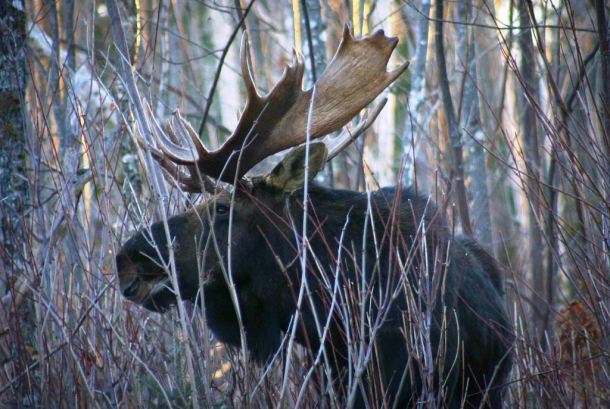
A bull moose patrols the Northeast Kingdom. Photo by Wayne LaRouche
Covered in thousands of blood-draining ticks, Vermont moose are struggling to survive.
Based on continuedstudiesconducted by the University of Vermont and the Vermont Fish & Wildlife Department on moose health, officials hope that decreasing the number of moose could reduce tick transmission and stabilize the population.
To that end, the department plans to issue another 100 moose-hunting permits this October.
Get all of VTDigger’s daily news.
You’ll never miss a story with our daily headlines in your inbox.
The Vermont Fish & Wildlife Board approved the proposal last month, with plans to issue “60 either-sex moose hunting permits and 40 antlerless moose permits.”
In 2021, the program drew almost 6,000 applicants for the 100 permits. A total of 62…
North Carolina’s Wildlife Resources Commission voted tooverturn the state’s bear hunting banthat was first enacted in 1971 when the black bear population was fewer than 1,000.
By
Shirin Ali | March 7, 2022
A black bear walking down a gravel road in the Alligator River National Wildlife Refuge near Manteo, North Carolina.Greg Meland/ iStock
Less than two weeks into Russia’s invasion of Ukraine and the country’s people and armed forces have mounted a staunch resistance against Russia’s forces.
Russia is seen as having made less progress than it expected.
Still, analysts say Russia is likely to “win” in Ukraine, and have drawn out various scenarios for what comes next.
As many as 1.5 million people have fled to neighboring countries in Europe for safety.
Less than two weeks intoRussia’s invasion of Ukraineand the country’s people and armed forces continue to mount a staunch — and undeniably brave — resistance against Russian forces.
But for all of Ukraine’s heart and courage in facing down multiple, sustained attacks from Russia’s military in the north, east and…
Minutes before the Ukraine invasion, the Russian presidentwarnedof “consequences that you have never experienced in your history.”
“Yes, Putin might do the unthinkable,”saidJames Clapper, the former director of national intelligence, toBusiness Insider.
For almost a decade, Russian doctrine has been to “escalate to deescalate,” to threaten or even to use nuclear weapons early in a conventional conflict or crisis…
When Vladimir Putin put Russia’s nuclear defense system on heightened alert last Sunday, the term “nukes” began trending on Twitter. A congressman from Louisiana wrote an unintelligible post about “millennial leftists who never lived one day under nuclear threat” now living under a “woke sky” of our own making. “U.S. PRESIDENT BIDEN SAYS AMERICANS SHOULD NOT BE WORRIED ABOUT NUCLEAR WAR,” a Reuters correspondent tweeted, apparently not realizing the effect of all caps. Later, the NUKEMAP, a site that enables users to simulate the damage from a nuclear weapon launched on their location, went down because too many people had logged on.
For Americans who can’t remember or weren’t around for most of the Cold War, nuclear apocalypse is the premise for a disaster movie, not a threat to our real lives. But a constant slurry of updates from Russia’s war on Ukraine — both Chernobyl and a working nuclear facility were captured by Russian forces — is making that threat more concrete. By the Wednesday following Putin’s announcement, a colleague told me that she’d had a scary, albeit realistic, nightmare in which she received a news alert on her phone saying that Biden had put the United States’ nuclear defense system on heightened alert, too.
In my text messages with friends, we discussed a planned vacation at the end of the month with an eye toward survival: “If we make it,” someone said. “Haaaaaa,” I replied. Our worries were diffused between a host of other concerns (COVID, climate change; take your pick) and veiled by the various detached registers with which people who get their news on social media talk about the things that scare us. “It’s okay, ‘nukes’ isn’t even trending above all of the names of the characters from Euphoria,” I told my sister on the phone. But behind the irony, I had gnawing, earnest questions: How concerned should we really be about nuclear war right now, and how should we act? Do you pack a bag? Call your mom? Make a joke? Just log off and look away?
To get an answer, I wanted to talk to an expert not just on nuclear weapons and on U.S.-Russia relations, but on the specific subject of nuclear fear. Cynthia Lazaroff is a disarmament activist and documentarian, whose 2017 film, US-Russia Relations: The Quest for Stability, featured prominent political voices, including former Soviet president Mikhail Gorbachev, raising the alarm about the danger of nuclear weapons. In 2018, the danger suddenly became imminent for Lazaroff, who was sitting in her home in Hawaii when she got a notification that a projectile was heading for the island and she should take cover. She said good-bye to her then-partner and called her daughter in Los Angeles to tell her she loved her, waiting as long as she could to hang up. The alert, we now know, was a false alarm. But Lazaroff considers the 38 minutes when she thought it was real to be a profound gift.
“That was my awakening, in the moment where that nuclear alert became the most real for me,” Lazaroff told me on the phone from Hawaii last week. When I asked her how she feels about the looming threat to which she has dedicated her life zooming back into popular conversation, she insisted we should be concerned about nuclear weapons all the time, not just because of recent international conflict the threat had always been pressing. “Nuclear weapons, just by their existence, and by statistics — if we don’t eliminate them, as long as we have them, they’re very likely to be used by accident, miscalculation, or mistake,” she said.
Related video: What an attack on a nuclear power plant could mean for Ukraine (NBC News)
Pause
Loaded: 32.08%LQCaptionsFullscreenUnmute
What an attack on a nuclear power plant could mean for Ukraine
As my colleague Eric Levitz laid out in a recent column, nuclear weapons are unpredictable even when they’re not wielded by an authoritarian as seemingly irrational as Putin. The early-warning systems that lock these devices into their trajectories can be accidentally triggered. The systems imposed to dismantle them can fail. Since the end of the Cold War, both the United States and Russia have ramped up their nuclear arsenals to the point where thousands of them are now ready and waiting for launch. Lazaroff said our political leaders are “sleepwalking” through an almost literal ticking time bomb.
But doesn’t my worrying about nuclear war from the security of my apartment in New York, I asked Lazaroff, reveal my very privileged position in a global hierarchy of anxieties? There were Ukrainians being shelled and shot in this conflict as we spoke; there were people suffering all over the world who were still managing to go about their days. In my city, some of my friends were working on crises with hourly dimensions: finding shelter for unhoused people, staving off our impending eviction crisis, or trying to prevent overdose deaths. “What I would say is that,” Lazaroff responded, “why do you think those people are being evicted? Why do you think that there are homeless people? Why do you think that there aren’t resources to take care of those basic needs? Why do you think there are more nuclear warheads in the United States than hospitals?”
Even having the time to contemplate such an all-encompassing threat is a blessing, I thought, but Lazaroff wasn’t interested in my taxonomy of concerns. Instead of siloing them, she wanted me to expand them into each other, to connect the issues of housing insecurity and inequality I mentioned at home with the systems that organize the whole world, specifically with the military-industrial complex her work attempts to dismantle. “Right now, the only people who are profiting from this war are the arms dealers,” she said. “We have Raytheon and Lockheed Martin boasting that their profits are higher, things are going well for them because of this conflict. We see arms being sent all over the place. We see calls for more defense spending money that’s needed. So much for human needs, the ones you say: pandemic, climate justice, racial and economic equality, health care, et cetera.” Nuclear weapons don’t take precedence over these more tangible issues; they unite them.
I realized at this point in our conversation that I had been looking for Lazaroff to say something to make me feel better, to help slow my heart rate in between using phrases like “the end of life as we know it.” I had called her to tell me how to handle fear, but I wanted her to alleviate it. I wanted her to square the bigness of what she was telling me with the smallness of my own life. I was going to go to dinner with a friend, and we would have things to discuss that felt so pressing to us — our love lives, our work — but that were grotesquely irrelevant in the context of war. “It feels crazy right now,” I told her, “to go out to dinner.”
“It should feel crazy” was her answer, in so many words. “We are being held hostage,” Lazaroff said, by nuclear weapons and the global capitalist system they uphold. Maybe the act of going out to dinner with the Doomsday Clock set 100 seconds from midnight isn’t crazy, but the dissonance between the world we have and the world we want is, and Lazaroff suggested I embrace that feeling. I understood that this was harder than being afraid. It took more effort to embrace the dire reality of our current conditions and then imagine what lies beyond them.
She did offer me one exercise to alleviate the acute anxiety of the moment: to concentrate on the world I want. “Go to the place where it’s already done,” Lazaroff suggested. “Go to the place hundreds of years into the future, where your great-great-grandchildren are on the beach, and they’re thanking you because they have clean air, they have clean water. We have to see it, even if it seems impossible.”
Chesher’s Outdoor Store posted toFacebook that it was holding the contest again in February, with various prizes and thousands of dollars in cash awarded to participants who killed the five heaviest coyotes, as well as five ‘additional hidden weight’ prizes.
The shop wrote it was $20 to enter, and all “applicable hunting reg’s will apply as well as any provincial/federal or municipal laws with the respect to hunting coyotes.”
Hector Rivera and Wandi Blanco put water on hotspots on a neighbor’s shed next to their home Saturday after the Adkins Fire tore through the area in Panama City, Florida.
(CNN)With nearly 1,100 homes evacuated, firefighting crews continue to battleseveral dangerous wildfiresacross three counties in the Florida Panhandle, officials said.
The most prominent blaze, the Bertha Swamp Road Fire, expanded over the weekend and was at 13,000 acres Monday, up from 9,000 on Sunday, with just 10% of it contained, according to aFacebook postby the Bay County Emergency Services, which cited the Florida Forest Service.
“The fire has shown extreme activity for two days as steady winds pushed the fire through thick, dry, and dead trees and vegetation left behind fromHurricane Michael,” the forest service said in…
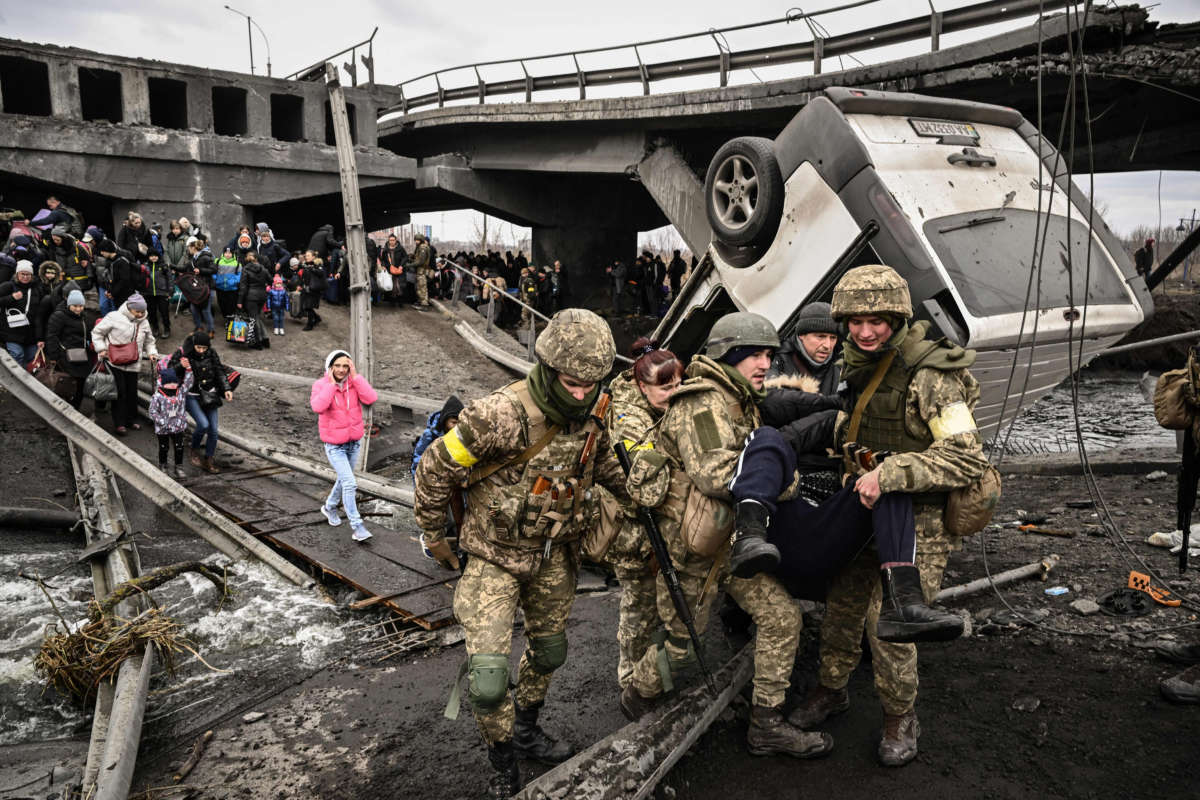
Ukrainian servicemen assist a person while people cross a destroyed bridge as they evacuate the city of Irpin, northwest of Kyiv, during heavy shelling and bombing on March 5, 2022, 10 days after Russia launched a military invasion of Ukraine.
The Amazon is approaching a tipping point, data shows, after which the rainforest would be lost with “profound” implications for the global climate and biodiversity.
Computer models have previously indicated a mass dieback of the Amazon is possible but the new analysis is based on real-world satellite observations over the past three decades.
Novel statistical analysis shows that more than 75% of the untouched forest has lost stability since the early 2000s, meaning it takes longer to recover after droughts and wildfires.
The greatest loss of stability is in areas closer to farms, roads and urban areas and in regions that are becoming drier, suggesting that forest destruction and…