International Atomic Energy Agency says Russian military orders of staff at nuclear plant violate international safety protocols
Rafael Grossi, director general of IAEA, points on a map of Zaporizhzhia nuclear power plant at press conference in Vienna, Austria on 4 March. Photograph: Joe Klamar/AFP/Getty Images
Staff at Ukraine’s Zaporizhzhia nuclear power plant are being told what to do by the Russian military commander who seized the site last week, in violation of international safety protocols.
The International Atomic Energy Agency (IAEA) expressed “grave concern” at the situation at the six-reactor plant, the largest in Europe. The agency was told by the Ukrainian nuclear regulator that “any action of plant management – including measures related to the technical operation of the six reactor units – requires prior approval by the Russian commander”.
The IAEA director general, Rafael Mariano Grossi, said on Sunday that the Russian military command over the nuclear plant “contravenes one of the seven indispensable pillars of nuclear safety and security” which states that the operating staff must be able to carry out their safety and security duties and be able to make decisions “free of undue pressure”.
Russian forces shelled the Zaporizhzhia plant in the early hours of Friday morning, damaging a walkway between two of the six reactors, and starting a fire in a nearby building used for training. As a result some of the reactors were shut down and others were put on low power.
The reactors themselves are well protected by a thick concrete shell, but there is concern that more vulnerable spent fuel rods could be hit, or that the power and cooling systems could be affected, potentially triggering a meltdown.
The IAEA also expressed concern that the Russian occupying force had reportedly shut down mobile phone networks and the internet connection “so that reliable information from the site cannot be obtained through the normal channels of communication”.
It said communications between the plant and the Ukrainian nuclear regulator have been affected, which the IAEA said contravenes another of the nuclear safety pillars listed by Grossi, requiring “reliable communications with the regulator and others”.
“In order to be able to operate the plant safely and securely, management and staff must be allowed to carry out their vital duties in stable conditions without undue external interference or pressure,” Grossi said.
“The deteriorating situation regarding vital communications between the regulator and the Zaporizhzhia [nuclear plant] is also a source of deep concern, especially during an armed conflict that may jeopardize the country’s nuclear facilities at any time,” he added. “Reliable communications between the regulator and the operator are a critical part of overall nuclear safety and security.”
The IAEA said that the operators at the plant were now being able to rotate between three shifts, relieving the operators who had been on duty at the time the plant was seized, but there were still “problems with availability and supply of food” which the Ukrainian regulator said was affecting morale on the plant.
The IAEA also expressed alarm that communication had been lost with institutions and enterprises in the besieged port city of Mariupol where it said there are “category 1-3 radiation sources, a probable reference to medical or industrial isotopes. A category 1 source can be lethal after more than a few minutes exposure.
“Such radioactive material can cause serious harm to people if not secured and managed properly,” the agency said in a statement.
Canadian researcher got involved during a search for polar bear penis bones
Emily Chung · CBC News · Posted: Jun 20, 2019 11:25 AM ET | Last Updated: June 20, 2019
The unusual whale was described as evenly grey all over, unlike belugas, which are white, and narwhals, which are mottled grey. The front flippers were shaped like those of belugas, and the tail like that of a narwhal. (Markus Bühler)
Modern DNA technology has confirmed a strange-looking whale skull with weird, twisted teeth collected by a hunter decades ago belongs to the offspring of a narwhal mother and beluga father.
“This is the only skull ever seen of this kind,” said Mikkel Skovrind, lead author of the new paper describing the animal. He said that’s a surprise, given both species are widely harvested by Indigenous people from Alaska to Canada to Greenland.
The strange skull, which belonged to an adult, was collected in 1990 in Disko Bay, West Greenland, by a subsistence hunter. At that time, two similar-looking whales were seen with it, described as being evenly grey all over, unlike belugas, which are white, and narwhals, which are mottled grey. Their front flippers were shaped like those of belugas and their tail was like that of a narwhal. All three whales were killed, but the skull was recovered from only one.
A 1993 study suggested the animal could be a hybrid, but DNA techniques at the time couldn’t confirm it.
Skulls of (a) a narwhal (b) the hybrid analyzed in the study, and (c) a beluga, show how different the teeth of narwhals and belugas are, and the unusual nature of the hybrid’s teeth. (Mikkel Høegh Post/Natural History Museum of Denmark)
The skull found its way to the collection of the Natural History Museum of Denmark, where Skovrind spotted it near the beginning of his PhD at the University of Copenhagen. He was captivated.
“It just looks really weird,” Skovrind recalled in a phone interview.
In particular, its 10 or so long, twisted teeth are very different from the teeth of either belugas — which have dozens of short, peg like teeth — and narwhals, which typically have no visible teeth except for the long tusk in males (and occasionally females.)
Immediately, Skovrind wanted to study it.
Working with his supervisor, Eline Lorenzen, and her lab and using modern DNA techniques typically used to analyze DNA from ancient hominin fossils, the researchers uncovered a lot of information about the whale.
They learned it was full grown and had one beluga parent and one narwhal parent. By looking specifically at its mitochondrial DNA, which is inherited from the mother, the researchers can tell that she was the narwhal.
Why it’s a surprise
While many kinds of whale hybrids had been found, researchers were surprised to find a narwhal-beluga hybrid.
For one thing, the two species aren’t that closely related — the last time they shared a common ancestor was five million years ago — around the last time humans shared a common ancestor with chimpanzees.
So to have the offspring of a beluga and narwhal reach adulthood is “quite amazing,” Skovrind said.
It’s also surprising because both species are intelligent and social, so females are likely choosy about their mates, Skovrind said.
“It’s quite weird that you see a beluga being allowed to mate with a narwhal female, when you look at how different a beluga male is from a narwhal male.”
A screenshot from drone footage captured by the Group for Education and Research on Marine Mammals shows a narwhal with a group of belugas in the St. Lawrence River in July 2018. (GREMM)
That said, researchers in Quebec report that lost male narwhal appears to have been fully accepted by a group of belugas in the St. Lawrence River, leading to speculation more hybrids will be seen in the future.
Skovrind said he’s been in touch with the researchers there: “We agreed if a baby pops up, we’ll get a sample.”
Different diet
The differences between belugas and narwhals extend to their diets — belugas usually eat fish around 500 metres below the surface, while narwhals dive deeper to eat fish and squid about 800 metres below the surface. So the researchers were curious about what the hybrid ate.
Narwhals diverged from belugas about five million years ago, suggesting they are about as related to belugas as humans are to chimpanzees. (Paul Nicklen/WWF)
It just so happened that Canadian researcher Paul Szpak, who specializes in that kind of analysis, was visiting the Natural History Museum of Denmark in the fall of 2017. He wanted to use the museum’s large collection of polar bear penis bone for a study on how the bears’ diets may have evolved in the past 5,000 years, recalled Szpak, an assistant professor of anthropology at Trent University in Peterborough, Ont.
He got talking to Lorenzen, and she suggested he help analyze the whale skull.
Szpak analyzed chemical isotopes in the bones that are influenced by diet, and found the hybrid didn’t feed like either of its parents — it dove right to the ocean floor, where it may have been eating animals like shrimp or squid, he suggests.
Szpak acknowledged that could be because of its weird teeth: “It can’t quite feed the way either parent species does.”
He also noted hybrids are sometimes larger than either parent species, and that appeared to be the case for this hybrid.
“Bigger animals are better at diving,” he said, and the hybrid may have taken advantage of that.
Both Szpak and Skovrind say the study shows how important it is for museums to collect bones and other natural history artifacts over time, as they preserve valuable scientific information that could be unlocked by new technologies in the future, as happened in this case.
“We can use these new techniques to get new information that we definitely couldn’t have gotten from these specimens when they were collected,” Szpak said.
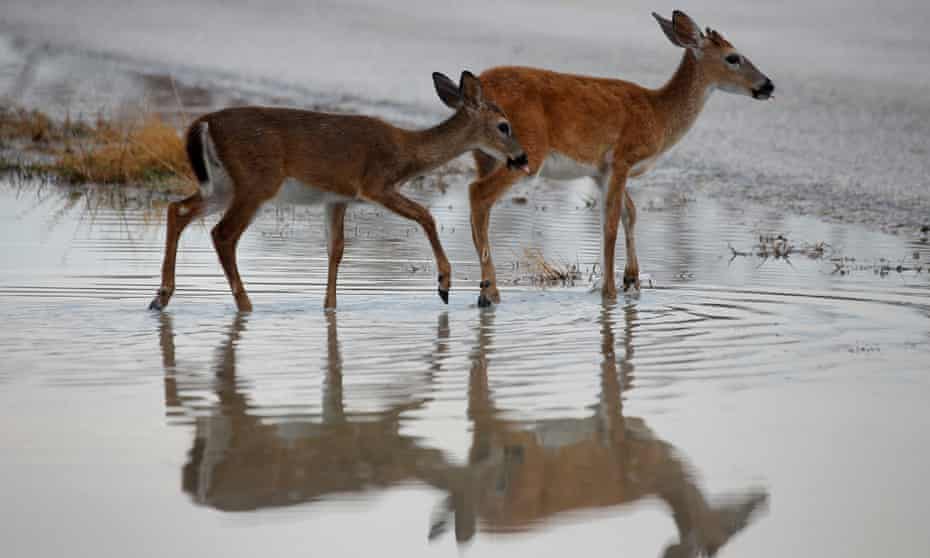
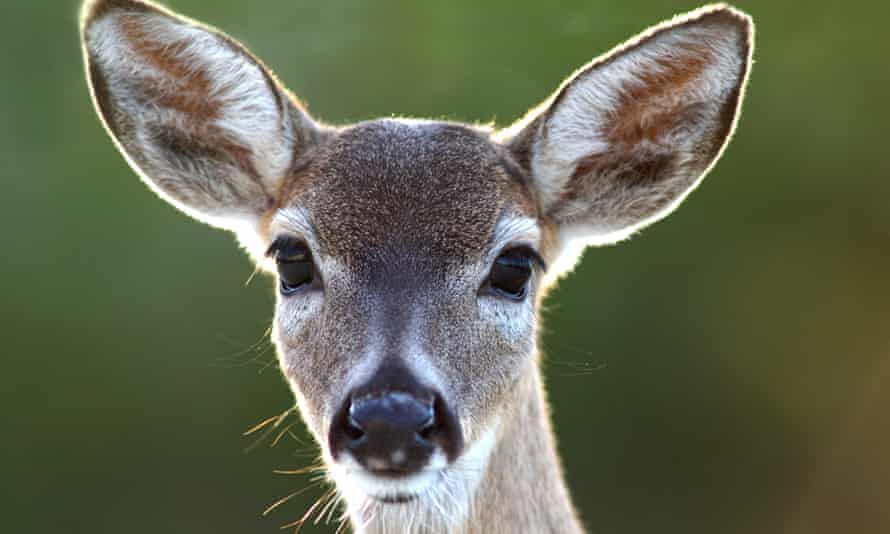
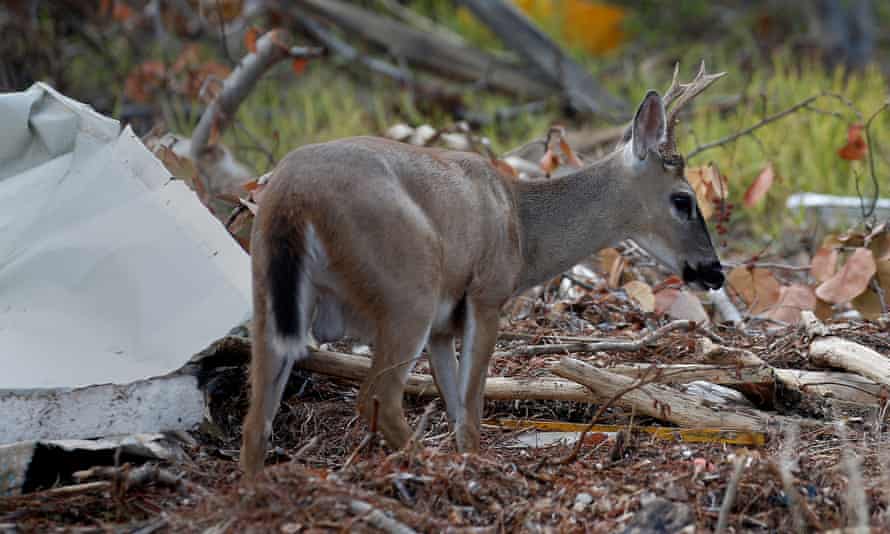
In the Florida Keys, one of the state’s most beloved animals also took a beating: the Key deer, a small subspecies of white-tailed deer that evolved in peaceful isolation on the islands and is now protected under the Endangered Species Act. Irma drowned them, slammed them into buildings and dragged them out to sea. “With Irma, we probably lost about 30% of the deer,” said Nova Silvy, a zoologist who has studied the deer since the 1960s on Big Pine Key, where most of them live.
Though the deer population has largely bounced back, the hurricane’s toll foreshadowed the dangerous future faced by this animal. In the coming century, the impacts of the climate crisis, especially sea level rise, will probably inundate many of the Florida Keys, including the endangered deer’s core habitat on Big Pine Key and neighboring islands.
Despite this bleak outlook, the US Fish and Wildlife Service (FWS), which administers the Endangered Species Act, has been working on proposals in recent years that would strip the Key deer of its endangered species status – even as the agency’s own scientists have highlighted the threat of rising sea levels to the deer’s habitat, according to records obtained by the Guardian and Type Investigations.
These efforts began under the Trump administration, which oversaw a concerted effort to remove protections for imperiled species, and they have outraged conservationists as well as some former FWS officials, who have opposed the agency’s attempt to remove protections for the Key deer.
Advertisement
“There are things happening [to the Key deer] down there that would raise flags for any animal,” said Tom Wilmers, a retired FWS biologist who spent years working with the Key deer. “And yet the agency is in denial. I just don’t understand how delisting or downlisting that animal helps anybody.”
More broadly, however, the plight of the Key deer is a window into the Fish and Wildlife Service’s broader failure to adequately protect endangered species threatened by the climate crisis. Most notably, an obscure but consequential legal memo from 2008, signed by top interior department officials at the end of the George W Bush administration, effectively absolves the FWS and other federal agencies that decline to regulate greenhouse gas pollution that harms endangered and threatened animals under the Endangered Species Act. As the law’s leading enforcer, FWS’s inaction is especially consequential.
“We are putting out ten gigatons of carbon emissions per year, plus or minus, and those emissions are causing the planet to warm. And we know as the planet warms a lot of things are happening, from extreme weather events to waterways being ice-free for longer,” said Stuart Pimm, a professor of conservation at Duke University. “They may not be quite as direct as someone going out with a shotgun and killing a bald eagle, but they are every bit as potent a factor in causing species extinctions.”
Presidential administrations have legal latitude to rescind the memo, but neither the Obama nor Trump administrations did so. Now, a group of scientists and conservationists, including Pimm, are calling on the Biden administration to take action by empowering the FWS to better protect imperiled species – not just Key deer, but polar bears, sea turtles and more – from the climate emergency. Until the White House does so, they say, the Endangered Species Act will remain hobbled when it comes to tackling one of the biggest threats that endangered species face.
The Key deer was supposed to be a conservation success story. By the mid-20th century the subspecies had been hunted to near extinction, leaving only a few dozen deer left, when the federal government established a wildlife refuge around Big Pine Key and listed the animal under the Endangered Species Act. From there the little deer made a comeback, and according to surveys conducted in 2020, they now number about 750 individuals or more.
On a windy spring day on Big Pine Key, Chris Bergh, a scientist and the south Florida program manager for the Nature Conservancy, points to the desiccated grey remains of several dead trees. Bergh has studied the impact of sea level rise on the Florida Keys ecosystem for more than 15 years. The pines that once stood here, he said, have retreated as rising ocean water slowly shrinks the precious freshwater pools that sustain the island’s wildlife.
Florida Key deer. Photograph: Papilio/Alamy
Indeed, even before the rising ocean fully drowns the Key deer’s home range, salt water contamination will ruin their drinking holes. Whether in 50 years or 100, the deer’s island habitat is probably doomed – so it would seem the deer are more in need than ever of the federal protections granted under the Endangered Species Act.
But the FWS has taken a different view. On 13 August 2019, its southeast regional director, Leo Miranda, drafted a memo to the agency’s top official at the time, “proposing to delist the Florida Key deer”.
“This determination,” he wrote, “is based on the best available scientific and commercial information, which indicates that the threats to this species have been eliminated or reduced to the point that the species no longer meets the definition of an endangered or threatened species.” He justified his proposal by citing the deer’s high population numbers and arguing that “there are uncertainties regarding what effects changes in sea-level will have on Florida Key deer habitat … before inundation” from rising waters.
A year earlier, though, FWS’s own scientists were already warning that sea level rise could imperil the deer’s habitat. In a draft research paper obtained by the Guardian and Type Investigations, the scientists drew on a range of existing research, including studies conducted by other federal agencies, to conclude that Key West could see between three and nine feet of sea level rise by 2100. In one set of scenarios modeled in that research, low-lying areas in south Florida like Big Pine Key would be mostly inundated between 2060 and 2080. That degree of sea level rise would wipe out the deer’s core habitat.
“The Florida Keys are going underwater due to sea level rise (SLR),” the paper’s authors wrote in an early version of the paper. “All SLR scenarios agree and depict this to happen.” The paper featured an image of what Big Pine Key could look like in the future: a tiny spit of land and a few squat mangrove trees standing above rising waters.
The draft research paper was circulated among agency staff, including Miranda, as early as August 2018. Nevertheless, FWS proceeded with its effort to remove the deer from the endangered species list until late summer 2019, according to documents obtained by Type Investigations and the Guardian through a public records request.
“I don’t know why they would do that – start writing a delisting rule at a point in time where you have the agency staff raising concerns,” said Karimah Schoenhut, a Sierra Club attorney who works on Key deer issues. “Agency scientists were pointing out sea level rise issues, saying there is no way you can delist species.”
An endangered Key deer among the debris after Hurricane Irma, in Big Pine Key. Photograph: Carlo Allegri/Reuters
Eventually, FWS backed away from the delisting plan, after the US Geological Survey found in a report that FWS had failed to take into account research that “would suggest an even greater risk to Key deer and its habitat than included in” FWS’s assessment of the deer’s status. But the agency didn’t entirely give up. Instead, it began planning to downlist the deer from “endangered” to “threatened”, a lesser classification that would not offer as much protection for the imperiled species. Internal communications obtained by the Guardian and Type Investigations show this plan remained a priority for top Trump administration officials at the interior department, but they failed to get the job done before Biden took over.
Last summer, the FWS’s scientific integrity officer concluded that the agency’s official assessment on which it based its downlisting plans did not use the “best available scientific information” and suggested that it should “not be used for decision-making”. As of January 2022, FWS was back at the drawing board, having initiated a new assessment of the Key deer’s status the previous summer, according to a statement the agency sent to the Guardian and Type Investigations. The animal’s future status as an endangered species remains up in the air.
Even if the Key deer does retain some federal protection, however, the FWS’s responsibility to protect animals from rising sea levels remains significantly curtailed – thanks in part to a legal memo issued during the final months of the George W Bush administration.
Observers say the Endangered Species Act could be a powerful tool in the fight against climate change. Under section 7, FWS has the authority to review projects undertaken, funded, or permitted by the federal government if they are likely to harm a protected species. If such projects jeopardize the survival of the species, the agency can force changes or prohibit them altogether. Environmental groups say this gives the FWS leverage to curtail fossil fuel projects or other programs whose emissions contribute to the climate crisis and threaten endangered animals.
In 2008, however, David Bernhardt, the interior department’s top lawyer at the time, signed an internal memo that effectively absolved FWS of responsibility under section 7 to regulate the climate change impacts of greenhouse gas emissions.
The memo stated that: “Where the effects at issue result from climate change potentially induced by [greenhouse gases], a proposed action … is not subject to consultation under the Esa and its implementing regulations.”
The Bernhardt memo now stands as an obstacle to climate action at FWS. It has allowed agencies including the FWS to avoid making tough decisions on greenhouse gas emissions for more than a decade, undermining the government’s ability to control fossil fuel pollution and protect the Key deer, polar bears, shorebirds, sea turtles and other species that face existential danger from melting sea ice, rising temperatures and disappearing habitats. In 2020, for instance, the Trump administration relied in part on the Bernhardt memo to avoid an endangered species consultation on its decision to scrap the Obama-era vehicle emissions standards. (Bernhardt served as interior secretary in the Trump administration.)
Environmental groups hope Biden will change course. In February 2021, a group of top researchers, scientists and academics, including Pimm, wrote Biden asking him to rescind the Bernhardt memo. They urged the agency to more fully consider greenhouse gas pollution as a threat to species protected by the Endangered Species Act. That would mean the climate danger to listed animals like the Key deer could provide a legal basis to apply the Esa in a new way to federally sanctioned fossil fuel projects – this in turn could lead to reform, including to the interior department’s vast oil and gas leasing programs. Fossil fuel production on public lands is the ultimate source of roughly a quarter of all greenhouse gas emissions in the United States.
“Climate change is the consummate challenge of our time,” said Dr Steven Amstrup, a signatory on the conservationists’ letter to Biden and chief scientist for Polar Bears International. “The US Fish and Wildlife Service should rescind the Bernhardt memo and, as the Esa requires, start addressing the existential threat greenhouse gas pollution poses to plant and animal species across all habitats.”
In response to questions about its continued use of the memo, the FWS said that “the current state of the science is such that we cannot currently establish a causal connection to tie a particular [greenhouse gas]-emitting project to measurable consequences to specific species or critical habitats”.
Amstrup disputes that rationale. He argues that in some cases, in fact, it is possible to measure the climate impact of specific fossil fuel projects on imperiled species – such as the sea level rise that threatens Key deer, or the declining sea ice that strands polar bears – by analyzing accumulated CO2 concentrations.
The interior department, meanwhile, told the Guardian and Type Investigations that it recognizes “an obligation to consider whether our actions contribute to the climate crisis, including the impacts to threatened and endangered species and their habitats.” It did not say whether it plans to rescind the Bernhardt memo.
“I don’t think the Esa by itself is going to solve the climate crisis,” said Brett Hartl, the government affairs director at the Center for Biological Diversity. But, he added, doing away with the memo “could help support efforts to move [federal agencies] to a much better place”.
Bernhardt, for his part, harshly criticized the letter conservationists sent to Biden.
“Some of the signatories to this letter like former DOI Solicitor John Leshy and former USGS employee Steven Amstrup are longtime activists, who continue to demand unworkable policies, which are not well grounded in the science or the law,” he wrote in a statement. “If successful their efforts will create additional chaos in the Esa interagency consultation process. As a result, I look forward to seeing whether the Biden administration will bend to their will on withdrawing legal opinion when the Obama administration did not.”
Leshy, in response to a request for comment on Bernhardt’s statement, said, “Scientific understanding as well as public consciousness of the close links between climate change and the earth’s rich biodiversity have advanced a great deal since then-Solicitor Bernhardt wrote his opinion in 2008. I expect the Biden administration will take a careful look at the issue his opinion addresses, as it should.”
On Big Pine Key, meanwhile, Nova Silvy continues to observe the Key deer as he has done for more than half a century – watching them rebound from near extinction to become a popular draw for tourists. He even has names for some of them – like Alba, a little doe with white legs. But he thinks the climate crisis is their biggest test yet.
“Unless we can turn it around, I think we are going to be in deep trouble with these deer,” he said. “I mean, I won’t see it – but my daughter may.”
This story was produced in partnership with Type Investigations and supported by the Alicia Patterson Foundation.
Testicular pain, erectile dysfunction, reduced sperm count and quality, decreased fertility are direct consequence of infection, new study shows.
Multiple tissues of the male genital tract can be infected withSARS-CoV-2, reports a new Northwestern Medicine study in large animal models. The study, in SARS-CoV-2 infected-rhesus macaques, revealed the prostate, vasculature of testicles, penis, and testicles were all infected with the virus.
The surprising discovery was made utilizing a PET scan specially designed to reveal sites of infection spreading over time in a whole-body scan. Scientists didn’t know what they would find, but they expected to see the virus in the lungs and high up in the nose near the brain because people were experiencing loss of taste and smell.
The fire started when someone’s backyard trash burning got out of hand, officials said.
(CNN)More than 600 homes have been evacuated as a fast-movingwildfirein Bay County on the panhandle of Florida prompted authorities to issue a state of emergency.
The Adkins Avenue fire has burned more than 1,400 acres (1.6 square miles) and is 20% contained, theFlorida Forest Service said.
The fire started Friday when someone was burning trash in their backyard and the flames got out of hand, Bay County Sheriff Tom Ford said at a news conference.
At least two homes have been destroyed and as many as 12 were damaged, Emergency Services Chief Brad Monroe estimated.
Vladimir Putin is an old man scared of death trying to turn back time.Ukraineand Ukrainians are as his blood sacrifice. Hisinvasionof their country is his attempt to forestall his personal, inevitable demise.
As we grow older, death becomes harder to ignore. As it approaches it’s natural to want to reverse time. We become nostalgic, a little bitter about the present. As death closes in we commit silly acts to prove we are still young. We try, a little comically, to thumb our nose against the inevitable. Dodge…
People hold a flag on an overpass in Brazil, Indiana on March 1, in support of a truck convoy bound for Washington, DC.
(CNN)Convoy groups led by American truckers are making their way toward the nation’s capital to demand an end to all Covid-19 mandates and restrictions.
The protestors, with members coming from at least three individual convoy groups, are expected to arrive in Washington, DC throughout the upcoming weekend.
The convoys follow the lead of Canadian protesters who in late January spentthree weeksdemonstrating against Covid-19 mandates,cripplingthree US border crossings and downtown Ottawa.
Canadian police arrestedmore than 100 people when the so-called “Freedom Convoy,”turned violent after truckers blocked roads and irritated residents with honking horns.
Donald Lee claimed he killed a Fannin bighorn sheep in Alaska but an online sleuth and Yukon conservation officers proved he didn’t
The photo on the left shows Donald Lee with the sheep. The photo on the right shows Yukon conservation officer Sean Cox in the same location, with arrows pointing out the natural landmarks proving that the animal was on the Canadian side of the border.Photograph: Yukon territorial court
When an Alaskan hunter ventured out into the rugged mountains and dropped his target with a single rifle shot, it seemed like the perfect crime.
The only witness lay dead on the rocky landscape.
But Donald Lee’s deception was uncovered after forensic work by a savvy online sleuth and conservation officers revealed that Lee killed a bighorn sheep inCanada– not the United States, as he had previously claimed.
Putin signs law on jail terms for ‘fake news’EPACopyright: EPARussian President Vladimir Putin has now signed into law a bill that punishes the spread of “fake” information about the country’s armed forces with jail sentences of up to 15 years.The bill was unanimously passed by Russian lawmakers on Thursday.Several independent Russian media outlets have been forced to close in recent days after describing as “invasion” or “war” what the Kremlin calls a “special military operation” in Ukraine.Putin also signed another bill that would allow fines or jail terms for calling for sanctions against Russia.Article share tools
Posted at 11:3911:39Blinken: ‘Stability in Europe hangs in the balance’Getty ImagesCopyright: Getty ImagesUS Secretary of State Antony Blinken is meeting with EU and Nato leaders on a six-nation trip through EuropeImage caption: US Secretary of State Antony Blinken…


 Russia‑Ukraine war: Mariupol evacuation halted forsecond day; Vinnytsia regional airport completely destroyed – live




 EPACopyright: EPARussian President Vladimir Putin has now signed into law a bill that punishes the spread of “fake” information about the country’s armed forces with jail sentences of up to 15 years.The bill was unanimously passed by Russian lawmakers on Thursday.Several independent Russian media outlets have been forced to close in recent days after describing as “invasion” or “war” what the Kremlin calls a “special military operation” in Ukraine.Putin also signed another bill that would allow fines or jail terms for calling for sanctions against Russia.Article share tools
 Getty ImagesCopyright: Getty ImagesUS Secretary of State Antony Blinken is meeting with EU and Nato leaders on a six-nation trip through EuropeImage caption: US Secretary of State Antony Blinken…

