Tanzania is seeking to attract well-off Americans as it targets the growing game hunting tourism market.
Last week, Tanzania Tourism Minister Damas Dumbaro was in Las Vergas to market the country’s hunting safaris at the 50th Annual Hunting Convention.
Dodoma said the tour was meant to ‘market Tanzania’s hunting blocks before the rich American hunting tourists and other trophy hunting investors around the world’.
Dr Ndumbaro led a delegation of tourism officials to the World Hunting Association meeting, which brought together 870 exhibitors showcasing trophy wildlife parts from several countries.
“We will market hunting blocks then attract international hunting companies, while learning about new strategies that would make hunting safaris more profitable to earn more revenues to the government,” the minister said.
Tanzania is focusing on attracting high-spending tourists such as those who can afford a 21-day hunting safari that cost about $60,000, excluding flights, gun import permits and trophy…
Police say more than 200 charges have been filed involving at least 27 bucks taken illegally in Mineral, Grant and Hampshire counties. (Sinclair Broadcast Group)
ROMNEY, W.Va. (AP) —Two former sheriff’s deputies and an emergency services chief are among eight people charged with illegal hunting in West Virginia.
West Virginia Division of Natural Resources Police Lt. Timothy L. White says the agency filed 223 charges involving at least 27 antlered bucks taken illegally in Mineral, Grant and Hampshire counties.
He says some of the charges include spotlighting deer and carrying loaded weapons in their vehicles from September through December.
Two Mineral County deputies and an emergency services official in Allegany County, Maryland, were charged in the case.
Officials say the deputies resigned after the investigation began, and the Maryland official has been suspended.
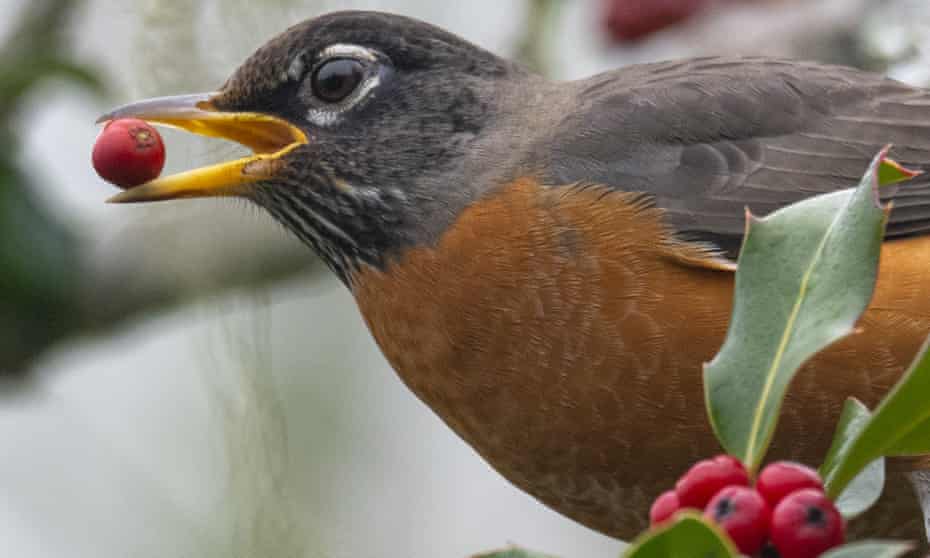
In the past half century, North America has lost a fourth of its birds. Earth is now a coalmine, and every wild bird is a canary
‘How diminished our world would be without birds, those dinosaurs with feathers and songsmiths with wings.’ Photograph: Robin Loznak/Zuma Press Wire/Rex/Shutterstock
When the poet Mary Oliver wrote “Instructions for living a life,” she reminded us: “Pay attention. Be astounded. Tell about it.”
This past autumn, wildlife officials announced that a bird, a male bar-tailed godwit, flew nonstop across the Pacific Ocean 8,100 miles from Alaska to Australia in just under 10 days. Fitted with a small solar-powered satellite tag, the godwit achieved “a land bird flight record”. But of course godwits have been doing this for centuries. Come next April-May, all things well, determined godwits will make the trip in reverse, bound for Alaska to nest and raise their young.
Northern wheatears, songbirds less than six inches long, will arrive in Alaska from sub-Saharan Africa. Arctic terns will return from Antarctica, with each bird flying the equivalent of three trips to the moon and back in a single lifetime. Bar-headed geese will fly over the Himalayas at altitudes exceeding 20,000 feet.
PT Barnum was wrong. The circus is not the greatest show on Earth. Nature is.
How diminished our world would be without birds, those dinosaurs with feathers and songsmiths with wings. Not that I was born John James Audubon. I used to ignore birds, and was poorer for it. Once, in my teens, while out with my .22 rifle, I spotted a red-tailed hawk riding a July thermal. I aimed and fired, and watched it drop from the sky. Stunned, I ran to it and found it thrashing in the dry summer grasses, dying. I walked away, fell to my knees, and threw up.
Now, decades later, I love birds – how they bring me joy and give me wings; how they enlarge my world, slow me down, make me listen. In every hawk I see a velociraptor. In every thrush I hear exquisite music. In every swallow I witness an aerial dance as they snap insects in midair. In every epic migration I find myself redefining what’s possible. And always the same question arises: can we, the human race, in all our commerce and carbon-burning, somehow save our winged cousins?
In the past half century, North America has lost more than one-fourth of its birds. Nearly everywhere, they are in decline. Massive die-offs of flycatchers, swallows, bluebirds, sparrows and warblers – described as thousands of birds “falling out of the sky” – have been recorded in recent years in New Mexico, Colorado, Texas, Arizona and Nebraska. Smoke from intense California fires forced tule geese to reroute their migration and take twice as long. Elsewhere, as birds lay their eggs earlier, due to a warming climate, more chicks die from sudden inclement weather events.
This is where we find ourselves, trapped in a diminished world of our own making. Today only 30% of all birds are wild; the other 70% are mostly poultry chickens. In essence, Earth is now a coalmine, and every wild bird is a canary – what ecologists call a “bio-indicator” – in that mine.
Their fate is ours.
Soon after news broke of the flight of the godwit, the US Fish and Wildlife Service announced newly extinct species including the ivory-billed woodpecker and Bachman’s warbler. “When the last individual of a race of living things breathes no more,” the naturalist William Beebe once observed, “another heaven and another earth must pass before such a one can be again.”
The author and climate crisis activist Kathleen Dean Moore writes, “Unless the world acts to stop extinctions, I will write my last nature essay on a planet that is less than half as song-graced and life-drenched as the one where I began to write.”
Of all the species that have ever existed, more than 99% are now gone, most having winked away during five major extinction events, the last caused by an asteroid that struck Earth some 66m years ago. Today, given global habitat loss (especially deforestation and prairies turned into cropland) and widespread persistent toxins, we – modern humans – are the asteroid. The sixth mass extinction is here, with about 600 species of North American birds at risk from human-caused climate change.
We must safeguard one of nature’s greatest creations: wild birds. Build a better world for them, and we’ll build one for ourselves. We must defend a livable planet by electing politicians who have empathy and an ecological conscience. Vote blue, act green. Restore native habitats and environmental health. Keep domestic cats indoors, and affix silhouetted hawk decals to windows. In the US alone, an estimated three to four billion birds die each year from cat predation and window strikes.
Put a birdfeeder out the window of a nursing home and watch the patients inside brighten. Birds bring happiness and improved health. A European study suggests that a backyard full of birds creates greater human satisfaction than a modest pay raise. Our survival and mental wellbeing are intricately tied to that of healthy lands, waters and biodiversity; nothing proves it better than wild birds.
In August 2020, as the Trump administration sought to weaken the 1918 Migratory Bird Treaty Act, a federal judge ruled in favor of the act and quoted Harper Lee’s famous novel: “It is not only a sin to kill a mockingbird, it is also a crime.”
I celebrated the ruling.
Later, in 2021, when the Biden administration reinstated and strengthened the act, I took a walk along the ocean near my home, binoculars (not a gun) in hand, and felt a deep sense of gratitude – even hope – knowing that more than tens of thousands of people around the world would volunteer in the annual Christmas Bird Count, a century-old tradition to pay attention, be astounded, and share stories about birds. Godwits might come to mind, and Mary Oliver’s poem Wild Geese:
Whoever you are, no matter how lonely, the world offers itself to your imagination, calls to you like the wild geese, harsh and exciting – over and over announcing your place in the family of things.
A frequent contributor to the Guardian, Kim Heacox is the author of many books, including The Only Kayak, a memoir, and Jimmy Bluefeather, a novel, both winners of the National Outdoor Book Award. He lives in Alaska. His favorite bird is whichever one he’s watching
Weighing the benefits of technology with the principles of fair chase has long been a difficult balance in hunting in Montana and across the West.
Photographing wildlife with remote trail cameras has grown in popularity over the last 20 years, whether as a noninvasive tool for research or a fun form of recreation. But in the hunting world, trail camera use has never been more hotly debated.
As technologies advance, the laws or regulations that made sense yesterday become obsolete tomorrow and states and organizations ask when they should tip the scales one way or another.Utah earlier this month joinedArizona and Nevada as Western states restricting the use of trail cameras, and the Boone and Crockett Club recently updated its trophy…
Idaho wildlife officials have approved expanding trapping for river otters despite widespread opposition.ByAssociated Press|Jan. 27, 2022, at 5:25 p.m.SaveMore
Idaho Wildlife Officials Expand River Otter TrappingMore
FILE – River otters scan the Heritage Park walking path on July 12, 2015, at Capitol Lake in Olympia, Wash. Idaho wildlife officials have approved expanding trapping for river otters despite widespread opposition. The Idaho Fish and Game Commission voted 7-1 Thursday, Jan. 27, 2022, to approve the plan that lifts trapping restrictions on the mainstem of the Middle Fork of the Clearwater River, mainstem of the Snake River and mainstem of the main Salmon River. (Steve Bloom/The Olympian via AP, File)THE ASSOCIATED PRESS
By KEITH RIDLER, Associated Press
BOISE, Idaho (AP) —Idahowildlife officials on Thursday approved expanding trapping for river otters despite widespread opposition.Recommended VideosPowered byAnyClipClimate change’s impact on Antarctica’s penguins68.7K2Play Video
ASHBURNHAM, Mass. (AP) — A Massachusetts resident has been charged with illegally killing a mother black bear with a bow and arrow after hunting season ended.
Massachusetts Environmental Police said in aFacebook postWednesday that the killing happened in late 2021 in Ashburnham while the bear was eating birdseed in person’s backyard.
The Montana Fish and Wildlife Commission is planning to meet Friday to review wolf hunting and trapping seasons in southwest Montana.
The commission will discuss potential next steps as Region 3 nears its wolf harvest threshold for the season, according to Montana Fish, Wildlife and Parks. The meeting is scheduled for 1:30 p.m., and it will bestreamed live
Micrograph of avian influenza, also known as bird flu (Credit: CDC/F.A. Murphy)
Two more people in mainland China have tested positive for H5N6 bird flu, raising the number of cases reported this month to eight, officials say. A recent spike in human cases has led to calls for increased surveillance.
The first case, a 68-year-old man from Langzhong in Sichuan province, fell ill on January 3 and was taken to a local hospital the next day, where he remains in critical condition. There was no word on how he may have…
Year-end climate reports show signs of a new and warmer normal that scientists say is likely to lead to more weather extremes.Link copiedSAVECreate your free profile or log in to save this articleJan. 28, 2022, 3:30 AM PSTBy Monica Hersher
Norbert Koll, a vacation-rental owner in Ahrweiler, Germany, said that record-breaking floods that struck the area last July “hit him like a brick.”
The flood filled homes with mud, destroyed roads and killed more than 200 people across Germany and Belgium, including an elderly couple staying in one of Koll’s rentals in Ahrweiler, about 100 miles west of Frankfurt.
Koll and his wife saw that a storm was coming when they checked radar maps earlier that week, but the magnitude of the flooding caught him by surprise.
“We didn’t expect the worst,” Koll said.
Norbert Koll’s vacation apartment rental business in Ahrweiler days after the floods in Germany.Courtesy Renate…
Victoria, B.C. (January 27, 2022) – Today, we learned that the provincial government of British Columbia’s controversial wolf cull was renewed for another five years despite widespread public opposition and a lack of action to protect critical old-growth habitat-the root cause of endangered caribou declines.
Earlier this month, B.C. released its Predator Reduction for Caribou Recovery Engagement Survey results. Nearly 60% of respondents were against the wolf cull program. The vast majority of respondents listed habitat protection (regulating land use), habitat restoration, and habitat management as the top three preferred actions for caribou recovery.
“The clear intent is to continue the needless scapegoating and killing of wolves instead of taking essential steps of protecting intact old-growth forests for endangered caribou while ensuring fossil fuel industries do not access and fragment this habitat further,” said Ian McAllister, Conservation Advisor for Pacific Wild. “By safeguarding and restoring caribou habitat, B.C. would be doing its part in mitigating climate change while also protecting the full suite of predator-prey relationships that are being destroyed through short-term greed.”
Additionally, the legality of culling operations is currently before the courts. These legal challenges include the authority to cull wolves by aircraft being inappropriately given to regional managers under current Wildlife Act regulations, and the majority of wolf culling occurring via civilians (contracted by the government) shooting from helicopters. These issues were presented to the court in 2021 and we have not yet received a decision from the judge.
“Since beginning in 2015, the wolf cull program has killed approximately 1,500 wolves,” said Laurie McConnell, wolf campaigner for Pacific Wild. “Nearly $2 million in taxpayer dollars were spent in 2019 and 2020 to kill 463 wolves, averaging $4,300 per wolf. Horgan’s favouritism to the forestry industry and wasteful spending amidst ongoing extinction threats to B.C.’s wildlife is extremely concerning. The government’s approach to this issue needs to change now.”
Pacific Wild is asking B.C. residents who are opposed to the government’s decision to contact the Minister of Forests, Lands, Natural Resource Operations and Rural Development, Katrine Conroy (FLNR.Minister@gov.bc.ca <mailto:FLNR.Minister@gov.bc.ca> ) about their concerns.
Media Contact
Nick Voutour Communications Manager Pacific Wild 902-809-9030 nick@pacificwild.org <mailto:nick@pacificwild.org>
About Pacific Wild
Pacific Wild supports innovative research, public education, community outreach and raising conservation awareness to achieve the goal of lasting environmental protections for the lands, waters and people of the Great Bear Rainforest and throughout British Columbia.
For immediate release . Victoria, B.C. (January 27, 2022) – Today, we learned that the provincial government of British Columbia’s controversial wolf cull was renewed for another five years despite widespread public opposition and a lack of action to protect critical old-growth habitat-the root cause of endangered caribou declines. Earlier this month, B.C. released its Predator Reduction …
pacificwild.org
Please write Minister Katrine Conroy FLNR.Minister@gov.bc.ca <mailto:FLNR.Minister@gov.bc.ca> and your MLA regardless where you live in BC! All Biodiversity needs help NOW and killing wolves is not the answer by any stretch!!!