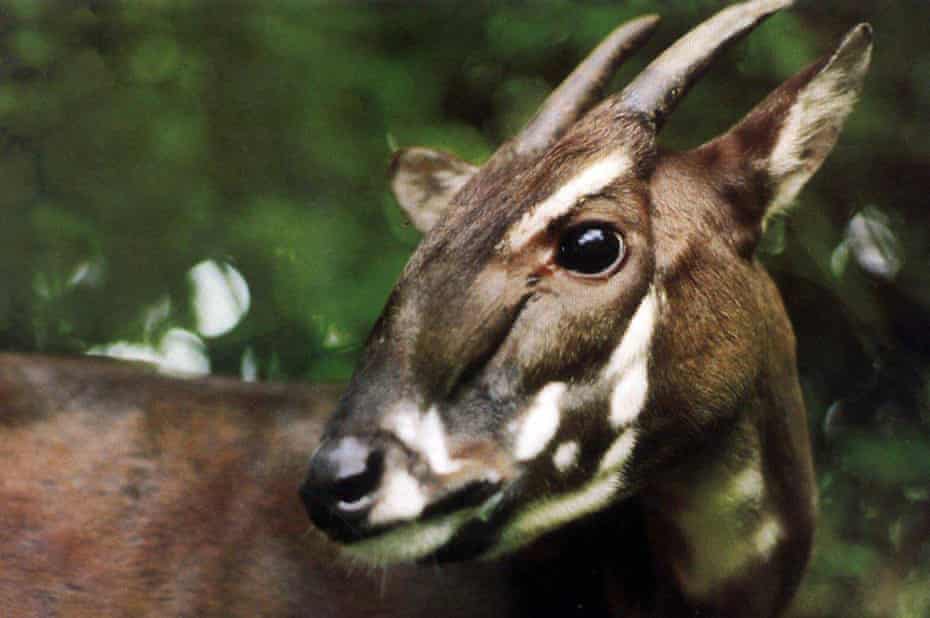
Weighing 80-100kg and sporting long straight horns, white spots on its face and large facial scent glands, the saola does not sound like an animal that would be hard to spot. But it was not until1992that this elusive creature was discovered, becoming the first large mammal new to science in more than 50 years.
Nicknamed the “Asian unicorn”, the saola continues to be elusive. They have never been seen by a biologist in the wild and have been camera-trapped onlya handful of times. There are reports of villagers…
Fifteen wolves were shot after roaming across the park’s northern border into Montana, according to figures released to The Associated Press. Five more died in Idaho and Wyoming.
Park officials said in a statement to AP that the deaths mark “a significant setback for the species’ long-term viability and for wolf research.”
One pack — the Phantom Lake Pack — is now considered “eliminated” after most or all of its members were killed over a two-month span beginning in October, according to the park.
Gianforte, an avid hunter and trapper, did not directly address the request to halt hunting in a Wednesday letter responding to Sholly.
“Once a wolf exits the park and enters lands in the State of Montana it may be harvested pursuant to regulations established by the (state wildlife) Commission under Montana law,” Gianforte wrote.
Gianforte last year received a warning from a Montana game warden after trapping and shooting a radio-collared wolf about 10 miles (16 kilometers) north of the park without taking a state-mandated trapper education course.
In his response to Sholly, the governor said Montana protects against overhunting through rules adopted by the wildlife commission, which can review hunting seasons if harvest levels top a certain threshold.
For southwestern Montana, including areas bordering the park, that threshold is 82 wolves. Sixty-four have been killed in that region to date this season, out of 150 wolves killed statewide, according to Montana Fish, Wildlife and Parks.
The most recent wolf killing along the Montana-Yellowstone border happened on New Year’s Day.
Wolf trapping in the area opened Dec. 21. Under new rules, Montana hunters can use bait such as meat to lure in wolves for killing and trappers can now use snares in addition to leghold traps.
“Allowances for trapping and especially baiting are a major concern, especially if these tactics lure wolves out of the park,” Yellowstone spokesperson Morgan Warthin said.
Urged by Republican lawmakers, Montana wildlife officials last year loosened hunting and trapping rules for wolves statewide. They also eliminated longstanding wolf quota limits in areas bordering the park. The quotas, which Sholly asked Gianforte to reinstate, allowed only a few wolves to be killed along the border annually.
The original quotas were meant to protect packs that draw tourists to Yellowstone from around the world for the chance to see a wolf in the wild.
Montana’s efforts to make it easier to kill wolves mirror recent actions by Republicans and conservatives in other states such as Idaho and Wisconsin. The changes came after hunters and ranchers successfully lobbied to reduce wolf populations that prey on big game herds and occasionally on livestock.
But the states’ increased aggression toward the predators has raised concerns among federal wildlife officials. In September, the U.S. Fish and Wildlife Service said it would examine if federal endangered species protections should be restored for more than 2,000 wolves in northern U.S. Rockies states including Montana, Idaho and Wyoming.
Protections for the region’s wolves were lifted a decade ago, based in part on assurances the states would maintain viable wolf populations.
A representative of the hunting industry said outfitters and guides support the preservation of wolves inside Yellowstone. But once the animals cross the boundary, sustainable hunting and trapping should be allowed, said Montana Outfitters and Guides Association Executive Director Mac Minard.
Minard questioned whether the 20 wolves killed so far this year after leaving Yellowstone should even be considered “park wolves.”
“That just doesn’t make sense,” he said. “Why aren’t they ‘Montana wolves’ that happened to go into the park?”
Marc Cooke with the advocacy group Wolves of the Rockies predicted a backlash against Gianforte and the state for not doing more to shield wolves leaving Yellowstone.
“People love these animals and they bring in tons of money for the park,” Cooke said. “This boils down to the commercialization of wildlife for a small minority of special interest groups.”
The one hopeful bit of information in Tom Lounsbury’s otherwise disturbingly vile piece, “Predator hunting a fun winter pastime, day or night” (besides the obvious fact that Tom and his readers could be out snow shoeing or cross-country skiing rather than taking pleasure in trying to end the lives of animals otherwise struggling to survive the elements) was learning that predator slayers don’t have to wear hunter-orange.
A quick check on C.A.S.H.’s (Committee to Abolish Sport Hunting) Hunting Accident page will remind “sportsmen” that hunters mistake one another for “game” on almost a daily basis. When they’re not busily shooting each other, they’re falling out of tree-stands or having some other fatal (or nearly-so) accident. Indeed, wearing hunter-orange has surely saved many a hunter’s life, but if making a casual winter pastime of murdering foxes or coyotes…
A bucket of KFC Beyond Fried Chicken is shown in a promotional stillKentucky Fried Chicken
On Wednesday, Kentucky Fried Chicken and Beyond Meat announced the release of the plant-based Beyond Fried Chicken nationwide beginning Jan. 10.
KFC restaurants across the United States are set to offer Beyond Fried Chicken for a limited time, while supplies last.
The plant-based menu offering was developed by Beyond Meat exclusively for KFC and is expected to offer the same flavor as KFC’s fried chicken but in a plant-based option, although the plant-based option is not prepared in vegan or vegetarian manner, KFC said.
The test was expanded to restaurants in Nashville and Charlotte in 2020, as well as select restaurants in Southern California in the summer of 2020, which led to a sell-out of the product in one week.
“We couldn’t be prouder to partner with KFC to offer a best-in-class product that not only delivers the delicious experience consumers expect from this iconic chain, but also provides the added benefits of plant-based meat,” said Ethan Brown, founder and CEO, Beyond Meat. “We are truly thrilled to make it available to consumers nationwide.”
Beyond Fried Chicken is set to be served with a choice of KFC dipping sauce — Honey BBQ, Ranch, Honey Mustard and KFC Sauce. It is available as KFC’s first-ever plant-based combo meal with Secret Recipe Fries and a medium drink, or à la carte in six or 12-piece orders, KFC said. Prices will start at $6.99, tax extra, and may vary by location.
A recreation of human ancestors stoking a fire by a cave.(Image credit: gorodenkoff via Getty Images)
Our human ancestors and relatives lived tens of thousands to millions of years ago, and we still have much to learn about their existence and abilities. In 2021, researchers investigated all kinds of clues, including ancient skulls that shed light on the evolution ofHomobrains, bones from previously unknownHomospecies and fossilized footprints that revealed just how early humans arrived in North America.
Here are 10 amazing discoveries about our human predecessors that scientists made in 2021.
The Earth reached its perihelion, its closest point to the sun for 2022, on Jan. 4, 2022.(Image credit: NASA)
The sun is just a little bit closer in Earth’s sky right now.
Earthis at its closest to thesunTuesday (Jan. 4) in its 365.25-day journey. This milestone, called perihelion, coincidentally happens near the start of the Gregorian calendar year observed by much of the world, including in North America.
The exact moment of perihelion this year occurred at 1:52 a.m. EST (0652 GMT),according to EarthSky. Earth was about 3 million miles (5 million kilometers) closer to the sun than it is at aphelion, when it is farthest from the sun, which takes place in early July. That variation is relatively small compared to Earth’saverage distance from the sunof 92,955,807 miles (149,597,870…
The Earth reached its perihelion, its closest point to the sun for 2022, on Jan. 4, 2022. (Image credit: NASA)
The sun is just a little bit closer in Earth’s sky right now.
Earth is at its closest to the sun Tuesday (Jan. 4) in its 365.25-day journey. This milestone, called perihelion, coincidentally happens near the start of the Gregorian calendar year observed by much of the world, including in North America.
Perihelion and aphelion don’t cause the seasons — those happen due to the tilt of the planet’s axis — but these orbital milestones do affect the seasons’ duration. When Earth is farther from the sun, it moves a little slower in its orbit than it does during the close approach, which causes the northern hemisphere’s winter to be about five days shorter than its summer.
That orbital behavior is explained in the second law of planetary motion formulated by astronomer Johannes Kepler during the 17th century.
Based in part on early telescopic observations by astronomer Tycho Brahe, Kepler realized that planets travel in ellipses, rather than the perfect circles imagined by many previous astronomers. Kepler figured out that an invisible line connecting a planet to the sun swept out an equal amount of area over the same amount of time during a planet’s journey around the sun. This characteristic means that a planet needs to travel faster when it is closest to the sun and slower when it is farthest; the speed difference was later explained further by theories of gravity.
A diagram of Earth’s elliptical orbit around the sun. (Image credit: NOAA)
Winter will still feel rather cold in the northern hemisphere, though, even with the shorter distance to the sun.
“Even when you take into account that difference in distance between aphelion and perihelion, there’s only about a 7% difference in average global [solar energy] that we receive,” Walter Petersen, a research physical scientist in the Earth science branch at NASA’s Marshall Space Flight Center, told Space.com in 2018. “And so it doesn’t amount to a great deal in terms of weather.”
Follow Elizabeth Howell on Twitter @howellspace. Follow uson Twitter @Spacedotcom and on Facebook.
Join our Space Forums to keep talking space on the latest missions, night sky and more! And if you have a news tip, correction or comment, let us know at: community@space.com.
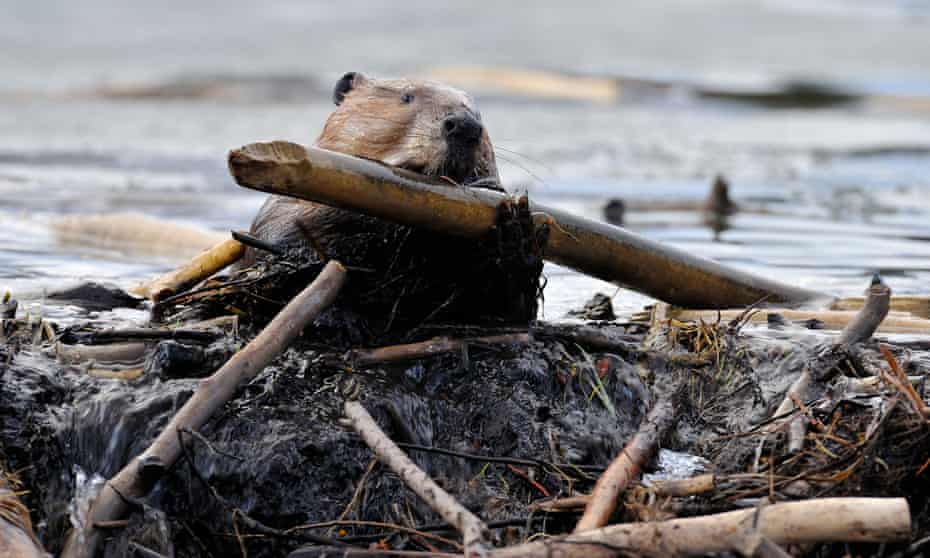
‘There are areas of Alaska that had no evidence of beavers 50 years ago that are now apparently saturated with them,’ said Ken Tape, an ecologist at the University of Alaska, Fairbanks. Photograph: Robert McGouey/Wildlife/Alamy
The transformation of the rapidly warming Arctic is being accelerated by a wave of thousands of newcomers that are waddling and paddling northwards: beavers.
Scientists who sought to map the spread of beavers in Alaska were astounded to find that the creatures have pushed far north into previously inhospitable territory and are now set to sweep into the furthest northern extremities as the Arctic tundra continues to heat up due to the climate crisis.
“We didn’t know what we would find and ended up being very surprised,” said Ken Tape, an ecologist at the University of Alaska, Fairbanks, who co-authored the new research.
“There are areas of Alaska that had no evidence of beavers 50 years ago that are now apparently saturated with them,” he said, adding: “It’s just a matter of time before they head even further north. When you consider this is likely happening across the rest of the Arctic in Canada and Russia, that gives you an idea of the scope of this change.”Advertisement
Using aerial photographs and satellite imagery reaching back to 1949, and observations recorded from before then, an international team of researchers involved in the Arctic Beaver Observation Network identified more than 12,000 ponds created by beavers damming rivers and streams across western Alaska. This number has doubled in the past 20 years.
In recent years, as the Arctic has heated up three times quicker than the global average, the North American beaver has ventured north and west and now occupies vast swaths of the Seward peninsula, a large landmass that extends from the western coast of Alaska.
The impact of these portly semiaquatic rodents has been felt by the remote Indigenous communities of Alaska, with the flooded areas created by beavers causing concern over access to food and travel.
It’s unknown how many beavers are now in the northern and western parts of Alaska, with estimates ranging from 50,000 to close to 100,000.
“The true impact of the spread of beavers into the Arctic on the environment and the Indigenous communities who live there is not yet fully known,” said Helen Wheeler, a researcher at Anglia Ruskin University. “However, we do know that people are concerned about the impact beaver dams are having on water quality, the numbers of fish downstream of the dams, and access for their boats.”
A broader consequence of the arrival of beavers could be the acceleration of the climate change which, in combination with a reduction in fur trapping over the past century, has probably allowed the beavers to push north. Beavers, which do not hibernate, have benefited from shortening winters and the wider availability of vegetation available to feed upon.
The pools that accumulate when beavers dam rivers create localized unfrozen “hotpots” that result in the thawing of permafrost, the always-frozen ground of the Arctic that holds vast amounts of carbon. Scientists warn that a widespread thawing of permafrost could cause global heating to spiral dangerously out of control.
“Those ponds absorb heat better, they change the hydrology of the area and the permafrost responds to that,” said Tape. “Beavers are coming in from the outside, imposing themselves on the ecosystem and disrupting it.
“It’s accelerating the effects of climate change. When you realize what’s happened in western Alaska is likely to happen to northern Alaska, it does give you pause.”
Tape said that the Brooks Range, a mountain range that runs across northern Alaska, will be an obstacle to the beavers but will not stop them as they follow rivers up to the north coast.
Calvin Shomaker, The Daily NewsWed, January 5, 2022, 4:18 AM·1 min read
Onslow County ambulance
A minor was shot in Onslow County last week in what officials are calling a hunting accident.
The victim, a young male, suffered a gunshot wound in Sneads Ferry on Dec. 31, according to officers from the Onslow County Sheriff’s Office and North Carolina Wildlife Resource Commission (NCWRC).
Onslow County Sheriff’s Office Chief Deputy Col. Chris Thomas said this week the incident happened in a wooded area near Old Folkstone Road and Ravenall Street, and the victim was transported to New Hanover Regional Medical Center in Wilmington.
The sheriff’s office assisted with the first law enforcement response and crime scene investigation, Thomas said, but the investigation was turned over to NCWRC, which handles investigations into hunting related incidents.
NCWRC Master Officer Barbara Smith was able to confirm the accident, but did not share further details…