Alaska to resume ‘barbaric’ shooting of bears and wolves from helicopters

 This article is more than 6 months old

This article is more than 6 months old

Renewed program would allow hunters to eliminate up to 80% of the animals on 20,000 acres of state land

Tom PerkinsMon 20 Jan 2025 07.00 ESTShare

Alaska is set to resume the aerial gunning of bears and wolves as a population control measure aimed at boosting caribou and moose herd numbers, even as the state’s own evaluation of the practice cast doubt on its effectiveness.

The renewed program would allow hunters to eliminate up to 80% of the animals on 20,000 acres (8,000 hectares) of state land. Environmental groups opposed to what they label a “barbaric” practice of shooting wildlife from helicopters is more about sport than scientific practice in part because hunters want caribou populations to increase because they are trophy animals.

“Alaska’s practice of indiscriminately strafing predators is both inhumane and inane,” said Rick Steiner, a former University of Alaska-Fairbanks ecologist now with Public Employees for Environmental Responsibility (Peer), which opposes the practice. “There is no scientific evidence that this carnage will boost populations of moose and caribou, and there is a growing body of evidence that it disrupts a healthy predator/prey balance in the wild.”

The report comes after the Biden administration effectively upheld Trump era rules that allowed for other inhumane hunting practices on federal lands in Alaska, like killing cubs in dens.

Alaska’s “intensive management” allows Alaskan game agents to kill any brown bear, black bear or wolf on some state lands. Nearly 100 bears, including 20 cubs, were killed by helicopter in 2023.

The latest program would allow aerial hunters to kill 80% of wolves (until the population is reduced to 35), 80% of black bears (until the population is reduced to 700) and 60% brown bears (until the population is reduced to 375).

Though the practice’s supporters say eliminating the predators helps boost sagging caribou populations, an October state report that examined predator kill practices came to a different conclusion.

“The goal of the project was to increase caribou calf survival by removing all bears and wolves from the calving grounds,” the report reads. “Data does not exist to evaluate whether the goal was achieved.”

The largest factors in caribou herd decline were “disease, nutrition, and winter severity”, the report states. About 65% died from starvation or dehydration.

Critics say the state also notes that it doesn’t know the practices’ full impact on bear populations because it did not estimate brown bear numbers before allowing the kills. More than half of the brown bears killed in 2024 were adult females, raising further questions about the population’s ability to rebound.

Meanwhile, the state refuses to allow photographs of the slaughter, independent observers to be present, or to subject the program to scientific review by the federal government.

The practice has had other consequences: the National Park Service has ended a more than 20-year study of wolf behavior in the nearby Yukon-Charley national preserve because the resident wolf population has fallen so low.

Meanwhile, it has reduced tourism in the area because the ability of visitors to view intact wolf packs inside adjacent Denali national park, one of the state’s major tourist draws, has plummeted. The state has said the hunting program raises revenue from hunters, but critics called it the “epitome of pound foolish”.

“The amount of tourist dollars from people seeking to view these predators in the wild dwarfs any incremental increase in hunting fee revenue the state hopes to realize,” said Peer executive director Tim Whitehouse.
Oswald’s Bear Ranch Slammed by Feds for Denying Bears Vet Care, Feeding Expired Food

ShareShare on FacebookPostShare on XShareShare on LinkedIn

For Immediate Release:
August 20, 2025

Contact:
Sara Groves 202-483-7382

Newberry, Mich. – A bear in obvious psychological distress was denied veterinary care at Oswald’s Bear Ranch and other bears were fed animal feed that expired in 2022, unsuitable restaurant scraps, and sugary snacks, which led them to become overweight or obese, according to a just-released report from the U.S. Department of Agriculture (USDA). Following a PETA complaint, a federal veterinarian inspected the facility on July 15 and documented that the young female black bear was repeatedly tossing her head, suddenly pacing in different directions, and exhibiting other signs of deep distress—and a staff member admitted that they had noticed the behavior but hadn’t bothered to do anything about it.

Oswald’s has a long history of ignoring the federal Animal Welfare Act. Among other violations, in 2021, the facility was cited by the USDA for feeding bears restaurant scraps and dog food, causing them to become overweight, and was instructed to consult a veterinarian to develop a diet plan—a directive Oswald’s appears to have ignored. That year, the USDA also ordered Oswald’s to pay a $2,400 penalty to settle a USDA complaint stemming from a tip from PETA that the roadside zoo had lied about the circumstances surrounding the death of a young black bear named Sophie, who was shot dead by a local sheriff after escaping her enclosure.

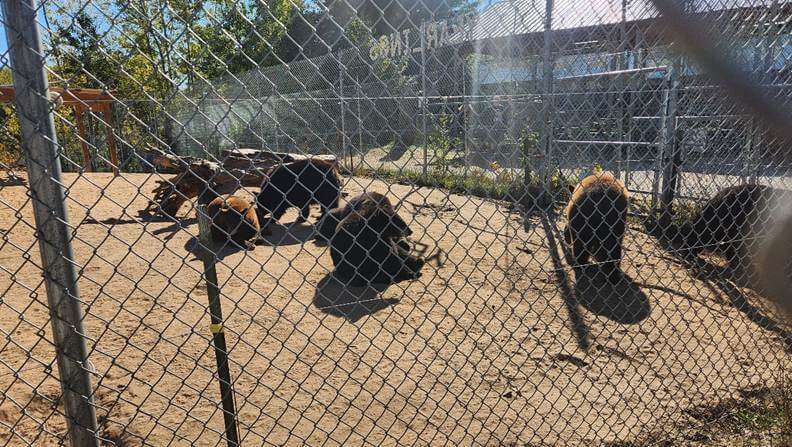
Bears confined to a small, barren pen at Oswald’s Bear Ranch. Photo: PETA

“Bears trapped at Oswald’s are sick and distressed, having been torn away from their mothers as infants, treated as props for tourist photos, and spending their lives behind a chain link fence instead of being able to be bears,” says PETA Foundation Associate Director of Legal Advocacy Jonathan Morris. “PETA urges everyone to stay far away from roadside zoos like Oswald’s that sentence animals to lives of illness and misery.” 

Bears allowed to be bears love to climb and explore, can travel more than 20 miles in a day, and have been seen maneuvering tree stumps to gather out-of-reach food and using rocks as “exfoliators” to shed excess fur. In nature, black bear cubs stay with their mothers for up to two years, but Oswald’s Bear Ranch—which falsely markets itself as a “rescue”—acquires weeks-old cubs from out-of-state breeders so it can sell cub-petting sessions. When the cubs become too large and dangerous to be handled, they’re crammed into a small, mostly dirt pen where all they can do is pace.

PETA—whose motto reads, in part, that “animals are not ours to use for entertainment”—points out that Every Animal Is Someone and offers free Empathy Kits for people who need a lesson in kindness. For more information, please visit PETA.org or follow PETA on XFacebook, or Instagram.

Montana Fish & Wildlife Commission Approves Record High Wolf Kill Quota

Media Contacts:
Chris Smith, WildEarth Guardians, 505-395-6177, csmith@wildearthguardians.org 
Nadia Steinzor, Project Coyote, 845-417-6505, nsteinzor@projectcoyote.org

Regulations and increased bounties expected to decimate wolf population 

HELENA, Mont.  Today, 458 wolves in the state of Montana received a death sentence from the Montana Fish & Wildlife Commission. 458 is the quota of wolves to be hunted and trapped during the 2025-2026 season—the highest quota the state has set since wolves in the Northern Rockies lost Endangered Species Act protections in 2011. The quota of 458 applies statewide with the exception of carve-outs for the region adjacent to Yellowstone National Park. Montana Fish, Wildlife, & Parks (FWP) data (page 44) indicates that a hunting and trapping quota of 450 could drop the population to below sustainable levels within one year; FWP defines a ‘sustainable level to be over 450 wolves, or enough wolves to maintain 15 breeding pairs. 

“The regulations approved today defy science and ethics–they greenlight a season of unrelenting wolf extermination,” said Lizzy Pennock, carnivore coexistence attorney for WildEarth Guardians. “As Montana sentences a record number of wolves to be slaughtered this year, it is clearer than ever that the state will drive these keystone predators to extinction unless they are federally protected. We are considering all avenues to protect wolves.”

“Today’s cruel, senseless wolf-killing vote proves that Montana is stuck in the distant past, when extermination rather than sound management was the goal,” said Nadia Steinzor, carnivore conservation director at Project Coyote. “Montana’s wildlife agency is supposed to protect natural resources for the benefit of all–but its own Commission just did the opposite by limiting public participation and pushing through an ecologically devastating proposal.”

Montana is already under fire in court for its record of mismanaging the state’s wolf population. Earlier this month, a federal district court pointed to the inadequacies of Montana’s wolf management as a key part of its ruling that the U.S. Fish and Wildlife Service violated the Endangered Species Act when it determined that gray wolves in the Western U.S.—including wolves in Montana—do not warrant federal protections.  The ruling detailed “serious concerns” about Montana’s wolf population estimate model, iPOM, which experts say overestimates the wolf population (see here and here) and described “negative public attitudes” which are “undisputedly expressed in the legislative body governing Montana.”

In addition to the total kill quota of 458, the Commission also approved increased killcounts for each hunter and trapper. This season, a single hunter is permitted to kill 15 wolves and a single trapper can also kill 15 wolves, meaning that a single person could kill 30 total wolves this season. Fortunately, the Commission voted down proposals to extend the wolf hunting season that would have allowed killing even during pup rearing season. 

The statewide quota applies to all of Montana with the exception of Region 3, adjacent to Yellowstone National Park, which limits wolf hunting and trapping to 60 animals, with Wildlife Management Units 313 and 316 on the border of the Park each limited to three wolves. The regulations keep in place limitations on wolf trapping in grizzly bear habitat secured by WildEarth Guardians and the Flathead-Lolo-Bitterroot Citizen Task Force in a 2024 legal settlement.

The Commission also approved an additional 100 wolves to be killed as “controlled removals,” which includes killing by USDA’s Wildlife Services at the behest of livestock producers and killing by private citizens who determine wolves are a “potential threat” to livestock, dogs, or people. Accounting for this approval, the total number of wolves the Commission approved to be killed this season in Montana is 558.  

Under the recent federal court order, the U.S. Fish & Wildlife Service must re-analyze whether Western gray wolves require Endangered Species Act protections. Even as it does so, WildEarth Guardians, Project Coyote, Footloose Montana, and the Gallatin Wildlife Association are in the midst of a lawsuit against Montana in state court which the groups filed in 2022. That lawsuit challenges the ongoing regulations and legislation targeting wolves as a violation of several state laws and the state constitution.

###