‘They can submit evidence that the defendant … was engaged in legal hunting on the streets of Kenosha that night,’ prosecutors responded. ‘I don’t think they really want to do that.’
Judge Denies Request For Evidence In Rittenhouse Trialhttps://buy.tinypass.com/checkout/template/cacheableShow?aid=SEz5CAOYyJ&templateId=OT5OZRMVSXLJ&templateVariantId=OTVEFBCYD4VQ4&offerId=fakeOfferId&experienceId=EXSYNQLM2GBE&iframeId=offer_2c555fc346d3333c8e02-0&displayMode=inline&widget=template
AsKyle Rittenhouse’s murder trial fast approaches, his lawyers have tried to dismiss one of the charges against him by invoking local hunting laws.
Mr Rittenhouse was 17 when he allegedly shot three people, killing two of them, during a 2020 protest in Kenosha,Wisconsin. He waschargedwith multiple felonies, including homicide, and one misdemeanor: possession of a deadly weapon by a person under 18.
Mr Rittenhouse has pleaded not guilty to all charges.
On Tuesday, the teen’s attorneys tried to get the misdemeanor dismissed by citing a Wisconsin hunting statute…
The Washington Department of Fish and Wildlife (WDFW) is considering proposed rules CR-101 and CR-102 to allow majestic black bears to be slaughtered once again in the spring.
Black bears are especially vulnerable in the spring, when they are desperately searching for food after a long hibernation and mothers are caring for cubs, and Washington is one of only eight states that still allows slaughter during this critical period. Wild families will be torn apart, and orphaned cubs will be left to starve. Furthermore, hunting has been proved to be ineffective at “managing” wild populations.
Please e-mail the WDFW at 2020SpringBear@PublicInput.com and let it know you oppose any rules allowing a spring bear hunt! Comments on this proposed rule will be accepted until October 21. If you can, please also register to attend the WDFW’s October 22 and 23 online public forum, during which you can speak out in opposition to this massacre.
Fox News Flash top headlines are here. Check out what’s clicking on Foxnews.com.
President Biden on Friday is set to restore two national monuments in Utah and a separate marine conservation area in New England after former President Trump stripped all three of environmental protections under his administration.
Biden is expected to sign three proclamations restoring protections for Bears Ears, Grand Staircase-Escalante, and Northeast Canyons and Seamounts national monuments. By doing so, Biden is “fulfilling a key promise and upholding the longstanding principle that America’s national parks, monuments, and other protected areas are to be protected for all time and for all people.”
The restoration of the Bears Ears National Monument brings back the boundaries set by former President Obama in 2016 and retains protections for an additional 11,200 acres added by Trump in 2017. This action will ensure that the total protected area of the Bears Ears National Monument covers 1.36 million acres.
Utah Gov. Spencer Cox, a Republican, was disappointed in Biden’s decision to restore Bears Ears and Grand Staircase-Escalante monuments, which the Trump administration downsized significantly in 2017.
This July 15, 2016, file photo, shows “Moonhouse” in McLoyd Canyon, near Blanding, Utah, during U.S. Interior Secretary Sally Jewell’s tour. (AP Photo/Rick Bowmer, File)
Grand Staircase-Escalante was first protected in 1996. Biden’s move restores protected area to 1.87 million acres.
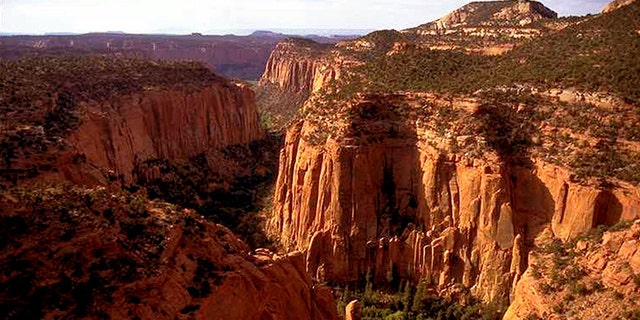
The monuments cover vast expanses of southern Utah where red rocks reveal petroglyphs and cliff dwellings and distinctive buttes bulge from a grassy valley. Trump invoked the Antiquities Act to cut 2 million acres (800,000 hectares) from the two monuments, calling restrictions on mining and other energy production a “massive land grab” that “should never have happened.”
His actions slashed Bears Ears, on lands considered sacred to Native American tribes, by 85%, to just over 200,000 acres (80,900 hectares). They cut Grand Staircase-Escalante by nearly half, leaving it at about 1 million acres (405,000 hectares). Both monuments were created by Democratic presidents.
The Upper Gulch section of the Escalante Canyons within Utah’s Grand Staircase-Escalante National Monument features sheer sandstone walls, broken occasionally by tributary canyons. (AP Photo/Douglas C. Pizac)
And in New England, the Northeast Canyons and Seamounts Marine National Monument in the Atlantic Ocean, southeast of Cape Cod, will return to its original protections under Obama in 2016. Under Biden’s order, recreational fishing “may continue.” Trump had made a rule change under his administration to allow commercial fishing at the marine monument. The monument is composed of 4,913 square horizontal miles.
The restoration of the protections for the monuments is consistent with recommendations of Secretary of the Interior Deb Haaland.
The White House said Biden’s protection of monuments is just one among a series of steps the Biden administration has taken to restore protections to some of America’s “most cherished lands and waters, many of which are sacred to Tribal Nations.”
Flames burn up a tree as part of the Windy Fire in the Trail of 100 Giants grove last month in Sequoia National Forest, Calif.Noah Berger/AP
LOS ANGELES — Northern California wildfires may have killed hundreds of giant sequoias as they swept through groves of the majestic monarchs in the Sierra Nevada, an official said Wednesday.
“It’s heartbreaking,” said Christy Brigham, head of resource management and science for Sequoia and Kings Canyon national parks.
The lightning-caused KNP Complex that erupted on Sept. 9 has burned into 15 giant sequoia groves in the park, Brigham said.
More than 2,000 firefighters were battling the blaze in sometimes treacherous terrain. On Wednesday afternoon, four people working on the fire were injured when a tree fell on them, the National Park Service reported.
Thankfully, this week, the Biden administration righted this terrible wrong by restoring the Migratory Bird Treaty Act’s authority over businesses responsible for incidental deaths of migratory birds caused as an indirect result of their operations. Consequently, businesses once again have a legal incentive to take actions to prevent such deaths, such as covering oil waste pits to prevent birds from mistaking them as ponds or marking power transmission lines to prevent birds from flying into them.
This victory ends what was a dangerous concession to the private sector that would cause birds suffering and cost them their lives. The FWS will resume enforcing the Migratory Bird Treaty Act as it had for decades previously, prohibiting incidental and purposeful killings alike. Underscoring the point, the FWS also issued an order providing instruction to its staff about implementing and enforcing the Migratory Bird Treaty Act.
The FWS went further in its efforts to encourage better protections, too, and announced it is seeking input to develop regulations concerning the incidental killing of migratory birds. This is expected to pave the way for a permitting program that will more actively engage businesses in migratory bird protection at all stages of their operations. Such a permitting program will further the development and adoption of best practices and technologies to prevent bird deaths.
The Migratory Bird Treaty Act was originally designed to combat threats associated with the hunting of migratory birds in the late 19th and early 20th centuries, but today’s world poses an altogether different set of hazards. The Act cannot address all the dangers to bird life, including climate change, loss of vital wetlands or overdevelopment. That’s why it’s critical that the statute maintain its authority over the everyday practices of industrial actors like energy companies, so that they internalize and implement operational strategies that better protect animals and nature. As these businesses become more engaged partners, they’ll help raise the bar for all of us in our efforts to design, build and manage infrastructure that minimizes harm to animals and the environment. The more our planning and design of communities, structures and landscapes takes animals and nature into account, the better off we’ll all be.
Stronger enforcement of the Migratory Bird Treaty Act is also essential to the restoration of waterways, wetlands and other environments birds inhabit. Following the death of more than one million birds after the BP Deepwater Horizon oil spill in 2010, BP paid $100 million in fines, which went to environmental remediation and improvement. The recent California oil spill has already produced a terrible impact on birds, and as always raises the question of how society will pay for the restoration of their habitat.
The restoration of the Migratory Bird Treaty Act’s incidental killing protections is welcome news, and we will urge the FWS to see the permitting program through to realization. We’re also pressing Congress to pass the Migratory Bird Protection Act—H.R. 4833, which is led by Reps. Alan Lowenthal, D-CA, and Brian Fitzpatrick, R-PA—intended to safeguard the Migratory Bird Treaty Act and to develop a permit program to ensure we keep building a world that’s safer for our fellow creatures.
Sara Amundson is president of the Humane Society Legislative Fund.
Increasing heat and rainfall extremes now far outside the historical climate
Alexander Robinson, Jascha Lehmann, David Barriopedro , Stefan Rahmstorfand Dim Coumou
AbstractOver the last decade, the world warmed by 0.25 °C, in-line with the roughly linear trend since the 1970s. Here we present updated analyses showing that this seemingly small shift has led to the emergence of heat extremes that would be virtually impossible without anthropogenic global warming. Also, record rainfall extremes have continued to increase worldwide and, on average, 1 in 4 rainfall records in the last decade can be attributed to climate change. Tropical regions, comprised of vulnerable countries that typically contributed least to anthropogenic climate change, continue to see the strongest increase in extremes.
Opening paragraphs
The year 2020 was marked by a range of intense extreme weather events around the globe, including heat waves and wildfires, heavy rainfall resulting in flooding, and a…
Updated 1:23 PM ET, Fri October 8, 2021Seahawks’ mascot lands on a fan and stands on his head.
(CNN)Taima the Hawk is a fixture at Seattle Seahawks home games, swooping through Lumen Field to the delight of thousands of football fans.The 16-year-old Augur hawk mascot made a particularly dramatic entrance at Thursday night’s game against the Los Angeles Rams — flying into the stands and landing on a fan’s back of the neck.Video shows the bird flapping wings as it appeared to be catching its balance on the hood of the sweatshirt the fan was wearing under his highlighter-green jersey.
Neither the fan nor Taima appeared to be injured in the awkward encounter, but it looked like it was an uncomfortable experience for them both.Unfortunately for Seahawks fans, the incident was one of the highlights of the game, or a harbinger of what was to come in their 26-17 loss to the Los Angeles Rams.
Source: CNNHuntington Beach Mayor: It’s ‘all hands on deck’ to mitigate oil spill 06:30
Huntington Beach Mayor: It’s ‘all hands on deck’ to mitigate oil spillCNN01:03/06:30And there are crews right now that are cleaning Now PlayingHuntington Beach…
(CNN)Tar balls that may be linked to the oil spill off the coast of Orange County, California, are washing up on San Diego beaches, county officials said Thursday, highlighting concerns about the widening environmental impact days after tens of thousands of gallons of crude oil spilled into the ocean.”While it is not impossible for this to occur naturally, the quantity is highly unlikely, highly unusual, and it is very likely that these tar balls are in fact the result of the oil spill,” San Diego County Board of Supervisors Chair Nathan Fletcher said in a news conference Thursday.”We do not know that for certain yet,” he added. Officials have collected samples, which are being tested.
A timeline of the California oil spill, from the first report to the clean-upSan Diego County will declare a state of emergency if the tar balls are tied to the Orange County oil spill, Fletcher said. Booms — floating barriers used to contain an oil spill — have been deployed out of an abundance of caution, he said.
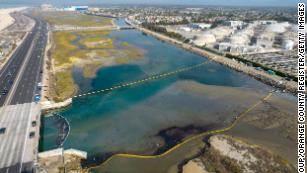
The news comes days after the first reports of the spill off the coast of Southern California, which forced the closure of beaches and threatened coastal habitats after oil leaked into the ocean from a split, or partial tear, in a pipeline several miles offshore.
According to Fletcher, lifeguards from the cities of Carlsbad and Oceanside saw the tar balls on their beaches Wednesday night, and officials have also received reports of tar balls in Encinitas and Del Mar, some 70 miles south of the beaches initially impacted in Orange County.Enter your email to subscribe to the CNN Five Things Newsletter.
We’ve got the day’s biggest headlines summarized for your busy schedule.Sign Me UpBy subscribing you agree to ourprivacy policy.There is no immediate threat to public health, Fletcher said, and the beaches will remain open until further notice. But officials have asked that people be on the lookout for the tar balls.A cleanup crew works on the beach on Thursday, October 7, 2021 in Huntington Beach, California.Meantime, officials continue their own cleanup efforts in Orange County, where nearly 1,500 people are expected to help out this weekend, Orange County Second District Supervisor Katrina Foley said on Twitter.People should not approach any oiled animals, she added, but call the Oiled Wildlife Care Network (OWCN).According to OWCN, as of Thursday evening, the number of wildlife recovered in the response totaled 35, including 10 birds that have been recovered dead.The oil spill has been designated a “Major Marine Casualty,” the US Coast Guard announced Thursday, the highest level of severity. In this case, it’s been designated as such “due to the potential involvement of a vessel and the resulting damages estimated in excess of $500,000,” the Coast Guard said in a statement.A class action lawsuit was filed against Amplify Energy and affiliated corporations Thursday on behalf of business owners impacted by the oil spill, claiming the companies failed to safely maintain the pipeline.CNN has contacted Amplify Energy, which operated the pipeline believed to be the source of the spill, for comment on the lawsuit, and is awaiting its reply.Workers in protective suits clean the contaminated beach after an oil spill in Newport Beach, California, on Wednesday, October 6, 2021.
US Coast Guard boards German cargo ship
While the exact number is not known, officials said in a news conference Thursday they estimate at least 24,000 gallons and possibly as much as 131,000 gallons of crude oil were released into the Pacific Ocean. US Coast Guard Captain Rebecca Ore said the worst case scenario would put the figure at a maximum of 131,628 gallons, or 3,134 barrels.A joint investigation between the US Coast Guard and other officials continues to move forward, Ore said.Authorities said earlier this week that the source appeared to be a 13-inch split found in a 4,000-foot section of pipe owned by Amplify Energy. The pipe had been pulled about 105 feet to the side, authorities said.A team of biologists from the University of California Santa Cruz and Tenera Consulting firm assess the overall biological habitat by gauging the biodiversity of the Little Corona del Mar tide pools on Wednesday, October 6, 2021 in Newport Beach, California.A preliminary report indicated the partial tear could have been caused by a vessel’s anchor that hooked the pipeline, the US Department of Transportation’s Pipeline and Hazardous Materials Safety Administration said in a notice to Amplify Energy. The incident remains under investigation.The US Coast Guard this week boarded a German cargo ship that was anchored in waters off Southern California when the pipeline began spilling crude oil into the ocean.Coast Guard officials boarded the Rotterdam Express Wednesday in Northern California, according to Roberto Bernardo, a spokesperson for the Port of Oakland. The ship was in port for about a day to unload its cargo, which is typical, Bernardo said, and is now headed for the Port of Manzanillo in Mexico.A spokesperson for Hapag-Lloyd, the German company that runs the ship, confirmed to CNN in an email Thursday that the ship had been boarded the day prior by the US Coast Guard.A boat checks on one of two oil containment booms at the entrance to Newport Harbor in Newport Beach Wednesday.The ship had anchored in an area of the Pacific Ocean on September 21, as directed by San Pedro Marine Traffic, Nils Haupt, the spokesperson, said in an email to CNN. The ship remained in the same position for 12 days before heading for Oakland.
“During the period in question the vessel has not moved from anchorage and has not passed over the pipeline,” Haupt said. “During anchorage no oil in the water has been spotted. Hapag-Lloyd is fully cooperating with all authorities involved.”The Unified Command responding to the oil spill declined to comment on the Rotterdam Express Thursday, saying in a statement, “We do not discuss ongoing investigations, but we are analyzing electric charting systems from our vessel traffic service to see what ships were anchored or moving over the spill area.”
Four ice cores from continental Antarctica were drilled in East Antarctica, including two as part of the Norwegian-American International Polar Year Antarctic Scientific Traverse. Credit: Stein Tronstad
Several years ago, while analyzing ice core samples from Antarctica’s James Ross Island, scientists Joe McConnell, Ph.D., and Nathan Chellman, Ph.D., from DRI, and Robert Mulvaney, Ph.D., from the British Antarctic Survey noticed something unusual: a substantial increase in levels of black carbon that began around the year 1300 and continued to the modern day.
Black carbon, commonly referred to as soot, is a light-absorbing particle that comes from combustion sources such as biomass burning (e.g. forest fires) and, more recently, fossil fuel combustion. Working in collaboration with an international team of scientists from the United Kingdom, Austria, Norway, Germany, Australia, Argentina, and the U.S., McConnell, Chellman, and Mulvaney set out to uncover the origins of the unexpected increase in black carbon captured in the Antarctic ice.
The team’s findings, which published this week in Nature, point to an unlikely source: ancient Māori land-burning practices in New Zealand, conducted at a scale that impacted the atmosphere across much of the Southern Hemisphere and dwarfed other preindustrial emissions in the region during the past 2,000 years.
“The idea that humans at this time in history caused such a significant change in atmospheric black carbon through their land clearing activities is quite surprising,” said McConnell, research professor of hydrology at DRI who designed and led the study. “We used to think that if you went back a few hundred years you’d be looking at a pristine, pre-industrial world, but it’s clear from this study that humans have been impacting the environment over the Southern Ocean and the Antarctica Peninsula for at least the last 700 years.”
The James Ross Island core drilled to bedrock in 2008 by the British Antarctic Survey provided an unprecedented record of soot deposition in the northern Antarctic Peninsula during the past 2000 years and revealed the surprising impacts of Māori burning in New Zealand starting in the late 13th century. Robert Mulvaney, Ph.D., pictured here led collection of the core. Credit: Jack Triest
Tracing the black carbon to its source
To identify the source of the black carbon, the study team analyzed an array of six ice cores collected from James Ross Island and continental Antarctica using DRI’s unique continuous ice-core analytical system. The method used to analyze black carbon in ice was first developed in McConnell’s lab in 2007.
While the ice core from James Ross Island showed a notable increase in black carbon beginning around the year 1300, with levels tripling over the 700 years that followed and peaking during the 16th and 17th centuries, black carbon levels at sites in continental Antarctica during the same period of time stayed relatively stable.
“From our models and the deposition pattern over Antarctica seen in the ice, it is clear that Patagonia, Tasmania, and New Zealand were the most likely points of origin of the increased black carbon emissions starting about 1300,” said Stohl.
Black carbon deposition during the past 2000 years measured in ice cores from Dronning Maud Land in continental Antarctica and James Ross Island at the northern tip of the Antarctic Peninsula. Atmospheric modeling and local burning records indicate that the pronounced increase in deposition in the northern Antarctic Peninsula starting in the late 13th century was related to Māori settlement of New Zealand nearly 4000 miles away and their use of fire for land clearing and management. Inset shows locations of New Zealand and ice-core drilling sites in Antarctica. Credit: DRI
After consulting paleofire records from each of the three regions, only one viable possibility remained: New Zealand, where charcoal records showed a major increase in fire activity beginning about the year 1300. This date also coincided with the estimated arrival, colonization, and subsequent burning of much of New Zealand’s forested areas by the Māori people.
This was a surprising conclusion, given New Zealand’s relatively small land area and the distance (nearly 4,500 miles), that smoke would have travelled to reach the ice core site on James Ross Island.
“Compared to natural burning in places like the Amazon, or Southern Africa, or Australia, you wouldn’t expect Māori burning in New Zealand to have a big impact, but it does over the Southern Ocean and the Antarctic Peninsula,” said Chellman, postdoctoral fellow at DRI. “Being able to use ice core records to show impacts on atmospheric chemistry that reached across the entire Southern Ocean, and being able to attribute that to the Māori arrival and settlement of New Zealand 700 years ago was really amazing.”
Research impacts
The study findings are important for a number of reasons. First, the results have important implications for our understanding of Earth’s atmosphere and climate. Modern climate models rely on accurate information about past climate to make projections for the future, especially on emissions and concentrations of light-absorbing black carbon linked to Earth’s radiative balance. Although it is often assumed that human impacts during preindustrial times were negligible compared to background or natural burning, this study provides new evidence that emissions from human-related burning have impacted Earth’s atmosphere and possibly its climate far earlier, and at scales far larger, than previously imagined.
Drilling camp on James Ross Island, northern Antarctic Peninsula. Credit: Jack Triest
Second, fallout from biomass burning is rich in micronutrients such as iron. Phytoplankton growth in much of the Southern Ocean is nutrient-limited so the increased fallout from Māori burning probably resulted in centuries of enhanced phytoplankton growth in large areas of the Southern Hemisphere.
Third, the results refine what is known about the timing of the arrival of the Māori in New Zealand, one of the last habitable places on earth to be colonized by humans. Māori arrival dates based on radiocarbon dates vary from the 13th to 14th century, but the more precise dating made possible by the ice core records pinpoints the start of large scale burning by early Māori in New Zealand to 1297, with an uncertainty of 30 years.
Measuring the chemistry in a longitudinal sample of an ice core on DRI’s unique ice core analytical system. Credit: Joe McConnell/DRI
“From this study and other previous work our team has done such as on 2,000-year old lead pollution in the Arctic from ancient Rome, it is clear that ice core records are very valuable for learning about past human impacts on the environment,” McConnell said. “Even the most remote parts of Earth were not necessarily pristine in preindustrial times.”
CODY- The U.S. Fish and Wildlife Service (Service) and Wyoming Game and Fish Department (Game and Fish) are currently investigating a grizzly bear attack. On Saturday morning, a man was injured by a grizzly bear while elk hunting west of Cody, Wyoming. The man rode out to the trailhead and was flown by helicopter to an area hospital where he is receiving treatment for what was initially reported as non-life threatening injuries.
Upon notification of the incident, Game and Fish immediately responded to the scene. Their initial investigation indicates the hunter was attacked after a sudden encounter at close range with an adult female grizzly bear with two cubs. The female grizzly was killed by the…







 Seahawks’ mascot lands on a fan and stands on his head.


 A cleanup crew works on the beach on Thursday, October 7, 2021 in Huntington Beach, California.Meantime, officials continue their own cleanup efforts in Orange County, where nearly 1,500 people are expected to help out this weekend, Orange County Second District Supervisor Katrina Foley
 Workers in protective suits clean the contaminated beach after an oil spill in Newport Beach, California, on Wednesday, October 6, 2021.
 A team of biologists from the University of California Santa Cruz and Tenera Consulting firm assess the overall biological habitat by gauging the biodiversity of the Little Corona del Mar tide pools on Wednesday, October 6, 2021 in Newport Beach, California.A preliminary report indicated the partial tear could have been caused by a vessel’s anchor that hooked the pipeline, the US Department of Transportation’s Pipeline and Hazardous Materials Safety Administration said in a notice to Amplify Energy. The incident remains under investigation.The US Coast Guard this week boarded a German cargo ship that was anchored in waters off Southern California when the pipeline began spilling crude oil into the ocean.Coast Guard officials boarded the Rotterdam Express Wednesday in Northern California, according to Roberto Bernardo, a spokesperson for the Port of Oakland. The ship was in port for about a day to unload its cargo, which is typical, Bernardo said, and is now headed for the Port of Manzanillo in Mexico.A spokesperson for Hapag-Lloyd, the German company that runs the ship, confirmed to CNN in an email Thursday that the ship had been boarded the day prior by the US Coast Guard.
 A boat checks on one of two oil containment booms at the entrance to Newport Harbor in Newport Beach Wednesday.The ship had anchored in an area of the Pacific Ocean on September 21, as directed by San Pedro Marine Traffic, Nils Haupt, the spokesperson, said in an email to CNN. The ship remained in the same position for 12 days before heading for Oakland.


