CALL ON GOVERNMENTS TO INCLUDE POPULATION IN BIODIVERSITY AGREEMENT
To prevent further biodiversity loss, we must address the impact of our growing humanpopulation. Please call on your country’s environment minister to support the inclusion of positive, choice-based population action in the Post-2020 Biodiversity Framework.
The UN Convention on Biological Diversity is the key international agreement protecting global biodiversity. Signatory governments must develop plans to protect biodiversity in their own nations, settargets and coordinateinternational action. Yet, progress is slow, targets are not being met and leaders are not taking this issue seriously enough.
Not a single one of the Aichi biodiversity targets have been met, in part because they fail to address human population growth, one of the main drivers fuelling the destruction of nature. It’s vital that the new programme of action to replace the Aichi targets addresses population to have…
Iwas once challenged by a friend to explain why it matters if species go extinct. Flustered, I launched into a rambling monologue about the intrinsic value of life and the importance of biodiversity for creating functioning ecosystems that ultimately prop up human economies. I don’t remember what my friend said; he certainly didn’t declare himself a born-again conservationist on the spot. But I do remember feeling frustrated that, in my inability to articulate a specific reason, I had somehow let down not only myself, but the entire planet.
The conversation would have gone very differently had I already read environmental journalist Emma Marris’s “Wild Souls: Freedom and Flourishing in the Non-Human World,” a razor-sharp exploration of the worth of wild animals and the species they belong to, and the responsibility we have toward them. “I wanted to know whether the massive human impact on Earth changes our obligation to animals,” Marris writes. “Our emotions about animals have always been strong, but are our intuitions about how — and whether — to interact with them still correct?”Advertisement:
As Marris details throughout the book, while there are good reasons to value animals as individuals, there is in fact no unassailable single reason to protect species. However, that realization does not mean we shouldn’t do so, only that we should go about it in a more thoughtful way, with an eye also toward individuals. Ultimately, Marris argues that it’s time to renegotiate our approach to wild animals and conservation to better match the realities of our human-dominated world.
At the heart of “Wild Souls” is the tension that often exists between acting in the best interest of an individual wild animal and acting in the best interest of their overall species or environment. These things do not always line up, practically or morally. “That tension hinges on trying to compare two very different things,” Marris writes. “In some ways, this is the toughest problem of all.”
Arguing for the worth of individual creatures, Marris points to a mounting body of scientific evidence showing that many nonhuman animals are “smart, emotional, and even kind,” with rich inner lives. These animals are sentient beings, she writes — selves. Given this, ethical arguments can be made for individual animals’ rights to flourish and to live autonomous lives. This applies whether the life is that of a tiger or a mouse. “We are used to common things being cheap and rare things being valuable,” Marris writes. “But selfhood is both common and priceless.”
On the other hand, the same ethical arguments cannot be made for the obligation to ensure species thrive, especially if this comes at a cost to individuals. While “many of us have a deeply felt intuition that causing a species to go extinct is wrong,” Marris writes, “‘species’ is an abstract concept” that simply encompasses a basket of animals that share a certain set of traits at a given time. “The basket itself is not sentient, cannot suffer or feel pleasure, and is not alive,” she writes.
Evolution — the process that wove the species basket — is likewise not inherently “good,” Marris continues, but rather “is just time and sex and death and mutation and chance.” While arguments can be made for why a particular species is important to humans, she concludes, it’s more difficult to find a rational justification for why a species or ecosystem has any intrinsic or objective final value beyond the individual animals it comprises.Advertisement:
Rationality aside, though, Marris, admits that she is deeply drawn to biodiversity — that “there’s something precious in what we call ‘nature,’ in the flow of energy, in the will to survive, in the way a lupine leaf holds a perfect sphere of rain.” She allows that overwhelming, logic-based justifications for protecting species are perhaps not necessary. Human passion alone can be reason enough to value the well-being of a rare species, even if it takes precedence over individual lives of members of that species or others.
On their own, these tensions can sound abstract. Marris gets around this by grounding the reader in real-world case studies on a number of topics, including keeping animals in zoos for educational purposes; supplemental feeding to sustain imperiled wild animals; captive breeding to bolster threatened populations or to secure genetic life rafts; and the practice of hunting as an ecological tool. As Marris explains, “I tried to look at these activities through the eyes of the individual animals as well as the framework of protecting species.”Advertisement:
Captive breeding, for example, usually benefits the species to the detriment of individuals, which must undergo the stress of capture and captivity — and sometimes wind up inadvertently losing their lives along with their freedom. “It’s an exercise in total domination, undertaken as part of a larger cultural project of stopping extinctions, which is arguably an attempt to reverse or reduce human domination over Earth,” Marris writes. While captive breeding does sometimes work, “does saving the kind justify restricting the autonomy of the individual?” she asks.
In the case of the California condor, the answer seems to be yes. In 1987, scientists captured the last of the world’s remaining wild condors for a captive breeding program that consisted of just 27 birds at the time. Although they were forced to forfeit their freedom, the birds likely would not have survived in the wild for much longer on their own, given the high mortality rates caused by the prevalence of lead shot in animal carcasses they were feeding on. Additionally, the species, which now numbers more than 300 in the wild, almost definitely would not have survived without intervention. So in this case, the program’s success, paired with the value of condors to humans, does seem to justify “any suffering and loss of autonomy experienced by the captured birds, especially since the levels of suffering seem quite low in this case,” Marris writes.Advertisement:
Marris suggests, though, that there should be limits to how far we go to protect biodiversity. This becomes particularly true, she writes, in instances when “we value ‘naturalness’ so highly that we become willing to hurt and kill animals to protect it.” Humans kill hundreds of thousands of invasive species each year, Marris estimates, and the ethics of lethal control can be weighed in a number of ways. In some cases, this method can be warranted: for example, in protecting an endangered species that humans are passionate about and that lives (or grows) on an island that is small enough for eradication of the invasive species to be done humanely. In other cases, though, killing invasive species solely on the basis of being invasive means depriving rats, feral cats, rabbits, possums, pythons, and other creatures — none of which maliciously chose to be born in a spot they did not evolve to occupy — years of life, without obvious justification.
Invasive species eradication also raises questions of where to draw the line on how we define natural. Over time, invasive species adapt to their environment and even evolve into new species, setting a new definition of natural. Climate change is also shifting many species poleward, causing “the idea that everything ‘should’ stay in its native range” to become “increasingly untenable,” Marris writes. As grizzly bears move north, for example, they are beginning to hybridize with polar bears, challenging “our cultural notions of discrete species and stable ecosystems.” Should the hybrid bears be shot, Marris asks, or “left alone to mate how they please, to respect their sovereignty?”Advertisement:https://creative-p.undertone.com/2150/87585-1620224649/m213-0.htmlADVERTISEMENTSCROLL TO CONTINUE READING
Perhaps the best way to save the polar bear from climate change’s deleterious impacts, she adds, is simply to “let it access the gene pool of its more flexible terrestrial cousin.”
Marris readily admits that she does not have all the answers, and that, in many cases, an answer that will simultaneously serve individual animals as well as species and ecosystems probably does not exist. What she does provide, though, is a useful set of guidelines that readers and society at large can adopt to more rigorously evaluate our attitudes toward wild animals, species, and the natural world.
As Marris argued in her 2013 book, “Rambunctious Garden,” and continues to build on in “Wild Souls,” the outdated notions of naturalness, wildness, purity, and ecological and genetic integrity — as often defined by a lack of anthropogenic influence pinned to some pre-colonial, frozen period of time — are not valuable or useful lenses through which to view environmental questions and decision-making. A more helpful and realistic set of considerations, she writes, would include the flourishing of sentient creatures, human compassion, and humility, the flow of matter and energy between living things, and biological diversity.Advertisement:
Find thousands of recipes, cooking guides for all skill levels, and more.SEE MORE →
“Taken together, I believe these values suggest that in a humanized world, we owe nonhuman animals respect and compassion, plenty of space, a climate that is not changing too quickly, and — in some cases — intervention to help them deal with environmental challenges caused by humanity,” Marris writes. And while our “reverence for the web and flow of life” may sometimes lead us to hurting or killing animals to protect a species or ecosystem, “we must not take life lightly.”
Thousands of British Columbians are calling on the province to stop the coyote cull it has planned for Stanley Park. Over the next two weeks, officials will be trapping and killing up to 35 coyotes.ADVERTISEMENThttps://629f4bbb04d24cdfa48cf815be9f349e.safeframe.googlesyndication.com/safeframe/1-0-38/html/container.html
This comes after 45 coyote attacks were reported in the past nine months in the park.
A petition started by Leilani Pulsifer a month ago, Save Vancouver’s Coyotes, has already gained more than 9,520 signatures (as of Saturday afternoon), and people continue to digitally sign their names.
One, is to urge the province to work with wildlife biologists and coyote experts to identify the aggressive individual animals, instead of killing all of them. Have the City of Vancouver and Park Board enforce the BC Wildlife Act, which states people cannot intentionally feed dangerous wildlife. Lastly, have the City pass a bylaw to prohibit the feeding of wildlife within the park and have an officer in the area handing out tickets to those who are found breaking the rules.about:blank
The Stanley Park Ecology Society is also speaking out about the coyote cull, releasing a statement, which reads in part, “SPES will continue to advocate for addressing the coyote problem at its source following the removal of the habituated coyotes. For ecological reasons, coyotes cannot be translocated nor rehabilitated.”https://platform.twitter.com/embed/Tweet.html?dnt=true&embedId=twitter-widget-0&features=eyJ0ZndfZXhwZXJpbWVudHNfY29va2llX2V4cGlyYXRpb24iOnsiYnVja2V0IjoxMjA5NjAwLCJ2ZXJzaW9uIjpudWxsfSwidGZ3X2hvcml6b25fdHdlZXRfZW1iZWRfOTU1NSI6eyJidWNrZXQiOiJodGUiLCJ2ZXJzaW9uIjpudWxsfSwidGZ3X3NwYWNlX2NhcmQiOnsiYnVja2V0Ijoib2ZmIiwidmVyc2lvbiI6bnVsbH19&frame=false&hideCard=false&hideThread=false&id=1434207568734216196&lang=en&origin=https%3A%2F%2Fdailyhive.com%2Fvancouver%2Fstanley-park-coyote-cull-petition&sessionId=1345cf4b860057ef8fd96abdc899d78e927a4083&siteScreenName=https%3A%2F%2Fdailyhive.com%2Fvancouver%2Fstanley-park-coyote-cull-petition&theme=light&widgetsVersion=1890d59c%3A1627936082797&width=500px
It also said coyotes will re-populate the park over time, adding the SPES, Park Board, BC Conservation Officer Service, and coyote experts are “making solid strides to future coyote populations from succumbing to habituation.”
The SPES said a pilot project is underway to see wildlife-proof garbage bins to prevent the animals from eating human food, as well as improved educational signage about wildlife feeding, and increased enforcement against feeding.
But, animal advocates are continuing to speak out about the coyote cull, expressing concern over how the animals will be trapped.ADVERTISEMENT
The Fur-Bearers are sounding the alarm about leg-hold traps that are used by trappers, claiming to be humane, saying the devices are “designed to hold a wild animal who will fight for their life to escape. Equivalent to slamming your hand in a car door.”https://platform.twitter.com/embed/Tweet.html?dnt=true&embedId=twitter-widget-1&features=eyJ0ZndfZXhwZXJpbWVudHNfY29va2llX2V4cGlyYXRpb24iOnsiYnVja2V0IjoxMjA5NjAwLCJ2ZXJzaW9uIjpudWxsfSwidGZ3X2hvcml6b25fdHdlZXRfZW1iZWRfOTU1NSI6eyJidWNrZXQiOiJodGUiLCJ2ZXJzaW9uIjpudWxsfSwidGZ3X3NwYWNlX2NhcmQiOnsiYnVja2V0Ijoib2ZmIiwidmVyc2lvbiI6bnVsbH19&frame=false&hideCard=false&hideThread=false&id=1433944561047408641&lang=en&origin=https%3A%2F%2Fdailyhive.com%2Fvancouver%2Fstanley-park-coyote-cull-petition&sessionId=1345cf4b860057ef8fd96abdc899d78e927a4083&siteScreenName=https%3A%2F%2Fdailyhive.com%2Fvancouver%2Fstanley-park-coyote-cull-petition&theme=light&widgetsVersion=1890d59c%3A1627936082797&width=500px
The group also said it learned through FOI documents no tickets have been issued related to wildlife feeding in three years in Stanley Park.
“It isn’t only the lack of communications that has allowed the Stanley Park situation to grow, but the lack of enforcement,” it said.ADVERTISEMENThttps://platform.twitter.com/embed/Tweet.html?dnt=true&embedId=twitter-widget-2&features=eyJ0ZndfZXhwZXJpbWVudHNfY29va2llX2V4cGlyYXRpb24iOnsiYnVja2V0IjoxMjA5NjAwLCJ2ZXJzaW9uIjpudWxsfSwidGZ3X2hvcml6b25fdHdlZXRfZW1iZWRfOTU1NSI6eyJidWNrZXQiOiJodGUiLCJ2ZXJzaW9uIjpudWxsfSwidGZ3X3NwYWNlX2NhcmQiOnsiYnVja2V0Ijoib2ZmIiwidmVyc2lvbiI6bnVsbH19&frame=false&hideCard=false&hideThread=false&id=1433941654252109828&lang=en&origin=https%3A%2F%2Fdailyhive.com%2Fvancouver%2Fstanley-park-coyote-cull-petition&sessionId=1345cf4b860057ef8fd96abdc899d78e927a4083&siteScreenName=https%3A%2F%2Fdailyhive.com%2Fvancouver%2Fstanley-park-coyote-cull-petition&theme=light&widgetsVersion=1890d59c%3A1627936082797&width=500px
On Instagram, Coyote Watch Canada shared a post by a wildlife photographer, Isabelle Groc, who said she is “deeply shocked and saddened” to hear of the decision to cull the coyotes in the park.
Groc also wrote, “I have been photographing Stanley Park for over 20 years and I have repeatedly witnessed people irresponsibly feeding wildlife, sometimes for decades, and getting away with it.”https://www.instagram.com/p/CTaRyHLr67Y/embed/?cr=1&v=13&wp=648&rd=https%3A%2F%2Fdailyhive.com&rp=%2Fvancouver%2Fstanley-park-coyote-cull-petition#%7B%22ci%22%3A0%2C%22os%22%3A10229.700000047684%2C%22ls%22%3A6689%2C%22le%22%3A7430.400000095367%7DADVERTISEMENT
On Thursday, before Canadian group The Sheepdogs was set to perform at the Malkin Bowl in Stanley Park, it tweeted “No damn coyote is gonna stop a Sheepdogs show!”
It went on to recommend concert goers get there before 7pm that evening because of the evening closures in Stanley Park, adding “let’s party in the park tomorrow night!”
But the tweet is drawing criticism over the remarks made about the coyotes.
Some called for the band and Park Board to cancel the show, while others questioned why it was still happening with the closures in effect.ADVERTISEMENThttps://platform.twitter.com/embed/Tweet.html?dnt=true&embedId=twitter-widget-3&features=eyJ0ZndfZXhwZXJpbWVudHNfY29va2llX2V4cGlyYXRpb24iOnsiYnVja2V0IjoxMjA5NjAwLCJ2ZXJzaW9uIjpudWxsfSwidGZ3X2hvcml6b25fdHdlZXRfZW1iZWRfOTU1NSI6eyJidWNrZXQiOiJodGUiLCJ2ZXJzaW9uIjpudWxsfSwidGZ3X3NwYWNlX2NhcmQiOnsiYnVja2V0Ijoib2ZmIiwidmVyc2lvbiI6bnVsbH19&frame=false&hideCard=false&hideThread=false&id=1433953684455444480&lang=en&origin=https%3A%2F%2Fdailyhive.com%2Fvancouver%2Fstanley-park-coyote-cull-petition&sessionId=1345cf4b860057ef8fd96abdc899d78e927a4083&siteScreenName=https%3A%2F%2Fdailyhive.com%2Fvancouver%2Fstanley-park-coyote-cull-petition&theme=light&widgetsVersion=1890d59c%3A1627936082797&width=500px
Pulsifer also shared this video on the petition to explain more reasons why she would like to see the coyote cull stopped.
The komodo dragon, the world’s largest lizard, is threatened with extinction as rising water levels driven by the climate crisis shrink its habitat, according to the latest “red list” update.
Endemic to a handful of Indonesian islands, the komodo dragon lives on the edge of forest or in open savannah, rarely venturing higher than 700 metres above sea level. Rising water levels are set to affect 30% of its habitat in the next 45 years, according to the International Union for Conservation of Nature (IUCN), which has changed its status from vulnerable to endangered.
The update – announced at the IUCN world conservation congress in Marseille – is the first for the komodo dragon in more than 20 years. It comes after the first peer-reviewed paper on how global heating would affect the giant lizards concluded “urgent conservation actions are required to avoid risk of extinction”.
As well as being unable to move to higher ground, the komodo dragons’ habitat is becoming increasingly fragmented by human activity, which makes populations less genetically healthy and more vulnerable. Their habitat range on the island of Flores in south-eastern Indonesia is thought to have shrunk by more than 40% between 1970 and 2000.
A rare image of komodo dragons fighting in Komodo national park, Indonesia. Photograph: Andrey Gudkov/Getty Images
“Because of human pressure, the forest is slowly being cut down and disappearing, and the savannah is affected by fires and degradation. That is why the animals are really in small little pockets,” said Gerardo Garcia, curator of vertebrates and invertebrates at Chester Zoo. “Habitats are being made even smaller due to rising sea levels.”Advertisement
Europeans discovered komodo dragons only in the early 20th century and were immediately fascinated by the creatures. Growing up to 3 metres long and weighing more than 150kg, komodos feed mainly on forest-dwelling pigs, deer, buffalo and fruit bats which hang in the low-lying mangrove trees. When they attack, their venomous saliva causes their prey’s blood pressure to suddenly drop and stops it clotting, sending them into shock. Despite their gory credentials we still know little about them because they’re so shy.https://interactive.guim.co.uk/uploader/embed/2021/09/komodo-dragonmap/giv-825WAcf5LtdE6m9/
“It is the most charismatic reptile on the planet yet until last year we didn’t really know where the komodos lived,” said Garcia, who was part of a three-year project with the Indonesian NGO Komodo Survival Programme that involved using camera traps to work out their movements. They discovered where they were living on Flores and now hope to do more focused conservation and community work in those areas. The subpopulation in Komodo national park is currently stable and protected.
Out of 138,000 species on the updated IUCN red list, more than 38,000 are threatened with extinction. The organisation also included a comprehensive reassessment of shark and ray species, with 37% now threatened with extinction due to overfishing, loss of habitat and the climate crisis. Sharks and rays are also burdened by the bad luck of their biology – they reproduce slowly and in low numbers, which means they are slower to bounce back compared with other species .
The IUCN red list update included some good news – four out of seven species of commercially fished tuna – Atlantic bluefin, southern bluefin, albacore and yellowfin – are on the path to recovery, thanks to the introduction of fishing quotas in the past 10 years.
“The new ratings certainly do bring some good news,” said Grantly Galland at the Pew Charitable Trusts. “Management has improved for bluefin tuna and albacore around the world in the past decade but we do still offer some caution in that IUCN ratings are based on entire species and it doesn’t allow for the assessment team to look at genetically distinct populations.”
For example, Atlantic bluefin is of least concern, but the western Atlantic population continues to experience serious declines, and is still at threat of being lost entirely.Advertisement
The success of albacore and southern bluefin tuna is due to the introduction of “harvest strategies” where the managers determine ahead of time what rules or actions they will take based on the status of the stock, and these new ratings are proof that those strategies are working.
Galland said: “When fishery managers are focused on a particular problem and dedicate efforts to fix that problem, they are able to do that, including reducing fish quotas when stakeholders don’t want them lowered. This shows that when we take those difficult decisions and focus on recovery we can actually achieve that.”
UK Becomes First Nation to Ban the Shark Fin Trade
UK Becomes First Nation to Ban the Shark Fin Trade
The UK aims to be the first country to comprehensively ban all importation and exportation of shark fins and related products.BY LIAM PRITCHETT | SEPTEMBER 2ND, 2021
The UK plans to introduce a comprehensive ban on the shark fin trade.
The British government recently announced that it will prohibit all importation and exportation of detached shark fins, in addition to all and any products containing the controversial ingredient.
The UK is the first country to propose such comprehensive restrictions. Animal welfare minister Lord Goldsmith published the details in a release from the Department for Environment, Food & Rural Affairs last month. However, the exact date of the ban is yet to be announced.
Finning involves the removal of fins, sometimes while still alive. Frequently, fishers discard the rest of the shark. It’s cruel, wasteful, and incredibly bad for the environment.
“Shark finning is indescribably cruel and causes thousands of shark[s] to die terrible deaths,” says Goldsmith. “Our action will not only help boost shark numbers, it will send a clear message that we do not support an industry that is forcing many species to the brink of extinction.”https://www.instagram.com/p/CTSi4esLt1o/embed/?cr=1&v=13&wp=648&rd=https%3A%2F%2Fwww.livekindly.co&rp=%2Fuk-ban-shark-fin-trade%2F#%7B%22ci%22%3A0%2C%22os%22%3A6046.799999952316%2C%22ls%22%3A2040.7999999523163%2C%22le%22%3A2729%7D
UK finally bans the shark fin trade
The UK banned shark finning in its waters back in 2013, but conspicuous defects in the legislation left room for the shark fin trade to continue. Existing restrictions are comparable to bans on the production of foie gras, veal, and fur that also fail to address continuing international trade.
The 2013 shark finning ban still allowed the importation of up to 25kg of shark fins for “personal consumption.” While a Greenpeace Unearthed investigation revealed that Britain exported over 50 tonnes of fins between 2017 and 2019 alone.
Humans have decimated approximately 70 percent of the world’s shark and ray population in less than five decades. We continue to kill up to 7.9 percent of the world’s existing sharks every year.
People hunt these 450 million year-old animals for their unique meat, organs, hides, and fins for use in controversial (but enduringly popular) dishes and medicines. But overfishing and other environmental problems also have a significant impact on depleted shark populations.
“It is encouraging to see the UK addressing the fin trade as an element of overfishing: the principal threat to sharks and rays,” says Ali Hood, Director of Conservation for the Shark Trust. “And we’re noting that the UK is ramping up its engagement in domestic and international shark conservation issues.”
Why are sharks important?
Sharks are a keystone species, making them absolutely essential for the continued health of their ecosystems and the marine environment in general.
They even store carbon within their bodies, and disrupting the natural cycle of life and death by hunting sharks contributes to climate change (which is yet another factor in their diminishing population).
Out of more than 500 varieties of shark, the IUCN now lists 143 as “under threat,” with various species ranging from “vulnerable” to “critically endangered.” Two specifically listed by the British government are the short fin mako and blue sharks, both ravaged by unsustainable fishing practices.
“Sharks have been around for millions of years and play a crucial role for the health of our oceans,” says shark conservationist James Glancy. “Yet, as a consequence of human activity, many shark species are critically endangered and face extinction in some regions.”
Two-time World Grand Championship Tennessee Walking Horse Midnight Sun. (Photo: VisitFranklin.com)
It’s showtime again in Shelbyville, a phrase you’ll likely hear announcer Mark Farrar shout at the Tennessee Walking Horse National Celebration that’s set to crown its 83rd World Grand Champion (WGC) on Saturday night. The 2021 World Grand Championship will likely be won by one of the two contenders who captured the preliminary World Championships last Saturday – Rodney Dick and ‘Really Coach’ or Tyler Baucom and ‘Minor Ordeal.’
But unfortunately, many of the trainers competing in the event have long records of violating the Horse Protection Act (HPA) that was designed to stamp out the painful practice of soring – the intentional infliction of pain to horses’ feet and legs by applying caustic chemicals such as kerosene, mustard oil, or other caustic substances or by inserting sharp objects into the horses’ hooves to induce an artificial high step known as the “Big Lick.”
Marty Irby (Animal Wellness Action)
The Big Lick is quite a different look than that performed by the first World Grand Champion, Strolling Jim, crowned in 1939, who wore nothing more than a regular pair of horse shoes on his front feet, and exhibited the sound, smooth, natural gait that made the walking horse famous. But for decades, every World Grand Champion has been allowed to show and compete with large-stacked shoes as tall as 8-10 inches on their feet, and metal ankle chains around their pasterns – devices used to exacerbate the pain caused by soring.
And 2021 would have been the last Celebration in history where the large-stacked shoes and ankle chains were worn if it weren’t for the Humane Society of the U.S. (HSUS) and Humane Society Legislative Fund (HSLF) whose leaders intentionally torpedoed an effort to enact anti-soring legislation because the compromise didn’t mirror all the provisions of the Prevent All Soring Tactics (PAST) Act. That bill failed to win support for nine straight years, and there’s no chance of that changing anytime soon.
The compromise – hard fought, with leaders of the Walking Horse industry finally assenting to change their ways – would eliminate chains on the horses’ ankles and require a dramatic reduction in the size of the stack shoes that make Walking Horse shows look medieval. The measure also makes soring a federal felony, ends a self-policing scheme, and bans using tail braces that hold the horses tail in a U-shaped position after the ligaments have been severed – all for a certain look.
Leaders at Animal Wellness Action have worked to enact the PAST Act since 2012 when it was first introduced in the U.S. House. We like its provisions, but the bill cannot pass in its current form. You legislate based not on your hopes, but by counting votes and understanding where legislative roadblocks exist. It’s Tennessee Walking Horse National Celebration time in Tennessee but efforts to enact legislation to ban anti-cruelty techniques like soring have been torpedoed by leaders of the Human Society of the United States.
The PAST Act only achieved passage through the House in July of 2019 as result of changing the bill’s name to the U.S. Senator Joseph D. Tydings Memorial PAST Act to honor the late Senator who authored the HPA and passed away in 2018. This was a strategy we developed with the Tydings family and the Citizens’ Campaign Against Big Lick Animal Cruelty – not the HSUS or HSLF. The measure – led by the two veterinarians in Congress at the time – Reps. Kurt Schrader, D-Ore., and Ted Yoho, R-Fla. – cleared the House by a vote of 333 to 96, but with opposition from Senators who hailed from Tennessee and Kentucky and 96 House Republicans opposing it, the bill was dead on arrival in the Upper Chamber. In light of that circumstance we pulled together representatives still involved in the breed to form those revisions to the PAST Act that would have ensured the bill became law. Had it been enacted at the end of 2020, it would have taken effect this November.
The House and Senate have the votes to pass the PAST Act, but almost every animal bill has to secure consensus in the Senate to pass, and we don’t have that on the PAST Act. In light of that political reality, we at Animal Wellness Action sat down with the industry and worked to secure a compromise that finally would end horse soring in America. The Horse Protection Act of 1970, which was a monumental achievement more than a half century ago, has proved too weak to stop soring. That’s why we need a fortification of the law that can be enacted, so we can finally end soring.
While the old PAST Act has been reintroduced this year by Sens. Mike Crapo, R-Ida., and Mark Warner, D-Va., it’s simply a messaging bill at this stage in the game, blocked by a handful of Senators from the region where soring occurs most, and there’s no end in sight.
The sabotaging of the solid compromise legislation in 2020 is regrettable, but we hope that stakeholders will come together and work through the differences to make changes that will enable the bill to clear the Senate and become law. The Humane Society’s opposition to compromise has only insured one thing: horses will continue to be sored indefinitely.
Irish Council Against Blood SportsMullingar, Ireland
SEP 3, 2021 —
Ireland’s largest fur farm appears to have shut down ahead of an upcoming ban on cruel fur farming.
When activists from the National Animal Rights Association visited the fur farm near Stradbally in County Laois at the weekend, they witnessed empty cages.
The cages had previously confined thousands and thousands of mink. In the past, the unfortunate creatures could be seen frantically jumping against the bars of the cages in desperate attempts to get free. They paced back and forth and circled repeatedly but their only escape from the cages came on the day they were killed. They were mercilessly grabbed, pulled out and dumped into a box filled with poisonous Carbon Monoxide gas before the fur was pulled from their bodies.
The sight of the empty cages was hailed by NARA as “a great moment…
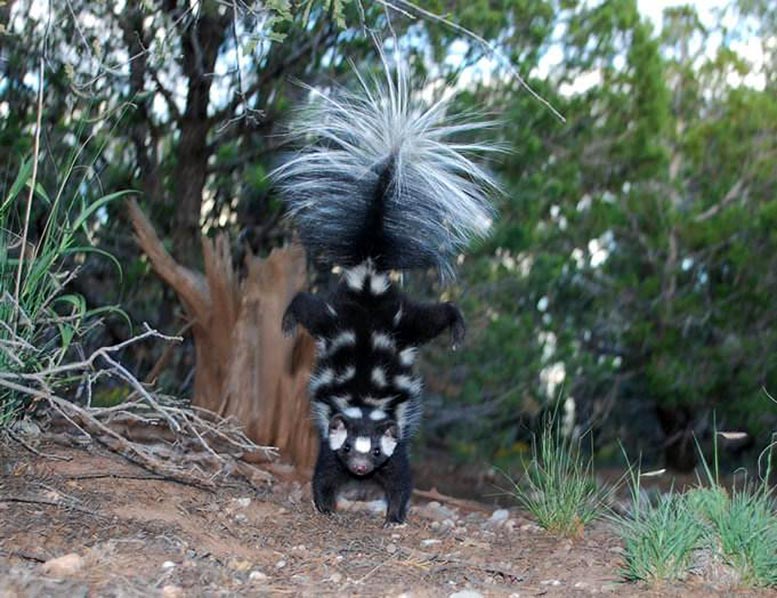
A spotted skunk doing its signature handstand. Credit: (c) Jerry W. Dragoo
Redesignating an endangered subspecies as a separate species could help it get protected.
Picture a skunk. You’re probably thinking of a stocky animal, around the size of a housecat, black with white stripes, like Pepé Le Pew. That describes North America’s most common skunk, the striped skunk, but they also have smaller, spotted cousins. Scientists still have a lot to learn about spotted skunks, starting with how many kinds of them even exist—over the years, the number of recognized species has ranged from two to fourteen, and lately, scientists have agreed there are four. But in a new paper in Molecular Phylogenetics and Evolution, researchers analyzed skunk DNA and found that there aren’t four species of spotted skunk after all: there are seven.
“North America is one of the most-studied continents in terms of mammals, and carnivores are one of the most-studied groups,” says Adam Ferguson, one of the paper’s authors and the Negaunee collections manager of mammals at Chicago’s Field Museum. “Everyone thinks we know everything about mammalian carnivore systematics, so being able to redraw the skunk family tree is very exciting.”
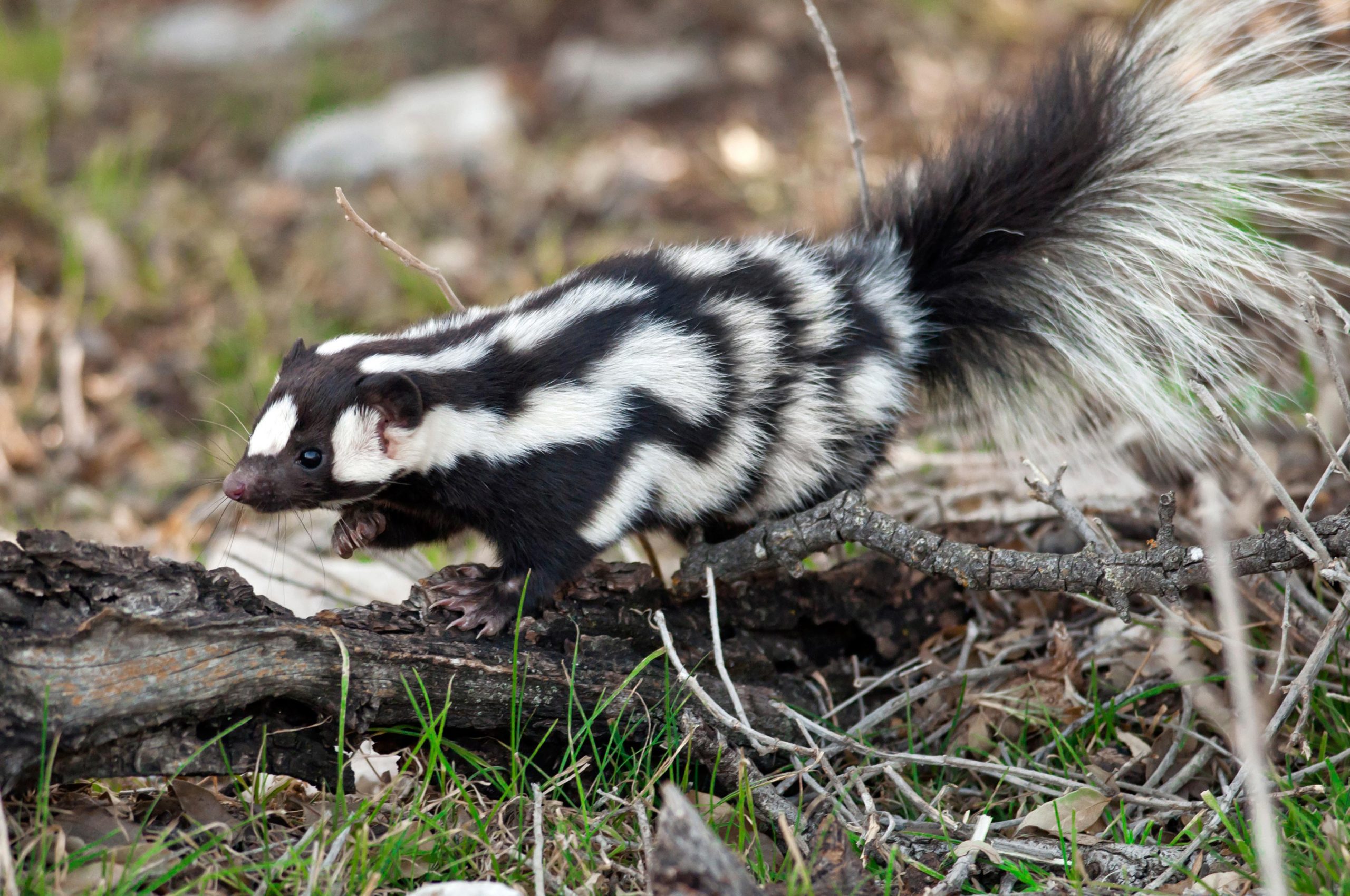
Spotted skunk. Credit: (c) Robby Fleischman
Skunks, like raccoons, otters, and weasels, are part of the Carnivora order of mammals (they’re omnivores, though). They’re distantly related to dogs, and even more distantly related to cats. Spotted skunks are found throughout North America, but they haven’t made themselves at home in urban areas the way their striped cousins have. Most spotted skunks weigh less than two pounds, whereas striped skunks can tip the scales at over ten. Like their name suggests, they have spots instead of stripes (although technically they’re just broken stripes). And while all skunks produce a nasty-smelling spray to deter predators, spotted skunks have the flashiest means of deploying it: they do a hand-stand on their front legs as an extra warning before they spray. “Spotted skunks are sometimes called the acrobats of the skunk world,” says Ferguson.
Scientists have been interested in spotted skunks for a long time—the first species formally recognized by Western science was described in 1758 by Carl Linnaeus, the inventor of the biological naming system still used today. Over the years, as many as fourteen species were recognized, though in recent decades that number’s been condensed to four. However, Ferguson suspected that there might be more, due to the lack of genetic sequence data from morphologically distinct or geographically isolated populations of this wide-ranging genus. “We figured there had to be some surprises when it came to spotted skunk diversity, because the genus as a whole had never been properly analyzed using genetic data,” says Ferguson.
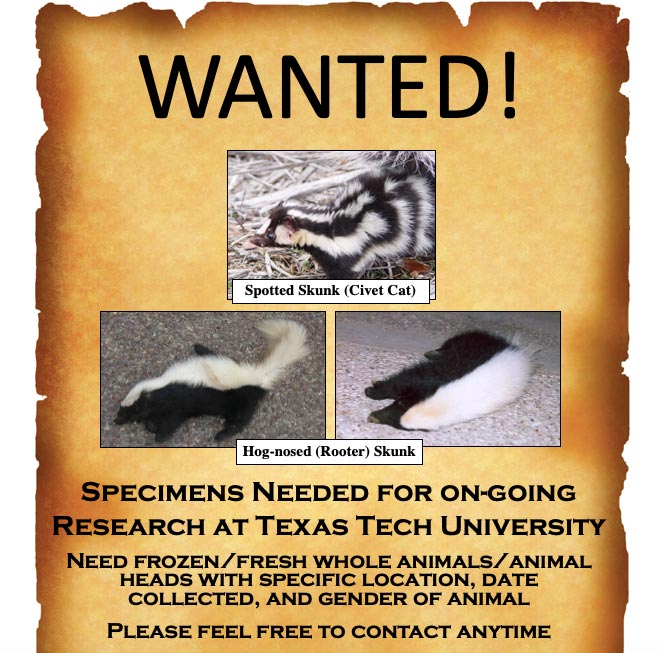
A “wanted” poster asking for roadkill skunk specimens to be used in research. Credit: (c) Adam Ferguson
Even though North American carnivores are by and large well-known, skunks are often understudied, in part because catching skunks is a good way to get sprayed. On top of that, spotted skunks are lithe and good at climbing trees, and they’re usually found in remote areas. To acquire the specimens needed for the study, the researchers had to get creative.
“We made wanted posters that we distributed across Texas in case people trapped them or found them as roadkill,” says Ferguson, who began collecting specimens used in this project while working on his MSc at Angelo State University. “People recognize spotted skunks as something special, because you don’t see them every day, so they’re not the kind of roadkill that people just paint over.”
In addition to modern specimens, the scientists used skunks in museum collections. “If we’re trying to tell the full story of skunk evolution we need as many samples as we can,” says Ferguson. “For example, we didn’t have any modern tissues from Central America or the Yucatan. We were able to use museum collections to fill those holes.” All in all, the researchers amassed a collection of 203 spotted skunk specimens.
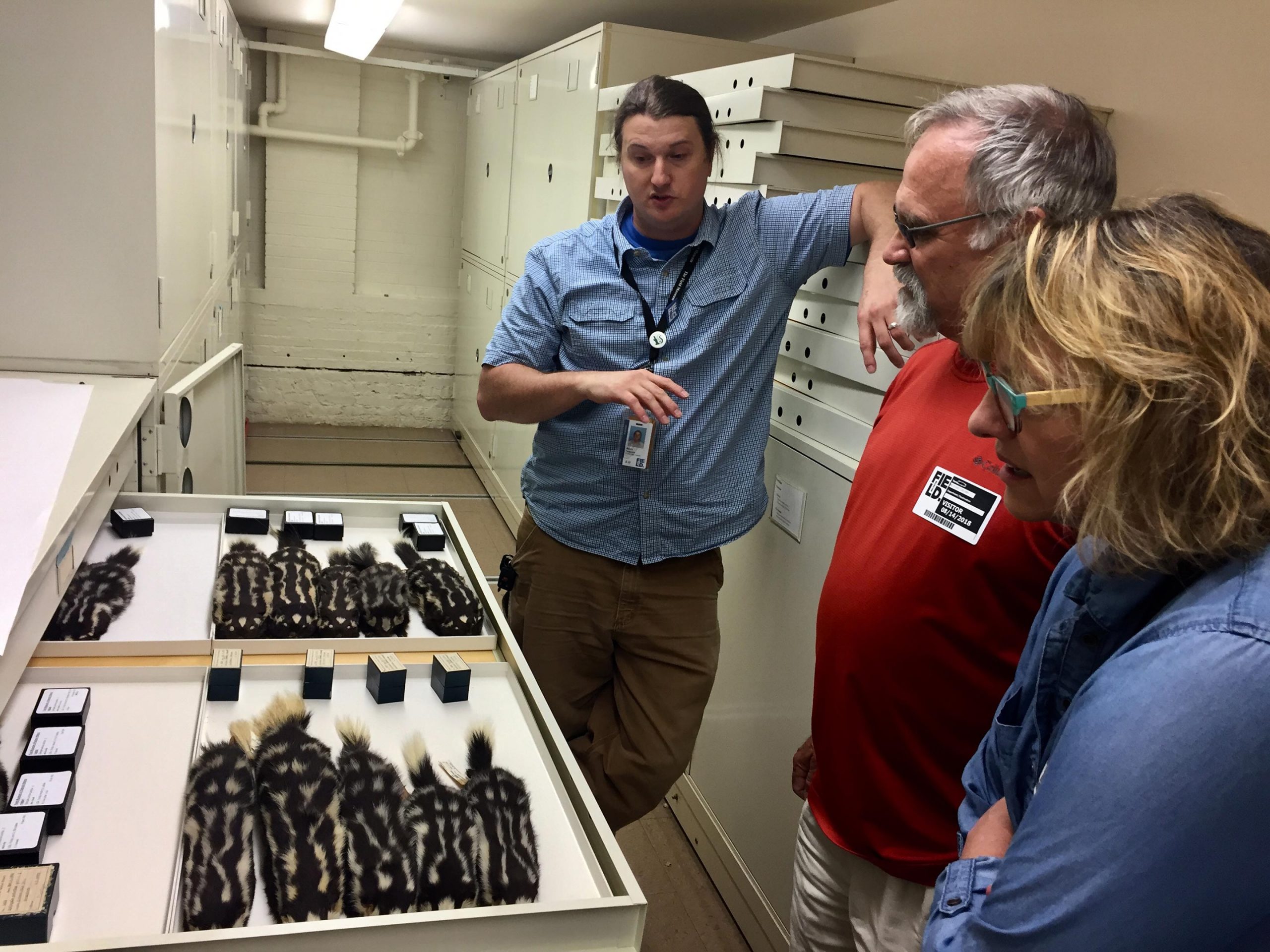
Adam Ferguson in the Field Museum’s collections with spotted skunk specimens. Credit: Courtesy of Adam Ferguson
The researchers took tissue samples from the skunks and analyzed their DNA. Comparing the DNA sequences revealed that some of the skunks that had previously been considered the same species were substantially different. These genetic differences led the researchers to regroup some of the skunks and resurrect several species names that haven’t been used in centuries.
“I was able to extract DNA from century-old museum samples and it was really exciting to see who those individuals were related to. It turns out that one of those was a currently unrecognized, endemic species in the Yucatan,” says Molly McDonough, a biology professor at Chicago State University, research associate at the Field Museum, and the paper’s first author.
Among the new species described are the Yucatan spotted skunk, a squirrel-sized skunk found only in the Yucatan Peninsula, and the Plains spotted skunk. Plains spotted skunks have been in decline for the past century, and conservationists have petitioned for them to be listed as an endangered subspecies. “If a subspecies is in trouble, there’s sometimes less emphasis on protecting it because it’s not as distinct an evolutionary lineage as a species,” says Ferguson. “We’ve shown that the Plains spotted skunks are distinct at the species level, which means they’ve been evolving independently of the other skunks for a long time. Once something has a species name, it’s easier to conserve and protect.”
The revised skunk family tree could also be a tool for scientists looking to understand skunk reproductive biology. “Besides the fact that they do handstands, the coolest thing about spotted skunks is that some of them practice delayed egg implantation—they breed in the fall, but they don’t give birth until the spring. They delay implanting the egg in the uterus, it just sits in suspension for a while,” says Ferguson. “We want to know why some species have delayed implantation and others don’t, and figuring out how these different species of skunks evolved can help us do that.”
And while skunks aren’t always the most popular animals, the researchers say that understanding how they evolved and protecting them from extinction is important to our whole ecosystem.
“By analyzing the genome of spotted skunks, we’ve been able to learn that their evolution and splitting into different species was driven by climate change during the Ice Age,” says Ferguson. “The different lineages we found might help us find different conservation angles for protecting them in the future.”
Reference: “Phylogenomic systematics of the spotted skunks (Carnivora, Mephitidae, Spilogale): Additional species diversity and Pleistocene climate change as a major driver of diversification” by Molly M. McDonough, Adam W. Ferguson, Robert C. Dowler, Matthew E. Gompper and Jesús E. Maldonado, 22 July 2021, Molecular Phylogenetics and Evolution. DOI: 10.1016/j.ympev.2021.107266
Three New Species of Hand-Standing Spotted Skunks Discovered
A spotted skunk doing its signature handstand. Credit: (c) Jerry W. Dragoo
Redesignating an endangered subspecies as a separate species could help it get protected.
Picture a skunk. You’re probably thinking of a stocky animal, around the size of a housecat, black with white stripes, like Pepé Le Pew. That describes North America’s most common skunk, the striped skunk, but they also have smaller, spotted cousins. Scientists still have a lot to learn about spotted skunks, starting with how many kinds of them even exist—over the years, the number of recognized species has ranged from two to fourteen, and lately, scientists have agreed there are four. But in a new paper in Molecular Phylogenetics and Evolution, researchers analyzed skunk DNA and found that there aren’t four species of spotted skunk after all: there are seven.
“North America is one of the most-studied continents in terms of mammals, and carnivores are one of the most-studied groups,” says Adam Ferguson, one of the paper’s authors and the Negaunee collections manager of mammals at Chicago’s Field Museum. “Everyone thinks we know everything about mammalian carnivore systematics, so being able to redraw the skunk family tree is very exciting.”
Spotted skunk. Credit: (c) Robby Fleischman
Skunks, like raccoons, otters, and weasels, are part of the Carnivora order of mammals (they’re omnivores, though). They’re distantly related to dogs, and even more distantly related to cats. Spotted skunks are found throughout North America, but they haven’t made themselves at home in urban areas the way their striped cousins have. Most spotted skunks weigh less than two pounds, whereas striped skunks can tip the scales at over ten. Like their name suggests, they have spots instead of stripes (although technically they’re just broken stripes). And while all skunks produce a nasty-smelling spray to deter predators, spotted skunks have the flashiest means of deploying it: they do a hand-stand on their front legs as an extra warning before they spray. “Spotted skunks are sometimes called the acrobats of the skunk world,” says Ferguson.
Scientists have been interested in spotted skunks for a long time—the first species formally recognized by Western science was described in 1758 by Carl Linnaeus, the inventor of the biological naming system still used today. Over the years, as many as fourteen species were recognized, though in recent decades that number’s been condensed to four. However, Ferguson suspected that there might be more, due to the lack of genetic sequence data from morphologically distinct or geographically isolated populations of this wide-ranging genus. “We figured there had to be some surprises when it came to spotted skunk diversity, because the genus as a whole had never been properly analyzed using genetic data,” says Ferguson.
A “wanted” poster asking for roadkill skunk specimens to be used in research. Credit: (c) Adam Ferguson
Even though North American carnivores are by and large well-known, skunks are often understudied, in part because catching skunks is a good way to get sprayed. On top of that, spotted skunks are lithe and good at climbing trees, and they’re usually found in remote areas. To acquire the specimens needed for the study, the researchers had to get creative.
“We made wanted posters that we distributed across Texas in case people trapped them or found them as roadkill,” says Ferguson, who began collecting specimens used in this project while working on his MSc at Angelo State University. “People recognize spotted skunks as something special, because you don’t see them every day, so they’re not the kind of roadkill that people just paint over.”
In addition to modern specimens, the scientists used skunks in museum collections. “If we’re trying to tell the full story of skunk evolution we need as many samples as we can,” says Ferguson. “For example, we didn’t have any modern tissues from Central America or the Yucatan. We were able to use museum collections to fill those holes.” All in all, the researchers amassed a collection of 203 spotted skunk specimens.
Adam Ferguson in the Field Museum’s collections with spotted skunk specimens. Credit: Courtesy of Adam Ferguson
The researchers took tissue samples from the skunks and analyzed their DNA. Comparing the DNA sequences revealed that some of the skunks that had previously been considered the same species were substantially different. These genetic differences led the researchers to regroup some of the skunks and resurrect several species names that haven’t been used in centuries.
“I was able to extract DNA from century-old museum samples and it was really exciting to see who those individuals were related to. It turns out that one of those was a currently unrecognized, endemic species in the Yucatan,” says Molly McDonough, a biology professor at Chicago State University, research associate at the Field Museum, and the paper’s first author.
Among the new species described are the Yucatan spotted skunk, a squirrel-sized skunk found only in the Yucatan Peninsula, and the Plains spotted skunk. Plains spotted skunks have been in decline for the past century, and conservationists have petitioned for them to be listed as an endangered subspecies. “If a subspecies is in trouble, there’s sometimes less emphasis on protecting it because it’s not as distinct an evolutionary lineage as a species,” says Ferguson. “We’ve shown that the Plains spotted skunks are distinct at the species level, which means they’ve been evolving independently of the other skunks for a long time. Once something has a species name, it’s easier to conserve and protect.”
The revised skunk family tree could also be a tool for scientists looking to understand skunk reproductive biology. “Besides the fact that they do handstands, the coolest thing about spotted skunks is that some of them practice delayed egg implantation—they breed in the fall, but they don’t give birth until the spring. They delay implanting the egg in the uterus, it just sits in suspension for a while,” says Ferguson. “We want to know why some species have delayed implantation and others don’t, and figuring out how these different species of skunks evolved can help us do that.”
And while skunks aren’t always the most popular animals, the researchers say that understanding how they evolved and protecting them from extinction is important to our whole ecosystem.
“By analyzing the genome of spotted skunks, we’ve been able to learn that their evolution and splitting into different species was driven by climate change during the Ice Age,” says Ferguson. “The different lineages we found might help us find different conservation angles for protecting them in the future.”
Reference: “Phylogenomic systematics of the spotted skunks (Carnivora, Mephitidae, Spilogale): Additional species diversity and Pleistocene climate change as a major driver of diversification” by Molly M. McDonough, Adam W. Ferguson, Robert C. Dowler, Matthew E. Gompper and Jesús E. Maldonado, 22 July 2021, Molecular Phylogenetics and Evolution. DOI: 10.1016/j.ympev.2021.107266
ROB BESCHIZZA12:34 PM THUSEP 2, 2021Photo courtesy of Binoche et Giquello
Auctioneers at Binoche et Giquello hope that it’s a good year for vintage furnishings—and that someone out there has at least $1.2m Euros anda lot of space to stash a full-size Triceratops skeleton. The 66m-year-old fossil’s skull alone is 2.62m (8′ 7″) long and 2m (6′ 7″) wide. With a total length of 8m (26′), it’s the largest Triceratops ever dug up.
The dinosaur lived in Laramidia, an island continent which stretched from present day Alaska to Mexico, and perished in an ancient flood plain currently known as the Hell Creek formation in South Dakota, where he was discovered by geologist Walter W. Stein Bill in May 2014. The dinosaur was excavated a year later, and later restored in Italy, the company said in a statement.


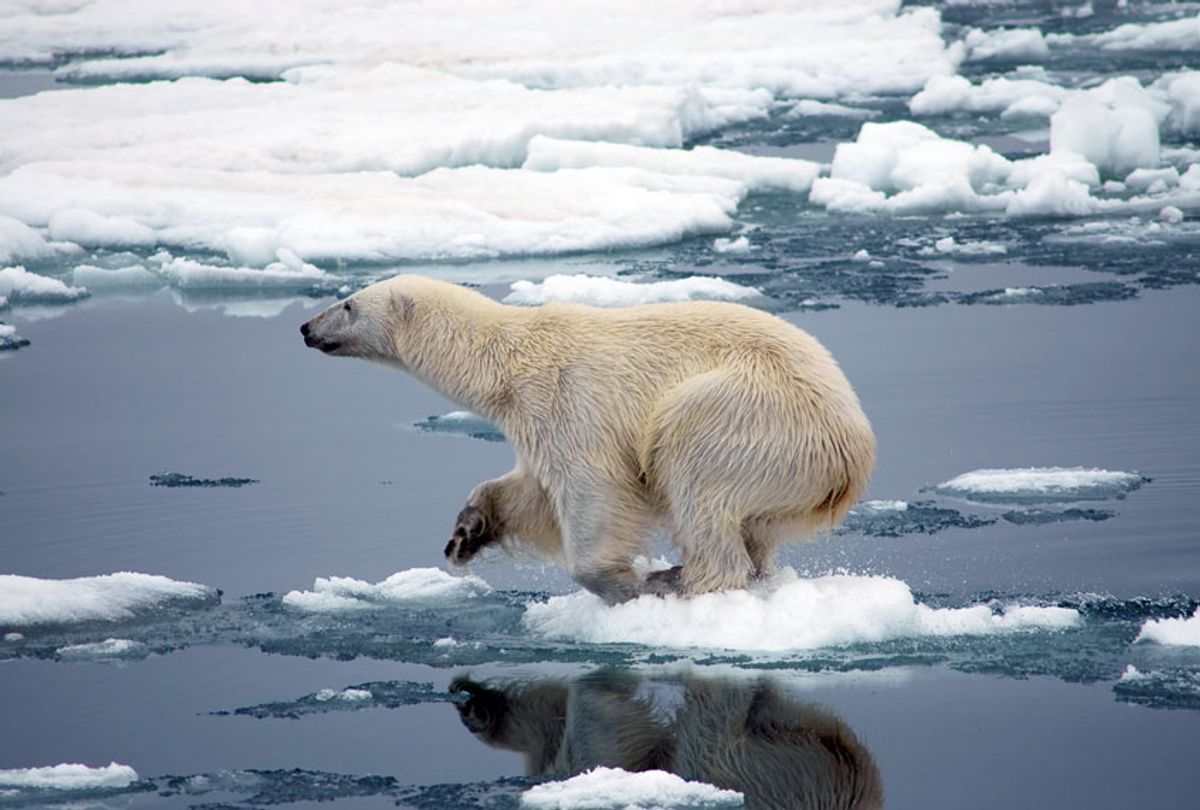 A large polar bear getting ready jump of a small piece of ice (Getty Images)


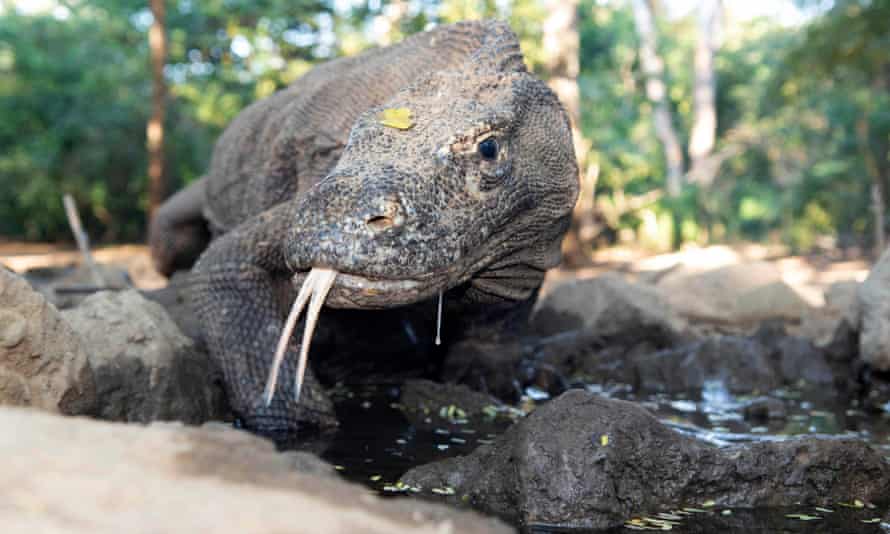
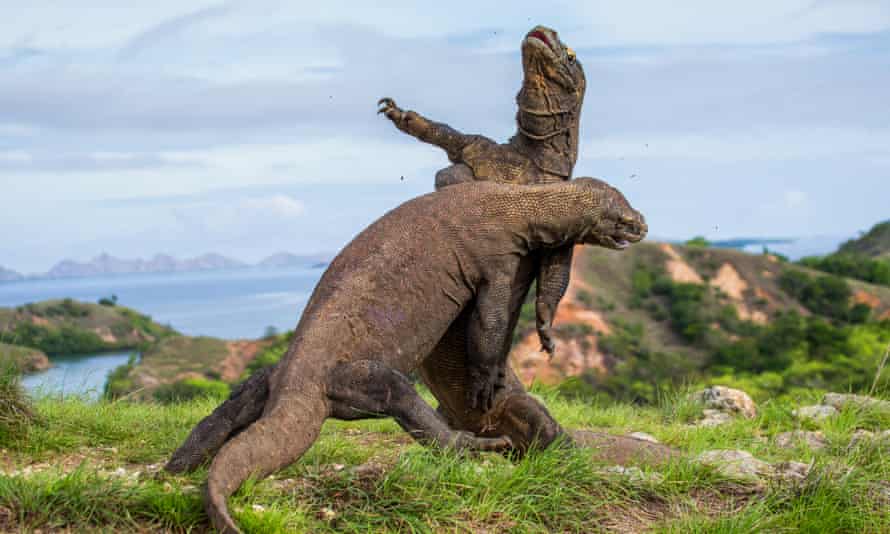



 Photo courtesy of Binoche et Giquello