Scientists discover ‘world’s northernmost island’ off Greenland’s coast

https://www.theguardian.com/world/2021/aug/28/scientists-discover-worlds-northernmost-island-off-greenlands-coast

Researchers say the tiny island in Greenland – roughly 30 metres across – was exposed by shifting pack ice
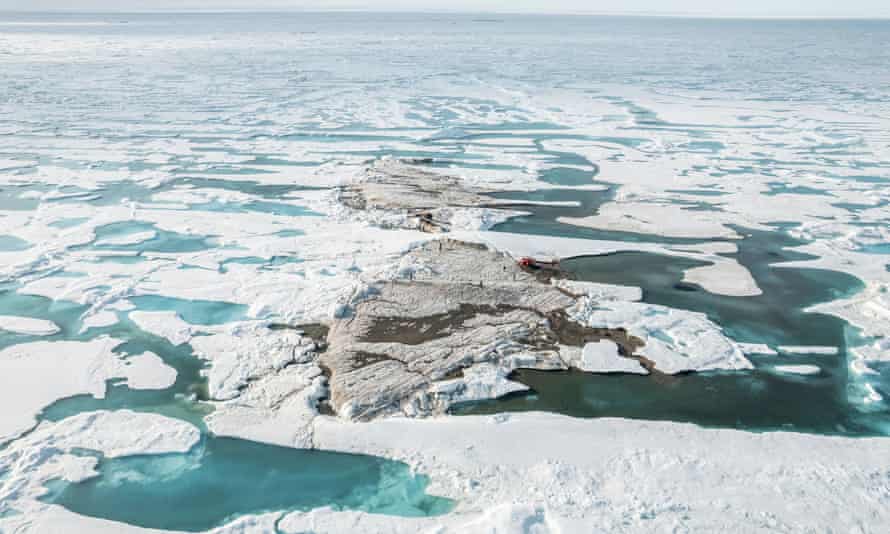
The tiny island off the coast of Greenland is the world’s northernmost point of land, according to the scientific expedition that discovered it.
The tiny island off the coast of Greenland is the world’s northernmost point of land, according to the scientific expedition that discovered it. Photograph: Julian Charriere/Reuters

ReutersFri 27 Aug 2021 22.29 EDT

Scientists have discovered a new island off the coast of Greenland, which they say is the world’s northernmost point of land and was revealed by shifting pack ice.

“It was not our intention to discover a new island,” polar explorer and head of the Arctic station research facility in Greenland, Morten Rasch, said of the find last month. “We just went there to collect samples.”
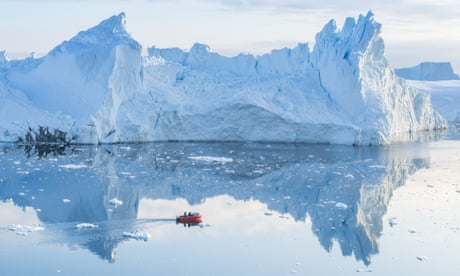
Icebergs near Ilulissat, Greenland. The climate crisis is having a profound impact on glaciers.

The scientists initially thought they had arrived at Oodaaq, an island discovered by a Danish survey team in 1978. Only later, when checking the exact location, they realised they had visited another island 780 metres to the north-west.

“Everybody was happy that we found what we thought was Oodaaq island,” said Swiss entrepreneur Christiane Leister, creator of the Leister Foundation that financed the expedition.

“It’s a bit like explorers in the past, who thought they’d landed in a certain place but actually found a totally different place.”

The small island, measuring roughly 30 metres (100ft) across and a peak of about 3 metres, consists of seabed mud as well as moraine – soil and rock left behind by moving glaciers. The team said they would recommend it is named “Qeqertaq Avannarleq”, which means “the northernmost island” in Greenlandic.

Several US expeditions in the area have in recent decades searched for the world’s northernmost island. In 2007, Arctic veteran Dennis Schmitt discovered a similar island close by.

The scientists said that although the new island was exposed by shifting pack ice, its appearance now was not a direct consequence of global warming, which has been shrinking Greenland’s ice sheet.
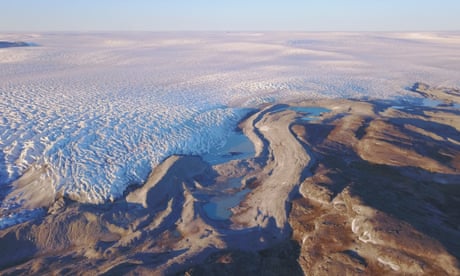
The Greenland ice sheet

Rene Forsberg, professor and head of geodynamics at Denmark’s National Space Institute, said the area north of Greenland has some of the thickest polar sea ice, though he added it was now 2-3 metres thick in summer, compared with 4 metres when he first visited as part of the expedition that discovered Oodaaq in 1978.

Any hope of extending territorial claims in the Arctic depends on whether it is in fact an island or a bank that may disappear again. An island needs to remain above sea level at high tide.

“It meets the criteria of an island,” Forsberg said. “This is currently the world’s northernmost land.” Although he did warn: “These small island come and go.”

Bitely Non-Profit Allows People with Disabilities to Enjoy Hunting and the Outdoors

Exposing the Big Game's avatarCommittee to Abolish Sport Hunting Blog

Hook and Hunting:

August 26, 2021Chelsea Dickens,Kaleb VintonPlay Video

spaceplay / pause

qunload | stop

ffullscreen

shift+←→slower / faster

↑↓volume

mmute

←→seek

.seek to previous

12…6seek to 10%, 20% … 60%

A tragic accident can leave a person feeling hopeless, angry and depressed. It changes a person’s life, and for some, it can bring a whole new sense of purpose.

This happened for Carson Nyenhuis of Grandville. A motorcycle accident left him paralyzed from the chest down.

“During my recovery and going through that, I got home and I had broken wrists so I couldn’t wheel around,” says Nyenhuis. “I had a chest brace on up to my neck. I couldn’t do a whole lot of moving.”

Nyenhuis says he became depressed and left him with a sense…

View original post 492 more words

Dove Hunting Season: Hunters Ready for Saturday, Sept. 4

Exposing the Big Game's avatarCommittee to Abolish Sport Hunting Blog

https://gadnr.org/dove-hunting-season-hunters-ready-saturday-sept-4

SOCIAL CIRCLE, GATuesday, August 24, 2021 – 14:00

The Georgia dove hunting season opens Sat. Sept. 4, 2021, according to the Georgia Department of Natural Resources’ Wildlife Resources Division (WRD).

“For wing shooters, dove season kicks off the fall hunting season,” says Alan Isler, Chief of the WRD Game Management Section. “Two big changes this year includes expanding the first dove season into October and changing opening day shooting hours – make sure you take note of the right shooting hours for the field you plan to hunt.”

The official 2021-2022 dove seasons are Sept. 4-Oct. 10, Nov. 20-28 and Dec. 19 – Jan. 31. Statewide shooting hours – for all of the dove season – are one-half hour before sunrise to sunset. However, on managed Wildlife Management Area (WMA) dove hunts, opening day shooting hours are one-half hour before sunrise to 12 noon.

More Dove Season Tips and…

View original post 236 more words

Greenhouse Gases and Sea Levels Shattered Global Records in 2020, Says NOAA

Florida woman hospitalized with COVID-19 comes home to find husband dead from virus

Exposing the Big Game's avatarThe Extinction Chronicles

https://abc7.com/florida-covid-lisa-steadman-coronavirus-winter-haven/10980237/

ByMckenna King, WFTSFriday, August 27, 2021 8:55AMabout:blankEMBED <>MORE VIDEOS

Have you seen home prices lately in the Antelope Valley? The surging market is fueling a whole host of problems – including pushing more people into homelessness.WINTER HAVEN, Fla. — A Florida woman, who battled and beat COVID-19 in the hospital for eight days, returned home to discover her husband had died in their home due to the virus.

“It was just like walking into a horror scene. It’s just been horrible,” Winter Haven resident Lisa Steadman toldWFTS, ABC Action News.

The 58-year-old thought she was through the worst of it.

She and her husband Ron both got diagnosed with COVID-19 in early August.

“I was in the hospital for eight days. Every day I talked to him,” she said.

Ron never ended up in the hospital. Instead, he was home taking care of the dogs…

View original post 341 more words

Western Europe Can Expect More Heavy Rainfall And Fatal Floods As The Climate Warms

Exposing the Big Game's avatarThe Extinction Chronicles

https://www.npr.org/2021/08/27/1031193790/western-europe-fatal-floods-climate-change

  • Facebook
  • Twitter
  • Flipboard
  • Email

August 27, 20215:00 AM ET

JACLYN DIAZ

Destroyed houses are seen in Schuld, Germany, on July 15 after devastating floods hit the region.Michael Probst/AP

Heavy rainfall and catastrophic flooding events like those that hit Western Europe last month will be more frequent and intense due to climate change,a new scientific study says.

From July 12-15, heavy rainfall led to severe flooding that killed more than 200 people in Germany and Belgium, andcaused billions of dollars worth of damage.

The World Weather Attribution initiative, an international group of climate scientists behind the report, said July’s historic rainfall was 1.2 to 9 times more likely to happen due to global warming.

The researchers used peer-reviewed scientific methods to examine how human-induced climate change affected rainfall events in Europe this summer.

Climate change increased the rainfall intensity

People check for victims in flooded cars…

View original post 265 more words

The Attack Outside Kabul Airport Pushes The U.S. Exit Into Deeper Disarray

Exposing the Big Game's avatarThe Extinction Chronicles

https://www.npr.org/2021/08/26/1031428645/the-attacks-outside-kabul-airport-pushes-the-u-s-exit-into-deeper-disarray

  • Facebook
  • Twitter
  • Flipboard
  • Email

August 26, 20217:11 PM ET

DEEPA SHIVARAMTwitter

SHARON PRUITT-YOUNG

Smoke rises from a deadly explosion outside the airport in Kabul, Afghanistan, on Thursday. A suicide bomber targeted crowds massing near the airport in the waning days of a massive airlift that has drawn thousands of people seeking to flee the Taliban takeover.Wali Sabawoon/AP

If the intention of the attack at the Kabul airport was to throw into disarray an already chaotic U.S. evacuation from Afghanistan, the effects of Thursday’s violence are only beginning to take shape. Flights have been taking off from the airport since the explosions occurred, and President Biden said the American withdrawal will continue.

“America will not be intimidated,”Biden said.

It was a combative stance from a U.S. president who was already facing criticism for the Taliban takeover of Afghanistan and who will now face the fallout from…

View original post 1,077 more words

Fossil of previously unknown four-legged whale found in Egypt

By ReutersAugust 26, 2021 12:02pm  Updated

An illustration of the semiaquatic "god of death" whale that lived more than 43 million years ago.
An illustration of the semiaquatic “god of death” whale that lived more than 43 million years ago.Robert W. Boessenecker

MORE ON:FOSSILS

CAIRO, Aug 25 – Scientists said on Wednesday they had discovered the 43 million-year-old fossil of a previously unknown amphibious four-legged whale species in Egypt that helps trace the transition of whales from land to sea.

The newly discovered whale belongs to the Protocetidae, a group of extinct whales that falls in the middle of that transition, the Egyptian-led team of researchers said in a statement.

Its fossil was unearthed from middle Eocene rocks in the Fayum Depression in Egypt’s Western Desert — an area once covered by sea that has provided a rich seam of discoveries showing the evolution of whales — before being studied at Mansoura University Vertebrate Palaeontology Centre (MUVP).

The new whale, named Phiomicetus anubis, had an estimated body length of some three meters (10 feet) and a body mass of about 1,300 lb and was likely a top predator, the researchers said. Its partial skeleton revealed it as the most primitive protocetid whale known from Africa.

A map detailing the Fayum Depression in Egypt, where paleontologists found the fossil whale.

“Phiomicetus anubis is a key new whale species, and a critical discovery for Egyptian and African paleontology,” said Abdullah Gohar of MUVP, lead author of a paper on the discovery published in the journal Proceedings of the Royal Society B.

The whale’s genus name honors the Fayum Depression and species name refers to Anubis, the ancient canine-headed Egyptian god associated with mummification and the afterlife.

Despite recent fossil discoveries, the big picture of early whale evolution in Africa has largely remained a mystery, the researchers said. Work in the region had the potential to reveal new details about the evolutionary transition from amphibious to fully aquatic whales.

Egyptian paleontologists from left, Mohamed Sameh Antar, Abdullah Gohar and Hesham Sallam, sit around the fossils of the new whale, Phiomicetus anubis, at Mansoura University Vertebrate Paleontology center.

With rocks covering about 12 million years, discoveries in the Fayum Depression “range from semiaquatic crocodile-like whales to giant fully aquatic whales”, said Mohamed Sameh of the Egyptian Environmental Affairs Agency, a co-author.

The new whale has raised questions about ancient ecosystems and pointed research towards questions such as the origin and coexistence of ancient whales in Egypt, said Hesham Sellam, founder of the MUVP and another co-author.

Scientists may find life on Earth-like planets covered in oceans within the next few years

https://www.cbsnews.com/news/hycean-exoplanets-extraterrestrial-life-earth-like-planets-oceans/

BY LI COHEN

AUGUST 27, 2021 / 7:40 AM / CBS NEWS

Life outside our solar system may be found within just a few years, thanks to the discovery of a new class of super hot, Earth-like planets, according to astronomers from the University of Cambridge.

The Cambridge researchers identified a new class of exoplanet, called Hycean planets, that, much like Earth, are covered in oceans and have atmospheres rich with hydrogen, an element that is essential for life. Many of the planets are “bigger and hotter than Earth”— up to 2.6 times larger than our planet and reaching atmospheric temperatures up to nearly 200 degrees Celsius, or 392 degrees Fahrenheit. 

Hyceans are further categorized as either “dark” or “cold,” with dark worlds only having habitable conditions on their permanent night sides and cold worlds receiving just a little radiation from the stars they orbit. But researchers believe that they could support microbial lifeforms that are similar to those found in the extreme aquatic environments on Earth, and that Hycean planets are likely common throughout space.   https://www.cbsnews.com/newsletters/widget/e879?v=305fa90a33f0116dfca7cfc9a664d373&view=compact#vVNNb9swDP0rgg87RY0tf8W%2BdeiA9TIU6HZahkIfdCPUlgxJiRsU%2Fe%2BjHCfpdh52s8lHPvHx8S2xY9DW%2BKR9S0BaBUmbwKZuklVy0DDhn7TDyGXAwGi9jmAM3noPgXy26pi8r5LguHzR5jk20f6L4aIHlbTB7WGVcBe07OF2H3bW3WP4Z1JmWVbWRUFZmW5oUW0E3SiW05orEJUogaky%2BfVX6Tc%2BQCzuNZF2B%2BYDIHbF1xc8V1VOBWPYVFUNFZ2UFFLIqjLtGFciuZQ87MUdD3FalrKM4jNYRbK8zco2b66w7zr0EeSlBhO0D54M%2FEg6bRTpdQfEGgKI3dFevwAZe24AMdIewIEi2hArgRtPJh12%2BBd2QAy8BtLBRI5Y6T9wHUeY9TYBuZ6WKOal7XuQUfmTfJliQqZ1RSXUnBZZ0VGe8pSKHCoODRc1FFGda91ZO4%2BbBPKJcB%2BcNXY4RpiCg5ZndgX%2BJdgRWbW%2Fg0PUJ26eP58BBib%2FpAMMGEY7wFcN7tI6tovBxxNtFG4On6JLBwd%2BRMfpA5AJ4kqQT8t5hxsJWSpKRWUmGlo0JaNNBzlloq6zLs86xtJzwWmmC8Heg1sIuEHqFRpl0CFpi4vAj3bv5Cyx8CTOgSDhuFEPPQ%2BddcP8BkzOM8YXP13l8HgdRnF3%2FB7J%2FTxyNMUy9B%2FZezXn6zxN6xzdJVgWpykAHckb2tVZs%2BlYI8qyPCu2TLOQxxmB93o%2FxJMane10%2FyEdCxACJu4HsyoeoYxja8n7H67H8C6E0bfb9XY9TdPNUniDx7xdx6%2FteneMzqTwahfX4icecgCHCwpO855Gh9OrvekZePL0dr04478TLmL9y8bv778B

“It’s exciting that habitable conditions could exist on planets so different from Earth,” study co-author Anjali Piette said in a statement.

Researchers say their findings, published in The Astrophysical Journal on Wednesday, indicate that discovering life outside of our solar system within the next few years is possible. 

“Hycean planets open a whole new avenue in our search for life elsewhere,” said Nikku Madhusudhan, the lead researcher from Cambridge’s Institute of Astronomy.https://platform.twitter.com/embed/Tweet.html?dnt=true&embedId=twitter-widget-0&features=eyJ0ZndfZXhwZXJpbWVudHNfY29va2llX2V4cGlyYXRpb24iOnsiYnVja2V0IjoxMjA5NjAwLCJ2ZXJzaW9uIjpudWxsfSwidGZ3X2hvcml6b25fdHdlZXRfZW1iZWRfOTU1NSI6eyJidWNrZXQiOiJodGUiLCJ2ZXJzaW9uIjpudWxsfSwidGZ3X3NwYWNlX2NhcmQiOnsiYnVja2V0Ijoib2ZmIiwidmVyc2lvbiI6bnVsbH19&frame=false&hideCard=false&hideThread=false&id=1430820781618044929&lang=en&origin=https%3A%2F%2Fwww.cbsnews.com%2Fnews%2Fhycean-exoplanets-extraterrestrial-life-earth-like-planets-oceans%2F&sessionId=9678d1d942a32cd8a99734d79e396607b58bf106&siteScreenName=CBSNews&theme=light&widgetsVersion=1890d59c%3A1627936082797&width=550px

Astronomers say a new type of #exoplanet, dubbed ‘Hycean’ planets, could be our best chance of finding the signatures of life outside our Solar System, potentially in the next few years: https://t.co/Qdu6yyiENj@cambridge_astro @CambridgeIPLU @exomadhu #space— Cambridge University (@Cambridge_Uni) August 26, 2021

Exoplanets — planets that orbit a star other than the sun in our solar system — were first identified nearly 30 years ago. Thousands of these planets have since been discovered, and most are between the size of Earth and Neptune. They are often referred to as “super-Earths” or “mini-Neptunes” and range from being mostly rocky to covered in ice. 

In 2019, Madhusudhan’s team published observations of a mini-Neptune, dubbed K2-18b, and found that it, along with similar planets, could support life under certain conditions. They believe that the planet and others may be home to certain biosignatures, including oxygen, ozone, methane and nitrous oxide, all of which are found on Earth. 

“Essentially, when we’ve been looking for these various molecular signatures, we have been focusing on planets similar to Earth, which is a reasonable place to start,” Madhusudhan said. “But we think Hycean planets offer a better chance of finding several trace biosignatures.”

“A biosignature detection would transform our understanding of life in the universe,” he continued. “We need to be open about where we expect to find life and what form that life could take, as nature continues to surprise us in often unimaginable ways.”

Researchers believe that these biosignatures can be detected with spectroscopic observations. Several Hycean worlds could be studied with a next-generation telescope, such as the James Webb Space Telescope, researchers said, which is set to launch this year.

More evacuations along Highway 50 near summit as Caldor Fire blazes toward Tahoe

Exposing the Big Game's avatarThe Extinction Chronicles

https://www.sacbee.com/news/california/fires/article253763083.html

BY MICHAEL MCGOUGHUPDATED AUGUST 27, 2021 07:20 AM

Play VideoDuration1:11See video as flames reach Highway 50 east of Kyburz in Caldor FireThe Caldor Fire burns on both sides of Highway 50 about 10 miles east of Kyburz on Thursday, Aug. 26, 2021, as the fire pushes east prompting evacuation orders all the way to Echo Summit.BYSARA NEVIS

MORE FROM THE SERIES


California Wildfires

The latest on the wildfires burning in California. Get updates on the Dixie Fire, Caldor Fire and others, including size, containment, evacuation orders and more.

EXPAND ALL


We’ve dropped the paywall on this article delivering critical public safety information on this developing story. Please consider adigital subscriptionto The Sacramento Bee to support local journalists reporting on these wildfires.

Authorities on Thursday expanded evacuations for the Caldor Fire to include the Twin Bridges and Echo Summit areas as the blaze grows closer to…

View original post 570 more words