The change comes as the world’s most populous country grapples with a demographic crisis.
A medical worker takes care of a newborn baby lying inside an incubator on February 11, 2021 in Jingzhou, China.Huang Zhigang / VCG via Getty ImagesAug. 21, 2021, 1:39 PM PDTByNicole AcevedoandThe Associated Press
China will allow married couples to legally have up to three children amid concerns that the number of working-age people in the world’s most populous country is falling too fast, consequently threatening its hopes of increased prosperity and global influence in the future.
The ceremonial legislature amended the Population and Family Planning Law on Friday as part of a decades-long effort by the ruling Communist Party to dictate the size of families in keeping with political directives.
Xinhua news agency, a Chinese state media organization, reported back in May thatthe law change had been approvedduring a Communist…
This summer, methane got a nickname that stuck. Climate scientists and policy analysts have been calling the greenhouse gas a “low-hanging fruit” for years, but the term seems to have caught on more broadly among world leaders, journalists and organizers, due in part to a major United Nations report on methane and the most dire Intergovernmental Panel on Climate Change assessment issued yet.
Methane is the second greatest contributor to the climate emergency after carbon dioxide, but unlike CO2, it only sticks around the atmosphere for about a decade. So cutting methane emissions drastically and immediately can have a sizable impact on keeping global warming below 1.5 degrees Celsius and thereby averting the most catastrophic impacts of climate change, such as global food shortage.
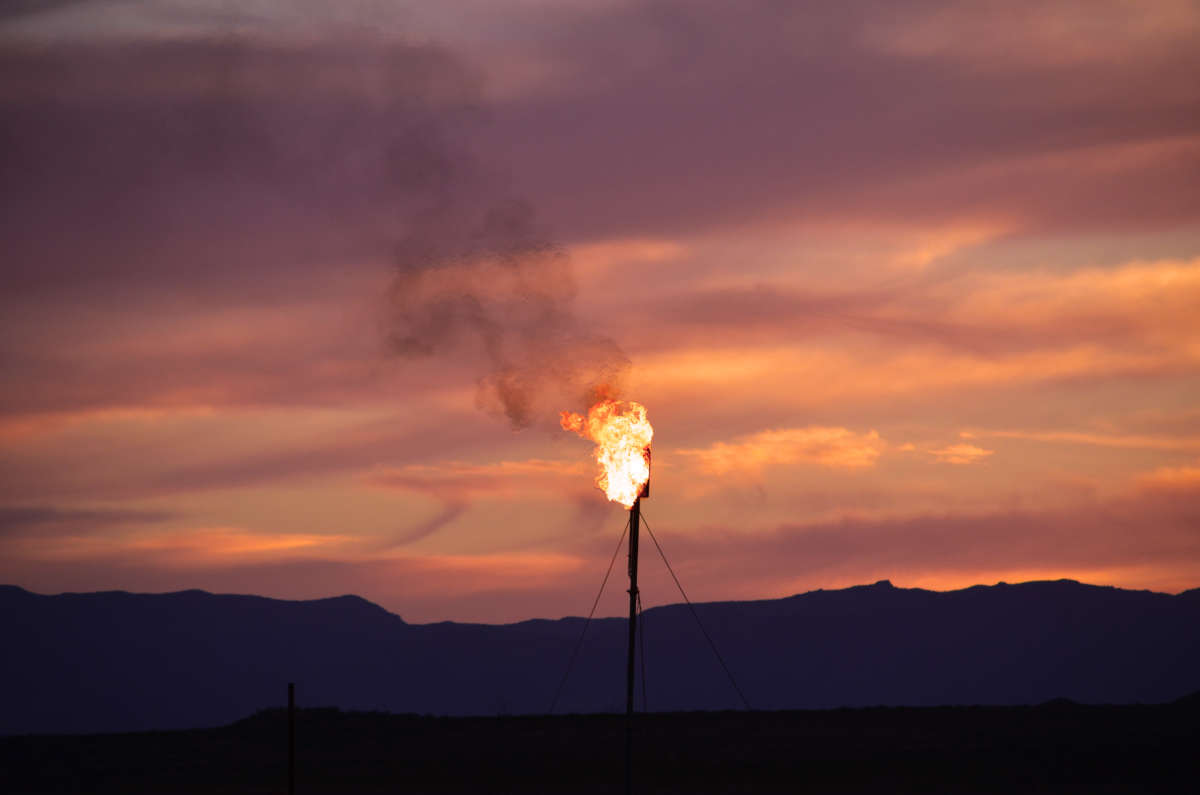
In total, the oil and gas industry is responsible for over one-third of methane emissions, some of which occur through flaring and venting: the practice of burning off, or releasing unwanted methane gas in the process of drilling, pumping, transporting and refining fossil fuels.
Get our free emails
Email
An August 19 report by Earthworks reveals that among the lowest of low-hanging fruits may be found in the Permian Basin, in West Texas, where up to 84 percent of producers are flaring without permits. Since fracking was commercialized a decade ago, the Permian Basin has exploded as the top oil-producing region in the U.S.
The report outlines how state regulators charged with keeping tabs on flaring, including the Railroad Commission of Texas (RRC), which issues flaring permits, and the Texas Commission on Environmental Quality (TCEQ), which oversees air quality, are doing nothing to stop producers observed to be dumping gas into the atmosphere. In other words, the Permian Basin is even more of a climate bomb — and a potential site of climate intervention — than environmentalists may have originally thought.
Texas is the top flarer of all U.S. states, according to federal data from 2019. But the practice is a problem far beyond the Lone Star State. A July study in Environmental Research Letters found that across the U.S., over half a million people live within three miles of a flare. Living near a flare is associated with 50 percent higher odds of premature birth. In addition to being a climate pollutant, methane, which seeps out of leaky flares, is also the primary precursor to the asthma-causing pollutant ground-level ozone.
Methane emissions have slid under the rug for years — in part because the gas is invisible to the human eye, but also because systems for monitoring emissions are less comprehensive and therefore more uncertain than for CO2. Sometimes, incomplete flaring leads to black smoke that is visible, also known as black carbon. But in recordings at oil and gas production sites without a special camera, you can also see a lot of sky.
The increased use of optical gas imaging (OGI) cameras in recent years has made it possible to watch dark plumes of otherwise unseen pollutants escape from inactive-looking infrastructure, like steel storage tanks and thin metal chimneys.
Sharon Wilson, a senior field advocate for Earthworks and co-author of the report on unpermitted flaring, is a certified optical gas imaging thermographer and has been busy capturing footage of oil and gas production sites around the U.S. since 2014.
It’s only when putting an OGI camera up to one’s face, Wilson told Truthout, that dark plumes of pollutants become visible, turning landscapes into what look like war zones. “If people could see with their naked eye what I see with my lens, there would never have been a fracking boom.”
According to the report, many flares are left unlit, which means they are seeping methane straight into the atmosphere, rather than burning it, which makes the release visible and at least converts the gas into less-potent carbon dioxide.
To assess flaring operations in the Permian, Wilson and co-author Jack McDonald pulled from two data sets. One was generated from Environmental Defense Fund helicopter flyovers using OGI cameras from the sky to capture flares in January, March and June of 2020. After ensuring the data was focused specifically on the area of the Permian Basin in Texas, rather than in New Mexico, the authors cross-referenced that data with permits logged in the RRC’s database.
If there was any overlap between a flare observed during flyovers and one for which a permit could be identified in the database, over any period, the authors gave the producer and regulators the benefit of the doubt, and counted that site as permitted. But ultimately, of the total 227 flares they ended up counting, a mere 35 sites had permits to flare every time they were observed to be doing so. Many companies were found to be flaring without ever obtaining a permit, including Diamondback Energy, Conoco and Shell.
In Texas, flaring permits are governed by a state administrative law known as Rule 32. Under the rule, flaring is only legal for the first 10 days of a new oil and gas operation. After that, the practice is illegal without a permit, except for during 24-hour emergency periods. But the law does not clearly define what conditions oil and gas companies need to justify a permit or emergency exemption.
As such, the operations that have received permits have essentially been rubber-stamped, the report suggests. Operators have applied for and received permits to flare for a host of nebulous reasons such as “inconsistent curtailments” or “economic conditions.” Still, the vast majority are unpermitted, the report suggests.
Earthworks visited one site known as the “Seattle Slew” 14 times with an optical gas camera, as is described in the report, and detected pollution every time — nine of which involved flaring specifically. The owner of the site, MDC, has never been issued a permit from the RRC, according to the analysis. Earthworks reported as much to the TCEQ.
According to correspondence Earthworks obtained via a public records request, the state agency did reach out to the company about the findings. “There is no way to estimate how much gas was vented, as we don’t measure our tank gas … since it isn’t sold to gas sales but instead sent to the combustor for incineration,” MDC replied. “Also, we don’t know for how long this gas was vented to the atmosphere.”
In spite of this response, the state agency did not issue any violations, Earthworks found. A TCEQ representative told Truthout that “compliance determinations were made based on a review of the completed questionnaires and other relevant data such as reported emission events and applicable permits or authorizations,” noting that the facility did have a permit covering other emissions, including volatile organic compounds, nitrous oxide and carbon.
Wilson says she’s documented numerous similar instances in which she’s reported emissions violations on the ground, such as at Diamondback’s Waler State Battery site, which regulators have all but shrugged off.
In response to the report, RRC Spokesperson Andrew Keese told Reuters, “A short-term observation of a flare from a flyover and absence of an explicit exception does not necessarily mean the observed flaring is illegal.”
In July, the RRC published data suggesting that the practice of flaring was declining across the state, dropping from 2.29 percent of all natural gas produced in June 2019, to 0.65 percent in May 2021. “Texas is seeing significantly reduced flaring rates as a result of improved technologies, infrastructure and regulatory processes,” RRC Chair Christi Craddick said in a statement.
McDonald, however, said that dealings with the two state agencies do not offer much assurance. “From what we can tell, this seems to be an issue broadly across Texas, with just this kind of systemic lack of will to go and get these permits.”
Without closely monitoring releases, or following up on violations, the agency’s data is a moot point. “Even if they are right that exempt flaring is exclusively the cause of the flaring, the RRC does not know how much flaring is happening,” McDonald said. “That means they are dramatically underestimating the amount of flaring that’s actually happening in the state because they aren’t able to account for all those exempt flares.”
As Clean Energy Wire has reported, oil and gas production in places like the Permian has expanded faster than infrastructure to transport it. Oil is still profitable, but gas prices are so low that it’s cheaper to burn it on the spot, or release it directly, than to pay to send it to markets.
The report concludes with a handful of actions state lawmakers and regulators could take to bring protocols in line with the regulatory agencies’ purported missions, including making all permitting data and enforcement actions publicly available online; updating Rule 32 such that it clearly identifies what justifications warrant a flaring permit or an emergency exemption; and creating an impartial panel free of oil and gas interests within the RRC to review all flaring permits.
But Wilson says real reform will also require action beyond state lines. “After over a decade, it’s pretty clear that Texas has no intention of enforcing any rules,” Wilson said, noting lawmakers’ and regulators’ conflicts of interest. The RRC’s Craddick, for instance, owns land with her father — a state congressman — that generated over $100,000 from natural gas production in 2019, according to TheTexas Tribune.
The Biden administration is likely to unveil a new methane rule in September. In anticipation, the RRC and TCEQ penned a letter to the Environmental Protection Agency (EPA) in July requesting minimal changes. “The TCEQ has a robust air permitting program. Air permits typically include fugitive monitoring programs and control of volatile organic compound emissions, which could include methane emissions since methane is not separated from [volatile organic compounds] prior to atmospheric release,” agency directors wrote. “Additional requirements to control and monitor methane specifically are burdensome to the regulated community, duplicative and are therefore unnecessary.”
Given that the EPA delegates how states must implement Clean Air Act regulations, Wilson says the moment warrants the strongest possible rule, such as one that would lead to slashing oil and gas methane emissions 65 percent by 2025. “If Biden is serious about taking action on the climate, the federal government will need to step in,” she said. “What they give, they can take away.”
Updated 4:02 AM ET, Sat August 21, 2021An aerial view of damage in the Bahamas from Hurricane Dorian on September 5, 2019.
(CNN)In the same week that Tropical Storm Fred caused catastrophic flooding in North Carolina, and Hurricane Grace made its second landfall in Mexico, Hurricane Henri is barreling toward New England, where it’s expected to be the first to make landfall there in 30 years.Hurricanes — also called tropical cyclones or typhoons outside North America — are enormous heat engines of wind and rain that feed on warm ocean water and moist air. And scientists say the climate crisis is making them more potent.The proportion of high-intensity hurricanes has increased due to warmer global temperatures, according to a UN climate report released earlier this month. Scientists have also found that the storms are more likely to stall and lead to devastating rainfall and they last longer after making landfall.
Interactive: Hurricanes are becoming more dangerous. Here’s why“We have good confidence that greenhouse warming increases the maximum wind intensity that tropical cyclones can achieve,” Jim Kossin, senior scientist with the Climate Service, an organization that provides climate risk modeling and analytics to governments and businesses, told CNN. “This, in turn, allows for the strongest hurricanes — which are the ones that create the most risk by far — to become even stronger.”
Scientists like Kossin have observed that, globally, a larger percentage of storms are reaching the highest categories — 3, 4 and 5 — in recent decades, a trend that’s expected to continue as global average temperature increases. They are also shifting closer to the poles, moving more slowly across land, growing wetter, and stalling in one location, Kossin found.
“There’s evidence that tropical cyclones are more likely to stall,” said Kossin, naming hurricanes Harvey, in 2017, Florence, in 2018, and Dorian, in 2019, as examples. Hurricane Harvey dumped more than 60 inches of rain on some parts of Texas, causing about $125 billion in damages, according to the National Hurricane Center, and killing more than 100 people.Evacuees wade down a submerged section of Interstate 610 in Houston after Hurricane Harvey in 2017 caused widespread flooding.”All of these were devastating to the places where they stalled,” he added. “The combination of slower movement and more rain falling out of them increases coastal and inland flooding risk tremendously.”
A 2020 study published in the journal Nature also found storms are moving farther inland than they did five decades ago. Hurricanes, which are fueled by warm ocean water, typically weaken after moving over land, but in recent years they have been raging longer after landfall. The study concludes that warmer sea surface temperatures are leading to a “slower decay” by increasing moisture that a hurricane carries.Enter your email to sign up for the Wonder Theory newsletter.close dialog
Want to stay updated on the latest space and science news?We’ve got you.Sign Me UpBy subscribing you agree to ourprivacy policy.And as storms like Henri makes landfall, torrential rain, damaging winds and storm surge become the most significant, often pernicious, threats. Storm surge, produced by wind blowing ocean water onshore is also expected to get worse over time due to stronger hurricane winds and climate change-fueled sea level rise, according to Kerry Emanuel, a professor of atmospheric science at the Massachusetts Institute of Technology.”It’s a very dangerous phenomenon,” he said. “And it’s responsible for a lot of the loss of life in the storms.”
Last year, the Trump administration announced that thegray wolfwould be removed from the list of animals protected by the Endangered Species Act. Before gray wolves were protected by the act, the species was considered near extinction after a combination of hunting, trapping, and loss of habitat decimated its numbers.
The Biden administration is now moving to uphold that decision, according tocourtdocuments filed Friday, despite concern from conservationists that it couldjeopardizethe recovery of the species.
Attorneys for the administration requested that a federal judge throw out a lawsuit from wildlife advocates that aims to restore Endangered Species Act protections for the animals, arguing that Trump’s 2020 rule, implemented by the U.S. Fish and Wildlife Service, “follows the law and is supported by the administrative record.”https://www.cbsnews.com/newsletters/widget/e879?v=cbfb55a18595c6934ce492132bcc0bc8&view=compact#tVPLbtswEPwVgmczlmS9bylSoLkUAZKe6iLgY5UQkUiBpKwaQf69S1lO3FyLXgx5d%2FYxs8NXasegrfG0faUgrQLaUqirhm7oQcOM%2F6QdRi4DBkbrdQRj8Np7COSLVUf6tqHBcfmizVNsov1Xw0UPirbBTbCh3AUte7iewrN1txj%2BSZXK8kwJYKLMgeVQKVZz0bC8K0tIswKarqS%2FPpV%2B5wPEYt7Db26U46TnDqdeAGN3KquSV7tOsrwpOf40ORNZXrIiLdM6rctyVyj6XnI3iRseIussyVKW1CxLSZK1WdYmxQfsQYc%2BgoRWYAhXgzbaI%2B0oBxHI3hMwigRLnhw%2Fktn2HXmeTEBRyOhsALmovCEK%2FKgDEGmNBGc86ZwdCOqrD9jQX0w8jrCobwKY8LhGMa%2FgoOU5je1egh0xrP0NHCKNeCj%2BdAYYmP0jDhwwjNeDbxpcVHHyUbcYuT%2FthtjJr6C11uGuuLQ%2BAJlBYA4nabmI3FWJgnonUFroWJpCxviuS1iSNWla52ldFc254HS4U%2FfJg1u7c4NDN7TXgw60zd%2BJ39vJyYW68CSujyDh8OJ3PQ%2BddcPpysIv1OK6jx8qePSwUdwdH%2BJkH5l6qQG1Xuj%2Blb1VS77aJUm1w9uLLEULNuhI0fGGdVXa1F3WiKIozlqtVNbhkSDwXk9DND6eudP9RToWIARMPAtmVXwqMtLWkvc%2FXI%2Fh5xBG3%2B63%2B%2B08z1dr4RU%2Buf02fu23i%2BFY9BNb%2FcQu%2FMSkwxcptR%2FYu4X229UB%2F3%2FCKsc%2FdXp7%2BwM%3D
The U.S. Forest Service announced Thursday that beginning on Aug. 22 it will close nine national forests from near Lake Tahoe at the Nevada border on the east all the way west to Six Rivers National Forest, which stretches north to the Oregon border and contains more than 1 million acres of land alone.
The Eldorado National Forest already had been closed because of the Caldor Fire, which gutted the Sierra Nevada town…
August 20, 2021Wisconsin’s February 2021 wolf hunt was the second-deadliest in the state’s history, with at least 218 wolves killed in less than three days, nearly double the quota allotment. John Pitcher/iStock.comIn every state where we’re working to protect wolves from trophy hunters and trappers, the political nature of the fight is obvious. But the tragic impacts of political gamesmanship involving wolves are especially evident in the controversy surrounding Wisconsin Natural Resources Board chair Frederick Prehn’s refusal to vacate his board seat after the expiration of his term on May 1. Wisconsin’s February 2021 wolf hunt was the second-deadliest in the state’s history, with at least 218 wolves killed in less than three days, nearly double the quota allotment. Prehn has admitted that his refusal to step down was partly rooted in his desire to influence the fall wolf hunting season
A woman holds a sign proclaiming her belief that she doesn’t need to be vaccinated or wear a mask because Jesus will protect her from coronavirus, as anti-vaccination protesters pray and rally near City Hall after the Los Angeles City Council voted earlier this week to create an ordinance requiring proof of vaccination to enter many indoor public spaces, in Los Angeles, August 14, 2021. (DAVID MCNEW/AFP via Getty Images)Facebook127TwitterRedditEmail9save
Two recent events have shed an illuminating light on who is and who isn’t moral in today’s world.
First, Cardinal Raymond Burke, a leader in the U.S. Catholic Church and a staunch anti-masker/vaxxer, was put on a ventilator as a result of his suffering from COVID-19. Second, the Intergovernmental Panel on Climate Change of the United Nations released its latest data-rich report, warning that “unless there are rapid and large-scale reductions in greenhouse gas emissions, limiting warming to close to 1.5 degrees Celsius or even 2 degrees Celsius will be beyond reach.”
Now, while most people assume that such a morality is grounded in religious faith, and while it is certainly true that all religions contain plenty of moral ideals, in our nation today, it is actually the most secular among us who are exhibiting a greater moral orientation — in the face of deadly threats — than the most devout among us, who are exhibiting the least.
Before proceeding, let me make it clear: When I say the “most secular among us,” I mean atheists, agnostics, people who never attend religious services, don’t think the Bible is the word of God, and don’t pray. Such self-conscious and deliberatively irreligious people are to be distinguished from the lackadaisically unaffiliated — often called “nones” — who simply don’t identify with a religion.
And by the “most devout among us” I mean religious fundamentalists who believe in God without any doubts, who attend church frequently, who consider the Bible the infallible word of God, who pray a lot, and who insist that Jesus is the only way, the only truth, and the only life. These strongly religious folks are to be distinguished from moderately religious Americans, who are generally liberal and tolerant.Advertisement:
Think of it like two ends of a spectrum, with one end representing the staunchly secular and the other end representing the deeply devout. Most Americans fall somewhere in the middle; both the “nones” and the moderately religious together comprise the majority of Americans. But as to those who occupy the end points of the spectrum, it is — as stated above — the affirmatively godless who are exhibiting greater moral proclivities in our nation today than the proudly pious.
We can start with the global pandemic. COVID-19 is a potentially deadly virus that has caused — and continues to cause — dire woe. Surely, to be moral in the face of such a dangerous disease is to do everything one can — within one’s limited power — to thwart it. No moral person would want to willfully spread it, bolster it, or prolong its existence. And yet, when it comes to the battle against COVID-19, it is the most secular of Americans who are doing what they can to wipe it out, while it is the most faithful among us, especially nationalistic white Evangelicals, who are keeping it alive and well. Taking the vaccine saves lives and thwarts the spread of the virus. So, too, does sheltering in place as directed and wearing protective face masks. And yet, here in the U.S., it is generally the most religious among us who refuse to adhere to such life-saving practices, while it is the most secular who most willingly comply. For example, a recent Pew study found that while only 10% of atheists said that they would definitely or probably not get vaccinated, 45% of white Evangelicals took such a position.Advertisement:https://1f1d3b142cbc478deadaded6ed9ff2e1.safeframe.googlesyndication.com/safeframe/1-0-38/html/container.html
Consider climate change. The best available data shows that — as a direct result of human activity — we are destroying our planet. The results are already manifesting with greater and deadlier frequency: poisoned air and water, massive wildfires, stronger hurricanes, brutal mudslides, quickly melting glaciers, rising sea levels, the wanton disappearance of forests and coral reefs. Such developments do not bode well for the future; more suffering and death are on the rapidly approaching horizon. And, yet again, what do we see? It is the most staunchly secular among us who understand the science behind climate change and want to do what needs to be done in order to prevent it, while it is the most pious among us who dismiss the science and don’t want to address the dire threat. For example, a recent PRRI study found that over 80% of secular Americans accept the evidence that human activity is causing climate change — and they place addressing climate change at the top of the list of their political priorities — while only 33% of white Evangelicals accept such evidence, and thus place is towards the bottom of their list of political priorities.
But it’s not just the pandemic and climate change that illustrate this widening religious/secular moral divide. Take gun violence. Currently, more Americans die annually from firearms than automobile accidents; since 2009, there have been 255 mass shootings in the U.S.; every few hours, a child or teen dies from a gun wound. When the founders of the country passed the Second Amendment, they couldn’t have imagined the instantaneous devastation a semi-automatic rifle can do in the hands of one vicious person. And there is no question that Jesus — who taught an unmitigated message of non-violence — would denounce the existence of such weapons. And yet, who is more pro-gun in today’s America? Not the hardest of atheists. Rather, it is the most fervent of Christians. For but one example: While 77% of atheists are in favor of banning assault rifles, only 45% of white Evangelicals are.Advertisement:
But wait — what about the rights of the unborn? While many people oppose abortion on decidedly moral grounds, it is also the case that many others support the right of women to maintain autonomy over their own reproductive capacities, on equally moral grounds. Hence, the deep intractability of the debate. And yet, most Americans — both religious and non-religious — do not see the abortion of a non-viable fetus as being akin to the murder of a living human being. And let’s be frank: It is impossible to square the assertion that the strongly religious are “pro-life” while they simultaneously refuse to get vaccinated, to wear a mask, to fight climate change, to support universal healthcare, or to support sane gun legislation. To characterize such an agenda as “pro-life” renders the label rather insincere, at best.
Admittedly, how morality plays out in the world is always complex, with numerous exceptions to the correlations above. For example, African Americans tend to be highly religious and yet are also extremely supportive of gun control. The Catholic Church, which has deftly overseen the most extensive pedophile ring in history, and continues to ban the life-saving use of condoms, also happens to morally oppose the death penalty. One study has found that Evangelicals actually get vaccinated at higher rates than the religiously unaffiliated (though not at a higher rate than agnostics). And members of religious congregations tend to donate more money to charity, on average, than the unaffiliated. And of course, the 20th century has witnessed the immoral, bloody brutality of numerous atheist dictatorships, such as those of the former USSR and Cambodia.
However, despite such complexities, the overall pattern remains clear: When it comes to the most pressing moral issues of the day, hard-core secularists exhibit much more empathy, compassion, and care for the well-being of others than the most ardently God-worshipping. Such a reality is necessary to expose, not simply in order to debunk the long-standing canard that religion is necessary for ethical living, but because such exposure renders all the more pressing the need for a more consciously secular citizenry, one that lives in reality, embraces science and empiricism, and supports sound policies — not prayer — as a way to make life better, safer and more humane.
Aman in Jersey City, New Jersey, was recently found with over 22 animals in his three-bedroom apartment—not all of them alive. Authorities found about “7-9” goats, about “4-5” dead chicken carcasses, a duck, and a dead pigeon nailed to his front door.
Authorities had received multiple complaints from concerned neighbors about the farm animals. When police and the health department arrived at the suburban row home, they found an odd scene.Police Raid Texas Property to Find ‘Animal Sacrifice’READ MOREPolice Raid Texas Property to Find ‘Animal Sacrifice’
They found “about four or five dead chicken carcasses, their throats slashed and they were left in a pile,” H. James Boor of the Division of Environmental Health for Jersey City told NBC-4 New York.NEWSWEEK NEWSLETTER SIGN-UP >
Alyza Brevard-Rodriguez, Otero’s landlord, was returning home from active duty in the Middle East with the U.S. Navy when she saw the animals grazing in the rental’s backyard. The bizarre situation got worse when she saw the pile of chicken carcasses.
The man, identified by authorities as Emilio Otero, claims he is a Santeria doctor. “I help people with cancer, ladies that not pregnant, people with psoriasis,” Otero told the local news station. Santeria is an Afro-Caribbean religion that started in Cuba and popularly sacrifices animals as a form of devotion.
However, Otero denies partaking in any animal sacrifices and says that he actually eats the animals as part of his religion. “It’s legal (in) the United States…you respect the religion,” Otero explained.
A man in Jersey City was found living with over 22 farm animals in his 3-bedroom rental, and his landlord believes he was sacrificing them. The above image shows a chicken and a goat together.CHALABALA/GETTY IMAGES
The Jersey City Code of Ordinances would state differently, though. According to the municipal code in Jersey City, “no pigeons, chickens or other poultry shall be permitted to run, fly or stray within 25 feet of such structure, provided that this shall not apply to homing pigeons.”
The code also requires a clean dwelling and chicken coop. Images obtained by NBC-4 show Otero’s backyard filled with cardboard boxes, grazing goats and the chicken carcasses.
“Jersey City has an ordinance that prohibits residents from keeping farm animals, livestock, in the city limits,” Boor said, adding that Otero could face jail time for breaking the city ordinances. “It could be $2000 and 90 days in jail.”READ MORE
Brevard-Rodriguez said that Otero hasn’t paid his rent since May but she cannot evict him due to the federal eviction moratorium. The Centers for Disease Control (CDC) issued the temporary protection from eviction on August 3. It prevents landlords from evicting renters who are behind on rent. The moratorium is set to end on October 3.
While the animals have been removed from the premise, Otero has not been arrested or charged by authorities. Santeria practices such as the ones Otero was involved in are protected under the Freedom of Religion act. He could potentially be charged for violating the city’s animal codes, according to the Division of Environmental Health.
Newsweek reached out to The Division of Environmental Health and the Jersey City Police Department for comment but did not receive a response in time for publication.
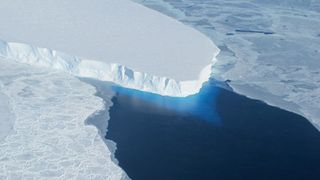
Underground heat is cooking the Thwaites Glacier from below, and could push it closer to collapse.
Antarctica’s Twaites Glacier is facing an assault of heat from the sky, the sea and deep underground.(Image credit: NASA)
WestAntarcticais one of the fastest-warming regions on Earth. For evidence, you need look no further than Thwaites Glacier — also known as the “Doomsday Glacier.”
Since the 1980s, Thwaites has lost an estimated 595 billion tons (540 billion metric tons) of ice, single-handedly contributing 4% to the annual global sea-level rise during that time,Live Science previously reported. The glacier’s rate of ice loss has accelerated substantially in the past three decades, partially due to hidden rivers of comparatively warm seawater slicing across the glacier’s underbelly, as well as unmitigatedclimate changewarming the air and the ocean.



 An aerial view of damage in the Bahamas from Hurricane Dorian on September 5, 2019.
 Evacuees wade down a submerged section of Interstate 610 in Houston after Hurricane Harvey in 2017 caused widespread flooding.”All of these were devastating to the places where they stalled,” he added. “The combination of slower movement and more rain falling out of them increases coastal and inland flooding risk tremendously.”



 A woman holds a sign proclaiming her belief that she doesn’t need to be vaccinated or wear a mask because Jesus will protect her from coronavirus, as anti-vaccination protesters pray and rally near City Hall after the Los Angeles City Council voted earlier this week to create an ordinance requiring proof of vaccination to enter many indoor public spaces, in Los Angeles, August 14, 2021. (DAVID MCNEW/AFP via Getty Images)