Don’t call us traitors: descendants of Cortés’s allies defend role in toppling Aztec empire

https://www.theguardian.com/world/2021/aug/13/mexico-tlaxcala-aztec-empire-anniversary

On the 500th anniversary of the Spanish conquest, people from Mexico’s smallest state Tlaxcala say their ancestors were liberators

Dancers celebrate the anniversary of the founding of Tenochtitlán, the Mexica capital, on 26 July.
Dancers celebrate the anniversary of the founding of Tenochtitlán, the Mexica capital, on 26 July. Photograph: Luis Barron/Eyepix Group/Pacific Press/REX/Shutterstock

David Agren in Tlaxcala@el_reporteroFri 13 Aug 2021 06.00 EDT

When people from the Mexican state of Tlaxcala travel to other parts of the country, they are sometimes insulted as traitors by their compatriots.

Tlaxcala is Mexico’s smallest state in size, but it played an outsized role in Mexico’s early history, not least when indigenous Tlaxcalans allied with Hernán Cortés’ tiny band of invaders to bring down the Aztec empire.

Now, as Mexico marks the 500th anniversary of the fall of the Aztec capital Tenochtitlán on Friday, the role of the Tlaxcalans in the conquest is being reconsidered.

Many historians argue that without the participation of the Tlaxcalans and other indigenous soldiers, Tenochtitlán might never have fallen to the Spanish.

Tlaxcalans allied with Hernán Cortés to bring down the Aztec empire in 1520.
Tlaxcalans allied with Hernán Cortés to bring down the Aztec empire in 1520. Photograph: Unknown/Corbis

They are also revising the accusation of treachery, arguing that Tlaxcalans and other city states were in fact fighting a war of liberation against the oppressive Mexica (as the Aztecs were known).Advertisement

https://imasdk.googleapis.com/js/core/bridge3.474.0_en.html#goog_1119052915https://imasdk.googleapis.com/js/core/bridge3.474.0_en.html#goog_1673244679https://imasdk.googleapis.com/js/core/bridge3.474.0_en.html#goog_810406701javascript:false

“It wasn’t 600 to 800 Spaniards who conquered [Tenochtitlán]. It was thousands and thousands of Tlaxcalans, Huejotzingas or other peoples, who were under the Mexica yoke and wanted to liberate themselves,” archaeologist Eduardo Matos Moctezuma told Radio Formula.

“Cortés had 30,000 to 40,000 Mesoamericans fighting with him,” said Aurelio López Corral, an archaeologist in Tlaxcala. “He couldn’t have done it on his own.”

The conquest is a singular event in Mexican history, seen both as a moment of national trauma and the founding act of the nation – and it remains deeply controversial.

Events to mark the anniversary have been met with tepid enthusiasm, as Mexico struggles with the coronavirus pandemic. A towering replica of the Templo Mayor – the Aztec civilization’s most sacred site – is being erected in Mexico City’s central Zócalo plaza.

President Andrés Manuel López Obrador has called on the Spanish Crown and the Vatican to apologize for their roles in the “so-called conquest”. Spain declined; Pope Francis apologized while visiting Bolivia in 2015.

Óscar Jaenada Gajo as Hernán Cortés in the TV series Hernán

Cortés himself is still a deeply polarizing figure in Mexican history, a rapacious villain who is also the nation’s founding father: Cortés and his indigenous translator known as La Malinche gave birth to the first Mexican.

In Tlaxcala, however, his role in the fall of the Aztec empire tends to be underplayed, said Yassir Zárate Méndez, who produced a documentary which challenged the official history’s treatment of Tlaxcala.

“He is not seen exactly as a villain, unlike in other places, but as someone who played a complicated role in history,” he said. “Cortés goes somewhat unnoticed and remains below the level of local figures.”

Those include Xicohténcatl the Younger, a Tlaxcalan prince who vehemently opposed aligning with the Spanish, and remains fondly remembered in the state.

At the time of the conquest, Tlaxcalans shared a cosmovision with the Mexica and spoke the same language – Nahuátl.

Mexico City prepares for the anniversary of the fall of the Aztec capital Tenochtitlán.
Mexico City prepares for the anniversary of the fall of the Aztec capital, Tenochtitlán. Photograph: Carlos Ramírez/EPA

But, unlike the imperial Aztecs, Tlaxcala had a more collective form of leadership, and when Cortés arrived, some in the leadership saw an opportunity to topple an old enemy, said Zárate.

The region provided soldiers for invading the island city of Tenochtitlán and allowed him to regroup after he was forced to flee an Aztec counteroffensive. Cortés reputedly built the boats used for eventually invading the Aztec capital in Tlaxcala.

“It was a question of political survival,” Zárate said. “To save yourself, you had to turn to whatever allies were necessary.”

After the fall of Tenochtitlán, the Tlaxcalans benefited handsomely from their arrangement – and Spaniards married into the local nobility. Tlaxcala received special status in the Spanish colonial period with a form of self-rule. Its residents received the right to settle other parts of the colony.

But when Mexico won independence in the 1820s, that power was lost, and an evolving national mythology focused on the fall of the Mexica, casting Tlaxcalans as traitors.

The National Institute of History and Anthropology (INAH) hosted forums in Tlaxcala in 2019 – 500 years after Cortés arrived in the state – exploring the local role in the conquest. It drew enormous interest, according to organizers.

“There’s a nagging thorn in most Tlaxcalans’ minds [about the conquest] and a sort of anger because the adjective ‘traitor’ has been so strong,” Juan de la Rosa, INAH delegate in Tlaxcala, said in a 2019 interview. “But they have the need to have arguments that explains why they’re not traitors.”

Three volcanoes are erupting at the same time in Alaska

Exposing the Big Game's avatarThe Extinction Chronicles

https://www.nbcnews.com/science/environment/three-volcanoes-are-erupting-time-alaska-rcna1672

The simultaneous eruptions have been going on for more than a week but do not currently pose a threat to nearby communities or air travel.Aug. 13, 2021, 10:08 AM PDT/UpdatedAug. 13, 2021, 10:13 AM PDTByDenise Chow

Along a remote, roughly 800-mile stretch of Alaska’s Aleutian island chain, three volcanoes are erupting at the same time, with at least two spewing low levels of ash and steam.

Image: Volcanoes erupt in Alaska
Active lava fountains spew from the Great Sitkin volcano in Alaska, on Aug. 5.Peggy Kruse / Alaska Volcano Obs / Reuters

The simultaneous eruptions have been going on for more than a week but do not currently pose a threat to nearby communities and have not disrupted any air travel so far, according to theAlaska Volcano Observatory.

Still, the volcanic activity has made for a busier-than-usual time across the Aleutian Islands, the vast archipelago that juts westward from the Alaska…

View original post 380 more words

Climate change is making people think twice about having children

https://www.cnbc.com/2021/08/12/climate-change-is-making-people-think-twice-about-having-children.html

PUBLISHED THU, AUG 12 20212:20 AM EDTUPDATED 27 MIN AGOSam Shead@SAM_L_SHEADSHAREShare Article via FacebookShare Article via TwitterShare Article via LinkedInShare Article via EmailKEY POINTS

  • Analysts at Morgan Stanley said in a note to investors last month that the “movement to not have children owing to fears over climate change is growing and impacting fertility rates quicker than any preceding trend in the field of fertility decline.”
  • Some people are choosing not to have children because they fear that that doing so will amplify global warming while others are concerned about extreme weather events their children may have to endure and the knock-on effects.
  • “Over the last few years, the climate has definitely been a major contributor to us not wanting children,” Daniel told CNBC, requesting that his surname be left out of the story over fears that he may be targeted online by people who disagree with him.

ChristinLola | iStock | Getty Images

A growing number of people are reluctant to bring a child into a world that’s set to be ravaged by climate change in the coming decades.

This week, the United Nations issued a “code red for humanity” as the world’s leading climate scientists delivered their starkest warning yet about the deepening climate emergency. The Intergovernmental Panel on Climate Change’s report on Monday said global temperatures are likely to rise by 1.5 degrees Celsius in the next two decades, exceeding a key target of the Paris Agreement — a landmark accord considered critically important to reduce the risk of a climate catastrophe.

Scientists’ increasingly bleak outlook for the future of the planet is putting more and more people off having children.

Analysts at Morgan Stanley said in a note to investors last month that the “movement to not have children owing to fears over climate change is growing and impacting fertility rates quicker than any preceding trend in the field of fertility decline.”

To support their argument, they pointed to surveys, academic research and Google data that shows climate change is directly and indirectly accelerating the decline in fertility rates. UCLA researchers showed that the number of births in the U.S. fell in the nine months after an extreme heat event while a study of 18,000 couples in China last year showed that climate change, and particulate pollution in particular, was associated with a 20% increased likelihood of infertility.

Some people are choosing not to have children because they fear that that doing so will amplify global warming.

“Having a child is 7-times worse for the climate in CO2 emissions annually than the next 10 most discussed mitigants that individuals can do,” analysts at Morgan Stanley said.

A Swedish study, published in IOPscience in 2017, found that having one fewer child per family could save approximately 58.6 metric tons of carbon each year in developed countries.

However, Kimberley Nicholas, one of the study’s authors, said in an interview with Vox this year that reducing the population is not the way to solve the climate crisis. “It is true that more people will consume more resources and cause more greenhouse gas emissions,” she said. “But that’s not really the relevant timeframe for actually stabilizing the climate, given that we have this decade to cut emissions in half.”

Enduring extreme weather

Others are concerned about extreme weather events their children may have to endure and the likely knock-on-effects. Crops could fail in some parts of the world, for example.

Daniel, a 35-year-old Brit who currently lives in Dubai, United Arab Emirates, has been married to his partner for almost 12 years. They were open to the idea of having children earlier on in their relationship but now they’re less keen.

“Over the last few years, the climate has definitely been a major contributor to us not wanting children,” Daniel told CNBC, requesting that his surname be left out of the story over fears that he may be targeted online by people who disagree with him.

The couple, who rely on air conditioning most of the year and like to travel, have been looking for ways to significantly offset their carbon footprint. “We thought about it quite a lot and quickly realized that adding another human being to the world would have a huge environmental impact,” Daniel said.

Children cool off in the water at a park as a heat wave hits the city on July 16, 2021 in Shenyang, Liaoning Province of China.

Children cool off in the water at a park as a heat wave hits the city on July 16, 2021 in Shenyang, Liaoning Province of China.VCG | Visual China Group | Getty Images

Prince Harry said in 2019 that he and his wife Meghan were planning to have a maximum of two children, citing environmental concerns.

The issue of bringing more people into a warming world is being discussed by people on social media with big followings.

In a 2019 Instagram live stream to her 1.5 million followers, 31-year-old New York Rep. Alexandria Ocasio-Cortez said: “Basically, there’s a scientific consensus that the lives of children are going to be very difficult. And it does lead, I think, young people to have a legitimate question: Is it okay to still have children?”

‘Existential angst’

Jessica Combes, a 39-year-old English teacher, told CNBC: “I refuse to bring children into the burning hellscape we call a planet.”

Combes said she has always been unsure about having children of her own. “Now, as I look at the state of the economy, shoddy global healthcare and climate change, I just feel like all my trepidation was well justified,” she said. I refuse to bring children into the burning hellscape we call a planet.Jessica CombesENGLISH TEACHER

Some of those who already have children are also worried. Thom James, 39, a managing partner at advertising and public relations firm Havas U.K., told CNBC: “I had a major depressive episode last year based on existential angst over the world my children would be growing up in.”

James has two girls aged three and six. “Worrying about their future is a frequent trigger for me,” he said. “I’m constantly thinking about when it’s going to be appropriate to dissuade them from having children of their own, as I think we’re really past the point of no return.”

Of course, if everyone stopped having children then humanity would eventually cease to exist. A fringe group of anti-natalists believe that’s exactly what should happen, but most people don’t share this view.

Indeed, many people see having children as a fundamental human right and one that can bring happiness and joy to families.

However, the climate emergency is a result of an increase in greenhouse gas emissions from burning fossil fuels, not population growth.WATCH NOWVIDEO06:30Degrowth: Is it time to live better with less?

The IPCC’s report warned that some of the climate changes researchers observed — such as continued sea level rise — were projected to be “irreversible over hundreds to thousands of years.”

The report also reaffirmed the urgent need for “strong and sustained” reductions of carbon emissions and other greenhouses gases to limit climate change.

U.N. Secretary-General, António Guterres said the findings were “a code red for humanity.”

He added: “This report must sound a death knell for coal and fossil fuels, before they destroy our planet.”

At present, even as policymakers publicly acknowledge the necessity of transitioning to a low-carbon society, the world’s dependency on fossil fuels is expected to get even worse in the coming decades.

— CNBC’s Sam Meredith contributed to this report.

Climate change: IPCC report is ‘code red for humanity’

Exposing the Big Game's avatarThe Extinction Chronicles

https://www.bbc.com/news/science-environment-58130705

By Matt McGrath
Environment correspondentPublished4 days agocommentsCommentsShareRelated Topics

fires

Human activity is changing the climate in unprecedented and sometimes irreversible ways, a major UN scientific report has said.

The landmark study warns of increasingly extreme heatwaves, droughts and flooding, and a key temperature limit being broken in just over a decade.

The report “is a code red for humanity”, says the UN chief.

But scientists say a catastrophe can be avoided if the world acts fast.

There is hope that deep cuts in emissions of greenhouse gases could stabilise rising temperatures.

Echoing the scientists’ findings, UN Secretary General António Guterres said: “If we combine forces now, we can avert climate catastrophe. But, as today’s report makes clear, there is no time for delay and no room for excuses. I count on government leaders and all stakeholders to ensure COP26 is a success.”

The sober…

View original post 1,286 more words

July was Earth’s hottest month on record, NOAA says

Exposing the Big Game's avatarThe Extinction Chronicles

https://www.nbcnews.com/science/environment/july-was-earth-s-hottest-month-record-noaa-says-n1276764

The announcement comes four days after the United Nations issued an alarming report about the urgent threat of climate change.YOUR VIDEO BEGINS IN:00:06TAP TO UNMUTE

Aug. 13, 2021, 8:53 AM PDTByDaniel Arkin

The world broke a major record last month — although it has little reason to brag about the milestone.

July was the hottest month ever recorded,according to datareleased Friday by the National Oceanic and Atmospheric Administration — an “unenviable distinction” that could ratchet up anxiety about climate change.

“In this case, first place is the worst place to be,” NOAA Administrator Rick Spinrad said in a statement. “July is typically the world’s warmest month of the year, but July 2021 outdid itself as the hottest July and month ever recorded.”

He said the record “adds to the disturbing and disruptive path that climate change has set for the globe.”

The combined land- and…

View original post 224 more words

When Kabul falls, America is in danger again

Exposing the Big Game's avatarThe Extinction Chronicles

When Kabul falls, America is in danger again

BY DOV S. ZAKHEIM, OPINION CONTRIBUTOR —08/13/21 10:00 AM EDT933THE VIEWS EXPRESSED BY CONTRIBUTORS ARE THEIR OWN AND NOT THE VIEW OF THE HILL16Share to FacebookShare to Twitter

Just In…

VIEW ALL

When Kabul falls, America is in danger again

© Getty Images

As Baghdad was falling to the forces of the United States and its coalition partners in March 1991, Iraqi Minister of Information Mohammed Saeed al-Sahaf, better known to Americans as “Baghdad Bob,” was offering an entirely different account of the events taking place on his doorstep. Among his…

View original post 838 more words

Despite Scorching Heatwave, Israel Illegally Allowed Live Cattle Shipments

https://www.haaretz.com/israel-news/.premium-israel-violates-animal-rights-rule-with-illegal-cattle-live-export-during-heatwave-1.10103461

A Romanian law prohibiting live exports when temperatures surpass 45 degrees Celsius was breached during a recent import from Romania to Israel that contained thousands of cattleShare in FacebookShare in TwitterSend in e-mailSend in e-mailSaveSave article to reading listZen ReadPrint article

Haaretz is celebrating 100,000 subscribers

SUBSCRIBE NOW AND GET 50% OFF ONE YEAR OF HAARETZ.COMSUBSCRIBE

Cattle being shipped from Romania

Cattle being shipped from RomaniaCredit: Israel Against Live ShipmentsNir HassonGet email notification for articles from Nir HassonFollowAug. 10, 2021

Israel violated an animal rights regulation this week when two ships, crammed with cattle, traveled from Romania to Israel during a heat wave with temperatures exceeding 45 degrees Celsius (113 degrees Fahrenheit). Romanian law prohibits live animal shipments at temperatures this high. One of the ships docked at Haifa port on Sunday. 

On July 29, Romania’s veterinary authority issued a rule barring long-distance shipments of live animals in extreme heat, saying that shipboard conditions in such weather would cause the animals undue suffering. However, the two ships set sail for Israel six days later. Each carried thousands of calves.

According to the organization Israel Against Live Shipments, after the calves were taken off the ship, they were placed in sheds in which temperatures reached 39 degrees Celsius (102.2 degrees Fahrenheit). Consequently, in the cargo holds where the animals were kept on board, temperatures likely exceeded 40 degrees.

Most of the ships that transport animals to Israel are quite old and have inadequate ventilation.

“Animals shouldn’t be cooked, and especially not alive,” said Yaron Lapidot, the organization’s founder. 

Cattle from a recent shipment from Romania

On hot summer days, he said, the organization often sees animals arriving weak and dehydrated, and these conditions can cause mass death. He urged the Agriculture Ministry to ban live animal shipments immediately, particularly when temperatures reach dangerous highs.- Advertisment -Ads by Brightcom

Though the ministry has stated it plans is to reduce live shipments, there has actually been an increase in the number of cattle and sheep imported to Israel over the last year. As of the end of July, the number had reached 591,000 – almost the same as the total for all of 2020.

Several countries, including New Zealand, India and Britain, have banned live shipments in recent years because of the suffering they inflict on the animals.

The Agriculture Ministry released a statement saying: “The Agriculture Ministry sets conditions for importing animals, which take into consideration the weather and the temperature inside the ships. It also inspects the certificates issued by the veterinary authorities in the country of origin. These certificates confirm that the shipments complied with European Union standards, including those related to weather. The health and welfare of all imports arriving in Israel are checked by the Agriculture Ministry’s veterinary authorities. In cases which are inconsistent with regulations, an inquiry is made with the relevant actors.- Advertisment -https://60cbf0b3a73f6b14cddbc28abaa8a86f.safeframe.googlesyndication.com/safeframe/1-0-38/html/container.html

“In all serious cases of regulatory violations, the Agriculture Ministry warns the importer and the relevant authorities in the country of origin and the EU. If the violations are repeated, additional measures are taken which may include prohibiting import from that particular ship or country. In this particular case, the ships set sail from Romania eight days ago, when temperatures were 29 degrees Celsius. One ship has already arrived, and the other will arrive today. The regulation went into effect last Friday, and is meant to deal with the upcoming days in which temperatures are expected to reach 45 degrees Celsius.”

LISTEN: Israeli settlers call the shots as Palestinian fatalities mount

Subscribe0:00– : –15Skip 15 seconds backwardsPlay audio15Skip 15 seconds ahead1XChange playback rate from 1 to 1.25Mute audio

Click the alert icon to follow topics:

Plant-based diet can fight climate change – UN

ADVERTISEMENThttps://3d6a0bd846ea611528d2b86cd52a3512.safeframe.googlesyndication.com/safeframe/1-0-38/html/container.html

By Roger Harrabin
BBC environment analyst, GenevaPublished8 August 2019commentsCommentsShareRelated Topics

Vegan burgers
image captionVegan burgers are now a fixture on many restaurant menus

Switching to a plant-based diet can help fight climate change, UN experts have said.

A major report on land use and climate change says the West’s high consumption of meat and dairy produce is fuelling global warming.

But scientists and officials stopped short of explicitly calling on everyone to become vegan or vegetarian.

They said that more people could be fed using less land if individuals cut down on eating meat.

The document, prepared by 107 scientists for the UN’s Intergovernmental Panel on Climate Change (IPCC), says that if land is used more effectively, it can store more of the carbon emitted by humans.

It was finalised following discussions held here in Geneva, Switzerland.https://buy.tinypass.com/checkout/template/cacheableShow?aid=tYOkq7qlAI&templateId=OTBYI8Q89QWC&templateVariantId=OTV0YFYSXVQWV&offerId=fakeOfferId&experienceId=EXAWX60BX4NU&iframeId=offer_0e763acc7b457c03340a-0&displayMode=inline&widget=template

How years compare with the 20th Century average

2019

10 warmest years

10 coldest yearsJFMAMJJASONDMonths-0.8-0.6-0.4-0.220th Centuryaverage+0.2+0.4+0.6+0.8+1.0+1.2ColderHotter

Source: NOAAREPLAY

“We’re not telling people to stop eating meat. In some places people have no other choice. But it’s obvious that in the West we’re eating far too much,” said Prof Pete Smith, an environmental scientist from Aberdeen University, UK.

We’re also wasting too much food. The panel estimates that greenhouse emissions associated with food loss and waste – from field to kitchen bin – is as high as 8-10% of ALL global emissions.

The report calls for vigorous action to halt soil damage and desertification – both of which contribute to climate change.

It also warns that plans by some governments to grow trees and burn them to generate electricity will compete with food production unless carried out on a limited scale.

The Earth’s land surface, and the way it is used, forms the basis for human society and the global economy.

But we are re-shaping it in dramatic ways, including through the release of greenhouse gases into the atmosphere. How the land responds to human-induced climate change is a vital concern for the future.media captionGases produced by livestock are a major factor in global warming, so should we change our eating habits?

How are climate change and food linked?

Climate change poses a threat to the security of our food supply. Rising temperatures, increased rain and more extreme weather events will all have an impact on crops and livestock.

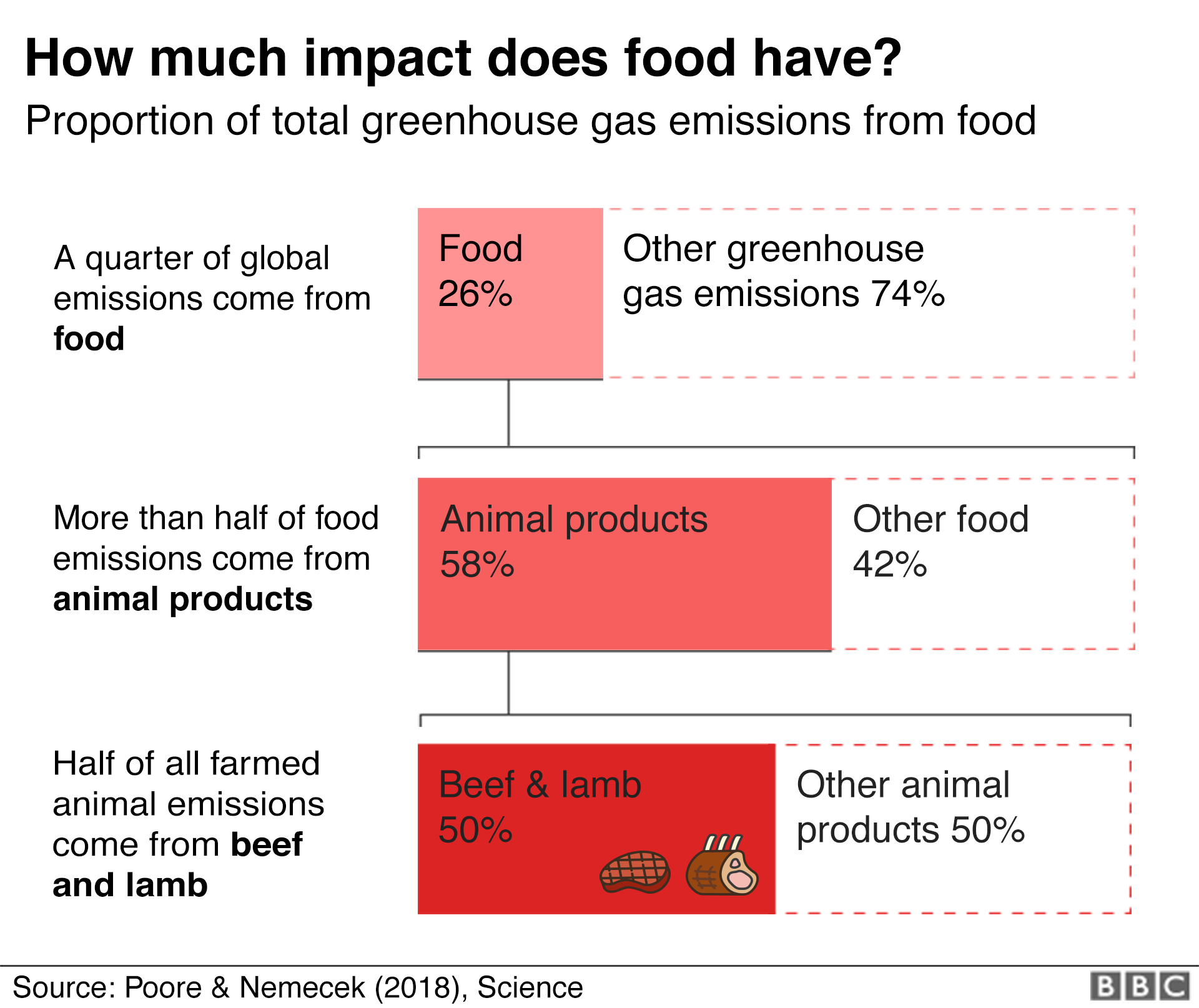
But food production also contributes to global warming. Agriculture – together with forestry – accounts for about a quarter of greenhouse gas emissions. Livestock rearing contributes to global warming through the methane gas the animals produce, but also via deforestation to expand pastures, for example.

The environmental impact of meat production is important to many vegetarians and vegans. A UK-based group called #NoBeef lobbies caterers to take beef and lamb off student menus.

In the US, vegan burger patties are made from plant-based meat substitutes said to taste like the real thing thanks to an iron-rich compound called heme.

Presentational grey line
Chart: A quarter of global greenhouse gas emissions come from food

Climate change food calculator: What’s your diet’s carbon footprint?

Presentational grey line

Peter Stevenson, from Compassion in World Farming, said: “A reduction in meat consumption is essential if we are to meet climate targets.”

But in some parts of the world, such as China, beef consumption is growing. This is despite attempts by the Chinese central government to promote traditional diets.

Can food waste be reduced?

Partage bike
image captionGeneva-based company Partage is helping tackle waste by taking in unsold food

The authors of the report encourage action to stop wasting food – either before or after its sale to consumers.

Waste food can sometimes be used as animal feed or, if suitable, redirected to charities to feed people in need.

One organisation here in Switzerland called Partage takes in unsold food discarded by shops and distributes it to local families.

It also collects stale bread and turns it into biscuits, dries fruit, and cans vegetables. All of this helps reduce the CO2 emissions involved in producing food.

July was ‘marginally’ world’s warmest month ever

Hungry nations add the least to global CO2

Stop abusing land, scientists warn

Road-testing the diet to save the world

Don’t trees absorb the CO2 we release?

trees
image captionExtra atmospheric carbon can nourish forests, but there comes a point where they are overwhelmed

The extra carbon that humans have put into the atmosphere is nourishing the growth of forests – especially in the Northern Hemisphere.

This can help to mitigate climate change, but it all comes down to a balance of factors. Experts say this effect on forests will be negated if the Earth heats up too much.

In fact, the report says areas near the equator may already be losing vegetation through heat stress.

Dr Katrin Fleischer, from the Technical University of Munich, Germany, warned that in some places a shortage of phosphorus in soil – a key ingredient for plant growth – would also hinder tree growth.

She said: “This would mean that the rainforest has already reached its limit and would be unable to absorb any more carbon dioxide emissions.

“If this scenario turns out to be true, the Earth’s climate would heat up significantly faster.”

Carbon cycle

How does soil fit in?

Soil is sometimes neglected as part of the climate system. But it’s the second largest store of carbon after the oceans.

Plants absorb CO2 from the atmosphere and lock the carbon away in the soil. But deforestation and poor farming practices can damage its ability to do this. When soil is degraded, carbon is released back into the atmosphere as CO2, while further plant growth is compromised.

Climate change is expected to speed this process up. Higher temperatures can help break down the organic matter in soil, boosting greenhouse emissions.

The report says reducing and reversing soil damage provides immediate benefits to local communities. Better land management, including controlled grazing by animals and tree planting, can boost soil fertility, helping to reduce poverty and boost food security.

“It’s really clear that the land’s being degraded through over-exploitation – and that’s making climate change worse,” said Prof Smith.

“The land is part of the problem but if we wise up about the way we use it, it can part of the climate solution.”

Can the problems be solved?

Changing the way humans use the land surface is a daunting challenge, especially as it will entail a major shift in farming methods.

Nevertheless, scientists say people need to:

  • Protect natural forest, particularly in the tropics
  • Eat less red meat and more vegetables
  • Safeguard and restore peatlands
  • Encourage “agroforestry”, where food crops are mixed in with trees
  • Improve crop varieties

But one practice touted as a climate change solution – bioenergy – has been treated with caution by IPCC experts.

Bioenergy involves burning vegetation as a substitute for fossil fuels.

To some countries, it appears to be an attractive option because CO2 emissions from the process can be captured.

Chomsky: Biden’s “Radical” Proposals Are Minimum Measures to Avoid Catastrophe