NASA Satellites Find Upper Atmosphere Cooling and Contracting Due to Climate Change

TOPICS:Atmospheric ScienceClimate ChangeNASANASA Goddard Space Flight CenterNoctilucent Clouds

By LINA TRAN, NASA’S GODDARD SPACE FLIGHT CENTER JULY 4, 2021

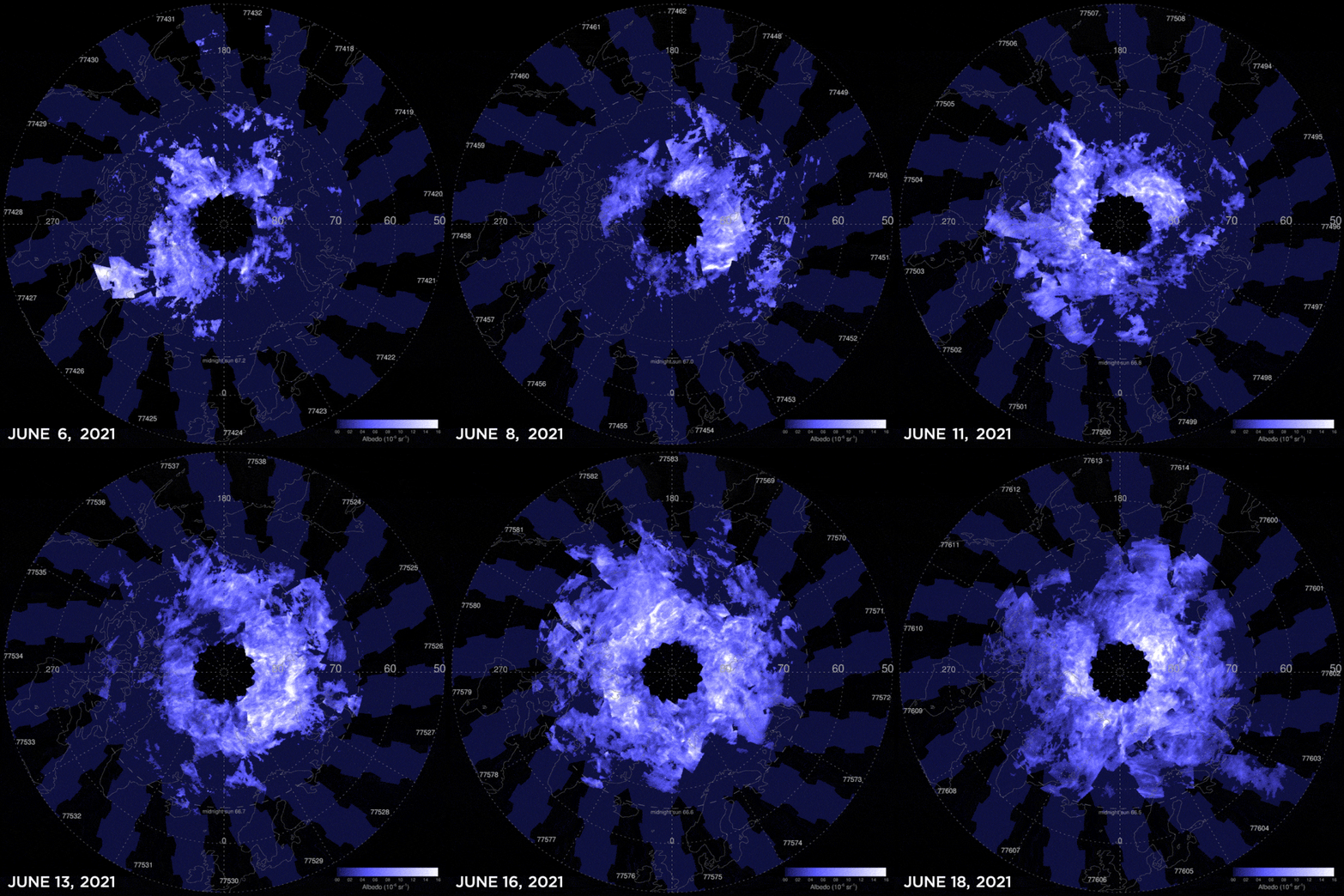
These AIM images span June 6-June 18, 2021, when the Northern Hemisphere noctilucent cloud season was well underway. The colors — from dark blue to light blue and bright white — indicate the clouds’ albedo, which refers to the amount of light that a surface reflects compared to the total sunlight that falls upon it. Things that have a high albedo are bright and reflect a lot of light. Things that don’t reflect much light have a low albedo, and they are dark. Credit: NASA/HU/VT/CU-LASP/AIM/Joy Ng

Since the mesosphere is much thinner than the part of the atmosphere we live in, the impacts of increasing greenhouse gases, such as carbon dioxide, differ from the warming we experience at the surface. One researcher compared where we live, the troposphere, to a thick quilt.

“Down near Earth’s surface, the atmosphere is thick,” said James Russell, a study co-author and atmospheric scientist at Hampton University in Virginia. “Carbon dioxide traps heat just like a quilt traps your body heat and keeps you warm.” In the lower atmosphere, there are plenty of molecules in close proximity, and they easily trap and transfer Earth’s heat between each other, maintaining that quilt-like warmth.

That means little of Earth’s heat makes it to the higher, thinner mesosphere. There, molecules are few and far between. Since carbon dioxide also efficiently emits heat, any heat captured by carbon dioxide sooner escapes to space than it finds another molecule to absorb it. As a result, an increase in greenhouses gases like carbon dioxide means more heat is lost to space — and the upper atmosphere cools. When air cools, it contracts, the same way a balloon shrinks if you put it in the freezer.

This cooling and contracting didn’t come as a surprise. For years, “models have been showing this effect,” said Brentha Thurairajah, a Virginia Tech atmospheric scientist who contributed to the study. “It would have been weirder if our analysis of the data didn’t show this.”

While previous studies have observed this cooling, none have used a data record of this length or shown the upper atmosphere contracting. The researchers say these new results boost their confidence in our ability to model the upper atmosphere’s complicated changes.

The team analyzed how temperature and pressure changed over 29 years, using all three data sets, which covered the summer skies of the North and South Poles. They examined the stretch of sky 30 to 60 miles above the surface. At most altitudes, the mesosphere cooled as carbon dioxide increased. That effect meant the height of any given atmospheric pressure fell as the air cooled. In other words, the mesosphere was contracting.

Earth’s Middle Atmosphere

Though what happens in the mesosphere does not directly impact humans, the region is an important one. The upper boundary of the mesosphere, about 50 miles above Earth, is where the coolest atmospheric temperatures are found. It’s also where the neutral atmosphere begins transitioning to the tenuous, electrically charged gases of the ionosphere.

Even higher up, 150 miles above the surface, atmospheric gases cause satellite drag, the friction that tugs satellites out of orbit. Satellite drag also helps clear space junk. When the mesosphere contracts, the rest of the upper atmosphere above sinks with it. As the atmosphere contracts, satellite drag may wane — interfering less with operating satellites, but also leaving more space junk in low-Earth orbit.

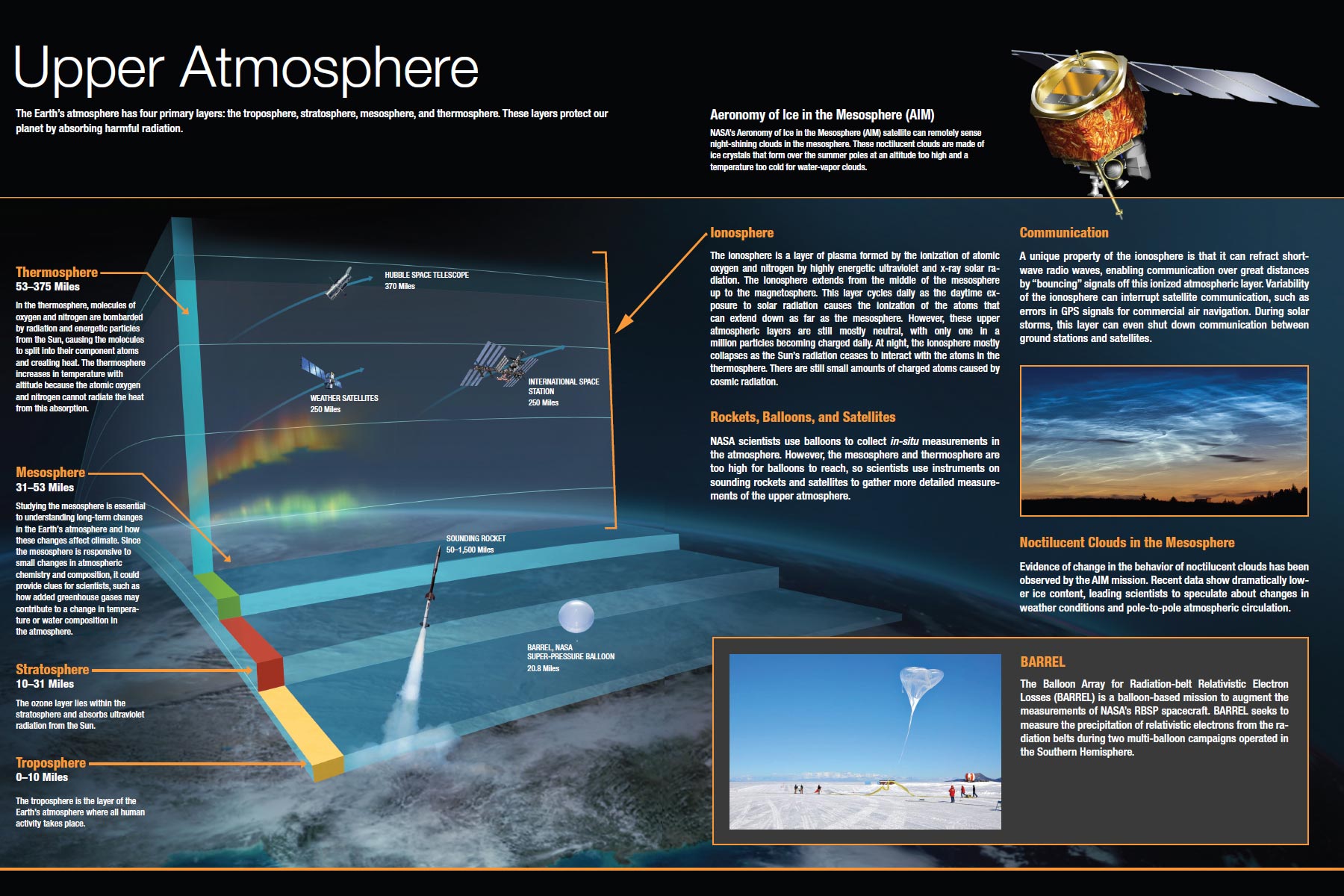
This infographic outlines the layers of Earth’s atmosphere. Click to explore in full size. Credit: NASA

The mesosphere is also known for its brilliant blue ice clouds. They’re called noctilucent or polar mesospheric clouds, so named because they live in the mesosphere and tend to huddle around the North and South Poles. The clouds form in summer, when the mesosphere has all three ingredients to produce the clouds: water vapor, very cold temperatures, and dust from meteors that burn up in this part of the atmosphere. Noctilucent clouds were spotted over northern Canada on May 20, kicking off the start of the Northern Hemisphere’s noctilucent cloud season.

Because the clouds are sensitive to temperature and water vapor, they’re a useful signal of change in the mesosphere. “We understand the physics of these clouds,” Bailey said. In recent decades, the clouds have drawn scientists’ attention because they’re behaving oddly. They’re getting brighter, drifting farther from the poles, and appearing earlier than usual. And, there seem to be more of them than in years past.

“The only way you would expect them to change this way is if the temperature is getting colder and water vapor is increasing,” Russell said. Colder temperatures and abundant water vapor are both linked with climate change in the upper atmosphere.

Currently, Russell serves as principal investigator for AIM, short for Aeronomy of Ice in the Mesosphere, the newest satellite of the three that contributed data to the study. Russell has served as a leader on all three NASA missions: AIM, the instrument SABER on TIMED (Thermosphere, Ionosphere, Mesosphere Energetics and Dynamics), and the instrument HALOE on the since-retired UARS (Upper Atmospherics Research Satellite).

TIMED and AIM launched in 2001 and 2007, respectively, and both are still operating. The UARS mission ran from 1991 to 2005. “I always had in my mind that we would be able to put them together in a long-term change study,” Russell said. The study, he said, demonstrates the importance of long-term, space-based observations across the globe.

In the future, the researchers expect more striking displays of noctilucent clouds that stray farther from the poles. Because this analysis focused on the poles at summertime, Bailey said he plans to examine these effects over longer periods of time and — following the clouds — study a wider stretch of the atmosphere.

Trap set for wolverine seen around Layton

https://www.fox13now.com/news/local-news/trap-set-for-wolverine-seen-around-layton

https://assets.scrippsdigital.com/cms/videoIframe.html?&host=www.fox13now.com&title=Wolverine%20trap%20set%20to%20catch%20elusive%20animal&kw=&autoplay=true&m3u8=https://content.uplynk.com/fc67107f1ec542e889830c6c77908f9f.m3u8&mp4=https://x-default-stgec.uplynk.com/ausw/slices/fc6/ef205c0e5ea14d77944cbd6904335118/fc67107f1ec542e889830c6c77908f9f/fc67107f1ec542e889830c6c77908f9f_e.mp4&purl=/news/local-news/trap-set-for-wolverine-seen-around-layton&dtrack=1&story=1&contplay=*recent&mute=1&tags=Homepage%20Showcase%2CLocal%20News&cust_params=temp%3D90-99%26weather%3Dcloudy&s=kstuThis trap, baited with a deer leg, was set up near Antelope Island to catch the wolverine.

By: Erin CoxPosted at 8:54 PM, Jul 02, 2021 

LAYTON, Utah — A trap has been set for the wolverine spotted several times this week in Layton in the hope it can be moved to safer territory.

Biologists with the Utah Department of Wildlife Resources (DWR) set a trap baited with a deer leg for the animal near Antelope Island, where another wolverine was spotted in May.

They don’t know if wolverines are breeding, or if they’re just coming down from areas further north.

It was placed near water sources and shade, and away from areas where a dog could accidentally be trapped, according to DWR biologist Adam Brewerton.

Several sightings were reported by Layone residents; it was captured on a security camera July 1 by Brittany Zepeda, who thought it looked like some kind of “devil dog,” and certainly not something usually seen in residential neighborhoods.

Just a few days earlier, Sandi Sabin and her husband were riding along the Denver and Rio Grande Western Rail Trail when she saw what she thought was a dog running toward them.

The “dog” was not on a leash and that’s when Sabin stopped biking and the wolverine ran back towards the couple.

“If anything it was very skittish,” said Sabin. “It would come towards us then saw us coming and ran back toward the other people, and it went back and forth just trying to figure out where it was going to go.”

Read – Rare wolverine spotted on Antelope Island

Mark Hadley, the Northern Region Outreach Manager for DWR said a Wolverine sighting in Utah is rare, and they don’t know much about the population.

“It would be awesome if we could capture the animal, put a GPS collar on it and take it up to a high elevation area and release it where Wolverines live,” said Hadley.

There have been only five wolverine sightings in Utah, the first in 1979, where the animal was shot illegally. The next sighting was not until 2014.

Scavengers by nature, Wolverines typically find animals that are already dead rather than killing for food.https://b7607f53d7c52e7d350d59e486acb92d.safeframe.googlesyndication.com/safeframe/1-0-38/html/container.html

Hadley advises families in Layton to keep pets inside at night, close during the day, and to be on the lookout until DWR can trap the Wolverine and relocate it.

FWP to decide future of wolf quota areas near national parks

Exposing the Big Game's avatarCommittee to Abolish Sport Hunting Blog

https://helenair.com/news/state-and-regional/govt-and-politics/fwp-to-decide-future-of-wolf-quota-areas-near-national-parks/article_9106a108-1d4b-5ac7-a513-acd20e0e44e3.html

SUBSCRIBE NOW $1*/mo. for 6 months!

Cache Creek Wolves
The Cache Creek Pack, west of Missoula, is pictured during a wolf counting flight conducted by Montana Fish, Wildlife and Parks on March 26, 2013.Montana Fish, Wildlife and Parks

Tom Kuglin

View original post 1 more word

Arizona to prohibit use of trail cameras that aid hunting

Exposing the Big Game's avatarCommittee to Abolish Sport Hunting Blog

https://apnews.com/article/az-state-wire-arizona-lifestyle-hunting-technology-4aefecf9e280024e5c3640328c9aa42c

today

PHOENIX (AP) — Arizona is moving to ban the use of trail cameras to take video or photos to aid hunting, with regulators saying the widespread practice runs counter to a doctrine that prey animals should have a chance to get away and that hunters shouldn’t rely on their skills, not technology.

The stateGame and Fish Commissionunanimously approved the ban during a June 11 meeting in Payson and plans to start implementing it as early as next January. Achieving the Jan. 1 target date depends on education and training, commission Chairman Kurt Davis told theArizona Republic.

Under the prohibition, cameras could no longer be placed at or near watering holes and other locations to help hunters by locating wildlife. The cameras are often triggered by motion and store pictures or videos to be viewed later.ADVERTISEMENT

The ban wouldn’t affect cameras used for non-hunting purposes…

View original post 318 more words

Critically endangered antelope saiga makes comeback

Exposing the Big Game's avatarThe Extinction Chronicles

By Helen Briggs
BBC Environment correspondentPublished19 hours ago

https://www.bbc.com/news/science-environment-57688320

Saiga calf
image captionThe saiga is known for its bulbous, protruding nose

The population of a rare type of antelope has more than doubled since 2019, in a remarkable turn around in fortunes.

According to the first aerial survey in two years, the number of saiga in their Kazakhstan heartland has risen from 334,000 to 842,000.

There were fears the animal was on the brink of extinction following a mass die-off in 2015.

Distressing images of carcasses strewn over the steppes made world headlines.

Following a series of conservation measures, including a government crackdown on poaching, and local and international conservation work, numbers have started to bounce back.

That, together with the natural resilience of the species, gives hope for their future, said Albert Salemgareyev of the Association for…

View original post 524 more words

Bezos, Gates back fake meat and dairy made from fungus as next big alt-protein

https://www.cnbc.com/2021/07/03/bezos-gates-back-fungus-fake-meat-as-next-big-alt-protein-.html

PUBLISHED SAT, JUL 3 202110:00 AM EDTBob WoodsSHAREShare Article via FacebookShare Article via TwitterShare Article via LinkedInShare Article via EmailKEY POINTS

  • Chicago-based Nature’s Fynd has meatless breakfast patties and hamburgers, dairy-free cream cheese and yogurt, and chicken-less nuggets scheduled to hit grocers’ shelves later this year.
  • The alternative foods sector grew U.S. retail sales 27% in 2020, and bringing the total market value to $7 billion.
  • Nature’s Fynd is building a 35,000-square-foot factory on the site of Chicago’s former Union Stockyards, the epicenter of the 20th-century meatpacking industry.
Unearthed by co-founder Mark Kozubal as a microbe from volcanic hot springs in Yellowstone National Park, Fy is the fermented, versatile, protein-rich source that Nature's Fynd and its CEO Thomas Jonas are hoping becomes the next big thing in alternative meat and dairy.

Unearthed by co-founder Mark Kozubal as a microbe from volcanic hot springs in Yellowstone National Park, Fy is the fermented, versatile, protein-rich source that Nature’s Fynd and its CEO Thomas Jonas are hoping becomes the next big thing in alternative meat and dairy.Nature’s Fynd

As consumers become increasingly comfortable eating faux-meat burgers that look, cook and taste like the real thing, a food-tech start-up backed by Jeff Bezos and Bill Gates is using fungus as the primary ingredient to create alt-meat foods.

Nature’s Fynd, based in Chicago, has raised $158 million in funding from investors including Bezos, Gates, and Al Gore. The company’s meatless breakfast patties and hamburgers, dairy-free cream cheese and yogurt, and chicken-less nuggets are scheduled to hit grocers’ shelves later this year.

The alternative foods sector skyrocketed in 2020, growing U.S. retail sales 27%, and bringing the total market value to $7 billion, according to the Plant-Based Foods Association (PBFA), a trade group comprising more than 200 member companies. Meanwhile, shipments of alt-protein products from food service distributors to commercial restaurants rose 60% year-over-year in April, according to research firm NPD Group.

The ascendant industry is headlined by Beyond Meat and Impossible Foods, whose alt-meat burgers, chicken and sausage products have disrupted the $733 billion U.S. food manufacturing industry. That has prompted Tyson Foods, Purdue, Hormel, Cargill and other traditional meat producers to launch their own products in the category.

Some alt-meat sales growth slowed amid the pandemic and restaurant closures. A recent report from J.P. Morgan claims that Dunkin’ has dropped its breakfast sandwich using a Beyond sausage patty from most restaurants, though that has not been confirmed by either company (Dunkin’ and Beyond Meat did return calls by press time.) Still, plant-based and cultured foods are projected to take a 60% market share of global meat sales by 2040, according to consulting firm AT Kearney.WATCH NOWVIDEO00:59Alt-meat loses steam as sales growth slows during the pandemic

Having lost 1% of its overall market to-date probably doesn’t rattle meat producers much, but looking at the declining costs of alt-meat should raise their eyebrows. In mid-June, Beyond Meat was selling for $6.40 per pound, bringing it closer to the price of traditional beef, making some progress on a long-term goal of Beyond Meat CEO Ethan Brown to reach cost parity with traditional meat. Beef patties were then selling for $5.26 per pound, according to the U.S. Department of Agriculture. Impossible Foods has cut its restaurant prices twice in the past year, and in February, the company slashed retail prices by 20%, lowering the price of two quarter-pound patties to $5.49.

Nature’s Fynd was co-founded in 2012 — initially as Sustainable Bioproducts — by Thomas Jonas and Mark Kozubal, now chief executive and chief science officers, respectively. A few years earlier, Kozubal had unearthed a microbe, Fusarium strain flavolapis, from volcanic hot springs in Yellowstone National Park. He led an R&D team that formulated the microbe into what the company calls Fy, the fermented, versatile, protein-rich source for Nature’s Fynd’s products.

Fermentation has been used in making bread, beer, wine, cheese and other products for millennia, and is now emerging as a key alt-protein platform with major potential to align science with entrepreneurship, policy and investment, according to the Good Food Institute. Even so, Nature’s Fynd has some catching up to do. U.K.-based Quorn, founded in 1985, has been offering its fungus-based meatless products in the U.S. since 2002. It was acquired by Philippine food maker Monde Nissin for about $830 million in 2015, according to Reuters. And the field of other potential competitors is growing.I don’t know anyone over 40 who is saying, ‘I should eat more meat.’Thomas JonasCO-FOUNDER AND CEO

Much as cows, chickens and pigs were domesticated centuries ago as protein sources, “now is the time for this second domestication,” Jonas said in a recent interview. “The farming of this microbe is an efficient way of producing protein that is just as good.”

Bringing the evolution full circle, Nature’s Fynd is building a 35,000-square-foot factory on the site of Chicago’s former Union Stockyards, the epicenter of the 20th-century meatpacking industry.

The climate-conscious food consumer

Beyond fungus, Nature’s Fynd also is representative of the food sustainability movement, whose mission is to reduce the carbon footprint of global food systems, which generate 34% of greenhouse emissions linked to climate change.

“The challenge for this and future generations is to learn to do more with less,” Jonas said. “Because with eight billion people, the Earth is not getting any bigger, its resources are dwindling and climate change is making it even more difficult to find land to grow crops to feed animals. The math just doesn’t work. So, the whole goal of our new protein system is to increase the efficiency of the complete protein chain.”

Consumer acceptance, of course, is paramount to Nature’s Fynd business model. In February, the company launched a limited, direct-to-consumer sampling of its patties and cream cheese exclusively online. Chief marketing officer Karuna Rawal said the formal product rollout will focus first on retailers, with food service partnerships to follow. “It’s important that we start with retail and be able to tell our story to the consumer in a way we can control the narrative,” she said.

In that vein, Nature’s Fynd packaging is emblazoned with a “Fy” badge, a la “Intel Inside,” to create brand recognition and loyalty.

With $158 million in funding from Jeff Bezos, Bill Gates, Al Gore and other investors, Nature's Fynd meatless breakfast patties and hamburgers, dairy-free cream cheese and yogurt, and nuggets, minus chicken, are scheduled to hit grocers' shelves later this year.

With $158 million in funding from Jeff Bezos, Bill Gates, Al Gore and other investors, Nature’s Fynd meatless breakfast patties and hamburgers, dairy-free cream cheese and yogurt, and nuggets, minus chicken, are scheduled to hit grocers’ shelves later this year.Nature’s Fynd

Not surprisingly, the greatest appeal for alt-meat products is among younger consumers.

“Gen Zers and millennials are the largest purchasers in the plant-based space,” said Sabina Vyas, director of strategic initiatives and communications at the PBFA. “As their purchasing power builds, [food] companies are going to have to adapt accordingly.”

Sixty-three percent of U.S. consumers between ages 24 and 39 believe their nutritional needs can be fully met with a plant-based diet, according to research from One Poll.

“I don’t know anyone over 40 who is saying, ‘I should eat more meat,’” Jonas said.

Chris Rivest, a senior climate-tech investor at Breakthrough Energy Ventures, established in 2016 by Gates and a coalition of private investors concerned about the impacts of climate change, said food is a commodity, with purchases based on taste, nutrition and cost.

He is a fan of the fungus, saying he was “blown away” by products he taste-tested (Gates was similarly impressed during a “60 Minutes” segment) and its nutritional value.

The company says the veg­an pro­tein includes all 20 amino acids, includ­ing the 9 essen­tial amino acids, and good lev­els of fiber, vit­a­mins and min­er­als, with no cho­les­terol or trans fats. It says Fy has one-tenth the fat of ground beef and 50% more pro­tein than tofu; twice as much pro­tein as raw peas.

Rivest also thinks the business can compete on cost. “We think the Nature’s Fynd model can undercut costs of traditional protein sources,” he said. “That’s what really sold us on this opportunity.”

Like many start-ups, scale is going to be critical for Nature’s Fynd’s success.

“We expect to have a lot of demand versus our [manufacturing] capacity, so we have to move fast and raise additional capital to move forward,” Jonas said. “We’re competing against the meat industry, which has been working on its supply chain for 300 years, so we have big catching up to do.”

Fireworks detonate on Ocean City beach, 1 injured

https://www.wbaltv.com/article/fireworks-detonate-on-beach-ocean-city-maryland/36922204#

No beach or boardwalk patrons were injured, police say

Share

WBALUpdated: 1:11 PM EDT Jul 4, 2021Infinite Scroll EnabledGreg Ng Digital Media ManagerPlay Video SHOW TRANSCRIPT

GET LOCAL BREAKING NEWS ALERTS

The latest breaking updates, delivered straight to your email inbox.SUBMITPrivacy NoticeOCEAN CITY, Md. —

Fireworks detonated Sunday morning on the Ocean City beach, injuring an employee who was setting up for July Fourth festivities.

Several videos of the explosion were tweeted around 10:30 a.m. Sunday. Video obtained by 11 News courtesy of Gilly Gene, who was on the beach, shows the explosion.https://5baca50aabba4a81e11fd88b3526ff9c.safeframe.googlesyndication.com/safeframe/1-0-38/html/container.htmlAdvertisement

According to Ocean City police, the Ocean City Fire Department was alerted for a vehicle fire at Dorchester Street and the beach.

“Firefighters arrived to find that no vehicle was on fire; however, there was an unintentional discharge of fireworks that were being set up on the beach for the town’s fireworks show,” police said.

Police said an employee of the fireworks company suffered minor injuries and refused to be taken to a hospital. No beach or boardwalk patrons were injured, police said.

“Our fire marshals are on the scene and will investigate the cause of the unintentional discharge,” Ocean City Fire Chief Richie Bowers said in a statement posted on Facebook. “Prior to the fireworks being off loaded from the vehicle, fire marshals secure a safe zone around the fireworks and put other safety protocols in place. It is this very zone and safety protocols that kept anyone else from being injured.”

Ocean City had planned to have fireworks at two locations Sunday. Town fire marshals are conducting safety inspections at both fireworks locations. The cause of the fireworks discharge was not immediately known.

A perimeter around the fireworks site has been established and will remain in place until the safety inspections are complete, which could take several days. Areas of the Boardwalk have also been closed to pedestrian traffic until a thorough safety inspection has been completed.

Due to an abundance of caution, all firework shows in Ocean City have been canceled.

The Maryland State Fire Marshal tweeted that it is “monitoring the fireworks explosion in @OCMaryland. Ocean City Fire Marshals Office is the lead agency and will be conducting the investigation into the incident.”

This report will be updated.

smoke seen before fireworks explosion on beach

David

UPDATE: Defendant in fatal hunting incident that killed boy testifies

Exposing the Big Game's avatarCommittee to Abolish Sport Hunting Blog

https://www.thetimesherald.com/story/news/2021/07/01/mother-slain-11-year-old-boy-speaks-john-varndell-jr-s-trial/7824502002/

Laura FitzgeraldPort Huron Times HeraldView Comments

Family members of Zachary Rock comfort each other as Heather Rohn, Zachary's mother, testifies during John Varndell Jr.'s trial Thursday, July 1, 2021, in the St. Clair County Courthouse in Port Huron.

Taking the stand in his own defense in his trial Thursday, John Varndell Jr. said he was “100%” surehe was shooting at a deer when he shot and killed his 11-year-old stepson in a hunting incident.

Varndell said he went into the woods with Zachary Rock, his stepson, and five other relatives onthe evening of Sept. 13. They were on a relative’s property in the 6300 block of Benoit Road in Clay Township to search for a deer he had shot earlier in the day.

John Varndell Jr. gets emotional while testifying during his trial Thursday, July 1, 2021, in the St. Clair County Courthouse In Port Huron. Varndell is facing charges related to allegedly killing his 11-year-old stepson.

Varndell said he had split off with three other relatives to search for a deer blind, while Zachary went with another child and an adult relative towardthe house.

Varndellwent off by himself because he said he thought he saw a deer. He shot eight times from a handgun.

“Do you agree with me as a hunter…

View original post 805 more words

Then and now: Arctic sea-ice feeling the heat

Exposing the Big Game's avatarThe Extinction Chronicles

https://www.bbc.com/news/science-environment-57650226

By Mark Kinver
Environment reporterPublished1 day agoShare

In our monthly feature, Then and Now, we reveal some of the ways that planet Earth has been changing against the backdrop of a warming world. The shrinking sea-ice in the Arctic is not only a sign of climate change, it is causing the planet to warm more quickly. This is because more sunlight is being absorbed by the darker ocean, rather than being reflected back into space.https://flo.uri.sh/visualisation/6397277/embed?auto=1

Arctic sea-ice plays an important role in controlling the planet’s temperature, and any problem with this natural thermostat is a cause for concern.

Figures from the US space agency (Nasa) suggest the loss of the minimum Arctic sea-ice extent is in the region of 13.1% per decade, based on the 1981 to 2010 average.

Amajor report on climate change in 2007linked the growing concentration of greenhouse gases in the atmosphere, caused…

View original post 654 more words