The riddle of how humans evolved to have fathers

https://www.bbc.com/future/article/20210625-the-riddle-of-how-humans-evolved-to-have-fathers

Share using EmailShare on TwitterShare on FacebookShare on Linkedin(Image credit: Afriadi Hikmal/Getty Images)

Human fathers are unusual among their mammalian counterparts for the role they play in their children's lives (Credit: Afriadi Hikmal/Getty Images)

By Elizabeth Preston27th June 2021From Knowable MagazineFew other mammalian dads invest as much time and care in rearing their offspring – or even the children of others – compared to human fathers.L

Lee Gettler is hard to get on the phone, for the very ordinary reason that he’s busy caring for his two young children. Among mammals, though, that makes him extraordinary.

“Human fathers engage in really costly forms of care,” says Gettler, an anthropologist at the University of Notre Dame. In that way, humans stand out from almost all other mammals. Fathers, and parents in general, are Gettler’s field of study. He and others have found that the role of dads varies widely between cultures — and that some other animal dads may give helpful glimpses of our evolutionary past.

Many mysteries remain, though, about how human fathers evolved their peculiar, highly invested role, including the hormonal changes that accompany fatherhood. A deeper understanding of where dads came from, and why fatherhood matters for both fathers and children, could benefit families of all kinds.

“If you look at other mammalian species, fathers tend to do nothing but provide sperm,” says Rebecca Sear, an evolutionary demographer and anthropologist at the London School of Hygiene and Tropical Medicine. Mothers carry the burden in most other animals that care for their children, too. (Fish are an exception – most don’t tend their young at all, but the caring parents are usually dads. And bird couples are famous for co-parenting.)

Even among the other apes, our closest relatives, most dads don’t do much. That means mums are stuck with all the work and need to space out their babies to make sure they can care for them. Wild chimps, for example, give birth every four to six years. Orangutans wait as long as six to eight years between young.

The ancestors of humans, though, committed to a different strategy. Mothers got help from their community and their kin, including fathers. This freed them up enough to have more babies, closer together – about every three years, on average, in today’s nonindustrial societies. That strategy “is part of the evolutionary success story of humans”, Gettler says.

Some clues about the origin of doting fatherhood come from our close primate relatives.Male gorillas will often act as babysitters for youngsters and research suggests they do this for a variety of reasons (Credit: Ibrahim Suha Derbent/Getty Images)
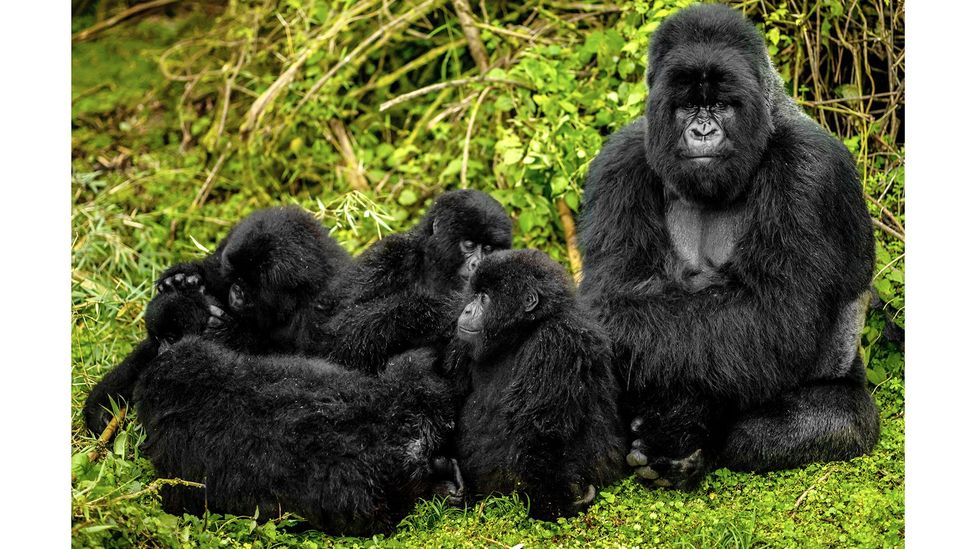
Male gorillas will often act as babysitters for youngsters and research suggests they do this for a variety of reasons (Credit: Ibrahim Suha Derbent/Getty Images)

Stacy Rosenbaum, a biological anthropologist at the University of Michigan, studies wild mountain gorillas in Rwanda. These gorillas provide intriguing hints about the origins of ape dads, as Gettler and co-authors Rosenbaum and Adam Boyette argue in the 2020 Annual Review of Anthropology.

Mountain gorillas are a type of eastern gorilla. They differ from western gorillas — a separate species more often seen in zoos — in their habitat and diet. Rosenbaum is more interested in another thing that sets mountain gorillas apart: “Kids spend a ton of time around males,” she says.

Those males may or may not be their dads. Male mountain gorillas don’t seem to know or care which young are theirs. But nearly all males tolerate the company of the youngsters. Unlike any other great ape that’s been studied in the wild, these males – bruisers twice the size of females, with huge muscles and teeth – are essentially babysitters. Some pick up the youngsters, play with them and even sleep cuddled together.

This male company can protect very young gorillas against predators, and it keeps the young from being killed by intruding males. Another important benefit might be social, Rosenbaum speculates.

The young gorillas mingling around an adult male might pick up social skills like human toddlers do from their peers at day care. Additionally, research has shown that the relationships between young gorillas and adult males persist as they grow up.

Babysitting may benefit male gorillas in another way, too: by making them more attractive

Another tantalising hint about how male gorillas benefit the young in their group comes from a recent paper on young mountain gorillas whose mothers died. Losing their mothers didn’t make these orphans more likely to die themselves, the researchers found. Nor did they experience other costs, such as a longer wait before having their own young. The orphans’ relationships with others in their group, especially dominant males, seemed to protect them from ill effects.

Mountain gorilla males aren’t the only primates to ally with kids. Adult male macaques also spend time with young. And baboon males form “friendships” with females and their young, which are often (but not always) their own offspring. These behaviours cost the male primates almost nothing. So, while the males may give their own offspring a survival boost, it’s not a big deal if they spend time with some unrelated youngsters too.

You might also like:

But babysitting may benefit male gorillas in another way, too: by making them more attractive. “One of our speculations is that females actually prefer mating with males who do a lot of interacting with kids,” Rosenbaum says. She’s found that male gorillas who do more babysitting earlier in life go on to father many more children when they’re older. Macaques, too, seem to be more attractive to females if they’ve spent more time hanging out with kids.

Anthropologists used to assume that fatherly behaviour could evolve only in monogamous animals, Rosenbaum says. Species like the mountain gorillas undermine that assumption. They also show that, despite what scientists have long thought, male animals don’t have to choose between spending their energy on mating or parenting. It seems taking care of kids can be a way of getting mates.

Studies of human dads and stepdads have hinted at the same idea. “A lot of guys will willingly enter into relationships with kids they know aren’t theirs,” says Kermyt Anderson, a biological anthropologist at the University of Oklahoma. That investment might seem paradoxical from an evolutionary perspective. But Anderson’s research suggests that men invest in stepchildren and even their own biological children partly as an investment in their relationship with the mother. When that relationship ends, fathers tend to become less involved.

A human dad who cares for his children or stepchildren is different, of course, from an ape or monkey who just lets youngsters hang around. But Gettler and Rosenbaum wonder whether our own ancestors had similar habits to mountain gorillas or macaques. Under the evolutionary pressures they faced, these friendly tendencies toward children could have ratcheted up into devoted fatherhood.Although humans fathers are unusual among animals, fatherhood can also vary greatly among humans too (Credit: Jason Armond/LA Times/Getty Images)
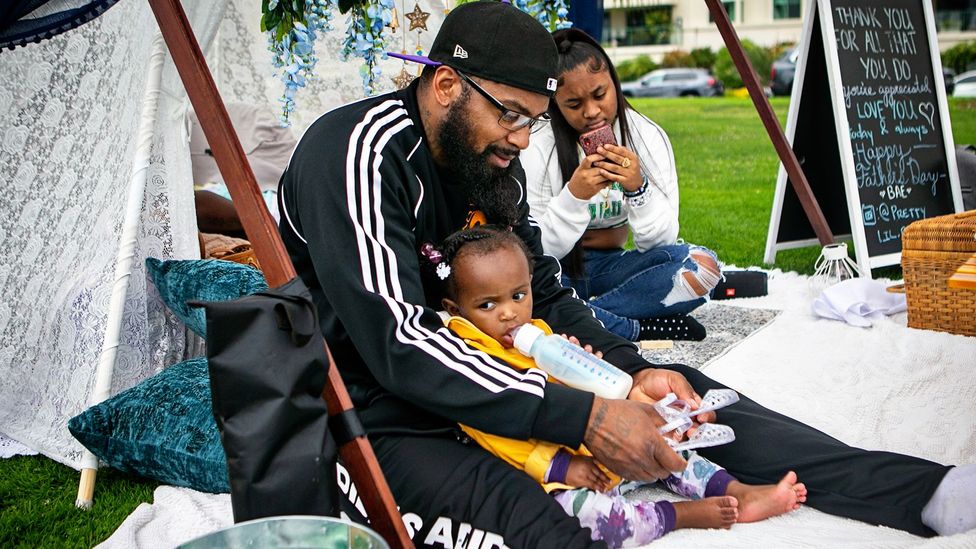
Although humans fathers are unusual among animals, fatherhood can also vary greatly among humans too (Credit: Jason Armond/LA Times/Getty Images)

Some clues to the evolutionary history of fatherhood are also written in the molecules of men’s bodies. 

Gettler worked on a long-term study of men in the Philippines, gathering biological data from them in their early 20s and following up five years later. He and his colleagues found that men with higher testosterone in their early 20s were more likely to have partners and children later on, when researchers followed up. But those new dads no longer had high testosterone — it had dropped dramatically, especially if they had a newborn at home. Once a man’s youngest child was a toddler, his testosterone began to creep back upward.

Testosterone is linked to mating and competitive behaviour in male animals. Suppressing it might be nature’s way of preparing fathers to cooperate with their partners and care for children, the researchers say. Although caring fathers are rare among mammals and most other animals, many can be found among birds — and those bird fathers also experience testosterone dips. 

Prolactin is another hormone linked to paternal behaviour in birds — this time, doting bird dads have more of it — and some studies have hinted at a similar effect in humans. Although we’re only distantly related to birds, evolution may have used the same mechanisms to encourage fatherly behaviour in both animals. Understanding those mechanisms better might help us learn how fatherhood evolved. 

“If we understand the physiological pathways that underpin care in those other species, we can look to see if the same signatures occur in human fathers,” says Gettler.

It’s clear human fathers are unusual in their attention to their children. “However, it’s also clear that fatherhood in humans is quite variable,” Sear says. Not all dads are doting, or even present.

Research has shown that fathers can have important roles in directly caring for their children, for example, and teaching children language and social skills

But that doesn’t necessarily affect basic survival. In a 2008 paper, Sear and co-author Ruth Mace asked whether children with absent fathers are likelier to die. They reviewed data on child survival from 43 studies of populations around the world, mostly those without access to modern medical care. They found that in a third of the studies looking at fathers, children were more likely to survive childhood when their dad was around. But in the other two-thirds, fatherless kids did just as well. (By contrast, every study of children without mothers found they were less likely to survive.)

“That is not what you would expect to see if fathers are really vital for children to thrive,” Sear says. Rather, she suspects that what’s vital are the jobs fathers perform. When a father is missing, others in the family or community can fill in. “It may be that the fathering role is important, but it’s substitutable by other social group members,” she says.

What is that role? Historically, Gettler says, anthropologists have viewed fatherhood as all about “provisioning” — bringing home the bacon, literally. In some foraging communities, more successful hunters also father more kids. But Gettler hopes to help expand the definition of a father. Research has shown that fathers can have important roles in directly caring for their children, for example, and teaching children language and social skills.

Fathers may also help their children by cultivating relationships in their communities, Gettler says. When it comes to survival, “Networking can be everything.”Human children also tend to have an unusually long lasting bond with their fathers (Credit: Daniel Shirey/Getty Images)

Human children also tend to have an unusually long lasting bond with their fathers (Credit: Daniel Shirey/Getty Images)

A dad’s job also varies culturally. For example, in the Republic of the Congo, Gettler works with two neighbouring communities. The Bondongo are fishers and farmers – they value fathers who take risks to gain food for their own families. Their neighbours, the BaYaka, are foragers who value fathers who share their resources outside their families.

“In the West we have this idealisation of the nuclear family,” says Sear: a self-reliant, heterosexual couple in which dad does all the provisioning and mum all the childcare. But worldwide, she says, families like this are very rare. A child’s biological parents may not live together exclusively, for life or at all, Sear writes in a recent paper. Childcare and food can come from either parent — or neither. Among the Himba of Namibia, for instance, children are often fostered by extended family.

“Possibly the key defining feature of our species is our behavioural flexibility,” Sear says. Assuming that certain roles are “natural” for fathers or mothers can make parents feel isolated and stressed, Sear writes. She hopes research can broaden our understanding of what fathers are for, and what a human family is. That might help societies to better support families of all kinds — whether they have dads like Gettler who are busy chasing the children around, or dads who are away fishing, or no dads at all. 

“I think we need to take a much more non-judgmental view of the human family, and the kinds of family structures in which children can thrive to improve the health of mothers, fathers and children,” says Sear.

* This article originally appeared in Knowable Magazine, and is republished under a Creative Commons licence.

TV Personality Ripped After Video Taunting Dead Deer While Hunting Resurfaces

Exposing the Big Game's avatarCommittee to Abolish Sport Hunting Blog

https://popculture.com/reality-tv/news/phil-spenser-ripped-video-taunting-dead-deer-hunting-resurfaces/

ByDANIEL S. LEVINE- June 28, 2021 05:44 pm EDT

https://embed.popculture.com/player/embed?args=player_id%3D161516321122021185%26log_window%3Dfalse%26resizable%3Dtrue%26autoplay%3Dtrue%26comp_ads_enabled%3Dfalse%26source%3Dpopculture%26resizable%3Dtrue%26watchAndRead%3D0%26uvpc%3Dhttps%3A%2F%2Fwww.cbssports.com%2Fapi%2Fcontent%2Fvideo%2Fconfig%2F%3Fcfg%3Duvp_popculture%26env%3Dprod%26warW%3D300%26warH%3D169%26js%3Djs%2Fmedia%2Fvideo%2Fplayer%2Fembed%2Fcslive.js%26css%3Dcss%2Fmedia%2Fvideo%2Fplayer%2Fembed%2Fcslive.css%26force_no_ads%3Dfalse%26ids%3D9a17010e-91d8-44e6-96ae-90b5c724bf9c%26env%3Dprod%26partner%3Dpopculture%26partner_m%3Dpopculture_mobile%26utag%3Dpopculturesite%26channel%3Dpopculturedefault%26cmpGroups%3D1%3A1%2C4%3A1%2C2%3A1%2C3%3A1%2C5%3A1

Phil Spencer, a British television host of property series, has come under fire again after a years-old video of him taunting a dead deer resurfaced onTwitter. Spencer is often criticized on social media for a 2011 photo that shows him holding a deer carcass. Spencer and Kirstie Allsopp have hostedChannel 4‘sLocation, Location, Locationseries since May 2000. The two also hosted the spin-offRelocation, Relocationfrom 2004 to 2011.

The clip in question shows Spencer, 51, wearing a full camouflage outfit and crouching over the dead deer. The one-minute clip surfaced on Twitter in June 2020, and was retweeted again last week, sparking a fresh conversation about it. The 2020 tweet did not mention where this video was from, but it appears to be part of a longer video he filmed for…

View original post 364 more words

Six state recreation areas will allow fireworks on July 4

https://www.newschannelnebraska.com/story/44154823/outdoor-notes-six-state-recreation-areas-will-allow-fireworks-on-july-4

Visitors to six state recreation areas will be allowed to touch off fireworks on July 4. The Nebraska Game and Parks Commission is urging them to be especially careful this year.Tuesday, June 22nd 2021, 3:25 PM CDTUpdated: Sunday, June 27th 2021, 9:39 PM CDTBy Nebraska Game and Parks Commission

LINCOLN, Neb. – Visitors to six state recreation areas will be allowed to touch off fireworks on July 4. The Nebraska Game and Parks Commission is urging them to be especially careful this year.

Visitors should always use caution when lighting fireworks but should be mindful of the dry conditions that exist across the state this year and the risk of wildfire.

The areas that will permit fireworks from 8 a.m. until midnight on July 4 are Branched Oak (Liebers Point only), Fort Kearny, Memphis, Fremont Lakes, Pawnee and Wagon Train.

Signs at recreation areas will point the way to designated fireworks sites, and boundaries will be clearly marked. Use of fireworks elsewhere in state areas or at other times is prohibited.

Only fireworks approved for sale in Nebraska by the state fire marshal are permitted, and visitors must pick up expended fireworks and deposit them in appropriate containers. Minor children must be supervised when discharging fireworks. Use, possession and the discharging of fireworks is at the sole risk of the users.

A park entry permit is required for all vehicles entering state recreation areas.

DNR committee at odds on fall wolf hunt in Wisconsin

Exposing the Big Game's avatarCommittee to Abolish Sport Hunting Blog

LOCAL NEWS

JUN 28, 2021

DANIELLE KAEDING

Wisconsin Public Radio

(Wisconsin Department of Natural Resources photo)

SUPERIOR, Wis. — As emotions run high around wolf management in Wisconsin, members of the state’s wolf harvest advisory committee failed to reach a consensus last week over a recommended harvest level for the fall’s hunt.

The committee is made up of various interests representing state wildlife managers, tribes, agriculture, hunting and environmental groups, among others. Department of Natural Resources Deputy Secretary Todd Ambs said the committee’s input would serve as a starting point for the agency to come up with a proposed harvest target.

“It will be incorporated into the department’s discussions and season recommendations at every level of review,”Ambs said during Tuesday’s meeting.

Ambs didn’t expect the committee would submit specific recommendations to the agency as it develops a harvest quota for the fall hunt, which is set to begin Nov…

View original post 880 more words

GOP Fights Climate Proposals as the Northwest Roasts Under Record Temperatures

Portland residents fill a cooling center with a capacity of about 300 people at the Oregon Convention Center June 27, 2021 in Portland, Oregon. Record breaking temperatures lingered over the Northwest during a historic heat wave this weekend.
Portland residents fill a cooling center with a capacity of about 300 people at the Oregon Convention Center June 27, 2021, in Portland, Oregon. Record-breaking temperatures lingered over the Northwest during a historic heat wave this weekend.

BYSharon Zhang, TruthoutPUBLISHEDJune 28, 2021SHAREShare via FacebookShare via TwitterShare via Email

As the climate crisis fuels flooding in Michigan and record high temperatures in the Pacific Northwest, Republicans and centrist Democrats in Congress are fighting to exclude climate provisions and other vital measures from President Joe Biden’s infrastructure bill.

Oregon, Washington and Idaho roasted under oppressive heat over the weekend, with temperatures in Portland, reaching a record high of 108 degrees Fahrenheit on Saturday — and then another record high of 112 degrees Fahrenheit on Sunday. Experts have said that the region, which has a high proportion of housing without air conditioning, isn’t prepared for such abnormally high temperatures.

Meanwhile, in Michigan, a downpour of rain caused major flooding in Detroit, which is similarly unprepared for extreme weather, experts say. Gov. Gretchen Whitmer (D-Michigan) declared a state of emergency over the weekend for the state.

Get our free emails

  • Email

Both extreme weather events are almost certainly due to or intensified by the climate crisis, which is creating increasingly inhospitable conditions for people in the U.S. This is the second year in a row that Michigan has experienced abnormal flooding, and the National Weather Service has called the heat wave sweeping the Northwest unprecedented and dangerous.

They’re the sorts of weather events that climate scientists have been warning about for decades and continue to raise alarm about today as the climate crisis only worsens, largely unmitigated. As researchers have pointed out, the record high temperatures in the Northwest aren’t just the highest temperatures to date — they’re likely some of the lowest highs that the U.S. will experience in the years to come.

Climate advocates have been warning that Biden’s infrastructure bill could be the president’s last best hope to enact major climate-related proposals to hit his goal of 50 percent emissions reduction by 2030. But in May, Biden offered to cut his infrastructure bill from $2.25 trillion to $1.7 trillion, and, this past week, agreed to further reduce it to a paltry $579 billion, with many of its most ambitious climate measures cut out.

The elimination of climate proposals largely seems to be the product of a group of bipartisan senators who negotiated the most recent deal with Biden. A previous Republican-only proposal eliminated climate spending almost entirely; the centrists’ plan includes some money for energy grid updates, but still eliminates large swaths of climate spending for things like renewable energy tax credits.

Progressives like Senators Bernie Sanders (I-Vermont) and Ed Markey (D-Washington) have decried these cuts, with Markey calling the move “climate denial masquerading as bipartisanship.” Climate advocates like the Sunrise Movement, meanwhile, are fed up with politicians promising action, only to have those promises yanked out from under them when congressional Republicans — and other fossil-fuel-funded politicians — get involved.

Meanwhile, the GOP continues to be almost completely uninterested in mitigating the climate crisis. People like Sen. Mitt Romney (R-Utah), who is a member of the bipartisan group, said earlier this month that “the Democrats’ agenda on climate change is probably something they’re going to pursue, by and large, outside of an infrastructure bill.” But, as Romney undoubtedly knows full well, most legislation that Democrats pursue on their own will immediately be blocked by Republicans with the filibuster.

Sanders has recently taken up an effort to incorporate climate action into legislation in the form of a $6 trillion reconciliation bill that will include everything that’s been cut from Biden’s infrastructure proposal plus items like expanding Medicare.

Democratic leadership has vowed to block the watered down infrastructure bill without the concurrent passage of the reconciliation bill. But a scuffle between Republicans and the White House over the weekend has left the pairing’s future in limbo as Biden walked back a promise to veto the infrastructure bill without the $6 billion package.

Sanders made it clear on Sunday that separating the two bills wouldn’t be acceptable to him, saying on Twitter that “There will not be a bipartisan infrastructure deal without a reconciliation bill that substantially improves the lives of working families and combats the existential threat of climate change. No reconciliation bill, no deal.”

Indeed, without drastic and decisive action, researchers with the Intergovernmental Panel on Climate Change warned recently in a draft report that the climate crisis will only worsen flooding, heat waves, diseases and other climate events. They also warn that the world may be approaching — or have already hit — tipping points for the climate, after which the crisis will worsen even faster.

Preventing the worst of the climate crisis will require near-immediate social upheaval, which activists have been advocating for and some progressives have been fighting for in Congress. The political conversation around the climate has evolved rapidly over the past few years, but progress may not be coming soon enough.

You’re a Mean One, Mr. Fudd

Elmer Fudd hunter

You’re a mean one, Mr. Fudd.
You really are a heel,
You’re as cuddly as a cactus, you’re as charming as an eel, Mr. Fudd.
You’re a bad banana with a greasy black peel!

You’re a monster, Mr. Fudd.
Your heart’s an empty hole.
Your brain is full of spiders, you have garlic in your soul, Mr. Fudd.
I wouldn’t touch you with a thirty-nine-and-a-half foot pole!

You’re a vile one, Mr. Fudd.
You have termites in your smile.
You have all the tender sweetness of a seasick crocodile,
Mr. Fudd.
Given the choice between the two of you,
I’d take the seasick crocodile.

You’re a foul one, Mr. Fudd.
You’re a nasty wasty skunk.
Your heart is full of unwashed socks;
Your soul is full of gunk,
Mr. Fudd.

The three words that best describe you
Are as follows, and I quote:
Stink!
Stank!
Stunk!

You’re a rotter, Mr. Fudd.
You’re the king of sinful sots.
Your heart’s a dead tomato squashed with moldy purple spots,
Mr. Fudd.

Your soul is an appalling dump heap
Overflowing with the most disgraceful
Assortment of deplorable rubbish imaginable,
Mangled up in tangled up knots.

You nauseate me, Mr. Fudd,
With a noxious super naus.
You’re a crooked jerky jockey and
You drive a crooked horse,
Mr Fudd!

ELmer Fudd hunter

You’re a three-decker sauerkraut
And toadstool sandwich,
With arsenic sauce!

TURKEY WILL NO LONGER CLASSIFY ANIMALS AS COMMODITIES

Turkey Will No Longer Classify Animals as Commodities

The country’s proposed legislation is in response to public outcry regarding incidents that involved violence toward stray animals

https://vegnews.com/2021/6/turkey-will-no-longer-classify-animals-as-commodities.

by NICOLE AXWORTHY

JUNE 28, 2021


468 Shares

Turkey’s highly anticipated animal-rights bill is expected to be presented to the Turkish Parliament and enacted into law in the coming weeks. The new legislation will redefine animals as living beings instead of “commodities,” as is the case under current laws. It also seeks jail time for anyone who kills, abuses, or tortures animals. 

The legislation aims to curb incidents of violence toward animals in the country, following public outcry regarding the treatment of stray animals by government ministries. In addition, in recent years, incidents of violence toward animals have made headlines, including an incident in which seven dogs and seven cats died after consuming chicken laced with poison. This month, a man was fined for killing and eating stray kittens. Under current laws, any act of torture or killing of a stray animal is punishable under “damage to commodities” and comes with a lenient fine. In the past, courts have also handed down light sentences in a few exceptionally brutal cases.

The law’s new definition will automatically put crimes like these on equal footing as violence toward humans and carry a jail sentence. The jail sentence sought for crimes against animals will be from six months up to four years, which will avoid criminals getting out on bail or converting the prison sentence to a fine. 

VegNews.Kittens3

Sweeping animal-rights legislation

The proposed legislation follows Parliament’s creation of an Animal Rights Legislative Commission in May 2019. The Turkish Grand National Assembly’s Animal Rights Investigation Committee spent several months meeting with animal-rights activists, nonprofit organizations, academics, experts, and other people involved in animal welfare and rights for a more comprehensive approach to the matter. The committee has since made its recommendations in the new legislation.

The recommendations also included banning zoos, circus animals, horse-drawn carriages, dolphin parks, fur farms, and pet stores, while restricting hunting and animal experimentation. However, the law deals largely with animal companions such as cats and dogs and does not address the cruelty to farmed animals, including fish. 

VegNews.Dog2

Improving companion animal laws

Countries around the world have different laws for animals who are considered companions. Last year, China’s Ministry of Agriculture announced it was removing dogs from the “livestock” category to instead consider them companion animals. However, this reclassification largely affects the global dog and cat meat trade, which animal-rights organizations have been working to ban for decades. According to the Humane Society International, approximately 10 million dogs are killed for food annually in China. Recognizing that dogs are companions instead of “livestock” is the first step toward eliminating the consumption and trade in dog meat.

Arizona Game and Fish Department hopes new camera ban will ensure fair chase

Exposing the Big Game's avatarCommittee to Abolish Sport Hunting Blog

https://www.azcentral.com/story/news/local/arizona-breaking/2021/06/26/arizona-game-fish-department-no-longer-allow-trail-cameras/5353679001/

Michael DonohueArizona RepublicView Comments0:000:45https://imasdk.googleapis.com/js/core/bridge3.469.0_en.html#goog_776179780

Zoe Fullem, community science manager for Sky Island Alliance, begins to remove a trail camera being used for the alliance's Border Wildlife study.

Arizonans have been placing trail cameras in hunting areas and watering holes for years, using the stored imagery to aid in their hunting activities.

Now, Arizonans will haveone last season to enjoy their trail cameras.

On June 11, 2021, the Arizona Game and Fish Department Commission voted unanimously to ban trail cameras “for the purpose of taking or aiding in the take of wildlife, or locating wildlife for the purpose of taking or aiding in the take of wildlife,” according to the bill.

A trail camera is a device that is placed in an area for the purpose of capturing photos or video wildlife while aperson is gone. The cameras are often triggered by motion and store pictures or videos to be viewed later.https://2b21d24486a222f396a7aea980ed1598.safeframe.googlesyndication.com/safeframe/1-0-38/html/container.html

Cameras for the purpose of property protection or wildlife viewing are not affected by this ban.

The ban…

View original post 774 more words

Letter: DWR should neither endorse nor promote animal cruelty

Exposing the Big Game's avatarCommittee to Abolish Sport Hunting Blog

https://www.sltrib.com/opinion/letters/2021/06/27/letter-dwr-should-neither/

FILE - In this June 11, 2009 file photo, a coyote watches from an enclosure as a cow walks past at the Millville Predator Research Facility in Millville, Utah. (AP Photo/Colin Braley, File)

FILE – In this June 11, 2009 file photo, a coyote watches from an enclosure as a cow walks past at the Millville Predator Research Facility in Millville, Utah. (AP Photo/Colin Braley, File)By Joni Wirts | The Public Forum| June 27, 2021, 5:00 a.m.

Dog fighting is illegal because it is widely recognized that canines deserve not to be subjected to such cruelty, yet it is perfectly legal to torture and kill coyotes in Utah. Animal cruelty is abominable to most, but many examples of unethical hunting (“trophy” hunting for bloodsport, not for food) are legal, or even endorsed, by wildlife agencies. The Utah Division of Wildlife Resources is holding a seminar on hunting predators that will teach participants skills like trapping, baiting, and hounding — all controversial practices that are illegal in many jurisdictions.

The problem with promoting the killing of carnivores like coyotes, wolves, bears or cougars…

View original post 201 more words