The COVID-19 vaccine and mask questions are coming as we go back to work
As we re-enter the world, the conversation over a mask or a vaccine may be a hot topic in your office. And yes, your employer can ask you about yoru vaccine status.
SOUTHFIELD, Mich. (FOX 2)-The state ofMichigansays it has confirmed the first case of hantavirus, a disease passed from rodents to humans, in a woman who was cleaning a vacant home in Washtenaw County.
According to the Michigan Department ofHealthand Human Services (MDHHS), the state’s first confirmed human case of Sin Nombre hantavirus was detected in the state. The MDHHS said the woman who tested positive was likely exposed when she was cleaning an unoccupied dwelling that had…
The deadline for the public to submit their comments to the agency is June 13.
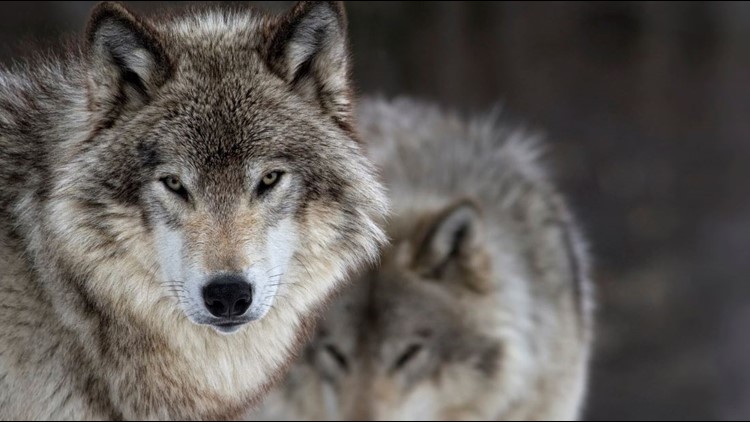
Credit: LeFion/ThinkStockWolvesAuthor:KTVB StaffPublished:8:30 PM MDT June 6, 2021Updated:8:30 PM MDT June 6, 2021
BOISE, Idaho — The Idaho Department of Fish and Game wants to hear from the public on a proposal to extend wolf hunting and trapping opportunities and enhanced methods of take. The proposed changes relate to a new state law that takes effect July 1.
Senate Bill 1211recently won approval from the Idaho Legislature and wassigned into lawby Gov. Brad Little. It extends wolf hunting and trapping with foothold traps to year-round on private property with landowner permission.
The law also expands the legal methods of take for wolves to include:
Weapon restrictions (for hunting big game) do not apply
Exemption from shooting hours
Hunting wolves over bait is allowed on private land
Guy McPherson is a professor emeritus of evolutionary biology, natural resources and ecology at the University of Arizona, and has been a climate change expert for 30 years. He has also become a controversial figure, due to the fact that he does not shy away from talking about the possibility of near-term human extinction.
Get the news you want, delivered to your inbox every day.
Email
While McPherson’s perspective might sound like the stuff of science fiction, there is historical precedent for his predictions. Fifty-five million years ago, a 5-degree Celsius rise…
A discussion of weather and climate of the Inland Northwest.
Wednesday, June 2, 2021
We’ve never seen a drought like this
We’ve never seen a drought like this
It’s well known that weather in the western US is drier than in the eastern US. As such, droughts are more common in the West. Most of the West is designed to accommodate this drier climate. The mountains get heavy snow in the winter, which slowly melts off in the spring and summer. There are numerous dams throughout the West which catch much of the snow melt, using it to irrigate our farmland (as well as generate electricity). This enables western farmers to grow crops in some rather arid locations. Still, there are some areas in the West that, similar to their eastern counterparts, rely solely on the rain and snow to irrigate their croplands. In the West we call this “dryland farming”. The biggest example of this is typically wheat and barley, but also includes a lot of hay. The Inland Northwest is known as one of the largest producers of wheat in the US.
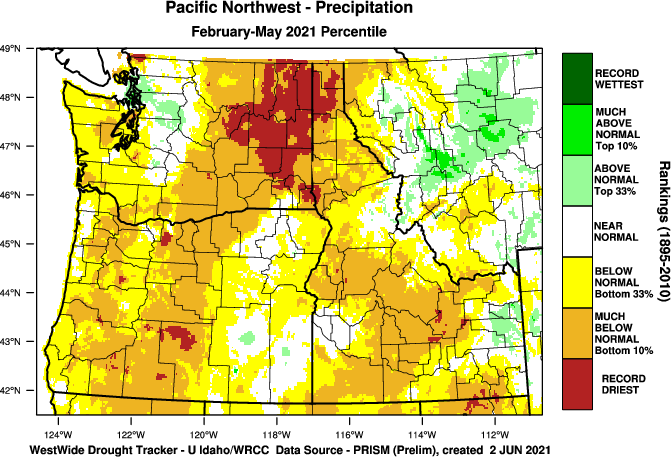
These dryland crops require moisture through the spring and into the early summer. Grains such as wheat and barley will ripen during the hot summer months and so they don’t really require much if any rain at that point until they are harvested in late summer. This matches the usual rainfall patterns we see here in the Inland Northwest. But not this year. Rainfall this spring hasn’t just been light, it’s been nearly non-existent. We haven’t seen anything like this before. Spokane just finished it’s driest February through May ever. EVER. Records for Spokane go back to 1881. That means this was the driest spring in 140 years! And it wasn’t just Spokane. The dark red area in the image below shows all of the areas that have had their driest February-May on record.
As you can see, it’s been dry over much of the Northwest this spring, but the Inland Northwest has been the epicenter of this dryness. The three month period of March through May was the driest for many other locations in the Northwest.
So the natural question is “what caused this drought?”. The answer isn’t straightforward and probably incomplete given our current understanding of weather and climate. One contributor that we are aware of is La Nina. To which you may be saying “I thought La Nina meant wetter than normal conditions for our area”, and you would be correct. Here’s a diagram showing the basic jet stream pattern for a typical La Nina that you may have seen before:
The purple and orange lines are meant to represent the variable jet stream patterns we normally see during a La Nina winter/spring. The purple line shows a colder phase of the jet stream, diverting up into Alaska and then bringing colder but drier air into the Northwest US. But then the jet stream will also at times follow the orange line, bringing Pacific moisture into the Northwest. The problem is that for the spring of 2021, we’ve seen a LOT more of the purple jet stream, and not so much of the orange jet stream. Note in the image above the big H and the blocking High Pressure in the Gulf of Alaska. Here’s the air pressure anomaly at about 18,000 feet in the atmosphere from the Feb-May period this spring.
What this shows is that the air pressure in the Gulf of Alaska has been higher than normal this spring. This compares very well with the idealized La Nina image previously shown with the Blocking High in the Gulf of Alaska. So this looks like what we would expect for a La Nina winter/spring. But now here’s the jet stream anomaly for this past spring:
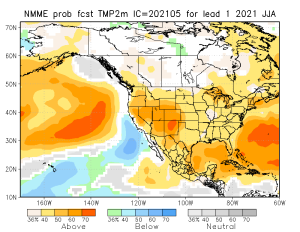
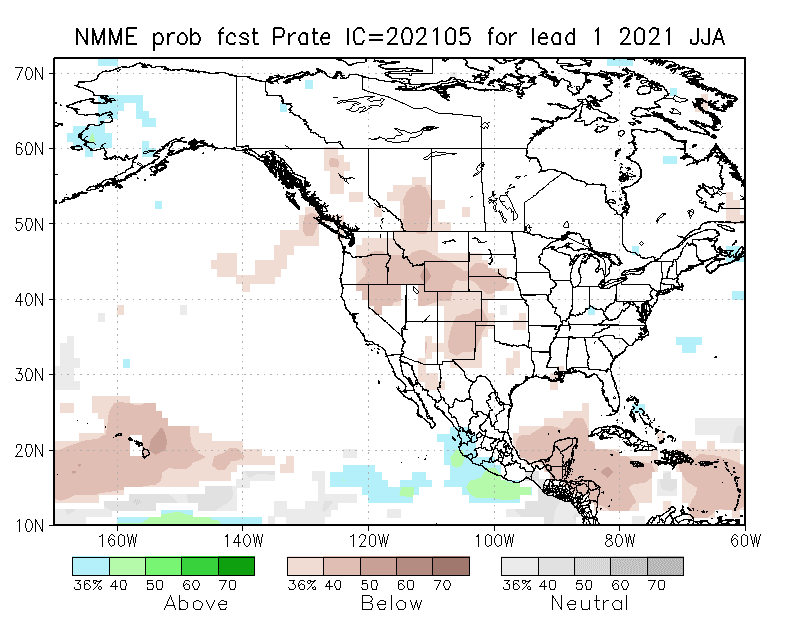
Do you see that ribbon of bright colors along the Canadian west coast? That shows that the jet stream this year has been coming from the northwest a lot more and a lot stronger than usual. Note that those bright colors extend all the way back to Alaska, across the north Pacifc and Kamchatka Peninsula. In other words, the “purple” jet stream has been doing its thing during a La Nina winter like it should. But then look at the other area of bright colors in the image above, out in the eastern Pacific. Those show that the jet stream across the Pacific has been much weaker and infrequent than normal. So the “orange” jet stream that is supposed to bring the moisture, hasn’t been doing its job this spring. The result is that we’ve been getting a lot more of the “purple” jet stream from the northwest (which is a dry weather pattern), and not nearly enough of the “orange” jet stream from the Pacific (which is a wet weather pattern). Is there any hope of this pattern changing? Officially, the Climate Prediction Center declared the 2020/21 La Nina over. That’s not to say that our weather pattern will necessarily change, especially since we are heading into the typical hot dry summer season. Here’s the computer forecast for the June-July-August season for temperature and precipitation. They call for a warmer and drier than normal summer overall all of the western US.
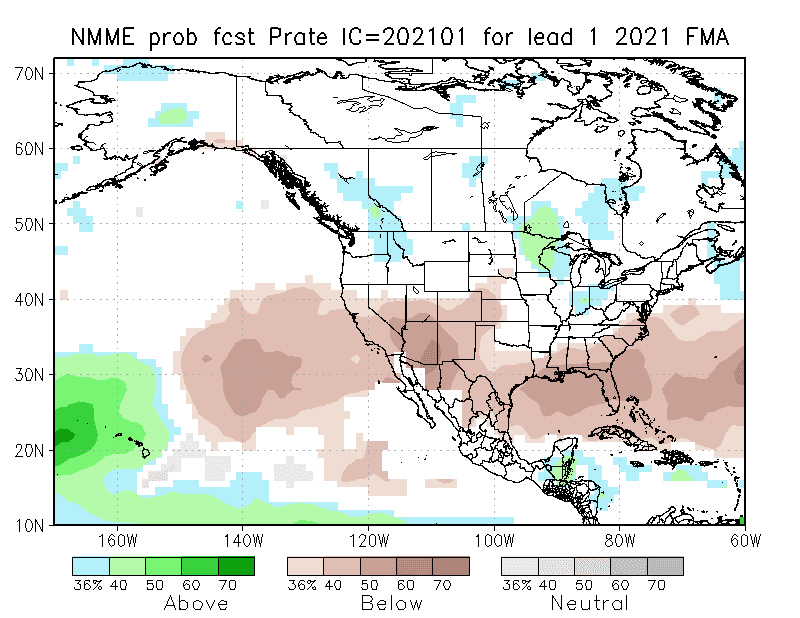
But this of course is a computer forecast. And you may be wondering if the computer forecasts correctly predicted our record dry spring. That’s a good question, and the answer is no, the computers never saw it coming. Here’s the forecast made back in February 2021 for the Feb-Mar-Apr timeframe. That area of light blue in the Inland Northwest shows that the computer actually expected that we would see normal or possibly wetter than normal conditions for our area, which agreed with the usual La Nina pattern.
What it’s about: Holy ordinance, Batman! During World War II, American scientists raced to develop crucial technology that would win the war: The B-29 bomber. Radar. The atomic bomb. And, a somewhat less crucial technology, the bat bomb: a bomb canister that contained live bats, each of which would carry an incendiary device and (in theory) start devastating fires across Japanese cities.https://www.dianomi.com/smartads.epl?id=3533
Biggest controversy: The part where we tried to defeat Imperial Japan with an army of bats. The idea came from a dental surgeon named Lytle S. Adams. An acquaintance of Eleanor Roosevelt, he wrote to the White House a month after Pearl Harbor suggesting the idea, which came to him during a trip to Carlsbad Caverns. Adams was “intrigued by the strength of bats” and believed they could carry an incendiary device, which could do serious damage to Japan’s largely wooden architecture.
With FDR’s approval, Adams led up an Air Force project to develop a bat bomb. His team for some wonderful reason consisted of a movie star (more on that later), an unnamed former gangster, an also unnamed former hotel manager, and chemist Louis Fieser, who developed the first synthetic vitamin K and cortisone, and more relevant to the war effort, napalm.
Their eventual prototype was a bomb-shaped metal canister with separate compartments for 1,040 Mexican free-tailed bats. The bomb would be dropped and then at 4,000 feet deploy a parachute, then open to release the bats. The bats would naturally roost in the eaves of buildings, but each one had a 15- to 18-gram payload of napalm (slightly heavier than the weight of the bat itself) on a timer. After several unsuccessful attempts at strapping the bombs to the bats, Adams’ team ended up gluing the devices directly to the bats.
Strangest fact: The only target destroyed by bat bombs was an American air base. Adams’ team made several tests of their bat bomb, but at Carlsbad Army Airfield Auxiliary Air Base in New Mexico, napalm-armed bats were accidentally released, roosted under a fuel tank, and set the base on fire. The project was then passed to the Navy and then the Marines and was renamed Project X-Ray.
Thing we were happiest to learn: America didn’t end up incinerating thousands of bats for the war effort. The Marines were surprisingly enthused about the bat bomb, believing the countless small fires the bats would start would be harder to fight and would spread more quickly than a smaller number of large fires caused by conventional bombing. But by mid-1944, with $2 million already spent on the project and at least another year until the bats would be combat-ready, the project was canceled. As for Fieser’s invention, the U.S. dropped napalm on Berlin and Tokyo without any animal intermediaries.
There are many of us who enjoy the outdoors with neither a gun nor a compound bow. Like hunters,most of that population works and looks forward to enjoying a Sunday without fear of being hit by a stray bullet.
Consider those of us with horses who enjoy riding or driving through woods and fields on crisp autumn days. According to Penn State Extension—which keeps track of the horse industry in Pennsylvaniaalong with the Pennsylvania Equine Council — that industry pumps $3.3 billion into the state economy$329 million of that comes from the recreational horse people who would be directly affected by Sunday hunting.
New cases, hospitalizations, and deaths are plummeting. What will it take to declare victory over COVID-19? Here’s everything you need to know:
Is the end near?Virologists are cautiously optimistic that by late summer, COVID-19 cases and deaths in the U.S. will fall so dramatically that life will return to near normal. Today, 135million Americans — more than half of all adults — have been fully vaccinated, and in 10 states, 70percent have received at least one dose. The Centers for Disease Control estimates that 100million Americans gained some immunity by surviving coronavirus infections (including asymptomatic ones). As a result, the pandemic is already exhibiting “exponential decay.” That’s a rapid plunge in transmission that occurs when the…
Visitors in masks dance with a band during a parade to mark the last day of the current season at Dubai Safari Park on May 31, 2021.Image Credit: Virendra Saklani/Gulf News
It was a seamless synthesis of science and art, expanding the frontiers of human knowledge while being eerily beautiful at the same time. That was the response when, in the 1960s, professor Henry Stommel, a pioneering oceanographer, introduced a model to his colleagues that explained the motions of ocean waters. Decades later, Dr. Michael E. Mann, a distinguished professor of atmospheric science at Penn State University, still marvels at what he describes as the “elegant” nature of Stommel’s model.
“It consisted of two boxes, a cold fresh box at high latitudes and a warm salty box at low latitudes, to represent the North Atlantic ocean,” Mann told Salon by email. “He showed that this simple model predicted an overturning ‘thermohaline’ circulation — a circulation driven by contrasts in ocean water density due to both temperature and salinity, each of which influence water density.”Advertisement:https://41ec6cc7d108e5e26a65e7bc9cd265db.safeframe.googlesyndication.com/safeframe/1-0-38/html/container.html
Thus, armed with a model so simple that it can be solved with algebra, scientists now understood the ocean currents in the Atlantic.
This is how scientists figured out what is called the Atlantic meridional overturning circulation, or “AMOC” for short. When it comes to the motion of the ocean, AMOC is essentially a complex system of conveyor belts. The first belt contains warm water that flows north, where it cools, evaporates and increases the salinity of the ocean water. That water then cools, sinks and flows south, creating a second major belt. These currents are connected to each other by regions in the Nordic Sea, Labrador Sea and Southern Ocean, keeping sea levels down on the United States’ eastern seaboard and warming up the weather in Europe.
This current system connects many different pieces of life on Earth: tides, hurricanes, sea levels, ocean life, salinity, fisheries, water pollution, temperatures, weather — all are affected by this current system. A sudden shift in how the Atlantic current system works would drastically change life on Earth.Advertisement:
Yet the more we learn about ocean currents, the more we have cause for alarm. A February study published in the journal Nature Geoscience reconstructed the history of the current going back 1,600 years and found that circulation is weaker now than at any other point in that span. They identified the most likely culprit as global warming. With the Greenland Ice Sheet and Arctic ice melting as the planet heats up, and rain and snow levels increasing, the water flowing north loses much of its salinity and density. This causes the water to flow south more slowly and weakens AMOC overall.
More recently, another study in the journal Nature Geoscience that identified the important role played by winds in causing changes in ocean circulation. As lead author Dr. Yavor Kostov of the University of Exeter said in a press release, scientists have struggled to understand the variability in AMOC because there are so many variables that have an effect on it. He noted that after learning that winds influenced circulation in both sub-tropical and sub-polar locations, scientists concluded that “as the climate continues to change, more efforts should be concentrated on monitoring those winds — especially in key regions on continental boundaries and the eastern coast of Greenland — and understanding what drives changes in them.”Advertisement:https://41ec6cc7d108e5e26a65e7bc9cd265db.safeframe.googlesyndication.com/safeframe/1-0-38/html/container.html
The obvious question, then, is: what will happen if climate change continues to weaken AMOC?
“This won’t lead to another ice age (like ‘The Day After Tomorrow,’ which is a caricature of the science), but it may well threaten fish populations and lead to accelerated sea level rise along the U.S. east coast,” Mann told Salon. “This is furthermore a reminder that there are surprises in the greenhouse, and often they are unwelcome ones. If we want to avoid more and more of these unwelcome surprises, we need to bring carbon emissions down dramatically in the years ahead.”
“AMOC acts as a relief valve for the Atlantic heat buildup in the tropics,” Trenberth explained. “In the Pacific there is no equivalent and the relief valve is ENSO,” which stands for “El Niño and the Southern Oscillation.”
Ken Caldeira, an atmospheric scientist at the Carnegie Institution for Science’s Department of Global Ecology, said that it is ultimately impossible to predict with certainty what will happen if AMOC slows down — but that it is very unlikely to be good.
“For me, it is not so much about the direct impacts of this particular change, which I think are highly uncertain, but rather if we are impacting major parts of planetary-scale processes and knocking them out of the range that they operated in (and we adapted to) over the entirety of human history, it is a pretty safe bet that we can anticipate some fairly nasty unknown unknowns,” Caldeira wrote to Salon. “That may be just indefensible bias that cannot be
Here are 5 of the most famous prehistoric creatures found preserved in the frozen depths of Siberia.
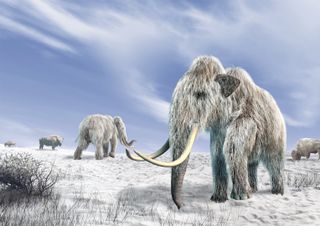
Woolly mammoths and prehistoric bison are among the prehistoric creatures found trapped in frozen time capsule of Siberia. (Image credit: Getty Images/Science Photo Library – LEONELLO CALVETTI)
These frozen prehistoric animals are superbly well-preserved and now famous around the world.
This woolly rhino baby, affectionately named Sasha by the man who found it, was the first young member of its species ever found. It’s unclear if it is male or female, but the horn size suggests it had been weaned by the time it died. It roamed the mammoth steppe, a dry, cold region from Spain to Siberia.
Scientists unearthed s squashed, mummified cat in eastern Siberia in 2017. It could either be a lynx kitten or a cave lion cub. Its coat is in beautiful condition, but we can’t be sure of the species as we don’t really know what a cave lion looked like.RECOMMENDED VIDEOS FOR YOU…Ancient Coronavirus InfectionHumans have been battling dangerous viruses since the beginning of time. An ancient coronavirus may have infected the ancestors of people living in modern-day East Asia starting 25,000 years ago and for millennia afterward, according to a new study.https://imasdk.googleapis.com/js/core/bridge3.463.0_en.html#goog_1699852498Volume 0% PLAY SOUND
Explorers unearthed two mammoth calves dating to about 40,000 years ago in two different areas of Siberia. Researchers took a closer look at the specimens using CT scans and discovered that both baby mammoths had choked on mud. The little mammoths appeared otherwise plump and healthy when they met their demise.
The most complete steppe bison specimen ever found is 9,000 years old. It has a complete heart, brain and digestive system, along with near-perfect blood vessels. Some organs have shrunk over time but are remarkable, nonetheless.
A two-month-old horse that died between 30,000 and 40,000 years ago made its way approximately 100 meters (328 feet) below the surface, deep in a Siberian crater. In life, the young horse stood almost 1 m (3 feet) tall, and its hooves are still intact, along with tiny hairs that are still visible inside the foal’s nostrils. Advertisement




 (Image:





 © Photo: Mondadori Portfolio (Getty Images)


 Ocean Current (Getty Images)