One of the fastest-warming regions of the U.S. is the Southwest — and that region, plus the broader West, is stuck in itsmost expansive and intense droughtof the 21st century.
Why it matters:Studies show that a warming climate is exacerbating the drought, and in some ways may be triggering it in the first place. That means the Southwest is drying out — and California’s large wildfires could start as soon as next month.
And one climate researcher says California’s Sierra Nevada Mountains saw one of the fastest snow melt-outs in history this year.
The drought situation is particularly severe in the Colorado River Basin and northern California. Scientists and public officials are warning that the California wildfire season is likely to be severe, due to the combination of dry vegetation and above-average temperatures.
President Bidensent a warning to the presidents ofChinaandRussiaduring his Memorial Day address on Sunday.
“I had a long conversation for two hours recently with [Chinese] President Xi [Jinping], making it clear to him we could do nothing but speak out for human rights around the world because that’s who we are,” Biden said. “I’ll be meeting with [Russian] President [Vladimir] Putin in a couple weeks in Geneva making it clear that we will not stand by and let him abuse those rights.”
WASHINGTON — Before he became a climate activist during his freshman year of college, Benji Backer had spoken at the Conservative Political Action Conference, written for right-leaning sites such as TownHall and RedState, and made a name for himself as a conservative commentator on television.
But like many other young people, he worried about climate change and didn’t see a place for himself in either the conservative movement, which mostly ignores or denies climate change, or the environmental movement, in which major institutes like the Sierra Club tend to align with Democrats.
“We want to plant a flagpole in the sand to say, this is an issue conservatives can and should lead on,” he said. “There is absolutely zero path to a zero emissions, climate change-free future without bipartisanship — and anybody who doesn’t accept that isn’t taking this seriously.”
The group has grown to more than 220 branches, many of which are on college campuses, with thousands of grassroots members and relationships on Capitol Hill.
The June 5 rally in Miami, a city that could wind up underwater if sea levels continue to rise, will feature like-minded Republicans such as Florida’s former Rep. Carlos Curbelo and Miami Mayor Francis Suarez, who has integrated climate adaptation into all of the city’s long-term planning.
“It is no longer an issue of the environment versus the economy; the environment is the economy,” Suarez said. “We hope to serve as a model of how conservative policies can protect the environment, invest in the future, and address the challenges of climate change.”
Backer and others say the partisan divide on climate is starting to narrow as people feel the effects of a warming climate and thanks to a rising generation of millennial and Gen Z voters who are far more likely than older Republicans to say human-caused climate change is real and that the government needs to do more about it.
Outside the left, many who care about the environment are turned off by what they view as the hectoring rhetoric of climate activists, Backer said.
“You have all these groups on the left, and then no groups on the right. That’s the market gap that we fit,” he said. “We are really the first and only grassroots movement in this space.”
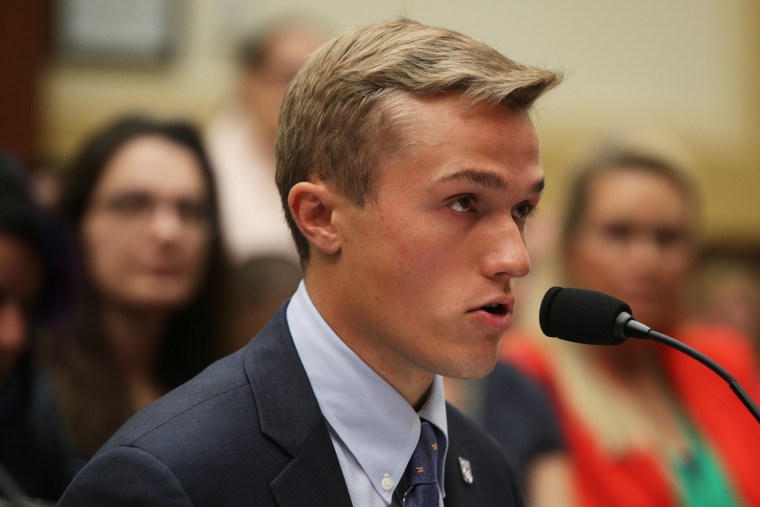
Benji Backer, president of the American Conservation Coalition, testifies during a House Foreign Affairs Committee hearing on September 18, 2019 on Capitol Hill.Alex Wong / Getty Images file
Focusing on more optimistic messages of innovation and local solutions can bring new people into the fold, he said, pointing to billionaire Elon Musk as an example of someone being rewarded in the market while reducing carbon emissions by popularizing electric vehicles.
In rural America, there’s a long history of conservation among hunters and fishermen, going back to former President Theodore Roosevelt, a Republican sportsman who founded the national park system, who now feel alienated by the culture of environmentalism and its often abstract goals.
“There are so many parts of this country that could be brought in if you can just make it about their backyards, something they can have personal buy-in,” said Backer, who spent much of last year on a cross-country road trip in a Tesla speaking with local groups. “And with climate change, that’s really easy to do that because it’s going to affect every community in this country.”
It focuses more on government carrots than sticks, such funding for clean energy research, and emphasizes nuclear power and carbon capture technologies, which progressive environments view warily.
“This shouldn’t be a partisan issue and it should be something that we can find sensible common ground on,” said Rep. Peter Meijer, R-Mich., a 33-year-old who thinks Republicans can champion a free market approach to climate solutions, told NBC News. “But that requires the Democratic Party to not greenwash economic redistribution efforts and it requires the Republican Party to stop denialism.”
The American Conservation Coalition has faced predictable criticisms from the left and the right, but has overlapping membership with both youth conservative groups like Turning Point USA and relationships with less politicized environmental groups, like the Nature Conservancy.
The group chose Miami for its first rally because it views Florida as an example of conservative leadership on climate.
Florida Gov. Ron DeSantis, a loyalist of former President Donald Trump who is eyeing his own 2024 presidential run, just signed legislation to prepare the state for rising sea levels and more severe storms that won overwhelming support in the GOP-controlled Legislature.
DeSantis notably did not talk much about climate change around the bill, nor does it address carbon emissions, but that may have helped depolarize the issue.
“We can debate all day the whys and how this happens,” Florida House Speaker Chris Sprowls, a Republican, said in response to Democratic criticism that it didn’t go far enough, “but if we just do that and we just debated all day, we wouldn’t do anything.”
Aylin WoodwardSat, May 29, 2021, 5:00 AM·7 min read
A fossilized mastodon skull and tusk discovered in an area of California east of Oakland.East Bay Municipal Utility District
A ranger patrolling a watershed area east of Oakland, California discovered a trove of hundreds of fossils last summer from nearly a dozen ancient species. The site contains hundreds of petrified trees as well.
It’s one of the largest fossil finds in California history, and new fossils are still being unearthed there almost every day.
The discovery include fossils from prehistoric elephants with four tusks, mammoth-like mastodons, tortoises, and camels. The findings have so far all been between 5 and 10 million years old.
The trove’s precise location remains a secret to protect the fossils and prevent looting.
The photos below show some of the findings so far.
Haverhill, MA – May 6: A site specialist employee with Curative waves to passing cars in Haverhill, MA on May 6, 2021. Haverhill area residents can get vaccinated by Curative at a pop-up clinic at an AMVETS Hall in Haverhill. Curative has been reaching out to hard-hit communities to encourage vaccination. Massachusetts is pivoting to a new outreach strategy in an effort to boost immunization among the unvaccinated. (Photo by David L. Ryan/The Boston Globe via Getty Images)
Dan Keating and Leslie ShapiroSat, May 29, 2021, 3:27 PM·6 min read
The country’s declining covid-19 case rates present an unrealistically optimistic perspective for half of the nation – the half that is still not vaccinated.
As more people receive vaccines, covid-19 cases are occurring mostly in the increasingly narrow slice of the unprotected population. So The Washington Post adjusted its case, death and hospitalization rates to account for that…
THEY WALKED IN on their own: the first wolves in more than 100 years known to call Washington state home, after this native species was nearly wiped out by hunting, trapping and government extermination campaigns.
Today, the Washington Department of Fish and Wildlife kills wolves only when they have repeatedly killed cattle, a relatively rare event, with about 80% of Washington wolf packs typically staying out of trouble with people.
Which brings us to the wolf that Ben Maletzke, statewide wolf specialist in the wildlife program for WDFW, likes to call The Old Guy.
WOLF 32M LIVED some 12 years as the patriarch of the Teanaway pack, kicking off the recovery of wolves in Washington despite living in cattle country, amid ranchettes, in a region that sees heavy recreational use year-round. He lost a mate to poachers, and the pack’s territory was roasted by wildfire in 2014. But still, wolf 32M and his family persisted, bringing the call of the wild back to the Central Cascades for the first time in a century, just two hours from Seattle.
Maletzke glided through powder on his snowmobile, a fresh snowfall providing perfect conditions for tracking work. Here, the winter ecology of the pack’s core territory was written in tracks. The soft sweep of grouse wings, the trot of a turkey, the hooves of mule deer and elk: all on the menu for a hungry wolf. But there was no sign of wolves that day. Maletzke was not surprised: “There are a lot of zeros when you are a wildlife biologist,” he said, changing out a data card in a motion-triggered wildlife camera.
Farther on the trail, he unpacked a chain saw to cut a tree fallen across the path, all in a day’s work for a backcountry biologist. “My mother says I got a Ph.D. in recess,” he said, gunning the snowmobile up into the mountains, into the core of the Teanaway pack’s home ground.
These wolves are what he calls steppingstones in recovery, the animals that could help lead the way to new territory, such as the vast sweep of country south of I-90 not yet recolonized by wolves. Recovery is still in early stages in Washington, with fewer than 200 wolves documented, and no statewide presence yet established.
Wolves disperse to new territory to find mates and begin packs of their own. Packs won’t overlap; the map Maletzke shows of known packs, with their movements tracked by radio collar, presents territories so strictly observed you would think they were fenced.
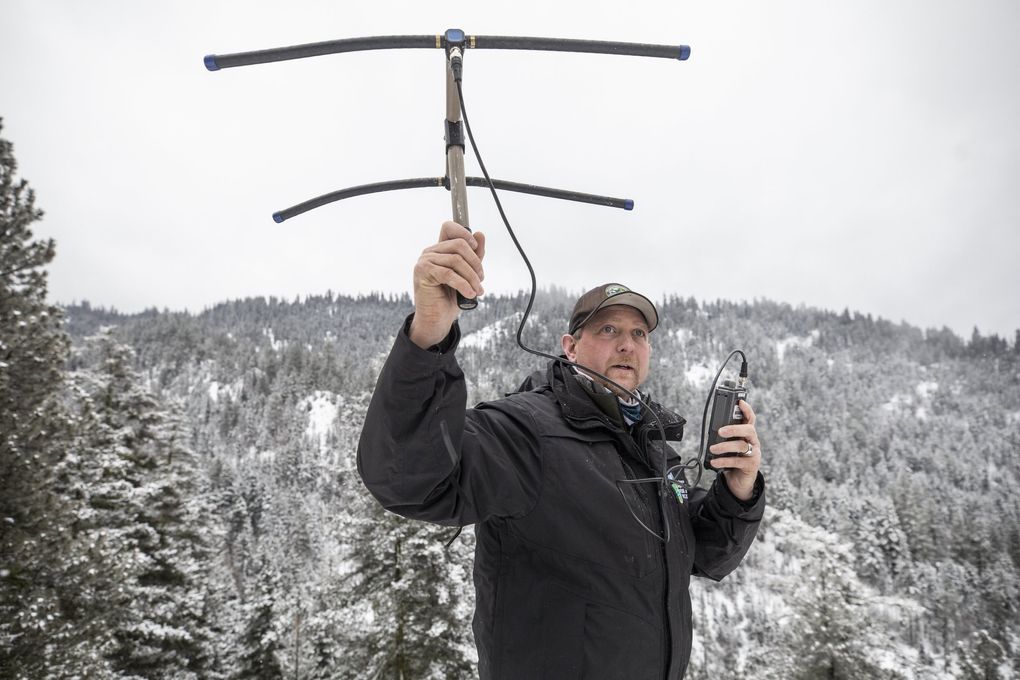
1 of 2 | Department of Fish and Wildlife biologist Ben Maletzke listens for the beeps from radio collars attached to wolves in the Teanaway pack. (Steve Ringman / The Seattle Times)
Wolves have few predators, but they can be killed by other wolves defending a territory or a kill. It is this pack dynamic that wildlife biologists are counting on, in time, to urge wolves into areas where they do not presently live. “We just need a couple to pick up and go,” Maletzke says. “It will happen.” For there are few animals more resilient or wily than the wolf.
WOLVES ARE THE most widely distributed of all land mammals, and one of the most adaptable.
The Bureau of Land Management (BLM) has reached a new cruel low with its Adoption Incentive Program (AIP), paying unscrupulous people to “adopt” wild horses and burros who then sell them to kill buyers all while telling the public they don’t send them to slaughter. Our tax dollars have been misused to remove the horses/burros off our public lands to be replaced with millions of cattle and sheep for far too long.
The BLM is preparing more roundups, leaving very few behind, and wants to use all kinds of birth control, some untested, as reported by the American Wild Horse Campaign. That is a recipe for extinction. A 2017 Public Policy Polling national survey found that 80% of Americans want Congress to keep anti-slaughter protections in place. Our voices are ignored in favor of the ranching industry that thinks it owns our public lands.
If taxpayers want this cruelty to stop, I urge them to contact their senators, representatives and the Department of Interior and tell them to rescind the AIP immediately, stop the roundups and reduce the ranchers’ grazing allotments. The millions of livestock are the ones degrading the landscape, not the thousands of horses/burros.
The successful rescue of two black bear cubs made for a wonderful story. But how many cubs orphaned by hunters during the ongoing spring black bear special permit hunting season will share the same reprieve?
Every spring, black bears emerge from their dens looking for food to nourish themselves and their newborn cubs. If a mother bear is killed during this hunt, her cubs are orphaned and do not survive. Why does Washington Department of Fish and Wildlife allow a hunt during such a vulnerable time?
Wildlife officials claim it is to manage timber damage. In truth the spring hunts solely provide more opportunity for hunters to kill bears at a time when…
(CNN)Travel is up, Covid-19 cases are down, and vaccines have been put in many arms.Thecoronavirus pandemicisn’t over, but Memorial Day weekend is set to look more like it did before the virusupended life more than a year ago.Americans Saturday were experiencing their first holiday weekend since the CDC changed itsmasking guidanceon May 13 — that fully vaccinated people don’t need to wear masks indoors, and they don’t have to keep their distance from others.
Mask mandates melted away. As of Friday, California, Hawaii, New Mexico were the only states with mask mandates for everyone.