A new study by Colorado State University researchers provides the most detailed accounting to date of the industry’scarbon footprint, a sum around which there is only limited understanding. What is clear, though, is that consumer demand for cannabis is insatiable and shows no signs of stopping as more states sign on to legalization.
The study, published inNature Sustainability,was led by graduate student Hailey Summers, whose advisor, Jason Quinn, is an associate professor in the Department of Mechanical Engineering. Summers, Quinn…
A billion years from now, as the sun heats up, the warmer atmosphere will break down carbon dioxide, killing off plant life, which in turn will shut off Earth’s source of oxygen.Sharing is caring!
Take a deep breath. The air expanding your chest is mostly nitrogen and oxygen, the chief components of our atmosphere. Oxygen exists in our atmosphere thanks to the exhalation of plants, through the process ofphotosynthesis. A study released in March 2021 shows that – a billion years from now, as the sun heats up – plants will die off, taking with them the oxygen in our atmosphere that…
“Trophy hunting is often seen as an aberration by a handful of individuals. However this investigation shows it is a large, powerful industry with a well-oiled and generously-funded lobbying machine.”
—Eduardo Goncalves
I had the good fortune to ask Patrick Hemingway about elephants just at the beginning of the worst conservation tragedy of the last decade — the slaughter of 130,000 elephants. “Enormous silly beasts,” as his father Ernest described them in “True at First Light.”He told me from his home in Montana, “For my money the elephant will soon be gone.” He of course recognized the royal “sport” for what it was, a colonial fabrication that belongs to the old days.Humanity lost a third of the world’s elephants due to poaching, often in…
This story was originally published by The Revelator.
Ahailstorm in South Texas. Tornadoes in Tennessee. Wildfires across the West. A barrage of Gulf Coast hurricanes. Those are among the record 22 weather and climate disasters that each topped $1 billion in damages last year in the United States.
In all, the price tag for 2020 hit a whopping $95 billion — and that’s just in the United States. Reinsurance firm Swiss Re put global economic losses at $175 billion last year, including $32 billion for floods in China and $13 billion in damages from Cyclone Amphan across India and Bangladesh.
The worst news? Our profligate burning of fossil fuels means we’re in store for more.
Studies show that climate change is supercharging some weather and climate events and will lead to more severe and longer-lasting heat waves, stronger hurricanes, an increased wildfire risk and a longer wildfire season. We can also expect more heavy rain events and severe droughts, not to mention other extreme events like February’s polar vortex.
“You can’t attribute any particular storm to climate change, but what we do know is that climate change tips the odds of making many of these events more severe,” says Bruce Stein, chief scientist and associate vice president at the National Wildlife Federation.
While experts tabulate the economic losses — homes destroyed, crops ruined, businesses shuttered — ecosystems and wildlife can also sustain damage that’s harder to quantify.
Many plants and wildlife evolved with and have adapted to dealing with large-scale disturbances, but we’re beginning to see “megadisturbances” at levels beyond what we saw in the past, says Stein.
And that can take a toll. Extreme weather can kill animals directly — or indirectly, like by destroying food sources, contaminating water or altering habitat, forcing a species to move into areas where there may be more competition, fewer resources or a greater risk of predation.
“What we begin to find when you get some of these mega disturbances is that it’s beyond the ability of a species — or their adaptive capacity — to bounce back,” says Stein.
The Research
The effects of climate change on the natural world are being felt at two speeds. One is more gradual, referred to by scientists as “ramping” — shrinking glaciers, rising sea levels. The second is quick, like extreme weather events.
Both are problematic, says Sean Maxwell, a postdoctoral research fellow at the University of Queensland’s Centre for Biodiversity and Conservation Science. But, he adds, “I think the changes to acute events have the greatest potential to devastate local populations or ecosystems, and the impacts of these events are often more difficult to plan for or avoid.”
Maxwell was the lead author of a 2018 study published in the journal Diversity and Distributions that examined how changes in the frequency and intensity of extreme weather and climate events affected wildlife. The researchers looked at 519 studies of ecological responses to extreme events — including cyclones, droughts, floods, and heat and cold waves — that took place from 1941 to 2015. They found that the response was negative 57% of the time. (And in those instances where species benefited, they were mostly invasive species.)
“Some of the negative responses we found were quite concerning, including more than 100 cases of dramatic population declines and 31 cases of local population extinction following an extreme event,” says Maxwell. “Populations of critically endangered bird species in Hawai’i, such as the palia, have been annihilated due to drought, and populations of lizard species have been wiped out due to cyclones in the Bahamas.”
Plant species, the researchers found, had the highest number of negative responses to extreme events, followed by reptiles and amphibians.
“Collectively, the studies in our review suggest that extreme weather and climate events have profound implications for species and ecosystem management,” the researchers concluded.
The Most Vulnerable
Species that are already threatened or endangered are of course especially at risk.
Take the Attwater prairie chicken. A million of these birds once ranged across the prairies of Texas and Louisiana.
Today fewer than 100 remain in the wild and scientists have sought to bolster their populations with captive breeding programs. But when Hurricane Harvey walloped Texas with 130-mile-per-hour winds and record rainfall in 2017, the birds were right in harm’s way.
“The Attwater Prairie Chicken National Wildlife Refuge tracked 29 individual birds, mostly hens. Post-hurricane, staff confirmed only five of them still alive,” Texas Climate News reported. “The hurricane also killed roughly 80% of a prairie chicken population on private property in Goliad County.”
Other species with limited ranges, like those on islands, also face big threats.
“If a species is well distributed, then if one part of its range gets hit, there’s the ability for it to recover,” says Stein. “But if essentially all its eggs are in one basket, and that particular place gets hit by one of these big disturbances, that’s when you have a real concern.”
In 2017 Hurricane Maria cut the population of just 200 Puerto Rican parrots in half. The year before, Hurricane Matthew was believed to have wiped out the last Bahama nuthatches (Sitta insularis). It took two years before a few of the birds were found — and then Hurricane Dorian struck in 2019, making their survival unlikely, according to Diana Bell, a professor of conservation biology at the University of East Anglia.
“In fact, Dorian may have not only sealed the fate of the nuthatch but also severely impacted other birds endemic to these islands, particularly the Bahama warbler and the Abaco parrot,” Bell wrote in an essay for The Conversation. “Also known as the Bahama Amazon parrot, this subspecies uniquely nests in limestone cavities on the ground which are likely to have been flooded by the storm surge.”
Compounding Crises
The risk to wildlife from extreme storms can be compounded by the ramping effects of climate change, too.
“If you have increasingly severe hurricanes where you’ve also got sea-level rise essentially providing a higher lodge point for the storm surge, then you start seeing impacts beyond the historical record,” says Stein.
In other places, extreme weather is an extra blow to species already struggling with other environmental pressures, like habitat loss, invasive species or pollution.
Last year the world watched in horror as land-use management, climate change and drought helped push Australia’s bushfires to a terrifying new level, killing 34 people and burning 37,500 square miles.
A study published in Nature Ecology and Evolution found that the fire impacted the critical habitat of 832 native species, with 70 species losing more than 30% of their natural range. Twenty-one of those were already at risk of extinction.
Those that survived could find themselves hard-pressed in future climate disasters. “Multiple extreme events are likely to act in synergistic ways to exacerbate risk of species’ extinction,” wrote Maxwell and the other researchers of the 2018 study.
Australia already has one of the highest extinction rates, and the wildfires could limit the capacity of some species to recover — like the endangered Kangaroo Island dunnart and the long-footed potoroo — and threaten others. Australia’s record blazes last year could push the number of endangered species in the country up by 19%, the study in Nature Ecology and Evolution found.
Solutions
When Hurricane Irma sacked the Florida Keys in 2017, the storm tossed boats ashore, destroyed more than 1,000 homes and left a trail of debris across the islands.
It also endangered one of the region’s beloved endemic species, the tiny Key deer, which today primarily live on Big Pine Key. Some deer were killed in the storm, and surviving animals faced threats to their already limited freshwater supply as the storm surge dumped saline ocean water into freshwater pools.
Island residents responded the way folks often do after a disaster — they offered help to their neighbors.
“What you saw during and shortly after Irma is that these Key deer were coming up to houses looking for fresh water,” says Stein. “And people were putting out kiddie pools of water for them.”
Following Australia’s bushfires last year, the country’s government jumped to the aid of wildlife by dropping 4,000 pounds of carrots and sweet potatoes to starving brush-tailed rock-wallabies who lost their food source in the blazes.
“There’s a lot of things that we can do to help human communities as well as wildlife after these acute disturbances,” says Stein.
But beyond immediate food and water relief, there’s a much bigger task ahead: reducing greenhouse gas emissions to address the ongoing dangers of climate change and the ability of ecosystems to adapt. Key deer, for example, also face a long-term threat to their drinking water supply from rising seas, something no number of kiddie pools can repair. And more severe hurricanes are likely in their future, too.
“As climate change continues to ensure extreme climate and weather events are more and more common, we now need to act to ensure species have the best chance to survive,” says Maxwell. “Wherever possible, high-quality and intact habitat areas should be retained, as these are the places where species are most resilient to increasing exposure to extreme events.”
If such intact habitat doesn’t exist, ecological restoration efforts can be used to help species adapt, his study found.
And the more we know, the better.
“Incorporating extreme events into climate change vulnerability assessments and adaptation plans will be challenging,” the researchers of the 2018 paper concluded. “But by doing so we have a greater chance of arriving at conservation interventions that truly address the full range of climate change impacts.”
And that could give more species a fighting chance in a changing climate.
A love of complex smells and flavours gave our ancestors an edge and stove pped hangoversDonna FergusonSun 7 Mar 2021 01.16 EST
279
Human evolution and exploration of the world were shaped by a hunger for tasty food – “a quest for deliciousness” – according to two leading academics.
Ancient humans who had the ability to smell and desire more complex aromas, and enjoy food and drink with a sour taste, gained evolutionary advantages over their less-discerning rivals, argue the authors of a new book about the part played by flavour in our development.
Some of the most significant inventions early humans made, such as stone tools and the controlled use of fire, were also partly driven by their pursuit of flavour and a preference for food they considered delicious, according to the new hypothesis.Advertisementhttps://5037925012011699e0d1c13b2cbcd914.safeframe.googlesyndication.com/safeframe/1-0-37/html/container.html
“This key moment when we decide whether or not to use fire has, at its core, just the tastiness of food and the pleasure it provides. That is the moment in which our ancestors confront a choice between cooking things and not cooking things,” said Rob Dunn, a professor of applied ecology at North Carolina State University. “And they chose flavour.”
Cooked food tasted more delicious than uncooked food – and that’s why we opted to continue cooking it, he says: not just because, as academics have argued, cooked roots and meat were easier and safer to digest, and rewarded us with more calories.
Some scientists think the controlled use of fire, which was probably adopted a million years ago, was central to human evolution and helped us to evolve bigger brains.
“Having a big brain becomes less costly when you free up more calories from your food by cooking it,” said Dunn, who co-wrote Delicious: The Evolution of Flavour and How it Made Us Human with Monica Sanchez, a medical anthropologist.Advertisementhttps://5037925012011699e0d1c13b2cbcd914.safeframe.googlesyndication.com/safeframe/1-0-37/html/container.html
However, accessing more calories was not the primary reason our ancestors decided to cook food. “Scientists often focus on what the eventual benefit is, rather than the immediate mechanism that allowed our ancestors to make the choice. We made the choice because of deliciousness. And then the eventual benefit was more calories and fewer pathogens.”
Human ancestors who preferred the taste of cooked meat over raw meat began to enjoy an evolutionary advantage over others. “In general, flavour rewards us for eating the things we’ve needed to eat in the past,” said Dunn.
In particular, people who evolved a preference for complex aromas are likely to have developed an evolutionary advantage, because the smell of cooked meat, for example, is much more complex than that of raw meat. “Meat goes from having tens of aromas to having hundreds of different aroma compounds,” said Dunn.
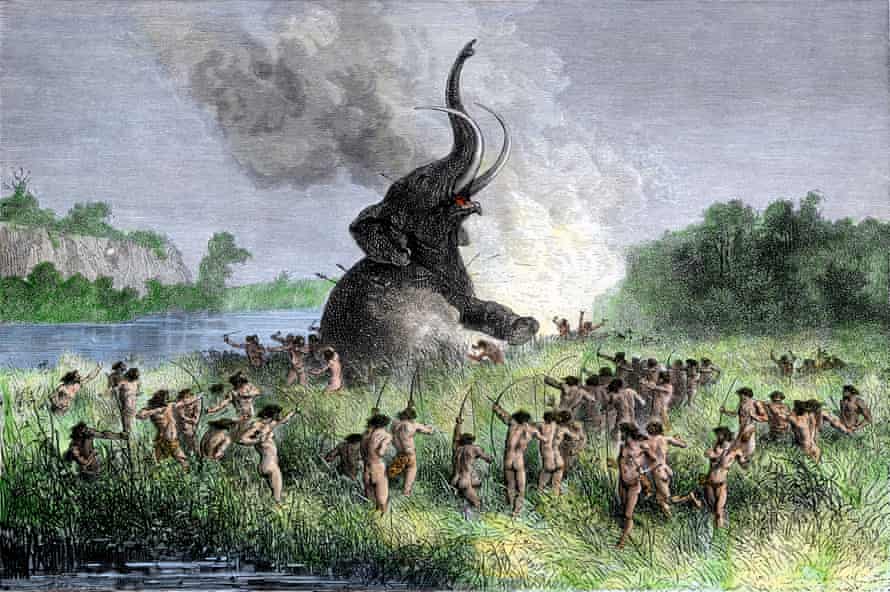
Prehistoric woolly mammoth hunters. Photograph: North Wind Picture Archives/Alamy
This predilection for more complex aromas made early humans more likely to turn their noses up at old, rotten meat, which often has “really simple smells”. “They would have been less likely to eat that food,” said Dunn. “Retronasal olfaction is a super-important part of our flavour system.”
The legacy of humanity’s remarkable preference for food which has a multitude of aroma compounds is reflected in “high food culture” today, Dunn says. “It’s a food culture that really caters for our ability to appreciate these complexities of aroma. We’ve made this very expensive kind of cuisine that somehow fits into our ancient sensory ability.”Advertisement
Similarly, our proclivity for sour-tasting food and fermented beverages like beer and wine may stem from the evolutionary advantage that eating sour food and drink gave our ancestors.
“Most mammals have sour taste receptors,” said Dunn. “But in almost all of them, with very few exceptions, the sour taste is aversive – so most primates and other mammals, in general, will, if they taste something sour, spit it out. They don’t like it.”
Humans are among the few species that like sour, he says, another notable exception being pigs.
At some point, he thinks, humans’ and pigs’ sour taste receptors evolved to reward them if they found and ate decomposing food that tasted sour, especially if it also tasted a little sweet – because that is how acidic bacteria tastes. And that, in turn, is a sign that the food is fermenting, not putrefying.
“The acid produced by the bacteria kills off the pathogens in the rotten food. So we think that the sour taste on our tongue, and the way we appreciate it, actually may have served our ancestors as a kind of pH strip to know which of these fermented foods was safe,” said Dunn.
Human ancestors who were able to accurately identify rotting food that was actually fermenting, and therefore OK to eat, would have had an evolutionary advantage over others, he argues. If they also figured out how to safely ferment food to eat over winter, they further increased their food supply.
The negative consequence of this is that fermented, alcoholic fruit juice, a sort of “proto wine”, would also have tasted good – and that probably led to horrific hangovers.
“At some point, our ancestors evolved a version of the gene that produces the enzyme that breaks down alcohol in our bodies, which is 40 times faster than that of other primates,” added Dunn. “And so that really made our ancestors much more able to get the calories out of these fermented drinks, and it would also probably have lessened the extent to which they had hangovers every day from drinking.”Advertisementhttps://5037925012011699e0d1c13b2cbcd914.safeframe.googlesyndication.com/safeframe/1-0-37/html/container.html
Flavour also drove humanity to innovate and explore, Dunn says. He thinks one reason our ancestors were inspired to begin using tools was to get hold of otherwise inaccessible food that tasted delicious: “If you look at what chimpanzees use tools to get, it’s almost always really delicious things, like honey.”
Having a portfolio of tools that they could use to find tasty things to eatgave our ancestors the confidence to explore new environments, knowing they would be able to find food, whatever the season threw at them. “It really allows our ancestors to move out into the world and do new things.”
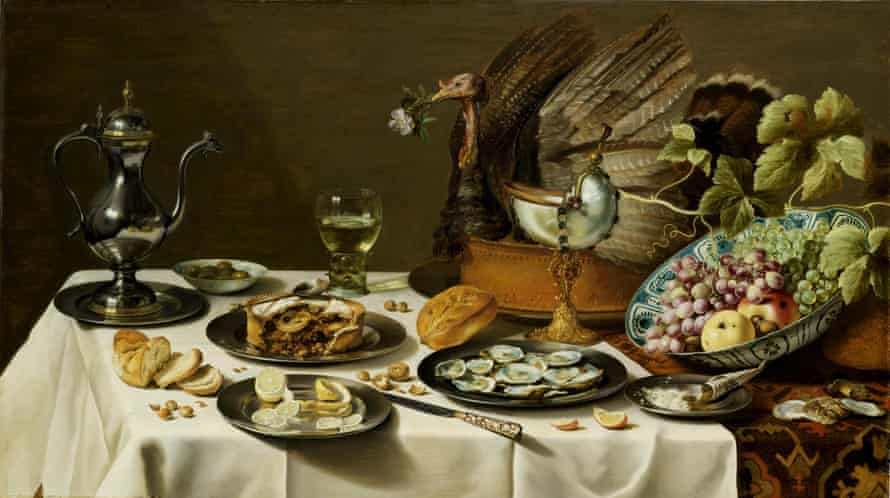
Still Life with a Turkey Pie, by Pieter Claesz, 1627. Photograph: FineArt/Alamy
Stone tools in particular “fast-forward” the ability of humans to find delicious food. “Once they can hunt, using spears, they have access to this whole world of foods that were not available to them before.”
At this point, Dunn thinks humanity’s pursuit of tasty food started to have terrible consequences for other species. “We know that humans around the world hunted species to extinction, once they figured out how to hunt really effectively.”
Dunn strongly suspects that the mammals that first went extinct were the most delicious ones. “From what we were able to reconstruct, it looks like the mammoths, mastodons and giant sloths all would have been unusually tasty.”Paleolithic diet may not have been that ‘paleo’, scientists sayRead more
To replicate the eating habits of prehistoric humans, the book, published later this month, details how one scientist dropped a horse who had just died into a pond and assessed how it fermented over time. “He would sample some meat to see if it was safe to eat. He described it as delicious – a little bit like a blue cheese,” said Dunn.
Until now, researchers have found no evidence of global tectonic activity on planets outside our solar system. Under the leadership of theUniversity of Bernand the National Center of Competence in Research NCCR PlanetS, scientists have now found that the material inside planet LHS 3844b flows from one hemisphere to the other and could be responsible for numerous volcanic eruptions on one side of the planet.
On Earth, plate tectonics is not only responsible for the rise of mountains and earthquakes. It is also an essential…
The neighbour of a woman whose 14-year-old rescue cat was savagely mauled to death by a group of hunting hounds caught the whole shocking incident on camera.
In the video, which CornwallLive has seen and a screenshot has been taken from above, the huntsman can be seen picking up the body of Mini, a black rescue cat, and throwing it over the fence of one of the neighbours’ gardens, in the usually quiet street…
Photo by Davida G. Breier. Tractor Supply chicks never experience the comfort and care of their own mother hen. They’re nothing but things for this company to make money from.
“I am not sure to whom I should file a complaint. Perhaps you can point me in the right direction. I went to Tractor Supply to pick up sunflower seeds and to my horror I saw baby chicks for sale in a new display that houses the chicks of different breeds stacked on top of each other and they are walking on wire mesh! It was very disturbing and quite different from how they were housed last year. There is no place for them to rest/sleep comfortably and they looked very stressed. Thank you very much for reading my email. Please let me know if there is anything I can do. I am a certified veterinary technician and understand farming and keeping chickens. This new setup at Tractor Supply is inhumane.”
What Can I Do?
Sign and share our Change.org petition to Tractor Supply, which includes direct contact information for the company CEO Hal Lawton. Sign & Share.
Contact Mr. Lawton and tell him what you saw at your local store. Tell him the situation is inhumane and that you will not shop at Tractor Supply until it is rectified.
Speak to the local store manager and urge that the store provide proper bedding, sheltered resting areas and other comforts for these suffering chicks.
Post a comment. Each Tractor Supply store appears to have its own local Facebook page where it is advertising baby chicks for sale.
Write a letter to the editor of your local newspaper(s) about this inhumane situation.
Alert your local humane society and urge them to intervene with the local Tractor Supply to help these chicks.
Tractor Supply and other farm supply stores are notoriously neglectful and indifferent toward the chicks and ducklings they display and sell each spring in thousands of local stores. This new way of keeping these baby birds, in stacked drawers on wire mesh, exceeds even the traditional inhumaneness. In addition, these stores are teaching customers by their example that such inhumane treatment is acceptable, thus encouraging buyers to imitate the abuse.