“Several flaws and issues were brought to the attention of the committee the resolution sponsor and because of those flaws and issues,” said Director of the Songbird Protection Coalition Julie Baker. “The vote to allow the recreational killing of sandhill cranes was postponed as of today, sadly though that does not mean Michigan sandhill cranes are safe but it does…
The following is a letter to the editor submitted to the newspaper by a reader. It does not necessarily reflect the views of the Echo Press. To submit a letter, send it to aedenloff@echopress.com or Echo Press, P.O. Box 549, Alexandria, MN 56308.7:25 am, Mar. 5, 2021
To the editor:
The public perception problem that Minnesota trappers are facing is of their own making (“Minnesota trappers fight public perception and dwindling participation,”Feb. 26 Echo Press). The gruesome pictures featured in that article are worth a thousand words of PR spin, and make it clear that trapping is a cruel pastime that has no place in modern society.
Most trapped animals are not killed for food, but rather to fuel the global fur trade. They die in steel-jaw leghold traps, which tear flesh, cut tendons and ligaments, and break bones and teeth as trapped animals bite –…
The Whale Entanglement Prevention Act introduced on Feb. 10 proposes that trap fisheries such as the crabbing industry use ropeless gear by Nov. 1, 2025, to stop the injury or accidental death of endangered marine life.click to enlarge
Photo By Jayson Mellom
GEAR CONTROVERSY Dungeness crab fishermen say they oppose new legislation that would mandate ropeless gear because it’s not effective and it’s overpriced.
Authored by Assemblymember Rob Bonta (D-Oakland) in collaboration with Social Compassion in Legislation and the Center for Biological Diversity, Assembly Bill 534 argues that crabbers use antiquated trapping gear that needlessly harms marine life.
California Coast Crab Association President Bejamin Platt said the industry has been against ropeless gear because it’s not cost-effective—the current price for the gear is more than $1,700.
“This is a particularly expensive gear type that no fisherman could afford and its incredibly slow and inefficient compared to what we do,” Platt said.
Dungeness crab fisherman typically use circular steel traps that are submerged onto the seafloor. The traps are attached to lines marked by floats on the sea’s surface that fisherman can pull to retrieve their traps.
The legislation proposes crabbers use ropeless gear with wireless technology that summons the trap back to the surface. However, several start-ups are still in the gear prototype testing phase.
Platt said that the fisherman have less than a minute to pull a pot from the ocean, rebait it, and put it back in the water.
“This [ropeless] gear, which every prototype that we’ve seen so far takes from eight to 10 minutes for each pot to be called back. It’s an electronic signal that has failed 20 percent of the time. So if I’ve got a 400-pot permit on my boat and I lost 20 percent of my gear every time I went out to try this gear, I would lose 80 pots. I’d be out of business within a couple of trips,” he said.
Platt said mandating ropeless gear will mean the end of the Dungeness crab fishery.
The Dungeness crab industry has taken its own steps to reduce the potential for entaglements. On March 2020, Fish and Wildlife approved the Lost or Abandoned Dungeness Crab Trap Gear Retrieval Program, a practice that Platt said many ports in the state already participate in.
At the end of every season, fishermen go out into ocean and look for abandoned or lost traps and return them to the owner, who pays a fee for its return. If the owner refuses to accept a crabpot’s return, their permit allocation is reduced. The industry also created a best practicies guide, which calls for reducing the length of the buoy lines attached to traps.
AB 534 is the Center for Biological Diversity’s latest move in its pursuit to eliminate entanglements. In 2017, the organization sued the California Department of Fish and Wildlife for failing to prevent commercial Dungeness crab gear from entangling, injuring, and killing humpback whales, blue whales, and sea turtles in violation the Endangered Species Act.
The parties settled the lawsuit the following year and created the Risk Assessment Mitigation Program (RAMP), which looks at data and analyzes where/when entanglement risks are higher to dictate the start or closure of Dungeness crab fishing seasons. Center of Biological Diversity Oceans Legal Director Kristen Monsell told New Times that while the RAMP regulations are a good first step, it doesn’t eliminate the risk to marine life entirely.
“Those regulations only apply to commercial Dungeness crab gear. We know that whales and sea turtles are getting tangled up in other fishing gear,” Monsell said. Δ
STATE HOUSE, BOSTON, MA (02/17/2021) – Gov. Charlie Baker held a State House press conference on Feb. 17, 2021 to announce that COVID-19 vaccine eligibility was expanding to include people age 65 and older. (Pool Photo)
Kills quickly exceeded statewide limit, forcing the state to end the hunting season earlyhttps://www.theguardian.com/us-news/2021/mar/03/wisconsin-hunters-kill-216-wolves-less-than-60-hours-uproar?utm_term=a04130d2fd9993ff9b973e5d36f72114&utm_campaign=GreenLight&utm_source=esp&utm_medium=Email&CMP=greenlight_email
Gray wolves in the North American wilderness.Photograph: GatorDawg/Getty Images/iStockphoto
Hunters and trappers inWisconsinkilled 216 gray wolves last week during the state’s 2021 wolf hunting season – more than 82% above the authorities’ stated quota, sparking uproar among animal-lovers and conservationists, according to reports.
The kills all took place in less than 60 hours, quicklyexceedingWisconsin’s statewide stated limit of 119 animals.
As a result, Wisconsin’s department of natural resources ended the season, which was scheduled to span one week, four days early.
Photographer Kunal K. Singh documented Grizzly 399 in a rare photograph taken last June that shows her protecting her cubs after another bear got too close for comfort.Photo by Kunal K. Singh359SHARES
Grizzly 399, often called the world’s most famous grizzly bear, has a fan base of wildlife watchers that numbers in the hundreds of thousands. Each year, dozens of paparazzi attempt to record her every waking moment, from the time she emerges from her den in the Greater Yellowstone Ecosystem in the spring until the time she goes back into hibernation in the late fall. She even has two entire books devoted to her.
This week, 399, as she was named by scientists who study grizzly bears, made news again when a photographer spoke to the media about how he documented her in a rare…
It’s less than a foot in length, with subdued brown-and-gold plumage, a black beak and beady red eyes. If you saw one sitting on a branch in front of you, you might not give it a second glance.
But this Southeast Asian native stands out in one notable way: It sings like an angel.
“It’s arguably the most beautiful song of any bird,” says Chris Shepherd, executive director of Monitor Conservation Research Society and an expert on Asian songbirds. “It’s amazing,” he adds.
The bird’s beautiful voice serves a vital ecological purpose: Males use it to attract mates. The better the song, the greater the chance of finding a female and propagating the species.
But the song has also come with a terrible modern cost. Humans have come to value the bulbul’s calls so much that they’ve collected the birds from almost every inch of their habitat. Captured birds, quickly caged, have been shipped to markets throughout Southeast Asia. Due to this overwhelming commercial demand, the species has disappeared from most of its range and is now critically endangered. Only a few pocket populations continue to hang on.
And the straw-headed bulbul is far from alone in this decline. Practically every songbird species in Southeast Asia faces a similar predicament. Many birds face the very real risk of imminent extinction, leaving some forests in the region eerily silent.
Recent research finds that several songbirds have become perilously close to vanishing — if they haven’t been lost already.
One Indonesian bird, the Simeulue hill myna, has only just been described as genetically and morphologically unique from other lookalike species. It probably went extinct in the wild in the past two or three years, according to a paper published last spring in the journal Ibis. As the researchers wrote, “On multiple recent excursions to Simeulue, most recently in July 2018, we were unable to find the bird and learned from locals that there had been a great drive to catch the last survivors on the island in response to a wealthy person’s bounty on these birds.”
The paper calls this an “extinction-in-process” and warns that any remaining birds left in captivity may die without producing offspring. Even if they do manage to breed, the researchers fear they could be hybridized with other similar-in-appearance mynas, obscuring their genetic lineage.
That same phrase, extinction-in-process, has also been used to describe the Barusan shama, which according to a 2019 study published in the journal Forktail has become one of the most threatened of Asian songbirds due to rampant collection. It’s now gone from all but one island.
Like the Simeulue hill myna, the Barushan shama’s plight went virtually unnoticed for years because many taxonomists have classified it as a subspecies rather than a full species. Newer research finds that it’s a species with four subspecies, few of which may now survive.
Not that the species/subspecies disputes matter too much at this point.
“Taxonomic debates about the rank of these forms should not stand in the way of trying to ensure the survival of what is clearly an evolutionarily distinct lineage,” says Frank Rheindt, a biologist with National University of Singapore and senior or lead author on both of the papers.
So what happens to these birds once they’re taken from the wild?
That’s where the story gets even bleaker.
Disposable Love
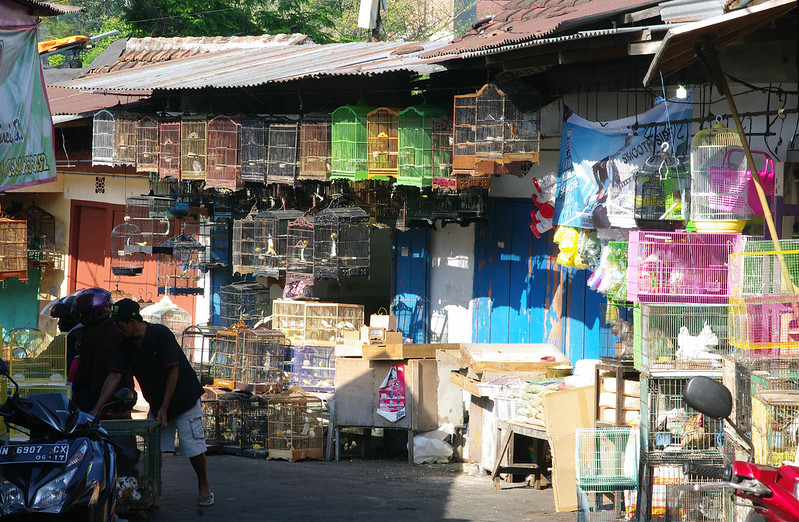
Songbirds are an important element of culture and tradition for many peoples in Southeast Asia. In Java, for example, it’s almost assumed that every household will have at least one pet songbird. The more birds, the more prestigious the home.
But wild songbirds in captivity…well, they don’t tend to last long.
“We’ve often called the caged songbird trade like cut flowers,” says Shepherd. “The birds look nice. They’re often inexpensive. You bring one home. It sits in a cage for a couple of days and it dies just like a cut flower. They’re not expected to live.”
And because many Asian cities feature massive markets full of birds that have been easily snatched from the wild — usually illegally — any bird that dies is relatively easy and inexpensive to replace.
Cages line the Malang bird and animal market on Java in 2016, Photo: Andrea Kirkby (CC BY-SA 2.0)
Even bird traders don’t put much value on their stock, since a new supply of wild-caught birds always seems to be waiting in the wings.
“I’ve seen some cages where the surviving birds are all sitting on top of dead birds in the cages,” Shepherd says. “You can’t see the floor of the cage. It’s covered with a few layers of dead birds, and then there’s some sick and half-dead birds perched on top of them. And they cost the dealers next to nothing. So, you know, even if they sell a few, they think they must be covering their costs or you wouldn’t have a business model like that.”
Although all of this seems to favor low-cost disposability, some species are captive bred by the thousands, and prices can soar for the right birds.
As with so many other groups of heavily traded species, the rarest birds fetch higher prices from collectors — a “better get them before they’re gone” collector’s mentality that pushes prices higher, drives further poaching and drives birds even closer to extinction.
The Simeulue hill myna, for instance, might have sold for about $100-$150, “certainly if a foreigner or non-Simeulue person asks,” says Rheindt. “This is easily 2-4 monthly incomes for rural people on the island.”
The Caged Bird Sings
Along with its rarity, a bird’s appearance is clearly a valuable trait to collectors. Some of the birds are strikingly beautiful, like birds of paradise and the Javan white-eye.
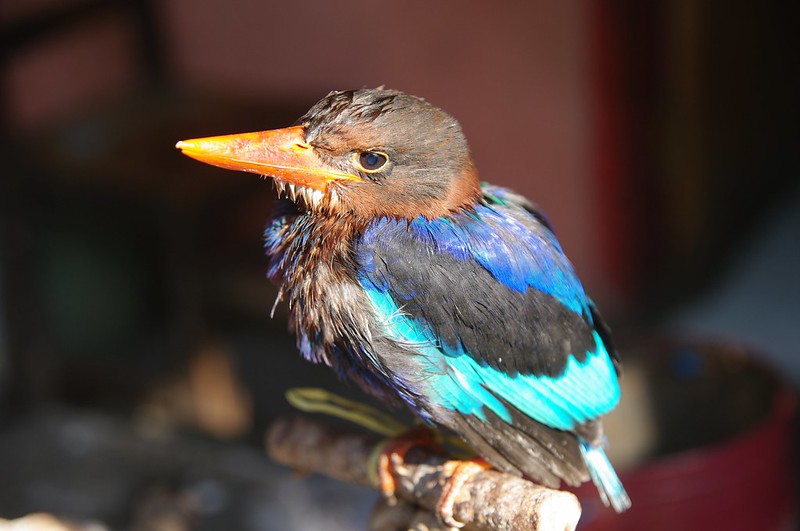
A kingfisher, looking a little worse for wear, in the Malang bird and animal market in 2016. Photo: Andrea Kirkby (CC BY-SA 2.0)
But the quality that typically drives up a bird’s market price?
That, of course, would be the song.
A good song can earn a bird owner a big payday. Entire competitions have sprung up that offer cash prizes for the birds with the best songs — up to $50,000, according to some reports. On Java these events are known as Kicau-mania (“kicau” is Indonesian for “chirping”).
The bird doesn’t get much for his work. Perhaps some food and a chance to sing again.
But it can take a lot of human effort to inspire them to sing for their suppers.
“People will keep the male birds in captivity for a long time,” says Shepherd. “Some birds don’t want to sing in captivity and take a long time before they adjust to the point where they’ll start to sing. Then they’ll train the bird. They’ll keep it near other males so it sings more frequently, because they naturally compete with their songs.”
This forced companionship changes the very nature of the song.
“Some birds pick up notes and sounds from other species,” Shepherd says. “Some of the species that are disappearing, they’re just training birds. They’re not even the ones used in competition. They just keep them beside other the species that compete so they have a more complex and unique song in the competition.”
After that, it’s a bit like a dog show.
“Everybody takes their bird in a cage and there are songbird judges. They walk around and listen to the song and there’s big cash prizes for the bird with the best.” (Most recently, these competitions have moved online due to COVID-19.)
Through all of this, the gift nature gave these animals to help propagate their species — song — ends up driving them toward extinction.
This makes the trade similar to trophy hunting, which values the biggest animals or those with the most beautiful features. “The strongest bird in the wild, the one with the greatest song, would be the one that would pass on his genes,” Shepherd says. “Those are the ones being removed from the wild. So, you know, only inferior birds are left behind.”
Unlike trophy hunting, however, where an elephant’s tusks can theoretically trade hands in perpetuity, a bird’s song is ephemeral — sung once, then lost to time.
Progress
Shepherd says the Asian songbird crisis went virtually ignored for many years. Relatively few scientists studied it, and funding for conservation remained scarce. That’s been a costly delay.
“One of the interesting and sad things is that lot of the species that I worked on in the early Nineties, the ones I tried to raise the alarm on, are now gone or almost gone,” he says. “And then the ones I was working on that were extremely common at the time are now the next wave that’s disappearing.”
Fortunately, that’s started to change. For one thing, scientific research about the trade and affected species continues to pick up. One of the most worrying studies came out last August and found that Java now has more songbirds in cages than in its forests. The study found that one species, the Javan pied starling (Gracupica jalla), now has fewer than 50 birds remaining in the wild, while 1.1 million live on the island in captivity.
Local groups have helped, too, which brings us back to the Simeulue hill myna and Barusan shama. A Simeulue-based organization called Ecosystemimpact set out to help the two birds at the beginning of 2020. Although their efforts were hampered by the COVID pandemic, they’re still trying to acquire any captive birds they can find to keep them out of the trade. If they do rescue any Simeulue hill mynas — such as four juvenile birds that reportedly recently turned up for sale on Facebook — they’ll need a permit from the government to breed them.
Even then, saving them from extinction won’t be easy.
“Hill myna are notoriously hard to breed, requiring large, tall aviaries with good vantage points over forested areas,” says program manager Tom Amey. “It’s not out of the question that hill myna will breed within our aviaries, but given their specific requirements, we feel it is unlikely.” They’re working on raising funding for new aviaries designed specifically for hill mynas.
They also hope to educate the community, to turn its love of captive birds into one that also supports wild populations.
“There is a distinct lack of bird song on Simeulue, especially within close to medium proximity of [human] habitation,” says Amey. “Our ambition is to bring the beautiful sounds of songbirds back to Simeulue’s forests and culture. Songbirds have played an important role in Simeulue culture and many members of the community wish to see them return.”https://www.instagram.com/p/BwMxmGahQZ2/embed/captioned/?cr=1&v=13&wp=548&rd=https%3A%2F%2Ftherevelator.org&rp=%2Fasian-songbird-crisis%2F%3Ffbclid%3DIwAR3Q8u8M27arScQoxAY0hnMENyNGO9pFIbiTrwoovUK1Qxm9eQZLsFKWxjw#%7B%22ci%22%3A1%2C%22os%22%3A6110.820000001695%2C%22ls%22%3A3848.984999989625%2C%22le%22%3A4061.6599999484606%7D
As with everything in the past year, progress to protect Asian songbirds has slowed down of late. “Unfortunately, the COVID crisis has been a huge, but legitimate, distraction from the global fight against extinction, and very little attention has been paid to such issues in the last few months,” says Rheindt.
Once the pandemic recedes, Shepherd suggests that tourism may play an important role in keeping birds alive, uncaged and in their natural habitats.
“There’s a very big birdwatching community,” he says, “and I think working with the community and with the birdwatching tour guides to raise awareness of the benefits of having songbirds around is important. The birdwatching industry’s worth millions. I think we need to raise awareness of the fact that you can lose your birds, but also awareness of the facts that having birds around is good for the environment, it’s good for your mental health, it’s good for all kinds of things — but it’s good for the economy.”
Until those messages resonate more than the ka-ching of a cash register, however, Asian songbirds will remain in crisis.
By Jonny TickleA leading Russian parliamentarian has proposed a new bill to ban the catching of marine mammals, which would eventually lead to the closure of the country’s many dolphinaria as collections could no longer be replenished.
Authored by State Duma deputy Svetlana Bessarab, of the ruling United Russia party, the bill would prevent the practice of taking mammals such as dolphins, seals, and killer whales into captivity, including for educational purposes. The aim is to stop the poaching of animals that have evolved to live in a large oceanic territory. Over time, as the animals currently affected eventually die, institutions with marine mammals would be forced to close.
As things stand, capturing marine mammals is already highly regulated, with purchasing from illegal poachers completed banned. However, according to Bessarab, there is now an absurd situation where state agencies seize animals from criminals and then hand them over to dolphinariums for ‘safekeeping’, despite these institutions not being equipped to rehabilitate the animals.
In 2018, activists discovered around 100 whales living in tightly packed aquatic ‘pens’ in Russia’s Far East. The animals were later declared as having been illegally captured, and the local governor said they would all be released back into the wild. In November 2019, the last of the captured whales were finally returned to their ocean home.
In our monthly feature, Then and Now, we reveal some of the ways that planet Earth has been changing against the backdrop of a warming world. Here, we look at the effects of extreme weather on a crucial reservoir that supplies water to millions of people in northern California.
This year islikely to be critically dry for California.Winter storms that dumped heavy snow and rain across the state are not expected to be substantial enough to counterbalance drought conditions.
Lake Oroville plays a key role in California’s complex water delivery system.
Bidwell Marina at Lake Oroville, California
Drag button to see how extreme drought has affected lake
July 2014July 2011
Source: Getty
This 65km-square body of water north of Sacramento is the second-largest reservoir in California.
Not only does Lake Oroville store water, it helps control…


 https://imasdk.googleapis.com/js/core/bridge3.445.1_en.html#goog_166364782Volume 90% (Xianwei Zeng / Audubon Photography Awards)