Walk into any supermarket and you’ll see rows of cheap chicken. But behind those plastic-wrapped breasts and drumsticks is an invisible ledger — one that tallies not just dollars, but hours of suffering. A new study argues we can finally calculate that hidden cost, and the math may change how we think about food.
Researchers have developed a way to calculate how many hours of suffering each bird endures under today’s industrial farming system, and how much it would cost to prevent it. Their conclusion: for about one extra dollar per kilogram of meat, we could spare chickens at least 15 to 100 hours of intense pain. It costs less than one-hundredth of a cent to prevent each hour of intense pain.
Measuring Pain Like Carbon Emissions
Policymakers are used to talking about the price of meat in terms of land, water, and greenhouse gases. What’s been missing is a way to measure what the animals themselves go through.
The researchers tested it on the European Chicken Commitment (ECC), a voluntary pledge urging companies to use slower-growing chicken breeds and improve welfare standards. They found that adopting ECC guidelines could prevent at least 15 to 100 hours of intense pain per bird, at a cost of just $1 more per kilogram of meat.
“These are not abstract values. They allow us to put animal welfare on the same footing as other policy priorities,” said Dr. Kate Hartcher from the School of Veterinary Science at the University of Queensland, one of the study’s authors.
The Hidden Life of Chickens
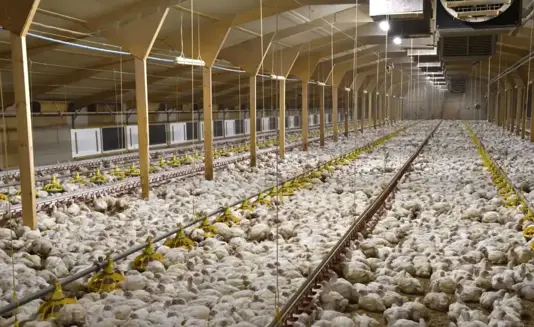
Fast-growing chickens dominate the global meat market. More than 70 billion are raised each year, making them the most populous land vertebrates on Earth. But decades of breeding for rapid growth left them with bodies that can’t keep up. Since the 1950s, chickens have tripled in size. Many suffer from lameness, heart failure, or heat stress, often enduring disabling or excruciating pain.
And the suffering doesn’t stop at the birds we eat. Parent flocks — chickens used to produce those broilers — are genetically primed to gain weight fast. To keep them alive long enough to breed, farmers must severely restrict their feed. That means mother hens spend most of their lives in chronic hunger.
“Few people are aware that the pain and distress behind chicken meat production begins even before a chick is born — with the life of their mother,” said Dr. Cynthia Schuck-Paim, the study’s lead author.
The ECC pushes for slower-growing breeds, like Ranger Gold, which live longer and avoid many of these health issues. Compared to standard broilers, they endure 33 fewer hours of very intense pain per lifetime, according to a conservative estimate.
Rethinking Costs and Benefits
One of the most striking insights from the study is how cheap it is to prevent suffering. Using European carbon pricing as a benchmark, the researchers calculated that avoiding one hour of intense chicken pain costs less than one-hundredth of a cent — about the same as the emissions from driving a car for 15 meters.
This challenges the idea that animal welfare improvements are too costly or environmentally harmful. Yes, ECC-compliant chickens may emit up to one extra kilogram of CO₂ per kilogram of meat. But the trade-off looks trivial when compared with the welfare gains.
The authors argue that intensive farming can no longer be defended as “green” if it produces only marginal environmental savings while inflicting enormous suffering.
Why This Matters
Animal welfare has long been sidelined in global food policy. The United Nations Sustainable Development Goals don’t mention it. Most food system models exclude it. Even debates about protein alternatives — plant-based or lab-grown — tend to focus on nutrition and climate, not the animals’ suffering.
By turning suffering into a measurable unit, the Welfare Footprint Framework could change that. It gives governments, companies, and consumers a yardstick to compare trade-offs clearly: dollars, carbon, and now, hours of pain.
As Dr. Hartcher put it, “the numbers speak for themselves.”
Walk into any supermarket and you’ll see rows of cheap chicken. But behind those plastic-wrapped breasts and drumsticks is an invisible ledger — one that tallies not just dollars, but hours of suffering. A new study argues we can finally calculate that hidden cost, and the math may change how we think about food.
Researchers have developed a way to calculate how many hours of suffering each bird endures under today’s industrial farming system, and how much it would cost to prevent it. Their conclusion: for about one extra dollar per kilogram of meat, we could spare chickens at least 15 to 100 hours of intense pain. It costs less than one-hundredth of a cent to prevent each hour of intense pain.
Measuring Pain Like Carbon Emissions
Policymakers are used to talking about the price of meat in terms of land, water, and greenhouse gases. What’s been missing is a way to measure what the animals themselves go through.
The researchers tested it on the European Chicken Commitment (ECC), a voluntary pledge urging companies to use slower-growing chicken breeds and improve welfare standards. They found that adopting ECC guidelines could prevent at least 15 to 100 hours of intense pain per bird, at a cost of just $1 more per kilogram of meat.
“These are not abstract values. They allow us to put animal welfare on the same footing as other policy priorities,” said Dr. Kate Hartcher from the School of Veterinary Science at the University of Queensland, one of the study’s authors.
The Hidden Life of Chickens
Fast-growing chickens dominate the global meat market. More than 70 billion are raised each year, making them the most populous land vertebrates on Earth. But decades of breeding for rapid growth left them with bodies that can’t keep up. Since the 1950s, chickens have tripled in size. Many suffer from lameness, heart failure, or heat stress, often enduring disabling or excruciating pain.
And the suffering doesn’t stop at the birds we eat. Parent flocks — chickens used to produce those broilers — are genetically primed to gain weight fast. To keep them alive long enough to breed, farmers must severely restrict their feed. That means mother hens spend most of their lives in chronic hunger.
“Few people are aware that the pain and distress behind chicken meat production begins even before a chick is born — with the life of their mother,” said Dr. Cynthia Schuck-Paim, the study’s lead author.
The ECC pushes for slower-growing breeds, like Ranger Gold, which live longer and avoid many of these health issues. Compared to standard broilers, they endure 33 fewer hours of very intense pain per lifetime, according to a conservative estimate.
Rethinking Costs and Benefits
One of the most striking insights from the study is how cheap it is to prevent suffering. Using European carbon pricing as a benchmark, the researchers calculated that avoiding one hour of intense chicken pain costs less than one-hundredth of a cent — about the same as the emissions from driving a car for 15 meters.
This challenges the idea that animal welfare improvements are too costly or environmentally harmful. Yes, ECC-compliant chickens may emit up to one extra kilogram of CO₂ per kilogram of meat. But the trade-off looks trivial when compared with the welfare gains.
The authors argue that intensive farming can no longer be defended as “green” if it produces only marginal environmental savings while inflicting enormous suffering.
Why This Matters
Animal welfare has long been sidelined in global food policy. The United Nations Sustainable Development Goals don’t mention it. Most food system models exclude it. Even debates about protein alternatives — plant-based or lab-grown — tend to focus on nutrition and climate, not the animals’ suffering.
By turning suffering into a measurable unit, the Welfare Footprint Framework could change that. It gives governments, companies, and consumers a yardstick to compare trade-offs clearly: dollars, carbon, and now, hours of pain.
As Dr. Hartcher put it, “the numbers speak for themselves.”
The anti-vaccine, anti-government crusade to save “the miracle cure birds” is over — and the fringe activists lost.
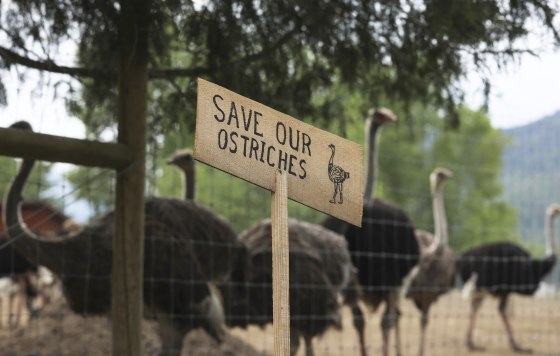
A sign calling for the protection of ostriches at the Universal Ostrich Farms on May 17, 2025, in Edgewood, British Columbia.Aaron Hemens / The Canadian Press via AP
Ostriches are not easy to kill. They are giant, prehistoric creatures, the fastest animal on two legs, and when spooked they run blindly with their wings outstretched. The ostriches at Universal Ostrich Farms near the border of British Columbia proved harder to kill than most.
The 300 or so birds — no one knew the exact count — had survived an outbreak of H5N1 avian influenza and been ordered slaughtered almost a year ago, but after court battles, cross-border political appeals, in-person protests and online campaigns to “save” the flock, the fight was over. The government had won.
The Canadian Food Inspection Agency (CFIA), which ordered and oversaw the culling, and the Royal Canadian Mounted Police, charged with maintaining the peace, had taken pains to hide the spectacle from view. In recent weeks, they’d roped off the ostrich pens from the road, stacked hay bales into a square 15 feet high and restricted the airspace above the farm, including to drones.
All day Thursday, the farmers and a couple of dozen supporters watched what they could from the highway, while others trained a high-powered camera from a nearby mountain, everyone streaming their scenes on Facebook. The mood swung between grief, defiance and delirium. One minute they danced, the next they dropped to their knees and wept. They passed a microphone attached to a portable speaker, taunting the CFIA workers in their white protective jumpsuits as they prepared for the cull.
“Walk away while you still can,” one protester screamed at government agents clumsily herding ostriches. “Run!” one of the farmers pleaded to the birds as the gospel song “I’ll Fly Away” played from her phone. One of the farmers flashed her breasts to a government drone buzzing overhead, then gave the middle finger. “F––– youuuuuuu,” she yelled to the sky.
Such was the end of the saga: What could have been a routine disease response at a small farm had become a cause célèbre for anti-vaccine, anti-government activists and the conspiratorial right. For the hundreds of pilgrims who had come to the farm in so many months — and the thousands more who joined the livestreams — the birds were more than large-eyed livestock; they were symbols of a government that had overreached during the pandemic, with mandates and quarantines, and was going further still. The episode underscores a legacy of the pandemic in the West: eroded trust in government agencies and rising vaccine hesitancy, and how partisan politics have complicated public health.
“Today it’s the ostriches, tomorrow it’s you,” one supporter, a singer and cryptocurrency entrepreneur, said from the farm in October, a common refrain among the camp’s many visitors.
“Should I too be culled and erased from this world?”
‘Big, beautiful ostrich antibodies’
The Universal Ostrich Farms’ 58 acres were once home to more than 400 ostriches, tended by farm owners Karen Espersen and Dave Bilinski. The farm had faced challenges in the past, including wildfires and creditors who’d been awarded hundreds of thousands of Canadian dollars after ostrich deals gone bad.
As they would later explain in court filings, Espersen and Bilinski had historically used the birds for breeding, meat and oil, but more recently, they’d pivoted the business into research and products made from extracting antibodies from their birds’ eggs. Partnering with Yasuhiro Tsukamoto, a Japanese researcher known as “Dr. Ostrich,” they dreamed of turning those egg-derived antibodies into biomedical and cosmetic products, among them OstriGrow to combat baldness, OstriTrim to curb hunger and OstriClear for acne.
But near the end of 2024, the miracle cure birds started getting sick.
The ostrich pens at Universal Ostrich Farms sat next to a pond where wild ducks would stop to rest. It’s almost certain, according to the CFIA, that those ducks, drawn into the pens to nibble on food left out for the ostriches, were carrying H5N1, and while they ate and pooped among the flock, they passed on the virus.
When you own a farm and your birds start showing signs of avian flu, when they look lethargic or swollen, when they cough or sneeze or tremor or have diarrhea or drop dead, as 30 of the birds at Universal Ostrich Farms did in December, you are required to report it to CFIA. Espersen and Bilinski did not. Instead, an anonymous tip brought the agency to the farm, where agents swabbed two of the carcasses for testing. The CFIA said the tests confirmed that they were infected with bird flu, so the agency declared the farm an “Infected Place” and gave Espersen and Bilinski a month to dispose of the rest of the exposed flock.
A word about bird flu: Scientists have warned that H5N1 could be the virus that starts the next pandemic. For wild birds, it’s been devastating. On its own, bird flu poses a smaller threat to us, but when humans do get it, the results can be severe; last November, a 13-year-old Canadian girl almost died. But the greater danger for humanity is when bird flu mixes with the ordinary seasonal kind — a real possibility as temperatures drop and flu season starts. In that rare collision, a process called reassortment can occur, which means the two flus trade genetic material and create something new and more contagious.
Online and in real life, the ostriches had become symbols of defiance — and the farm a destination for conspiracists, fringe media, and animal lovers.
The Canadian Food Inspection Agency is tasked with controlling the spread of bird flu, and its policy, known as stamping out, says that when a farm is infected, any potentially exposed birds are slaughtered (culled, in farmspeak) and the government pays the farmer to restock with new birds.
Culling is an unpleasant but necessary business, according to the CFIA, to stop outbreaks and maintain international trade agreements that undergird a $6.8 billion poultry industry. But in the case of the ostriches, it was more complicated. Ostriches are classified as poultry by the CFIA, but they’re not chickens. A single ostrich may be worth thousands of dollars and live up to 70 years, meaning the loss of 400 could ruin the farm. And unlike chickens, which are likely to die from bird flu, ostriches are more resilient to the virus.
Unlike Covid-19 in humans, avian flu is less severe for older ostriches. But the owners of Universal Ostrich Farms claimed the fact that their older ostriches survived was evidence of something special. Espersen and Bilinski argued that their flock was now immune and, what’s more, that their ostrich eggs contained antibodies capable of detecting and treating all kinds of viruses, from Covid to avian flu. The farmers contended that they should qualify for a “rare and valuable genetics” exemption from the cull. To qualify, the farm was asked to submit documents proving the ostriches’ economic or genetic importance, as well as evidence of biosafety measures taken to separate the healthy birds from the exposed ones.
When the Universal Ostrich Farms provided neither, CFIA denied its request. And the birds kept dying. By mid-January, 69 ostriches were dead of suspected flu, leaving about 300 from the original flock.
Instead of complying with the CFIA orders, the farmers took the agency to court, managing to stall the cull for months through a series of granted stays as the case wound its way through the justice system. By August, Espersen and Bilinski seemed to have exhausted their options after a federal appeals court ruled that despite its “considerable sympathy” for the farmers, it was not the role of the court to make, change or grant exemptions from government policies.
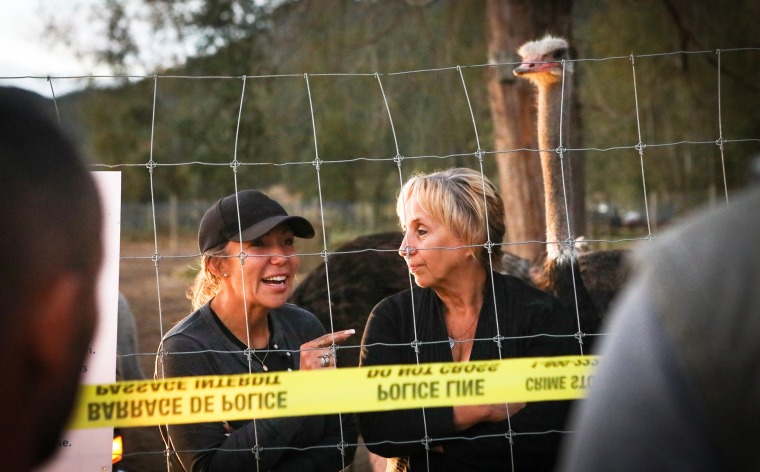
Espersen, right, the co-owner of Universal Ostrich Farms, speaks with supporters with her daughter, Katie Pasitney, on Sept. 22, 2025, at the farm in Edgewood, British Columbia.Aaron Hemens / The Canadian Press via AP
As the sun rose over the Universal Ostrich Farms on Sept. 22, a convoy of CFIA trucks and Royal Canadian Mounted Police cruisers rolled down the farm’s gravel road. They’d come with a warrant to take possession of the farm, expel the farmers and start the preparation for culling hundreds of ostriches.
Katie Pasitney was ready on Facebook Live, broadcasting the scene to tens of thousands of followers.
Pretty and quick to tears, Karen Espersen’s daughter had been the face of the farm since the spring, appearing in countless media interviews and hundreds of livestreams, her hair usually swept up in a signature trucker hat to protect from the sun and the wobble of ostriches — constantly, and affectionately, she insisted — pecking at her head.
“Here come the RCMP, the killers that have no appreciation for life,” Pasitney narrated. “This is a plea out to the world. Stop this massacre from happening.”
“They know something’s wrong,” Pasitney said, gesturing toward the field of wandering ostriches and calling them by name, birds like Freedom, and Charlie (named after Charlie Kirk).
Pasitney’s followers lit up the comments in all-capped panic. The farm’s supporters had spent months streaming, posting and rallying behind the birds; now the flock seemed just moments from execution. Online and in real life, the ostriches had become symbols of defiance — and the farm a destination for conspiracists, fringe media, animal lovers, and anyone looking for a cause.
Far-right and anti-vaccine groups urged followers to visit over the summer, and they came, setting up tents, camping on the property and filming around the clock. Veterans of the “Freedom Convoy,” the 2022 protest that gridlocked Ottawa, Ontario, for weeks over Covid restrictions and Prime Minister Justin Trudeau’s government, became fixtures at the farm. They held fundraisers and outdoor concerts at which attendees donned ostrich costumes. A far-right preacher, convicted in 2022 for inciting convoy protesters to block an Alberta border crossing, baptized visitors in the neighboring river.
Canada’s right-wing outlet Rebel News dispatched multiple reporters, and at one point a helicopter, to the farm. As it had with truckers before, Rebel framed the dispute as a standoff between farmers and a totalitarian Canadian state. Its website launched a Save the Ostriches! fundraising campaign, next to others like Trans Madness! and Guard the Border!
And as attention grew, so did the claims. By summer, the farmers were telling Rebel News that their ostrich eggs could cure Covid but that they had been silenced.
“That’s why they want them dead,” Pasitney said on a livestream in September. “Because Big Pharma would lose billions of dollars … because you might not have to take as much medication, you might not need your vaccination if you actually just build up your own antibodies with big, beautiful ostrich antibodies.”
‘We should not be killing them, we should be studying them!’
When we spoke over the summer, Pasitney said she saw the ostriches as something bigger than just birds.
“If it was another chicken, we wouldn’t be here,” she said. “But because they’re ostriches and they’re resilient, like humanity should be, people see themselves in them.”
She wiped her eyes, wet again with tears. “They are the Trojan horse,” she said. “And the leader in this war — a war for change.”
Her message caught on in the U.S., helped in no small part by grocery store magnate and GOP megadonor John Catsimatidis, an animal lover who took up the farm’s cause and poured $50,000 into its legal defense fund, promising that he and his friends would “write a check” for whatever else Pasitney needed.
“He’s become like a grandfather to me,” Pasiney said of the billionaire.
In April, Catsimatidis enlisted the help of his government by way of a friend, U.S. Health and Human Services Secretary Robert F. Kennedy Jr., whom he’d known since Kennedy’s days as an environmental activist cleaning up the Hudson River. Kennedy is well known for his interesting history with wild animals, especially birds; he’s a skilled falconer, befriends wild ravens and kept a backyard pet emu named Toby until it was killed by a California mountain lion. As expected, Kennedy was an eager recruit, sending Catsimatidis photos of himself with ostriches to seal the deal, the billionaire said.
“We should not be killing them, we should be studying them!” Kennedy said on Catsimatidis’ radio show. “I support you 100%. I’m horrified by the idea that they’re going to kill these animals.”
The next month Kennedy, along with National Institutes of Health Director Jay Bhattacharya and Food and Drug Administration Commissioner Marty Makary, got on a call with CFIA President Paul MacKinnon to pitch their solution. If Canada spared the ostriches, the NIH and FDA would partner with CFIA to test the animals and then use them in yet-to-be designed research. In a letter posted to X after the call, Kennedy wrote, “We believe significant scientific knowledge may be garnered from following the ostriches in a controlled environment at the Universal Ostrich Farm.” When CFIA declined, Dr. Mehmet Oz, head of the Centers for Medicare & Medicaid Services, offered to rehome the flock at his Florida ranch.
Because they’re ostriches and they’re resilient, like humanity should be, people see themselves in them.”
Farmer Katie Pasitney said
Reconsidering the cull now that the birds had stopped dying and the risk had become more stable wasn’t totally unreasonable. Dr. Scott Weese, an infectious-disease veterinarian at the University of Guelph, wrote about the farm on his blog, Worms & Germs, before quitting due to threats and harassment. Early on, he’d argued that a compromise might be possible.
“In a perfect world, we test all the birds,” Weese told me. “If they’re all negative, maybe they should be fined, substantially for the risks they’re putting everyone through, and for ignoring rules. Then rehome the birds.”
But, ticking off the farm’s sins, Weese likened the owners to a drunk driver who, on an impaired drive back home, almost kills someone but makes it to the driveway safely: They failed to report the infection at the start and had been uncooperative with CFIA since, they disregarded quarantine orders, and they invited a convoy to the farm while it was under quarantine. In short, Weese said, “They’ve broken every basic concept of infection control.”
Given the farm’s lax biosecurity, Angela Rasmussen, a virologist at the University of Saskatchewan’s Vaccine and Infectious Disease Organization, said that testing the ostriches, as the farm owners demanded, would have come at enormous cost and effort, and even then would be unlikely to yield clear answers. Beyond those hurdles, Rasmussen said, the farmers’ recent comments villainizing the CFIA and spinning conspiracy theories about the agency’s motives suggested they would just reject testing results that didn’t fit their beliefs.
“The only way to really be sure,” she said, “is to cull them all.”
Rasmussen’s interviews were clipped, reposted and dissected on Pasitney’s Facebook page and by right-wing creators, including David Freiheit, a Canadian lawyer known online as Viva Frei, who called the CFIA a “Soviet-style, state-sanctioned terrorist organization.”
The emails and calls poured in afterward. “YOU are the definition of EVIL,” a typical email to Rasmussen read.
It wasn’t just the experts. The farm had trouble garnering support from other mainstream sources. President Donald Trump, whom supporters had begged to intervene, made no mention of the ostriches during a White House meeting with Prime Minister Mark Carney in October. And while it was no surprise that the liberal Canadian prime minister refused to hear their cause, even the leader of the Conservative Party, Pierre Poilievre — who had once championed conspiratorial anti-government causes including their trucker convoy — was quiet on the ostriches, opting only to criticize the CFIA’s “mismanagement.”
Even neighbors were organized against it. Twenty-six of the village of Edgewood’s 235 residents shared their grievances with CTV News: about the farm’s biosecurity practices and the hullabaloo the summer of protests had caused in their small community.
“It’s like living next to Chernobyl,” said one cattle farmer.
‘Why, Daddy, why did you kill the ostriches?’
Back at the farm, it wasn’t a standoff in the American mold (this was still Canada, after all) but even without guns, it wasn’t entirely peaceful.
Volunteers cooked meals for the expelled farmers and their visitors, and at night there was fellowship under a white revival tent. Pasitney provided the morale with nighttime karaoke parties and fireside hangouts. One night they were all treated to the vocal stylings of an orange-jumpsuited Elvis tribute artist.
Pasitney called the CFIA “government assassins,” warned that “every person involved will be held accountable” and in the next breath pleaded for calm. Her followers moved between rage and heartbreak, too.
One woman wrote that she saw her children’s faces on the ostriches’ bodies. Another wondered who among them would join in a class-action lawsuit against the government for “mental and emotional trauma.”
In one Facebook group with 65,000 members, supporters toggled between livestreams, watching as the CFIA boxed the ostriches in walls of hay. Some said they cried all day. Others missed work or couldn’t sleep. One woman wrote that she saw her children’s faces on the ostriches’ bodies. Another wondered who among them would join in a class-action lawsuit against the government for “mental and emotional trauma.”
They weren’t completely helpless, though. As Pasitney and other livestreamers identified supposed co-conspirators in the cull — farmers accused of supplying hay for the kill box, maintenance crews that provided CFIA with port-a-potties, truckers who hauled in equipment — those businesses were bombarded with bad reviews, doxxing and threats. One local gas station owner wept on the phone, begging for the harassment to stop, before Pasitney went live to tell her followers they’d gotten the wrong business.
The morning the CFIA convoy arrived, 72-year-old Lois Wood, a neighbor of the farm, stepped onto her porch to feed her cat and found a masked man pouring gasoline around her home. When she screamed, she later told CTV News, the man doused her and punched her in the face. In a video captured on one of the farm’s livestreams, Wood can be heard screaming. The RCMP said a suspect associated with the protest camp had been identified and arrested.
Pasitney later said on a livestream that Wood had been “working with” the CFIA from the beginning — that she’d been the anonymous neighbor who reported the dead ostriches, which Wood denied.
A few days later, a fire broke out near the CFIA’s hay walls. Campers claimed it had been the work of “antifa” or government plants trying to make them look bad. The cause of the fire, which RCMP calls “suspicious,” is still under investigation.
At a line of police tape that separated the farm’s owners from the ostriches, now in effect property of the Canadian government, a dozen supporters recorded police officers.
“You’re going to be culled!” one man shouted.
“You’ll have to tell your children, why, Daddy, why did you kill the ostriches?” one woman taunted. “Will you tell them you were ‘just following orders?’”
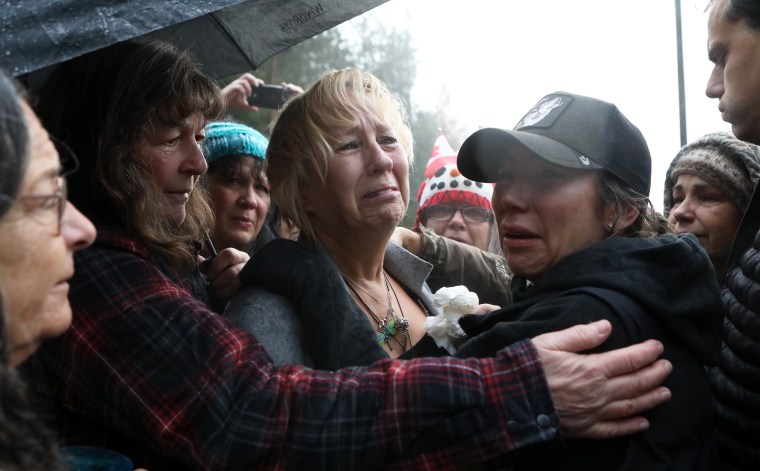
Espersen is embraced by supporters and Pasitney on Nov. 6, 2025, at the Edgewood farm after the announcement that the Supreme Court of Canada dismissed the farm’s appeal to stay an order to cull more than 300 of its ostriches.Aaron Hemens / The Canadian Press via AP
‘Make this a revolution’
Just as tensions at the farm reached their peak in October, Pasitney announced to her congregated supporters that there had been another miracle: Canada’s Supreme Court had granted them one final reprieve. While it decided on whether it would take the case, the court ordered the CFIA to pause the cull, but while retaining custody of the farm, and the animals.
The time spent waiting gave farmers and their supporters more room to spin new rumors.
Stories spread that the CFIA was starving the birds, killing them in secret, and hiding the hens and laundering the eggs to a Big Pharma operation. More arrests followed, too. One popular fixture was arrested, released and banned from the farm for climbing over the fence and pushing feed to an ostrich — “their last meal,” the activist called it. Another, known for his sweaters emblazoned with “Hugs,” was reportedly arrested after following a CFIA vehicle. An elderly protester was found dead on the property early one morning. Police said the death wasn’t suspicious; the farmers said it showed the distress the CFIA had wrought.
“Shame on you, Canadian government. Shame on you,” Pasitney cried to the assembled media. “I ask for the world to rise up, Canada to rise up, our farmers to rise up, and make this a revolution.”
Instead, a few dozen weeping campers joined hands in the rain, forming a circle to pray: that the police might change their hearts, that God might bestow upon the birds the gift of flight or, failing that, that their ultimate sacrifice, like Jesus’, might be the spark that dismantled the government agency responsible for their murders. The hymn “Amazing Grace” played from a loudspeaker as supporters pressed their faces to the blue police fence for one last look at the ostriches that had consumed the last year of their lives.
As it got dark around 6 p.m., bright floodlights aimed outward from the enclosure blocked any view from the road. Single shots rang out every few seconds for several hours. By morning the birds were dead.
A change in the rules means that some ‘free range’ birds being fattened for Christmas can spend their lives cooped up insideMaeve Cullinan Global Health Security Reporter. Paul Nuki Global Health Security Editor
It is hoped the new rules will help to protect farmers’ livelihoods – but critics say it is misleading Credit: GLYN KIRK/AFP via Getty Images
Chickens and turkeys are being sold as “free range” even though the birds have never been outside, under a change in the law.
The practice, which consumer advocates describe as “misleading” and “dishonest”, has been enabled by a little publicised change to the food regulations following a series of bird flu outbreaks.
It means that virtually all the “free-range” turkeys, geese, ducks and chickens being fattened for Christmas will have spent at least half of their short lives inside.
Eggs from hens kept in similar conditions are also being marketed as “free-range”.
The “free range” label – regulated by the Department for Environment, Food and Rural Affairs (Defra) since 2007 – is supposed to guarantee minimum welfare standards.
Free range birds would normally have “continuous daytime access to open-air runs” for “at least half of their lifetime” and generous space in which to move.
Now, however, if Defra declares a poultry lockdown, they can be kept inside for the duration of their lives, with so-called “free range” chickens and turkeys cooped at 13 and 10 birds per square meter respectively.
A sign displayed in Lakenheath, England, shortly after confirmation of new H5N1 cases Credit: Dan Kitwood/Getty Images
While initially “free range” birds kept inside had to be rebranded “barn reared” after 12 weeks, Defra quietly changed the law in September to allow farmers to keep the free range label no matter how long their animals were locked down.
On November 6, a nationwide lockdown was introduced by Defra for poultry farms in England and Wales – meaning that most animals being reared for Christmas will have spent much of their lives inside.
Professor Chris Van Tulleken, the British doctor whose best selling book Ultra Processed People has brought a new focus to food marketing, called for “clear, honest, and utterly transparent labelling”.
“As an infection scientist these measures are important for controlling pandemic risk, but as a consumer I would assume that a free-range chicken has had a free-range life with access to the outside and might feel misled,” he told the Telegraph.
“It’s vital that we know at a glance how all our food is produced, but especially our meat which has such significant impacts on human and planetary health. It is consumer pressure that has previously led to enormous improvements in poultry welfare in this country.
“There is also a justice issue here – many people buy meat very carefully and spend a premium because they care about animal welfare. If there is a reduction in welfare that should be reflected on the label and in the price.”
Chickens are typically slaughtered at eight to 12 weeks old and turkeys are killed when they are between 14 and 24 weeks.
While all farms in England were ordered to lockdown on 6 November, many others were under lockdown before that – meaning that some birds being sold as free range will never have seen daylight.
All non-frozen birds destined for the Christmas table will have spent their final six to eight weeks indoors – about a third to half of their lives.
Toby Kelly, son of the owner of KellyBronze turkeys – a farm that produces more than 155,000 birds a year – said the new rules would help to protect farmers’ livelihoods.
“You keep all our birds outside and rear them free range, and then you have to bring them in for a [bird flu] housing order. I think it’s absolutely the right thing that you should still be able to call them free range.
“Animal welfare is paramount, and you don’t want to risk losing our flock to bird flu, and so bringing them inside helps you mitigate that risk to some degree,” Mr Kelly said.
Few doubt that the new rules protect farmers, and the 30 to 200 per cent price uplift a “free range” label can command.
But the question, say critics, is not whether the lockdowns are necessary in business or animal welfare terms, but whether birds which are raised in barns should continue to be marketed as free range.
In a debate in the House of Lords earlier this year, the Conservative peer Lord Blencathra called for a “serious look” at the definition of free range.
Advertisement
“I understand that in the consultation 66 per cent of respondents felt that the proposal would cause little or no confusion among consumers. Of course not, since how are consumers to know how long the hens have been shut inside in the first place while … still labelled free range?
“I am not worried about consumers being confused but I am worried about misrepresentation”.
He added: “If hens are confined inside for six months, nine months or even more, consumers have a right to know that their eggs are not really free-range”.
Defra says it changed the rules to protect the free-range poultry sector in the UK which is worth over £1 billion a year.
A consultation run by DEFRA prior to the legislation changing received 14 responses, 13 of which were from the poultry industry: poultry meat producers, importers, exporters, and manufacturers.
No consumer organisations responded, and it is unclear whether they were approached for comment by Defra.
Sue Davies, Head of Food Policy at Which? told The Telegraph a“delicate balance” needed to be struck between consumer and sustainable farming interests in the face of avian influenza.
Advertisement
“When the all-important Christmas market is involved, it’s vital that the government and industry explain clearly to consumers what is happening and how their food is affected, so shoppers have the facts at their disposal when they go to buy turkey or other poultry products,” she said.
The current lockdown for poultry in England and Wales is expected to last most of the winter, far exceeding the life of most birds.
The new rules mean that birds that have spent their entire lives without access to outside space can continue to be sold as free-range.
“Consumers are being ripped off… it’s misleading,” said Scott Dixon, the consumer rights author and advocate. “I would call it an outrage, because consumers are paying a premium for free range”.
A Defra spokesperson said: “When a mandatory housing measure is introduced, it is to safeguard the welfare of the birds which are at risk of suffering from this highly contagious and unpleasant disease that can rapidly spread through flocks causing high mortality.
Advertisement
“Housing measures have been an effective measure to reduce the likelihood of flocks being infected. Our priority is always to minimise the suffering to poultry and protect livelihoods.”