Scientists trying to bring back the woolly mammoth end up with woolly mice

The IndependentFollow

1.4M Followers

https://www.msn.com/en-us/news/technology/scientists-trying-to-bring-back-the-woolly-mammoth-end-up-with-woolly-mice/ar-AA1AeuBm?ocid=widgetonlockscreen&cvid=8ceba05361cc4bbfbfec673c1ec96341&ei=55

Story by Christina Larson

 • 4h • 

3 min read

Extinction may be forever, but the next best thing may be just around the corner. Biotech company Colossal Biosciences is attempting to genetically engineer living animals to resemble extinct species such as the woolly mammoth.

Woolly mammoths, which disappeared roughly 4,000 years ago, once roamed the icy landscapes of Europe, Asia, and North America. Colossal first announced its audacious plan to “revive” the woolly mammoth, and later the dodo, in 2021. Since then, the company has concentrated on identifying key traits of these lost creatures by analyzing ancient DNA. Their goal, according to CEO Ben Lamm, is to genetically engineer these traits into living animals.

This approach has been met with a mixed reception from the scientific community, with some questioning its potential benefits for conservation efforts.

“You’re not actually resurrecting anything — you’re not bringing back the ancient past,” said Christopher Preston, a wildlife and environment expert at the University of Montana, who was not involved in the research.

On Tuesday, Colossal announced that its scientists have simultaneously edited seven genes in mice embryos to create mice with long, thick, woolly hair. They nicknamed the extra-furry rodents as the “Colossal woolly mouse.”Genetically edited mice with long, thick, woolly hair at a lab in Dallas, Texas. (Colossal Biosciences via AP) (© John Davidson)

Genetically edited mice with long, thick, woolly hair at a lab in Dallas, Texas. (Colossal Biosciences via AP) (© John Davidson)

Results were posted online, but they have not yet been published in a journal or vetted by independent scientists.

The feat “is technologically pretty cool,” said Vincent Lynch, a biologist at the University of Buffalo, who was not involved in the research.

Scientists have been genetically engineering mice since the 1970s, but new technologies like CRISPR “make it a lot more efficient and easier,” said Lynch.Related video: 10 Believed Extinct Animals Still Alive (Wild Wonders)

about:blank

There have been sightings of animals which have been said

Wild Wonders

10 Believed Extinct Animals Still Alive

More videos

The Colossal scientists reviewed DNA databases of mouse genes to identify genes related to hair texture and fat metabolism. Each of these genetic variations are “present already in some living mice,” said Colossal’s chief scientist Beth Shapiro, but “we put them all together in a single mouse.”

They picked the two traits because these mutations are likely related to cold tolerance — a quality that woolly mammoths must have had to survive on the prehistoric Arctic steppe.

Colossal said it focused on mice first to confirm if the process works before potentially moving on to edit the embryos of Asian elephants, the closest living relatives to woolly mammoths.Wooly Mammoth's lived during the last Ice Age, feeding on tundra vegetation (Natural History Museum)

Wooly Mammoth’s lived during the last Ice Age, feeding on tundra vegetation (Natural History Museum)

However, because Asian elephants are an endangered species, there will be “a lot of processes and red tape” before any plan can move forward, said Colossal’s Lamm, whose company has raised over $400 million in funding.

Independent experts are skeptical about the idea of “de-extinction.”

“You might be able to alter the hair pattern of an Asian elephant or adapt it to the cold, but it’s not bringing back a woolly mammoth. It’s changing an Asian elephant,” said University of Montana’s Preston.

Still, the refinement of precision gene-editing in animals could have other uses for conservation or animal agriculture, said Bhanu Telugu, who studies animal biotechnology at the University of Missouri and was not involved in the new research.

Telugu said he was impressed by Colossal’s technology advances that enabled scientists to pinpoint which genes to target.

The same approach might one day help fight diseases in people, said Lamm. So far, the company has spun off two health care companies.

“It’s part of how we monetize our business,” said Lamm.

The Independent is the world’s most free-thinking news brand, providing global news, commentary and analysis for the independently-minded. We have grown a huge, global readership of independently minded individuals, who value our trusted voice and commitment to positive change. Our mission, making change happen, has never been as important as it is today.


Dead swans ‘need to be tested for bird flu’

13 hours agoShareSave

Richard Daniel

BBC News, Suffolk

Reporting fromOulton Broad

Alice Cunningham

BBC News, Suffolk

Jamie Niblock/BBC Sue Mitchell smiles at the camera. She has short blonde hair and wears glasses, a black coat and a blue top underneath. She also wears gold hoop earrings.
Sue Mitchell fears bird flu is behind the death of several swans at Oulton Broad

A wildlife enthusiast is concerned bird flu could be behind the deaths of several swans near an inland waterway and testing needs to be carried out.

At least four carcasses have been found at Oulton Broad near Lowestoft, Suffolk, over the past three weeks, which Sue Mitchell feared could be a result of the disease.

She reported the birds to the Department for Environment, Food and Rural Affairs (Defra), but it had not been able to get to the birds.

East Suffolk Council told the BBC its teams would collect them and inform Defra afterwards.

“They said they would collect it and test it, or at least the first one, but it hasn’t happened,” Ms Mitchell said.

However, she was told that due to the location of the birds close to the water, Defra’s teams would be unable to access them.

She was instead encouraged to contact the council, but feared if the birds were not collected and had died of bird flu, it could spread to others.

“They need to take action; they ask the public to report it,” she said.

“There’s people having their whole flocks of chickens culled because of bird flu and then we’ve got these instances here and nobody is acting at all.”

Jamie Niblock/BBC Paul Rice smiles at the camera. He wears a black cap with a blue gilet and navy jumper underneath.
Paul Rice said he had counted 72 swans at Oulton Broad this year compared to last year’s 50

Paul Rice is the yacht station manager for the council at Oulton Broad and said the swan population numbers had recently increased.

He was aware of the reports, but had not received any request “to deal with them in the way we normally would with bird flu” and could not comment on their cause of death without tests.

“The swans that I’ve seen, especially the ones in this area which we see on a regular basis, look as healthy as I’ve ever seen them,” he said.

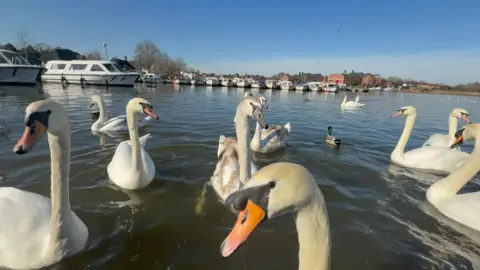
Jamie Niblock/BBC Swans are pictured swimming on water at Oulton Broad.
East Suffolk Council said it was handling the carcasses

Advertisement

A council spokesperson said: “East Suffolk Services will collect the [remaining] swan carcass. This is in hand. Once collected Defra will be informed.”

When approached for comment Defra pointed out its Animal and Plant Health Agency (APHA) carried out year-round surveillance of dead wild birds submitted via public reports and warden patrols, but not all dead birds would be collected.

APHA also publishes a weekly report on bird flu findings in wild birds and members of the public are encouraged to report dead wild birds either online or by calling Defra’s helpline.

More Than 1,500 Sandhill Cranes Killed by Bird Flu in Indiana, Raising Concerns Among Biologists

The tall, slender grey birds are making their annual spring migration to northern breeding grounds. Experts say the virus could become a larger problem if it gets passed to endangered whooping cranes

Sarah Kuta

Daily CorrespondentMarch 3, 2025 2:45 p.m.


Large grey bird with a red forehead soaring through the air
Migrating sandhill cranes stop to rest and refuel in the Midwest as they make the long journey northward to their breeding grounds. U.S. Fish and Wildlife Service

More than 1,500 sandhill cranes have been found dead in Indiana, placing them among the latest victims of the highly contagious bird flu strain H5N1, reports thePost-Tribune’s Amy Lavalley.

The tall, slender grey birds are in the middle of their spring migration. They’re heading north to breeding grounds in Alaska, Canada and eastern Siberia. As they make the annual journey, the birds stop to rest and refuel in various places throughout the Midwest, including Indiana.

What Does a Cowboy Look Like?

Next

Stay

In recent weeks, biologists with the Indiana Department of Natural Resources have counted hundreds of dead sandhill cranes statewide. At least 500 of the birds were found dead in Jackson County, in the south-central part of the state, in early January.

Since then, as the birds have continued to fly northward, deaths have been reported in other parts of Indiana. And 1,500 deaths is likely an underestimate, officials say.

“This year they brought avian influenza with them and it just ripped through the population very quickly,” Eli Fleace, a biologist with the Indiana Department of Natural Resources, tells the Post-Tribune.

The birds are dying from the H5N1 strain of avian influenza, which has been wreaking havoc on America’s poultry industry and, in turn, driving egg prices to rise. The deadly pathogen has also been wiping out wild birds, including more than 5,000 snow geese in eastern Pennsylvania in January.Report This Ad

Wild birds—especially those that migrate in large flocks—are particularly susceptible to the highly contagious strain. Biologists are hopeful the deaths will slow this spring, since the virus tends to peak during the fall and winter.

“Humans really can’t do much in a single season,” Fleace tells the Post-Tribune. “You can’t ask [the birds] to isolate from each other.”

Meanwhile, volunteers in northwest Indiana are doing what they can to help stop the spread. Donning masks and gloves, they’re gathering as many sandhill crane carcasses as they can from frozen lakes and shorelines. Acting on the advice of biologists, they’re double-bagging the carcasses in trash bags and disposing of them in a rented dumpster; they’re also sanitizing any equipment they use to pick up the bodies.

“I decided someone’s got to do something about it and pick up these birds,” says Sean Leone, a resident of Upper Fish Lake in northwest Indiana, to WSBT’s Cicily Porter. “So, I started getting volunteers together and asking people if they’d like to donate bags or gloves or whatever to help, you know, bring you into the community and everybody helps chip in and do their part.”

An estimated 650,000 sandhill cranes live in North America, and their population is increasing, according to the American Bird Conservancy. But their close relatives, whooping cranes, are much less abundant: Around 800 of those endangered birds are still in existence.Report This Ad

Whooping cranes often share habitats with sandhill cranes, as well as other waterfowl. Experts are concerned about the spread of H5N1 between the different species.

“If [the virus] gets into a small number of [whooping cranes], that’s a large percentage of the population,” says Diana Boon, director of conservation medicine for the International Crane Foundation, to USA Today’s Trevor Hughes and Dinah Voyles Pulver.

Biologists in central Nebraska are also following the recent sandhill crane deaths closely. Hundreds of thousands of the birds—roughly 80 percent of the total population—spend several weeks resting and fattening up near the Platte River in February, March and April. So far, no sick or dead cranes have been reported in Nebraska.

“We’re preparing for the worst, but hoping for the best,” says Bethany Ostrom, a biologist with the nonprofit Crane Trust in Wood River, Nebraska, to KETV’s Andrew Ozaki. “The cranes aren’t magically, like, immune to this. And so that’s pretty concerning with how big of congregations we get here.”Report This Ad

Wildlife biologists across the country are asking members of the public to report any sick or dead animals. The overall risk of infection is low for humans, but 70 people in the U.S. have contracted the virus since 2022. In January, the country reported its first human death from H5N1 bird flu.