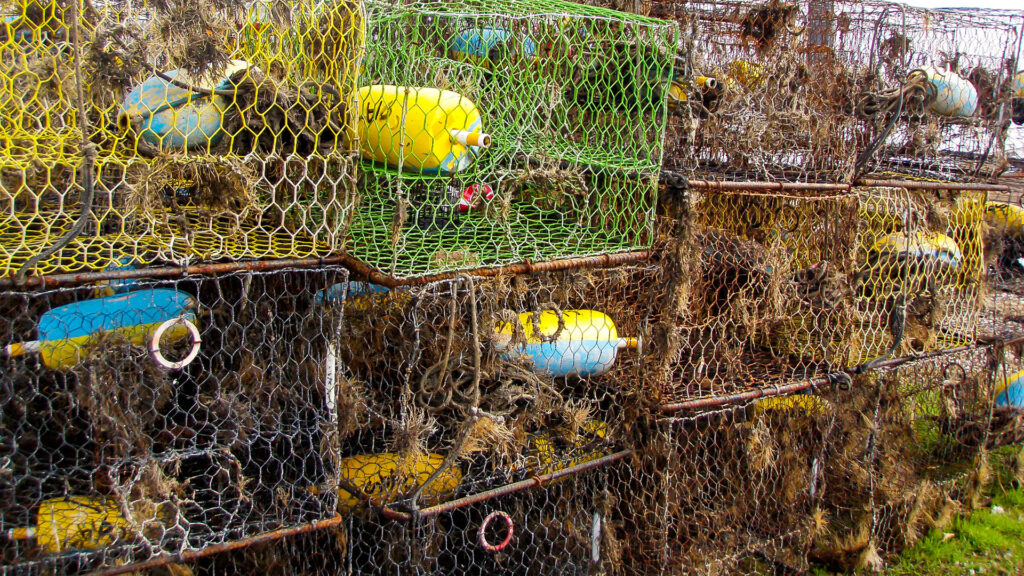
The Virginia Institute of Marine Science (VIMS) and William and Mary’s Coastal Sciences school are leading the charge nationwide to clean up discarded fishing gear and “ghost pots” from U.S. waterways.
William & Mary’s Batten School and VIMS, administratorsof the National Fishing Trap Removal, Assessment, and Prevention (TRAP) Program, has awarded $1.4 million to fund 11 projects to retrieve derelict lobster and crab traps in 2025. This initial round supports projects in California, Connecticut, Delaware, Florida, Louisiana, Maine, Maryland, New York, Washington and the Pacific Island State of Palau, as well as ongoing efforts by the Virginia Marine Debris Program.
In 2023, using funds from the Bipartisan Infrastructure Law, the National Oceanic and Atmospheric Administration’s (NOAA) Marine Debris Program awarded an $8 million, four-year competitive grant to the Batten School & VIMS to administer the TRAP program. One important feature of the project will be standardizing data collection practices and establishing a national database to evaluate the environmental and economic impacts of these projects.
“This is a special program because it allows local communities to tackle the issues that impact their environments and livelihoods the most, all under the same overarching goal,” said Kirk Havens, who directs the Center for Coastal Resources Management at VIMS. “The Batten School & VIMS is uniquely positioned to lead these efforts thanks to our nearly two decades of experience tackling this issue in the Chesapeake Bay.”
Lost, abandoned, discarded fishing equipment can harm ecosystems and economies by trapping and killing animals, damaging marine habitat, and competing with actively fished gear. After the crab disaster declaration in 2008, VIMS and the Virginia Marine Resources Commission worked with local watermen to begin the Virginia Marine Debris Removal Program, which ultimately led to the removal of more than 34,000 derelict crab pots between 2008 and 2014.
The NOAA Marine Debris Program supported that research. A 2016 study estimated removal efforts over the six-year period in Virginia and Maryland increased blue crab harvests in the Chesapeake Bay by 38 million pounds, putting an extra $33.5 million into the pockets of local watermen. An additional 2016 report revealed that removing just 10% of derelict crab pots and lobster traps on a global basis could increase landings by 293,929 metric tons—a yearly value of $831 million.
Here on the Chesapeake, the Batten School & VIMS received $152,669 to continue the Virginia Marine Debris Removal Program, employing local watermen. In Maryland, the Oyster Recovery Partnership received $134,226 to fund the removal of derelict pots from Anne Arundel County waters. It, too, builds on two decades of successful derelict trap removal projects to benefit watermen and improve local waterways.
This year’s TRAP projects must submit standardized data on their progress to the Policy Innovation Lab, a partnership between the Batten School & VIMS and the University of Georgia Carl Vinson Institute of Government. The lab’s analysis of this broad dataset will help to prevent trap loss and improve programs to remove them.
Later in the spring, the Batten School & VIMS will solicit proposals for TRAP funding in 2026. For more information, visit trapprogram.org. For more on TRAP, including a list of the 2025 projects that received funding, click here.
More than 20 million egg-laying chickens in the U.S. died last quarter because of bird flu, data from the U.S. Department of Agriculture shows, marking the worst toll inflicted on America’s egg supply since the outbreak began.
The record number of chicken deaths, which includes those birds culled when infection is discovered in a flock, come as figures show egg prices have soared to the highest they have been in years, driven in large part by the virus.
“Unlike in past years, in 2024, all major production systems experienced significant losses including conventional caged, cage-free, and certified organic types,” a USDA report said this month.
Taxpayers will pick up the tab for the lost birds. To incentivize farmers to quickly report and stomp out the virus, a USDA program pays producers for the eggs and poultry they cull.
Last year, the Animal and Plant Health Inspection Service said it had spent $1.25 billion on payments to farmers since the outbreak started in 2022.
Why are bird flu cases high right now in poultry?
U.S. officials brace every winter for upticks in bird flu because migrating wild birds that spread the virus fly south during the colder months.
It’s also easier for the virus to spread in the winter. Heat and sunlight degrade the virus on surfaces, the USDA says.
This winter has been different because a strain of the bird flu virus has spilled over into dairy herds too, leading to hundreds of infected herds.
Authorities suspect the virus has been hitching a ride in droplets of contaminated raw milk. Those are ferried between farms by workers’ clothing, equipment and animals shared between farms.
California has been hit especially hard in recent months, forcing the state to declare a state of emergency to try to respond to the bird flu outbreak.
This winter’s surge of bird flu is from a different virus than the uptick of seasonal flu infections that also drives humans to emergency rooms every winter.
While bird flu led to millions of dead poultry over the past year, the Centers for Disease Control and Prevention has tallied only 66 confirmed human cases in the U.S. from bird flu viruses.
Most American cases of bird flu have been mild. A majority were farm workers who were infected after close contact with animals infected by a bird flu strain that spilled over into dairy cows in late 2023.
Researchers think this bird flu strain mutated to be milder to humans than other variants spreading in the wild. Those other strains usually cause more severe disease when they jump into humans.
Can animals be vaccinated for bird flu?
The USDA announced this week it is drawing up a new stockpile of poultry vaccines. That vaccine will target the D1.1 strain of the virus, which has been spreading in wild birds and was recently to blame for a fatal human case in Louisiana.
But officials said it’s unlikely the vaccine will be used. The Biden administration has been weighing the possibility of vaccinating poultry for bird flu for years.
That is different from plans to potentially vaccinate cows for bird flu, which the USDA says appears “more feasible and more likely to be successful” in battling the virus. Seven potential vaccines are now being tested in field safety trials, the department said.
One major hurdle has been the fear that vaccines will only hide the symptoms of the otherwise highly lethal disease in birds. That could result in export restrictions from countries afraid the virus could spread to them through poultry products.
In 2023, the USDA banned imports of some products from Europe after authorities announced they would start vaccinating some poultry for bird flu.
Spread of the virus through contaminated meat in the U.S. has already happened during this year’s outbreak at least twice: raw pet food made from sick animals was linked to an outbreak that killed cats in California and Oregon.
A Food and Drug Administration spokesperson told CBS News that the agency is now urging the animal food supply chain to take steps to curb the threat of the virus spreading, including heat treatment to kill off the virus and avoiding using infected animals.
“All recent detections of H5N1 in cats had these things in common: the infected cats ate wild birds, unpasteurized milk, raw poultry, and/or raw poultry pet food,” the spokesperson said.
Stray Rescue traveled to Perryville after a group of neighbors struggled to catch the stray dog more than a week after he was first spotted injured.
Default Mono Sans Mono Serif Sans Serif Comic Fancy Small CapsDefault X-Small Small Medium Large X-Large XX-LargeDefault Outline Dark Outline Light Outline Dark Bold Outline Light Bold Shadow Dark Shadow Light Shadow Dark Bold Shadow Light BoldDefault Black Silver Gray White Maroon Red Purple Fuchsia Green Lime Olive Yellow Navy Blue Teal Aqua OrangeDefault 100% 75% 50% 25% 0%Default Black Silver Gray White Maroon Red Purple Fuchsia Green Lime Olive Yellow Navy Blue Teal Aqua OrangeDefault 100% 75% 50% 25% 0%
Published: Jan. 14, 2025 at 3:40 PM PST|Updated: 21 hours ago
ST. LOUIS, Mo. (First Alert 4) -A young dog is now in the care of a St. Louis animal rescue after being injured by a hunting trap in rural Missouri.
According to non-profit Stray Rescue, the dog was first spotted by neighbors in Perryville a few weeks ago. The dog was seen with his back leg caught in a hunting trap, limping around with the trap attached to his paw.
After more than a week of trying to catch him, nearby homeowners were successful, removing the hunting trap and handing the dog over to Stray Rescue in St. Louis.
“These things shut so tightly, they just completely caught off circulation, so he had no blood flood essentially from his ankle down,” said Dr. Edie Oliver, a veterinarian at Stray Rescue.
The one-year-old Husky-Shepard mix is now named Behrle and on Monday, the decision was made to amputate his back leg, due to the injury caused by the trap.
“The good thing about his back leg being gone is dogs recover really well with that leg, since they put the majority of their weight on their front legs,” said Dr. Oliver. “So in a matter of weeks he’ll be up and about like nothing ever happened.”
Donna Lochmann is Stray Rescue’s Chief Life Saving Officer and traveled down to Perryville, nearly daily, in an attempt to catch Behrle. In her years of animal rescue, she’s never seen a dog caught in a hunting trap like this.
“No, I actually have never seen a trap like that attached to a dog,” she said. “I’ve heard of them and I feel like they’re so inhumane.”
Using hunting traps like the that injured Behrle is not illegal in Missouri, but veterinarians encourage hunters to use other means for catching animals.
“If you want to do trapping and that kind of thing there are way more humane ways to do it,” said Dr. Oliver. “He was able to drag this around but usually they’re staked in the ground and that’s assuming someone is coming around regularly to check them.”
Behrle will spend the next few weeks recovering, before being placed in a foster home and becoming ready for adoption.
“He’s a stray, but he’s such a good boy,” said Dr. Oliver. “Sweet, calm and I think he’ll continue to get more comfortable.”
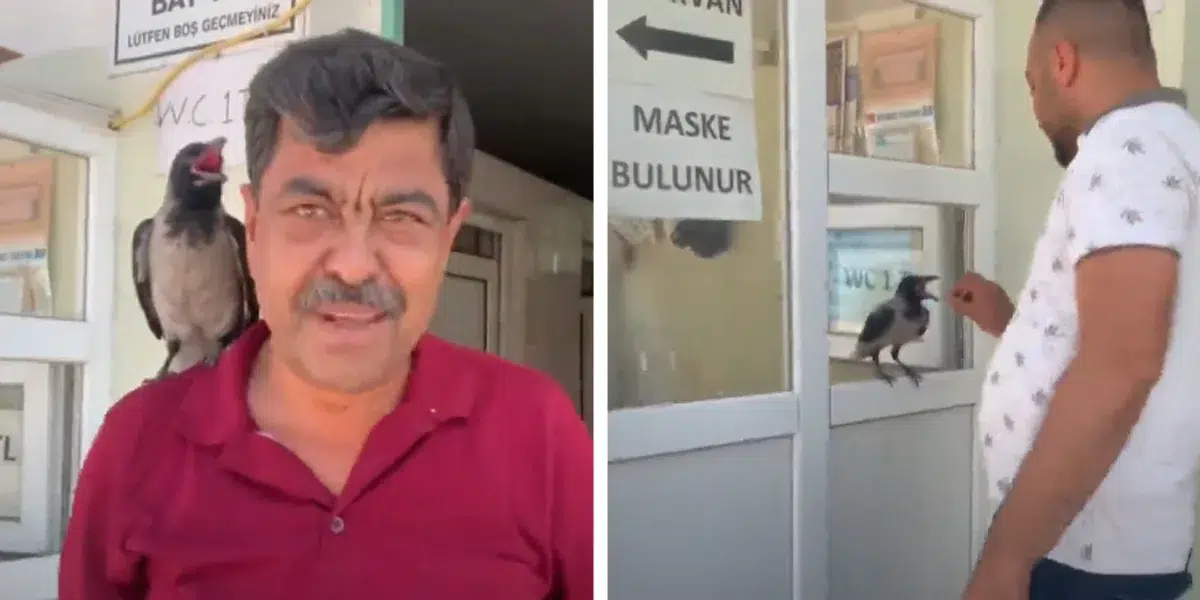
In a heartwarming tale of reciprocity and animal intelligence, a rescued crow has captured the hearts of many by assisting its human savior at work. This extraordinary story unfolds in Turkey, where a mosque attendant’s act of kindness towards a fallen bird blossomed into an unlikely partnership, demonstrating the profound connections that can form between humans and animals.
A chance encounter leads to an unexpected friendship
İsmail Atmaca, a dedicated mosque attendant in Turkey, experienced a life-changing moment during a routine workday. While tending to his duties, he witnessed a young crow tumble from a nearby tree. Moved by compassion, Atmaca investigated the scene and discovered the bird was unable to fly.
Without hesitation, Atmaca took the fledgling under his wing, both literally and figuratively. He brought the crow to his booth and began nurturing it with care and attention. Little did he know that this simple act of kindness would evolve into a remarkable bond, reminiscent of the touching story of Jack, the once-unwanted dog who found a loving family.
Atmaca’s decision to bring the crow home and subsequently to work initiated a daily routine that would soon captivate the local community. The bird, affectionately named Cabbar, quickly became more than just a rescued animal – he transformed into a loyal companion and an eager assistant.
As Cabbar grew stronger under Atmaca’s care, he began to display an uncanny interest in his rescuer’s work duties. The crow’s curiosity led to a surprising development: Cabbar started mimicking Atmaca’s actions at the mosque booth.
Initially, Cabbar’s involvement was limited to playfully toying with coins in the booth. However, his behavior evolved, and he soon began actively collecting money from patrons who used the facilities. This unexpected turn of events showcased the crow’s remarkable intelligence and adaptability.
The unique partnership between Atmaca and Cabbar garnered attention from locals and eventually caught the eye of a news station. Footage of the duo working together quickly spread, highlighting their special bond and Cabbar’s newfound role as an unofficial assistant.
A crow’s gratitude: more than just bird-brained behavior
The story of Atmaca and Cabbar serves as a testament to the complex emotional capabilities of animals. Experts in animal behavior suggest that Cabbar’s actions may indeed be a form of gratitude, challenging our understanding of avian cognition.
Here are some fascinating aspects of crow intelligence that might explain Cabbar’s behavior:
Problem-solving skills
Tool use and creation
Facial recognition abilities
Social learning and cultural transmission
Emotional intelligence and empathy
This heartwarming tale reminds us of the power of compassion and its ability to transcend species boundaries. Much like the story of the security guards who welcomed a dog they were supposed to evict, Atmaca’s kindness towards Cabbar resulted in an unexpected and beautiful friendship.
The relationship between Atmaca and Cabbar highlights the profound impact that animal companionship can have on human well-being. Studies have shown that interacting with animals can reduce stress, lower blood pressure, and improve overall mental health.
Consider the following table illustrating the benefits of human-animal interactions:
Benefit
Description
Stress Reduction
Interacting with animals lowers cortisol levels
Improved Mood
Animal companionship increases oxytocin and serotonin
Enhanced Social Connections
Pets can facilitate human-to-human interactions
Increased Physical Activity
Caring for animals often involves exercise
Sense of Purpose
Caring for an animal provides a meaningful routine
Atmaca’s experience with Cabbar exemplifies these benefits. He expresses how the crow’s presence brings him joy and companionship, echoing the sentiments of many who find solace in animal relationships. This connection can be particularly powerful for those facing challenges, as seen in the case of the exhausted father who found support through social media.
The story of Atmaca and Cabbar serves as a poignant reminder of the ripple effects of kindness. A simple act of helping a fallen bird led to a friendship that not only enriched Atmaca’s life but also touched the hearts of many who witnessed their bond.
This tale encourages us to consider the impact of our actions, no matter how small they may seem. Just as a mysterious donor’s generosity brightened a family’s holiday, Atmaca’s compassion resulted in an unexpected and heartwarming outcome.
Moreover, the story challenges our perceptions of animal intelligence and emotional capacity. Cabbar’s apparent gratitude and desire to “help” at work demonstrate that the bonds between humans and animals can be more complex and meaningful than we often assume.
As we reflect on this extraordinary tale, we’re reminded of the importance of kindness, the potential for unexpected friendships, and the profound connections that can form across species. In a world that sometimes feels divided, stories like that of Atmaca and Cabbar remind us of the universal language of compassion and the joy that can come from helping others, regardless of their form.
While not every act of kindness may result in such a remarkable partnership, the story encourages us to remain open to the possibilities that arise when we extend a helping hand. It serves as a heartwarming counterpoint to more somber news, such as the passing of a young TikTok influencer, reminding us to cherish the connections we form and the positive impact we can have on others’ lives.