Wildcat Hills mountain lion season closes
Reply

News | Jan 10, 2025

Despite persistent calls from wildlife advocates to alter its practices around mountain lion hunting, Colorado Parks and Wildlife is staying the course.
On Thursday, the agency’s commission followed the staff recommendation and approved a 9.6% reduction in the number of lions that can be hunted for the 2025-2026 season, but made no other changes.
The reduction will allow for up to 610 lions to be hunted in the next season, down from 674 during the season currently underway.
The reduction was recommended due to one of two new thresholds put in place by Parks and Wildlife’s updated mountain lion management plans for the west and east regions of Colorado. These plans were passed in 2021 and 2024 and added caps to the number of adult female mountain lions that could be hunted as well as on the number of human-caused lion deaths not related to hunting. The goal of the caps is to maintain a stable population of mountain lions, according to the agency.
In the most recent season, the number of adult females hunted exceeded the 22% limit, hitting 24%, in the western hunting region.
Colorado offers mountain lion hunting during a nearly five-month period from November to March. Since 2014, the agency has been able to extend the season through April if the number of lions killed falls short of its cap.
The state offers an unlimited number of licenses for hunting mountain lions but requires that purchasers complete a specific education course before purchase. All lions killed are required to undergo a Parks and Wildlife inspection, which enables the agency to collect data on the lion’s sex, age and location.
This data is reported daily on the Parks and Wildlife website throughout the season so hunters can track the number of lions hunted in certain areas including the number of females who have been killed — and what the limits are in that area.
In recent years, the agency has sold around 2,500 licenses annually, with only about 20% successfully harvesting a mountain lion, according to information presented by Mark Vieira, the carnivore and furbearer program manager for Parks and Wildlife, at Thursday’s meeting.
Vieira said the caps on the number of lions hunted and requirements make the species “among the most tightly regulated of the state’s big-game species.”
In the last full hunting season, from 2023-2024, 500 lions — 265 male lions and 235 females (both adult and sub-adult) — were killed across the state, slightly above the three-year annual average of 491. In the current hunting season, which began in mid-November, 189 lions had been killed, 64 of which were females.
This was the commission’s first annual review of hunting permits since voters rejected Proposition 127 in November with nearly 55% of the vote. If passed, the measure would have banned hunting mountain lions, bobcats and lynx.
At the commission’s Wednesday and Thursday meetings, dozens of public commenters reiterated the concerns brought forth by the ballot measure. In addition to opposing hunting as a wildlife management tool, ethical concerns were raised over the use of hounds — which account for over 90% of lion hunting in Colorado — and the permitted hunting of female mountain lions.
“This is not a sustainable management practice,” said Valerie Hunter-Goss, a Fort Collins resident. “The tradition of hounding is reckless and threatens mountain lion populations. Removing key females from their communities wreaks havoc on the species balance. We ask for more accountability and ethical hunting practices like fair chase in managing mountain lions.”
The number of female lions — both adult and young — hunted spiked in the 2023-2024 season, accounting for 47% of the total harvest. In the prior five years, it had been between 39% to 41%.

Vieira hypothesized that the ballot measure was behind the spike.
“The only explanation I have is that last winter, when faced with the possibility of a ban on lion hunting via Proposition 127, a small but measurable portion of hunters made a different selective decision than ever before and opted to harvest the female causing this 2023 adult female harvest proportion increase,” he said.
Per its new plans, Parks and Wildlife tracks — and limits — the number of adult females that can be hunted, but places no limits on sub-adult cats. This is because adult female mountain lions are the “biological engine of the population,” Vieira said.
“Those adult females are out there producing kittens, propelling the population forward, and we want to protect those,” he said. “It’s not that sub-adult male lions or sub-adult female lions are not necessarily important … and we have the data to suggest that they’re very much out there in abundance in Colorado sub-adults, but we want to protect those females.”
It is also illegal to kill mountain lion kittens — defined as those with spots — or females with kittens.
The use of hounds to selectively hunt mountain lions, the winter-only season — which allows identifying kitten tracks in the snow — the education course and new thresholds all help protect adult female lions in Colorado, Vieira noted.
Some of the houndsmen and hunters that spoke on Thursday reiterated this and spoke against some of the claims made about them. Kody Lostroh, vice president of the United Houndsmen of Colorado, said they were behind the reduction in quota and other thresholds.
“It lines up with the science, and that’s what we want,” Lostroh said. “There’s nothing in us that wants these things eliminated. We love mountain lions … We want (management) to line up the best way possible for the populations and for the opportunity for us as well.”
While the commission and staff discussed some of the concerns raised by the public, it unanimously passed the regulations with no changes beyond the staff’s recommendation.
Dallas May, the commission’s chair, backed the agency’s current management system and enforcement.
“We cannot legislate morals and ethics,” May said. “We have a system in place, the education course that a hunter is required to carry that certificate of completion with them. And yes, we have had instances of people violating that or having illegal take, but the fact of the matter is we have a system in place that punishes that and we enforce it.”
Commissioner Jay Tutchton added that in rejecting Proposition 127, voters showed support for the agency’s current mountain lion management, which he called “advanced and sustainable and as scientifically based as any other state.”
“A key part of democracy is that we accept the results … I think we’re struggling with that a little, but the public has spoken on both wolves and lions, and we have to accept both,” Tutchton said. “There’s some thorny ethical issues that people are in different places on and they view the world differently … but the commonality, for me, is that everyone wants those animals on the landscape and our job as (Parks and Wildlife) is to ensure that those animals remain on the landscape for future generations, whether they want to watch them or hunt them.”
The wild cats were humanely trapped using cameras near baited traps and are in quarantine
Libby Brooks Scotland correspondentThu 9 Jan 2025 05.21 ESTShare
Two lynx that were illegally released into the Scottish Highlands have been captured overnight and are said to be in good health.
Police had issued a warning to the public on Wednesday evening not to approach the wild cats, after several sightings in the Drumguish area, near Kingussie.
Working alongside Police Scotland, experts from the Royal Zoological Society of Scotland (RZSS) humanely trapped the wild cats and they are now being cared for in quarantine facilities at Highland Wildlife Park before being transferred to Edinburgh Zoo.
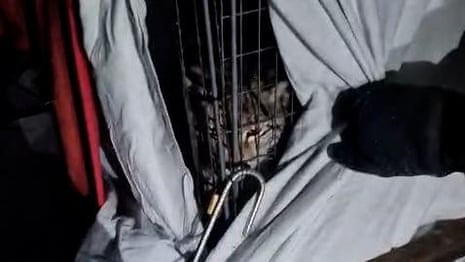
The wildlife conservation charity condemned the illegal release as “reckless” and “highly irresponsible”, as did other animal welfare groups, who warned that it was likely the pair would have died in the wild. There were calls for whoever was responsible to face “the full force of the law” at the Scottish parliament on Thursday.The video player is currently playing an ad.Skip Ad
Police said enquiries were continuing to establish the full circumstances on Thursday. While charities working towards the reintroduction of lynx to the Highlands have condemned the illegal release, there is speculation that someone who had grown frustrated with the slow progress of the campaign had taken matters into their own hands.
The fact that the usually shy and elusive animals were photographed in snowy woodland by a local resident suggests they were used to human interaction.https://interactive.guim.co.uk/uploader/embed/2025/01/lynx-map/giv-455971h8Q1JRpJwZ/
Eurasian lynx, which typically grow to the size of a labrador retriever and have thick grey-brown fur with black spots and a white belly, were once native to Britain but driven to extinction about 1,000 years ago.
David Barclay, the manager of the RZSS saving wildcats team, said: “We set live trail cameras near baited traps and it was a long night for our specialist keepers who were taking turns to monitor any activity.
“It was amazing to see the lynx being captured safely and humanely, which makes the lack of sleep more than worth it.
“Biosecurity laws mean the cats need to spend 30 days in suitable quarantine facilities, so we will transfer them from Highland Wildlife Park to Edinburgh zoo, where we will further assess their health and welfare. Long term, they may return to Highland Wildlife Park, which is near where they were trapped, though it is too early to say for certain.”
RZSS’s chief executive, David Field, condemned the illegal release “in the strongest possible terms”.
“It was a highly irresponsible act and it is very unlikely they would have survived in the wild due to a lack of adequate preparation. Their abandonment was reckless to the animals, public the community and nature.
“For now, we have named them ‘The KillieHuntly Two’ and thankfully they appear to be in good health.”
Highland Wildlife Park is already home to two grown northern lynx, a subspecies of the Eurasian lynx, named Switch and Neon.
The charity partnership Lynx to Scotland described the illegal release as “grossly irresponsible”.
Peter Cairns, the executive director of Scotland: The Big Picture, one of the charities involved, said: “We understand the frustration of all those who wish to see lynx restored to the Scottish landscape, but an illegal release is not the way to achieve that aim.”
The farmers’ body NFU Scotland, which opposes the reintroduction of lynx to the Cairngorms, had raised concerns overnight about the predators attacking livestock.
Adding to speculation about how and why the cats were released, one witness described encountering them near a layby, where straw bedding had been left for them.
Willie Anderson, deputy team leader of Cairngorm mountain rescue team, said he came within 60 yards of the pair.
“They had definitely been illegally released because they were 100 yards from a pile of straw bedding that contained dead chicks and, interestingly, porcupine quills – the bedding was peppered with porcupine quills,” he said.
“They were very tame and you could see they had been released from a nearby layby because there was the straw there too. They were only 100 yards from that spot and the road. I don’t think they would have survived in the wild.”
Anderson praised the speed at which experts at the Highland Wildlife Park had recaptured the animals.
“The park had traps they use for their Scottish wildcat reintroduction programme, so they left baited cages and incredibly they caught both. The cages also had cameras so staff could monitor them,” he said.
“To catch one lynx in a cage was great but two was really fantastic. I have done a few rescues in my time but this was one of the more unusual events that I have come across.”
The Highland Wildlife Park is familiar with winter escapades: last February an escaped Japanese macaque became a global sensation after he went on the run for four days, before being lured back by a yorkshire pudding.
Edward Mountain, MSP for the Highlands and Islands, raised the issue at first minister’s questions on Thursday, calling for the illegal release to be recognised as “a very serious wildlife crime”.
“The release of these lynx was not only reckless and ignorant, but also illegal,” he said.
“There is a reason why the reintroduction of species is carefully regulated, and those responsible must be caught and face the full force of the law.
“If these lynx were not caught, it is likely that they would have died. I am relieved that the animals are safe, but it is important that we recognise the significance of this serious wildlife crime”.

