Two hunters shot on first day of deer firearms season in western Minnesota
Reply

Story by Adam Pack
• 4h • 4 min read
‘It’s Gonna End On Day One’: GOP Lawmakers, Fishermen Urge Trump To Keep Promise To Axe Offshore Wind© The Daily Caller
Critics of the offshore wind industry are calling on President-elect Donald Trump to keep his campaign promise of ending federal support for offshore wind on his first day in office.
Trump’s return to the Oval Office may deal the problem-riddled offshore wind industry another blow if his administration follows through on his pledge to scrap federal support for offshore wind projects during his second term. Republican lawmakers, opposed to heavily subsidized green energy, and commercial fishermen, who view the industry as an existential threat to their livelihoods, are calling on the president-elect to follow through on his campaign’s promise, which could imply ending federal subsidies and lease sales for the industry. Biden Celebrates Offshore Wind ‘Progress’ Despite Industry’s Major Struggles, Cancellations)
XfinityBetter internet for less
“We are going to make sure that [offshore wind] ends on day one. I’m gonna write it out in an executive order,” Trump told a crowd of his supporters at a campaign rally in Wildwood, New Jersey, on May 11. “It’s gonna end on day one.”
Since January 2021, the Biden-Harris administration has approved ten offshore wind projects at commercial scale and conducted six offshore wind lease sales, including one held just last week in the Gulf of Maine that was criticized by the commercial fishing industry as part of President Joe Biden’s wider climate agenda. Offshore wind has notably suffered from inflation headwinds, project cancellations and souring public opinion despite the Biden administration’s embrace of the industry.
“I have no doubt that a second Trump administration will do the right thing for Americans by scrapping the Biden-Harris offshore wind agenda,” Republican New Jersey Rep. Jeff Van Drew, a vocal critic of the offshore wind industry, told the DCNF. “These projects are a burden on our economy, harm local communities and are nothing but a political payoff to special interests. President Trump understands that true energy independence and prosperity come from American oil, gas, solar and especially nuclear energy, through a balanced energy policy — not from wasteful wind projects that put our economy and environment at risk.”
XfinityBetter internet for less
“I think it’s a very wise decision,” Republican Maryland Rep. Andy Harris, chairman of the House Freedom Caucus, told the DCNF. “We are wasting money, and the worst part is that all that money is going to foreign wind companies because there are no American wind companies. They’re all foreign companies that are making billions of dollars off the American energy ratepayer.”
The Vineyard Wind energy project, jointly owned by a Danish investment firm and a Spanish utility, earned Republican lawmakers’ ire in July when debris from one of the project’s turbine blades — which stretches longer than the Statue of Liberty — washed up on Massachusetts’ beaches after breaking apart and falling into the ocean.
“We should never allow foreign owned companies to control our energy supply — much less harm our environment while doing it,” Harris wrote on X.
The New England Fisherman’s Stewardship Association (NEFSA), a commercial fishing industry group that organized a “flotilla protest” at the site of the broken Vineyard Wind turbine in August, is calling on the Trump administration to walk back on Biden’s goal of deploying 30 gigawatts of offshore wind by 2030. The group is also advocating for the incoming Trump administration to “delist unleased wind energy areas” off the coast of New England and the mid-Atlantic.
bestmoneyWho Normally Has The Cheapest Car Insurance In Washington
NEFSA CEO Jerry Leeman told the DCNF that he’s optimistic that the Trump administration will be “a voice of reason” on offshore wind, which he claimed would be a welcome departure from the previous administration, whom he accused of prioritizing green energy goals over fishermen’s livelihoods and the health of the marine environment.
“The incoming administration has an historic opportunity to save American workers from foreign developers, reinvigorate iconic coastal towns, and improve America’s food security,” NEFSA CEO Jerry Leeman said in a press release following Trump’s election win.
The Trump administration may also seek to repeal the Inflation Reduction Act subsidies that offshore wind projects are eligible for, which could make the industry’s continued growth off the Atlantic coast not as economically viable, according to Travis Fisher, director of energy and environmental policy studies at the Cato Institute.
“I would expect the prospects of offshore wind to dim once the subsidies in the Inflation Reduction Act are repealed,” Fischer told the DCNF. “The high cost of offshore wind is unavoidable. State and federal subsidies can mask the cost by shifting it to the tax base, but ultimately either ratepayers or taxpayers will bear the significantly above-market cost of offshore wind in the states that mandate it.”
Offshore wind developers and wind turbine makers’ stock prices substantially decreased on Wednesday following news of Democratic presidential nominee Kamala Harris’ defeat the previous night.
The Trump campaign did not respond to a request to comment from the DCNF.
All content created by the Daily Caller News Foundation, an independent and nonpartisan newswire service, is available without charge to any legitimate news publisher that can provide a large audience
By Austin Williams
Published November 8, 2024 6:56pm CST
javascript:false
Infectious disease expert Peter Chin-Hong joins LiveNOW’s Austin Westfall to discuss some notable updates as it relates to the bird flu.
LOS ANGELES – In a significant move, the Centers for Disease Control and Prevention (CDC) has issued new guidelines urging farms to test workers exposed to bird flu, even if they show no symptoms.
These Barefoot Shoes are Leaving Neuropathy Experts BaffledBarefoot Vitality|
This comes after a CDC study found antibodies in several dairy workers, signaling possible bird flu infection among asymptomatic individuals. The guidance, aimed at minimizing virus spread among livestock workers, underscores the need for closer monitoring and prevention.
Federal health officials are recommending increased bird flu testing for farmworkers, even those without symptoms, following a study showing that dairy workers may be at risk for infection.
The CDC’s guidance comes after blood tests indicated that 8 out of 115 workers surveyed in Michigan and Colorado had antibodies to the H5N1 bird flu virus. Dr. Nirav Shah, principal director of the CDC, emphasized that these actions are designed to protect farmworkers and prevent the virus from mutating as it spreads.
The CDC’s recent study, which focused on workers in close contact with infected animals, represents the largest assessment of bird flu exposure in the U.S. since the virus was first detected in dairy cattle earlier this year.
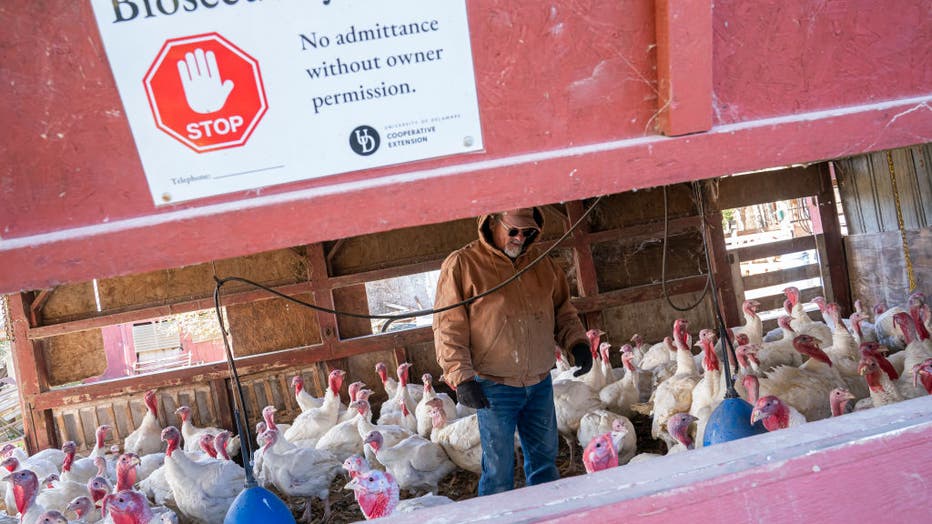
Bill Powers checks on his flock of white turkeys, which have been kept under shelter all year to prevent exposure to avian influenza, at his familys farm on November 14, 2022 in Townsend, Delaware.
Notably, four out of the eight workers with antibodies had no symptoms, suggesting that the virus may spread among farmworkers without causing obvious signs of illness. Experts say this finding has prompted the CDC to update its guidelines.
“In the past, we’ve recommended testing only for symptomatic workers,” said Dr. Gregory Gray, an infectious disease researcher, in a report by the Associated Press. “This updated guidance reflects a growing assessment of the risk posed by H5N1.”
The study found that farmworkers’ duties—often involving the handling of milk or cleaning milking parlors—are likely to increase their exposure to bird flu.
None of the eight workers with antibodies wore respiratory protection, and only a few used eye protection, raising concerns about adequate safety measures.
Researchers also noted that infected cows often have high levels of the virus in their milk, a significant factor for infection risk.
Experts warn that each new infection, whether in animals or humans, raises the risk of the virus adapting in ways that could heighten its danger. Angela Rasmussen, a virologist at the University of Saskatchewan, emphasized that the current response to H5N1 might be inadequate given the virus’s ability to jump between species.
“If this virus continues spreading across different species, there’s a risk we might see it mutate in ways that could pose even greater risks to humans,” she said.
While the CDC’s new guidance calls for expanded testing, researchers highlighted challenges in implementing it effectively, particularly due to resistance from farm owners and workers.
Some farm owners have been reluctant to allow testing, and many workers may not seek testing unless symptoms arise. This reluctance, along with logistical barriers, has slowed efforts to contain the virus on farms.
Since the initial detection of H5N1 in dairy cows, the virus has spread to 446 cattle herds across 15 states. Recently, the U.S. Department of Agriculture confirmed bird flu in a pig on an Oregon farm, marking the first detection in swine in the U.S.
This expansion into new livestock populations underscores the urgency of CDC’s updated recommendations and the importance of proactive testing and preventative measures in high-risk environments.

BRADFORD — Four people were taken to the hospital this morning after a car collided with a horse drawn buggy in Bradford.
Fire Chief Desmond Murray said it happened around 6:30 near the intersection of the Charleston Road and Main Road.
He said the call originally came in as a person on a horse that had been hit.
“When we got there we realized it was a horse and buggy but the buggy was so badly damaged you couldn’t recognize it anymore,” said Murray.
The road was shut down while medical personnel treated patients.
Chief Murray said the driver of the car and three people in the buggy were transported to the hospital with serious but non-life threatening injuries.
He said unfortunately the horse was very badly injured and had to be put-down at the scene.




By The Sentinel
·Nov. 6, 2024, 10:50 am
Share:
Cassandra Ballard | Sentinel Staff Writer
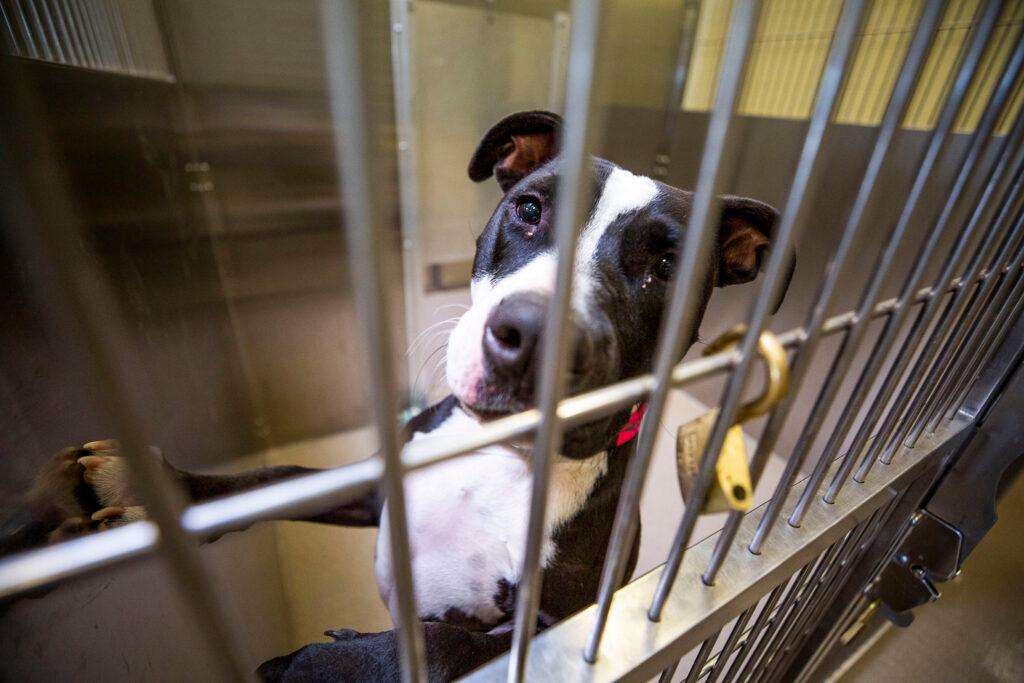
In early returns, Aurora voters appeared poised to repeal a years-old ban on pit bull dogs.
Measure 3A, which would repeal the 20-year-old ban, was leading about 44,341 votes to 40,184 votes at about 7:30 p.m.
The pit bull ban in Aurora was initially enacted in 2005 with some leniency for people the city had previously issued a license. In 2014, voters approved a referendum to keep the ban. In 2021, however, Aurora City Council approved the removal of dog breed restrictions from the city ordinance — without going back to voters for permission.
Later, in 2021, Aurora resident Matthew Snider sued the Aurora City Council over the vote because it did not include voter support. He argued that the council broke city charter language and that Aurora voters decided on the issue and must decide on any changes. By 2023, the Colorado Court of Appeals ruled in favor of Snider.
So, Aurora lawmakers asked voters whether the city should repeal the restricted breed ban and allow residents to own American Pit Bull Terriers, American Staffordshire Terriers and Staffordshire Bull Terriers.
“We had a big moment of panic when we saw that the repeal had been overturned because we do see a big difference when we have breed-specific legislation on the books,” said Senior Director of Advocacy and Education at the Dumb Friends League Ali Mickelson, “but they are not enforcing that ban right now. So we haven’t felt that yet, but we are preparing for it.”
She said that when there is a breed-specific ban, there is an influx of banned breeds brought to the shelter, and it is very challenging to find them new homes.
Many shelters are usually already at maximum capacity, so having a breed-specific ban overwhelms shelters with finding placement for them. Mickelson said that many shelters are moving away from destroying unwanted dogs, and Colorado shelters have a strong network for moving animals.
When there was a pit bull ban in Denver, and Aurora was fully implementing its breed-specific ban, the shelter would have to label the kennels, warning people that they might live in a place with a ban on that breed.
“We have these families that come in, and they’re so excited to find out more about a dog, and then they find out that they can’t adopt that dog because of the restrictions in their community,” Mickelson said. “It just results in us having dogs that stay longer.”
Denver Dumb Friends League sits at the border of Aurora and Denver. When there was a ban in both cities, Mickelson said they had difficulty finding homes for those breeds.
“When those two communities had those bans, that just really, really limited our doctors for those breeds,” she said.


