Is Our Weather Turning Against Us? Scientists Predict Rapid Escalation of Extreme Weather
Reply

Diana Logan
Mon, September 9, 2024 at 9:43 AM PDT
https://www.yahoo.com/lifestyle/endangered-wild-dog-puppies-playing-164317551.html
3 min read8

Yahoo is using AI to generate takeaways from this article. This means the info may not always match what’s in the article. Reporting mistakes helps us improve the experience.
Generate Key Takeaways
The first time I ever saw a dingo I was completely shocked. They looked no different, to my estimation, than the kind of mixed-breed mutts I was used to coming across in the pound. And that made perfect sense, for dingos—though wild dogs and actually quite dangerous—are descended from previously domesticated dogs thousands upon thousands of years.
But I was also interested to see the videos of these African Painted Dog pups playing on the Savannah. African Painted Dogs have always been a wild animal, and in fact bear little relation to their domesticated (very distant cousins) despite the use of the name “dog.” However, you’d never know it to watch this pack of pups playing with their mom.
In this video, a pack of eight African Painted Dog puppies gambol and vocalize on a dirt road, while adults in their group look on. They have giant black splotches of coloration all over their light bodies and comically huge, adorably rounded ears.
But don’t let their adorable faces fool you—these little fur ball are actually savage and vicious hunters, who use their incredible stamina, mouth full of sharp teeth and cooperative hunting methods to bring down game far larger than they are.
The name of this species is one of some degree of controversy. They are most often called African Wild Dogs, though conservation groups say that the term makes them sound as if they are domestic dogs who are stray or feral, rather than actual wild creatures who have as much right to the land as any other. Others call them African Painted Wolves. African Painted Dogs are extremely endangered due to habitat loss and fragmentation.
They are the only surviving member of the genus Lycaon, and broke off from the rest of the canine family over two and a half million years ago. (Compare this to wolves and even coyotes, who like, domesticated dogs, are part of the genus Canis.) Their far remove from more familiar, American canines make these an animal more suited to zoos and far-off savannahs than as pets.
Behaviorally, African Painted Dogs are not suited to domestication or taming, as they are extremely aggressive and adapted to run great distances in pursuit of their large antelope prey. All of their teeth are sharp, and they hunt in large packs dominated by a male and female breeding pair. Young females go off to join their own packs, which is an unusual structure in pack animals.
Their painted coats are made entirely of bristle hair, which becomes sparser and sparser as they age, until they are mostly hairless. They communicate through body language like tail movements and also a range of vocalizations, including a “sneeze” sound used during hunting to confer with the rest of the pack.
African Painted Dogs eat primarily antelope, impala, wildebeest, kudu, gazelle and sometimes warthogs. They compete with lions for their food, and lions will kill African Painted Dogs they perceive to be encroaching on their food source. They are also often the victims of having their kills stolen by hyenas. But the biggest threat to this species’ survival is habitat loss.
Looking for more PetHelpful updates? Follow us on YouTube for more entertaining videos.
Or, share your own adorable pet by submitting a video, and sign up for our newsletter for the latest pet updates and tips.
Posted September 6, 2024 | Reviewed by Tyler Woods
https://www.psychologytoday.com/ie/blog/animal-emotions/202407/lessons-from-40-years-among-wolves
“This is a book about a courageous woman. Often alone in wild country, she endures hardships and faces danger in many forms… It is a book I highly recommend: informative, fascinating, and beautifully written.” —Dr. Jane Goodall
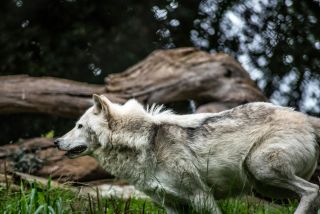
Source: Amar Saleem/Pexels.
My research interests for decades have focused on the behavior and social ecology of wild carnivores with a focus on coyotes. I also have been, and remain deeply interested in, the social behavior and behavioral ecology of wild wolves.1 So, when I learned about Dr. Diane Boyd’s new book called A Woman Among Wolves: My Journey Through Forty Years of Wolf Recovery, I couldn’t wait to get my eyes on it. I’ve known of Diane’s long-term research for many years, and I remain fascinated by what she was able to do, often against all odds, Often called “the Jane Goodall of wolves,” a well-deserved monicker, I couldn’t agree more with the accolades her book has received—it truly is a story of passion, resilience, and determination in a career dominated by men. Here’s what she has to say about her landmark and deeply inspirational book.
Marc Bekoff: Why did you write A Woman Among Wolves?
Diane Boyd: I wrote A Woman Among Wolves for many reasons: 1) because it is a story that has not been told before, despite the numerous wolf books out there; 2) many of my old coworkers have passed away and can no longer share their narrative; 3) it’s a story that needs telling, of connecting those early years of natural wolf recovery through dispersal without reintroduction, when wolves were truly rare and endangered; 4) it travels full circle from the early wolf recovery efforts monitored by dedicated field biologists in the 1970s and 80s, and updated through present times, including the cultural shifts over these five decades as the societal pendulum has swung from one extreme to the other; and 5) most importantly, I hope through good storytelling and balanced knowledge to open peoples’ minds about what wolves are and what they are not.
article continues after advertisement
.png.jpg?itok=z5Y4Y7Oy "Greystone Books/with permission.")
Source: Greystone Books/with permission.
This is my personal story that weaves revealing insights about a few individual wolves, wolf population dynamics, science, social dimensions, and politics throughout the book in a way that any reader can take away something new and hopefully thought-provoking. In the long run, I believe all of this will improve wolf conservation efforts and increase human tolerance for having wolves back on the landscape.2
MB: Who do you hope to reach?
DB: I wrote this book for the general public reader who might have an interest in wolves, ecology, facing challenges, or simply love a good adventure story. I also hope to mentor young future biologists, especially women, who want a meaningful career in the wildlife conservation field and to follow their dreams. I’ve published numerous articles in peer-reviewed journals and technical book chapters. However, I strongly believe that more headway is gained in conserving our wildlife and their habitat by reaching out to a broader public audience through well-written popular books and magazine articles based on sound science, but less technically written. Your average peer-reviewed journal article is read by a small number of academics and managers, whereas popular publications have readerships of millions across the world and, I believe, more power to change conservation perspectives.
MB: What are some of the major topics you consider?
DB: I discuss wolf ecology and behavior, trophic cascades, fear, resilience, wolf-dog-human relationships, the process of domestication of dogs from wolves, complex predator-prey relationships, interspecific carnivore interactions and competition, the myth of the Super Wolf, pro-wolf and anti-wolf perspectives, cultural differences across the world in wolf management, and social values as they impact/enhance/battle wolf recovery.
The more complex scientific concepts are presented through stories, examples, and clear language, without the technical jargon of typical scientific discourse that may lose many readers. And yet, there is enough very current science to appeal to the ecologist-biologist-behaviorist. The public reader will better grasp the complicated and highly debated concept of trophic cascades by reading about dynamic exchanges between wolves, mountain lions, grizzly bears, and coyotes than if the reader waded through a long list of scientifically documented studies covering the same. I did not use citations in the text or footnotes (which, as a trained technical writer, was difficult at first until I got into the rhythm of writing a memoir) because my editor wanted the book to flow smoothly without readers being encumbered with a more technical format. There is a list of “further readings” at the end for those who want to delve into more of the research behind discussions in the book.
article continues after advertisement
MB: How does your book differ from others that are concerned with some of the same general topics?
DB: A Woman Among Wolves differs from other wolf books in that it is a memoir written by a woman and her crew who doggedly pursue wolf recolonization from the very first wolf to walk down from Canada in 1979, unaided by humans, and subsequent dispersers that recolonized northwestern Montana 15 years before wolves were reintroduced to Yellowstone and central Idaho.
The story expands from this historical, small-scale natural recovery up to present times and a wolf population of more than 3,000 wolves in the western U.S. I would estimate that 99 percent of the public thinks that all wolves in the western U.S. were reintroduced into Yellowstone and Idaho, are foreign, and don’t belong on the landscape, thus packing some baggage; this needs to be corrected. There are many elements that set my book apart from the hundreds of wolf books out there: it is a long-term first-person memoir written by a woman biologist in a male-dominated field, a mix of heart and biology, covering viewpoints from pro- and anti-wolf philosophies, and not preachy. I tell a powerful story without telling readers what they should think, although it will be obvious to the reader that I am passionate about wolves, research, and communication.
MB: Are you hopeful that as people learn more about these wolves they will treat them with more respect and dignity?
DB: I can best answer this by quoting the last paragraph in my introduction:
“I hope these stories, spanning more than four decades of traveling the rocky road of wolf recovery, inspire conservation dreams and actions in the next generations, who will make critical decisions and craft solutions for future wildlife-human interactions. Finally, I hope that this story provides a nuanced understanding of wolf recovery that will make someone who is contemplating killing a wolf pause—and then decide not to pull the trigger.”
References
In conversation with Dr. Diane K. Boyd. Diane holds a PhD in Wildlife Biology from the University of Montana. She divides her time between her home in Kalispell, Montana, and her beloved cabin in the North Fork. She is the author of numerous scientific papers on wolves. An interesting story written about her work titled The Woman Who Runs with the Wolves was published in 1993 in Sports Illustrated.
1) For more information on the behavior of wild wolves see The Power and Legacy of Yellowstone’s Alpha Female Wolf 06; The Story of Yellowstone Wolf 8: From Underdog to Alpha Male; The Reign of Wolf 21, Yellowstone’s Benevolent Alpha Male; The Redemption of Yellowstone’s Renegade Alpha Wolf 302; and Yellowstone Wolves: Everything You Want to Know and More.
2) MB: How does your book relate to your background and general areas of interest? DB: This book is a memoir about my life’s work, the interesting people and wolves I’ve encountered along the journey, and the remote places I’ve lived in and experienced deeply. So, the book encompasses my background and general areas of interest. Over the nearly fifty years that I have been involved with wolf research, I have had so many backcountry wildlife adventures/misadventures that it was a natural and straightforward process to weave the story telling with the science underlying my curiosity and passions.
Hunters can now use drones to track wounded deer, turkey, elk, and black bears, the Missouri Department of Conservation said.


Credit: WZZM
Author: Hunter Bassler
Published: 1:48 PM CDT September 9, 2024
Updated: 2:34 PM CDT September 9, 2024

MISSOURI, USA — The Missouri Department of Conservation recently released multiple rule changes ahead of this year’s deer and turkey hunting season, including an additional tool hunters can add to their arsenal.
Hunters can now use drones to recover wounded deer, turkey, elk, and black bear during the respective hunting seasons, according to Missouri’s Wildlife Code. All other uses of drones are still prohibited while hunting, including pursuing, taking, driving, or otherwise harassing wildlife.
Drone operators must first obtain permission from the public or private landowner where the game animal was shot. Using a drone to trespass on someone’s property to locate and recover a wounded animal is still prohibited. Drone operators also cannot have any kind of weapon on them while flying a drone.
“No person may possess or control a firearm, bow, or other implement whereby wildlife could be killed or taken while afield, whether acting singly or as one (1) of a group of persons, during times when an unmanned motor-driven air conveyance is in flight,” the wildlife code said. “Operators of unmanned motor-driven air conveyances used in the recovery of a wounded animal as prescribed in this paragraph are exempt from hunting permit requirement.”
Missouri’s archery deer and turkey hunting season begins on Sept. 15, kicking off the fall hunting season. The turkey firearms portion begins on Oct. 1 and runs through Oct. 31. Early antlerless deer hunting runs through Oct. 11-13, and late antlerless runs through Dec. 7-15.
Click here to read all the new regulations for this fall’s hunting season.
Written by: Ejay Camposano
| Published on September 8, 2024

Dog owners know their pups love them deeply, even if they express it differently than humans. Recent research, however, left many dog lovers saddened when it revealed that most dogs don’t like being hugged. This doesn’t mean our furry friends dislike affection; they thrive on our love and approval! Instead of giving them hugs, which can make them uncomfortable, try showing your devotion in ways they truly understand—belly rubs, treats, or playtime. These gestures strengthen your bond and express love in a language they fully appreciate.

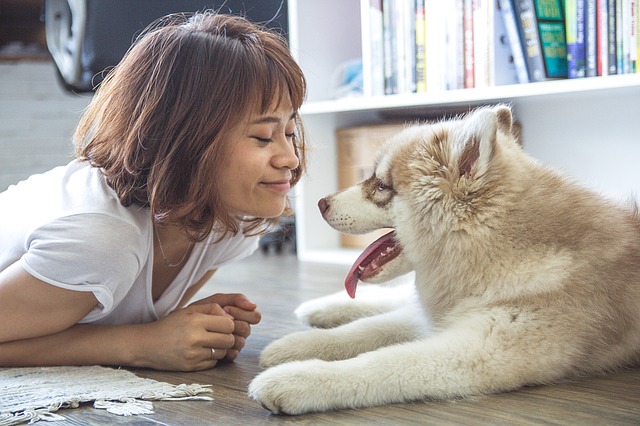
Dr Brian Hare, Professor of Cognitive Neuroscience at Duke University, topped the NY Times bestseller list with his book, The Genius of Dogs. In an interview with Anderson Cooper this past Spring, he told the dog-loving newsman that when your dog stares at you, he is “hugging you with his eyes.”
https://imasdk.googleapis.com/js/core/bridge3.665.1_en.html#goog_1861463795
63.3K
iHeartDogs – Allergy and Itch Chew
Next
Stay
This doesn’t mean you should stare deeply into the eyes of the dog that guards your local junkyard! Direct eye contact is still considered a challenge or threat in many situations. But with your trusted pet, try gazing into his eyes when you are calmly relaxing.
Speak softly, stroke him gently, and maintain eye contact. According to Hare, these quiet moments stimulate the release of Oxytocin in the canine brain – the same hormone that bonds mother and child.
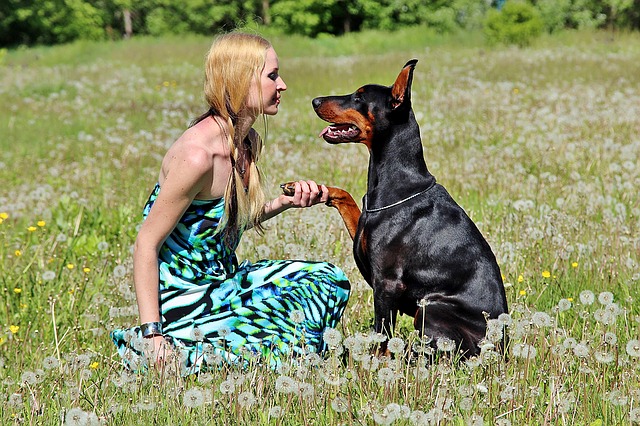
A Japanese study published in the September 2013 volume of Behavioral Processes found that dogs raise their eyebrows – especially the left one – when greeted by their owners. Using a high-speed camera, they scrutinized the dogs’ facial movements when seeing their owners vs. strangers.
When the strangers came along to greet them, the test dogs displayed far less facial activity, most of which was right-sided. The significance is that the right brain controls the left side of the face and is tied to emotion, while the left brain controls the right side of the face and is tied to analytical behaviors.
The more facial activity you display when greeting your dog, the more they know they are loved. If you can raise one eyebrow (sadly, I cannot), then make it to the left one. Your pup will really feel special!
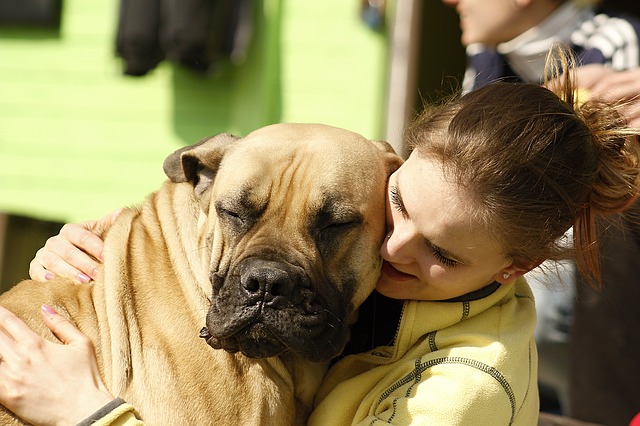
Not just figuratively, but press your weight against your dog physically. Not to the point where he feels cornered (or crushed!), but just a little to show you trust him. Our pups do this to display their affection for us, which is often overlooked.
Have you ever had your pooch press up against the backs of your legs while you’re busy in the kitchen? That’s a type of dog hug! Try giving him one right back.

Emory University neuroscientist Gregory Berns is the author of How Dogs Love Us, and he has spent decades studying the canine brain using MRI. According to his research, sleeping with a human is the ultimate display of love and trust our dogs can give because that is when they are most vulnerable.
It also shows that they consider us a member of their pack. If you have a No Dogs in Bed policy, try snuggling up on the sofa or floor for a few minutes daily to show affection.
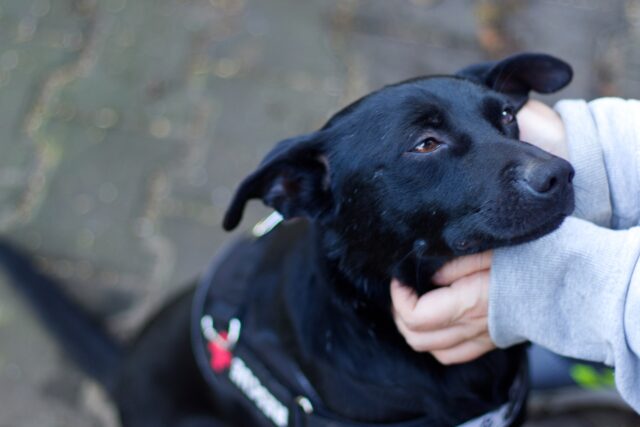
A pat on the head might feel natural to show praise, but rubbing your dog’s ears may express more love. When you rub your dog’s ears, their bodies produce endorphins. Endorphins are hormones that cause pleasure for your pup. A gentle ear massage in a circular motion is enough for your dog to know how you feel.
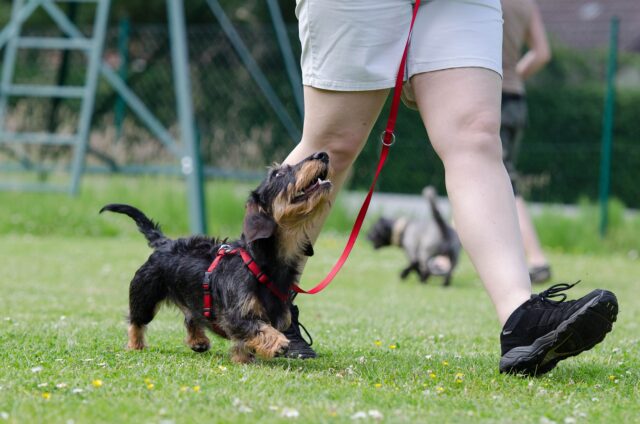
Engaging in fun activities with your dog is a great way to help your bond grow. Going for walks, playing fetch, or working on training are all ways to show your dog you care. These activities bring you and your dog closer together.
When your dog sees you having fun, they’ll feel happy too. In addition to feeling loved, your dog will get the exercise and mental stimulation they need.
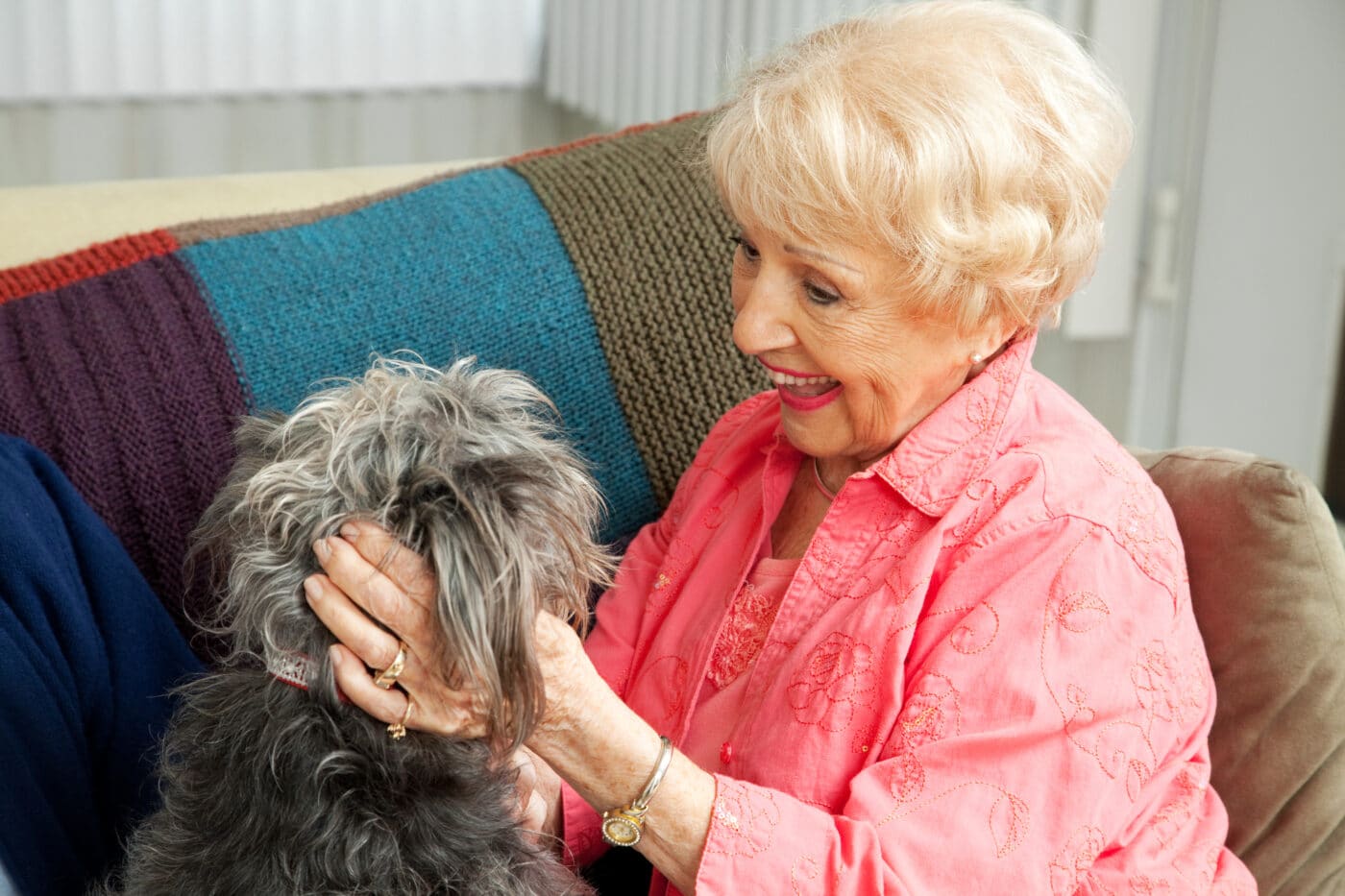
We all do it! As dog parents, it’s hard to resist having conversations in a high-pitched voice with our dogs. It might be embarrassing to admit, but dogs enjoy it. They respond well to the exaggerated emotions in your voice, and it helps them know you’re addressing them.
So, there’s no need to feel crazy if you talk to your dog. Odds are, their love for you grows even stronger when you do. Reading to dogs is another special way to bond with them.
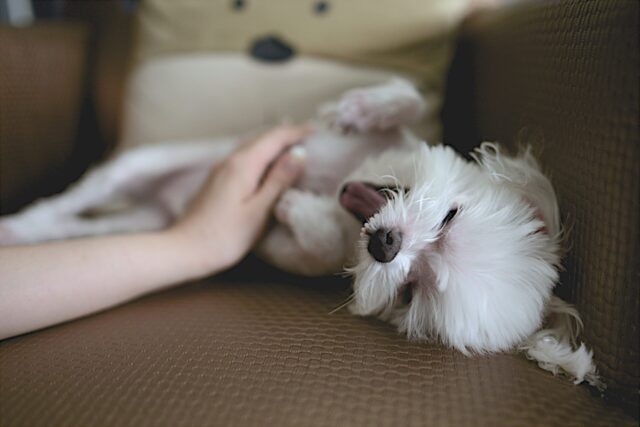
Not every act of love has to be grand. You can show your dog you love them just by petting them. Touching a dog releases oxytocin, a hormone that makes you feel good. So, if your dog enjoys it, there’s no reason to hold back on the pets and belly rubs.
Adding an extra touch to your dog’s routine, such as a massage, grooming session, or extended petting time, might make your dog feel more loved. Most dogs will happily welcome the extra attention.
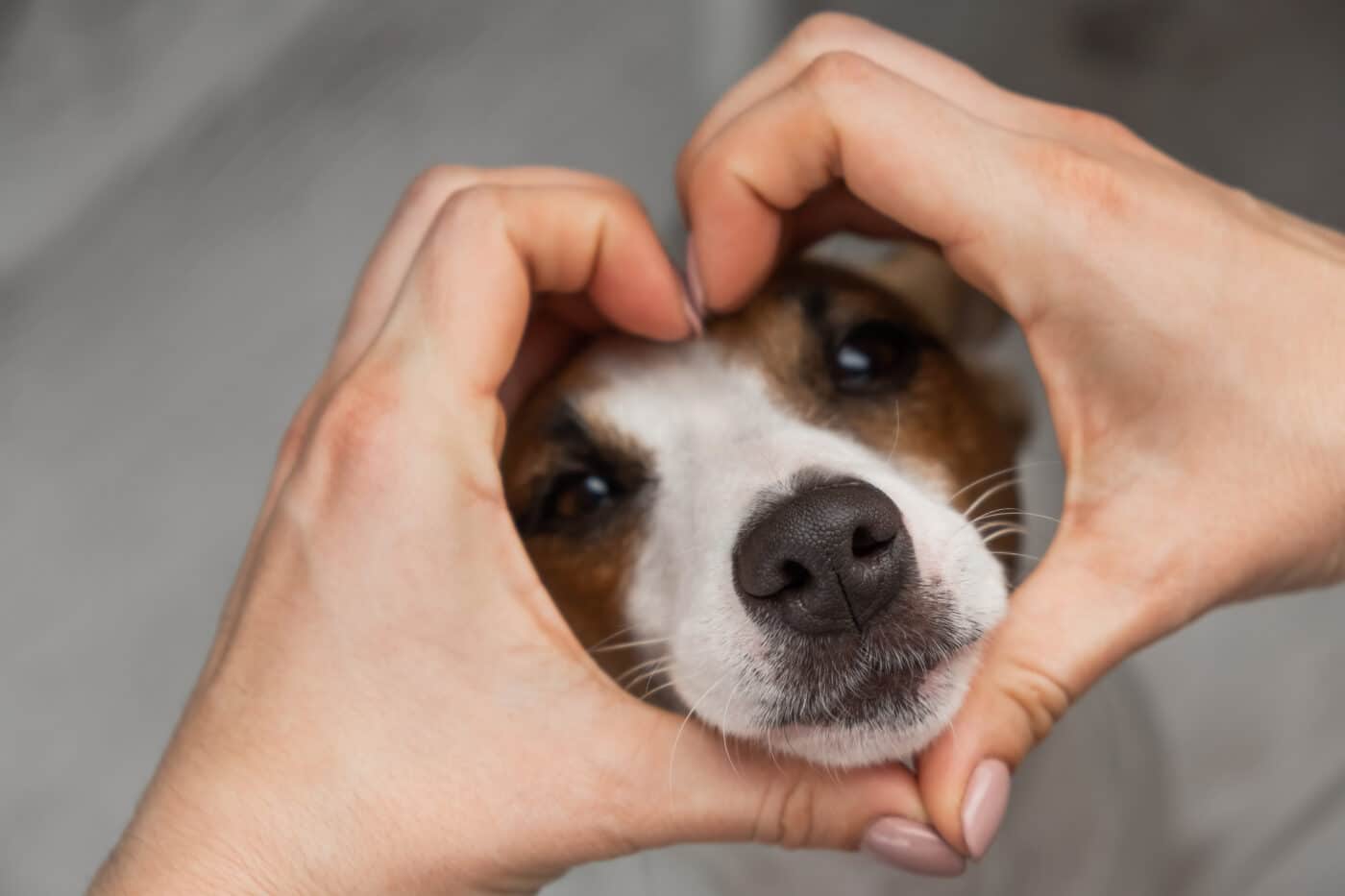
Throughout his extensive research Dr. Berns has found that although it’s sometimes hard for us to tell what our dogs are thinking, they definitely do not have the same problem reading our emotions! If your love is true for your pups, they know it by reading your voice, body language, and actions. So just keep doing what you’re doing, and your dogs will reward you by showing affection in their own special ways.
Dog owners know their pups love them deeply, even if they express it differently than humans. Recent research, however, left many dog lovers saddened when it revealed that most dogs don’t like being hugged. This doesn’t mean our furry friends dislike affection; they thrive on our love and approval! Instead of giving them hugs, which can make them uncomfortable, try showing your devotion in ways they truly understand—belly rubs, treats, or playtime. These gestures strengthen your bond and express love in a language they fully appreciate.
Dr Brian Hare, Professor of Cognitive Neuroscience at Duke University, topped the NY Times bestseller list with his book, The Genius of Dogs. In an interview with Anderson Cooper this past Spring, he told the dog-loving newsman that when your dog stares at you, he is “hugging you with his eyes.”
This doesn’t mean you should stare deeply into the eyes of the dog that guards your local junkyard! Direct eye contact is still considered a challenge or threat in many situations. But with your trusted pet, try gazing into his eyes when you are calmly relaxing.
Speak softly, stroke him gently, and maintain eye contact. According to Hare, these quiet moments stimulate the release of Oxytocin in the canine brain – the same hormone that bonds mother and child.
A Japanese study published in the September 2013 volume of Behavioral Processes found that dogs raise their eyebrows – especially the left one – when greeted by their owners. Using a high-speed camera, they scrutinized the dogs’ facial movements when seeing their owners vs. strangers.
When the strangers came along to greet them, the test dogs displayed far less facial activity, most of which was right-sided. The significance is that the right brain controls the left side of the face and is tied to emotion, while the left brain controls the right side of the face and is tied to analytical behaviors.
The more facial activity you display when greeting your dog, the more they know they are loved. If you can raise one eyebrow (sadly, I cannot), then make it to the left one. Your pup will really feel special!

