White-tailed deer in north Idaho’s Boundary County tests positive for chronic wasting disease

Idaho Fish and Game Logo on Gold Background

  1. Home
  2. Press Releases and Articles

idfg-rphillips

Wednesday, August 14, 2024 – 1:04 PM MDT

This is the first CWD detection in north Idaho

Idaho Fish and Game recently received test results confirming a positive case of chronic wasting disease in an adult female white-tailed deer roughly 3 miles outside of Bonners Ferry in hunting Unit 1. The deer was reported to Fish and Game by a landowner who found the dead deer in early July. 

The positive test result marks the first known case of CWD in north Idaho. 

Fish and Game is currently developing a plan for disease sampling to determine the prevalence and distribution of CWD in the area. The timing of the detection will allow hunters to take an active role in providing samples for the effort. 

The goal of Fish and Game’s CWD Strategy is to detect and minimize the spread of the disease to maintain healthy big game herds into the future, which cannot be accomplished without help from hunters.

“While we are disappointed by the detection of CWD in north Idaho, the department is well-prepared to respond to the situation thanks to having a comprehensive Chronic Wasting Disease Strategy, a history of sampling for CWD in deer throughout the area, and experience dealing with affected populations in other parts of the state,” said Panhandle Regional Supervisor Carson Watkins. “Going forward we’ll be working closely with the Boundary County community to chart a course for long-term management of CWD on the landscape.”

Fish and Game would like to sample as many deer, elk and moose as possible in Unit 1 and adjacent units to evaluate the extent of the disease in the area. 

Currently, Fish and Game is asking all hunters participating in deer, elk or moose hunts in the Panhandle to have their harvested animal tested for the disease. Hunters can take heads of harvested deer, elk and moose to any regional Fish and Game office to have samples collected or get directions on the Fish and Game CWD webpage (idfg.idaho.gov/cwd) on how to collect and submit samples themselves. 

Fish and Game will also have numerous drop-off sites located around the Panhandle Region where hunters can deposit heads or samples from harvested animals to be tested. Those locations can also be viewed on Fish and Game’s CWD web page. 

Fish and Game is also asking people to report any roadkill deer, elk and moose in the Highway 95 corridor from the vicinity of Bonners Ferry to the Canada border, as well as along Highway 2 from Bonners Ferry to the Montana state line. If people observe deer, elk or moose that appear to be sick in Boundary County, they are encouraged to report the observation to Fish and Game by calling the Panhandle Region office at (208) 769-1414. 

Chronic wasting disease is a contagious, fatal neurological disease that affects deer, elk and moose. There is no cure for CWD, no approved live test for wild animals, and no vaccine. It is found in 35 states and four Canadian provinces, including all neighboring states east of Idaho and Washington to the west. 

The disease affects the brain of infected animals and symptoms include excessive salivation, drooping head/ears, tremors, extremely low body weight, and unusual behavior, such as showing no fear of humans and lack of coordination. 

According to the U.S. Center for Disease Control, there have been no reported cases of CWD infecting people; however, CDC recommends that people do not eat meat from an animal that tests positive for CWD.

ADFG Announces Guidelines For Prince Of Wales Wolf Hunting, Trapping

 By chrisco2  August15, 2024  Featured Content, Hunting  0 Comments

Guidelines for Unit 2 Wolf Hunters and Trappers

(Ketchikan) – The Alaska Department of Fish and Game (ADF&G), Division of Wildlife Conservation is reminding Unit 2 wolf hunters and trappers that sealers will collect the following samples from each harvested wolf:

  1. 1)  Skin sample – Requested for trappers and hunters to provide
    A small piece of skin with hair attached (1.5 inches long x 0.25 inches wide) from anywhere along the cut edge of the hide.
  2. 2)  Muscle sample – Requested if available
    A small piece of muscle about the size of a dime.
  3. 3)  Foreleg bones – Requested if available
    One entire foreleg bone (images below) from the front leg of the wolf.

The skin sample will be used for genetic analyses, muscle for diet analyses, and the foreleg bones will allow us to estimate age structure of harvested wolves.

Good examples

page1image321469152
page1image321469776
page1image321470080

Additionally, ADF&G is reminding hunters and trappers that per regulation, all wolves taken in Unit 2 must be sequentially numbered or marked by the hunter, the hunter must call the ADF&G Ketchikan office at (907)225-2475 within 7 days of take to report the date and location of take, and all hides must be sealed within 15 days of take.

What does this mean for wolf hunters and trappers?

  1. When a wolf is harvested from Unit 2, write down the specific location and date you harvested the wolf with a sequential number starting with “1” (examples below). You will continue this process for each additional wolf harvested (2, 3, etc.). Ensure the tag will not fall off and get mixed up with other wolves or lost.
  2. Call the Ketchikan Fish and Game Office (907-225-2475) to report your harvest within 7 days of take. Report your harvest information to a Ketchikan Wildlife Conservation staff member or leave a message with the following information:
    1. Your name
    2. Hunting, trapping, or combo license number
    3. The sequential number written on the tag attached to the wolf
    4. The precise date and location the wolf was harvested
    Example: “Hello, my name is John Doe, my combo license number is 2112345, I harvested wolf #1 near the head of Mable Creek on November 20, 2024. I harvested wolf number #2 at the western end of Miller Lake on November 25, 2024.”
  3. Seal the wolf within 15 days of take. Along with all the information you normally provide to sealers, the sealers will also take:
    1. The sequential number for each wolf, plus the specific date (day-month-year) and specific location of take for each wolf
    2. Skin samples, plus muscle samples and foreleg bones for each harvested wolf

Precise information on when and where individual wolves were harvested helps in calculating a more accurate wolf abundance estimate for Unit 2. Please provide a GPS point for harvest locations or describe harvest location relative to a well-known landmark or road feature such as, “head of Klakas Inlet” or “junction of US Forest Service roads 3000 and 3030”. If there is no obvious land feature near where a wolf was harvested, use the closest known feature and distance from that feature such as, “one mile southwest of Honker Lake near the head of an unnamed stream.”

Think tank says mountain lion hunting ban would cost Colorado millions annually; supporters call foul

News News | Aug 15, 2024

Elliott Wenzler  

ewenzler@aspentimes.com

Debate over a ballot measure that aims to ban hunting mountain lions and bobcats is starting to increase ahead of the general election.
National Park System/Courtesy photo

Supporters and opponents of a ballot measure that would ban mountain lion and bobcat hunting in Colorado are arguing over the financial impacts of the proposal after a conservative-leaning think tank released a study on the topic this week.

The Common Sense Institute projected the change in hunting regulations — if approved by voters in November — would cost Colorado Parks and Wildlife millions of dollars annually.

But the group proposing the measure, Cats Aren’t Trophies, is calling foul on that math. 


“It’s really just pseudoscience,” said Samantha Miller, the campaign manager for the group.

The Common Sense Institute report claims, based on 2023 data, the state would lose around $410,000 and $15,000 annually in mountain lion and bobcat hunting license sales, respectively. Those, combined, represent less than 0.4% of the revenue for the agency’s wildlife operations. 


The analysis goes on to foresee a significantly greater loss in revenue if the mountain lion population increases due to the lack of hunting, ultimately diminishing game populations like elk and mule deer. 

“The dynamic impact ranges from $3.6 million to $5.8 million — 9 to 14 times larger — when accounting for lost elk and mule deer permit revenue affected by an increase in mountain lion population,” according to the think-tank study, which references predicted annual impacts. 

The authors came to that figure by assuming the mountain lions that wouldn’t be hunted would kill at least one elk or deer per week, resulting in a loss of hunting license sales for those animals. 

While the impact on decreasing mountain lion and bobcat hunting licenses is accurate, the second calculation is flawed, said Erik Molvar, a wildlife biologist with the Western Watersheds Project and an advocate for Initiative 91.

“You cannot assume that because you will have more mountain lions on the landscape, that you will have fewer mule deer and fewer elk,” he said. 

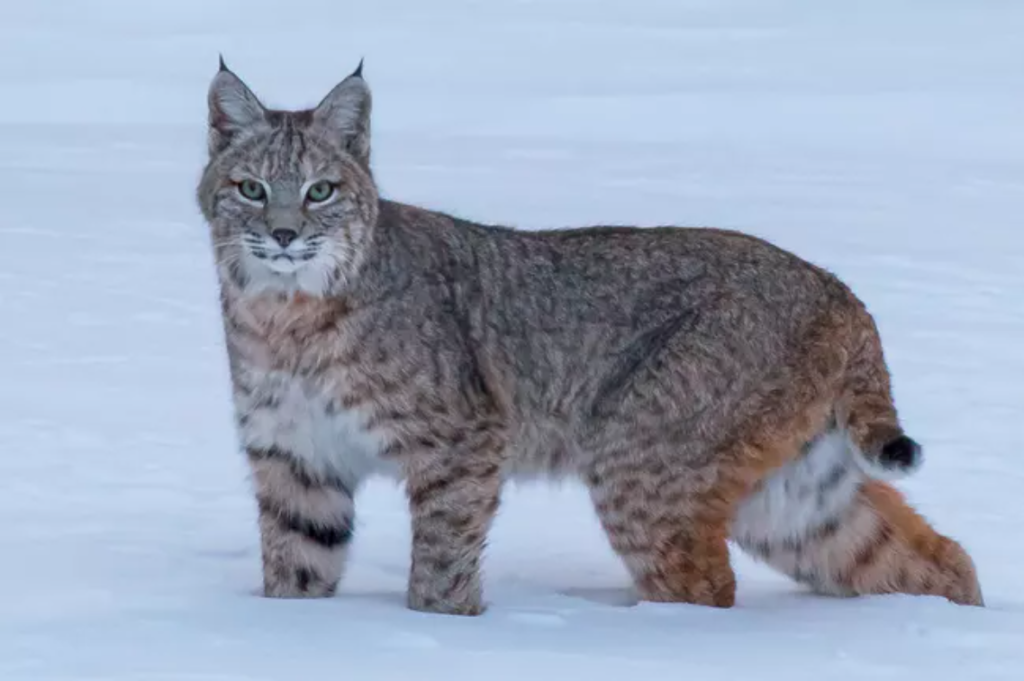
A bobcat is pictured in winter at Rocky Mountain National Park. A proposed ballot measure would ban hunting the species, if approved by voters during the general election.

DJ Summers, an author on the Common Sense Institute report, said it was the organization’s assumption that those elk and deer kills would impact the overall species’ populations.

Parks and Wildlife is prohibited from taking a position for or against the initiative and declined to comment on the study that looked at budget impacts, said Travis Duncan, a spokesperson for the agency. 

The state agency is an enterprise agency, meaning it’s almost entirely funded by fees, such as those from hunting tags, rather than taxes. 

In 2023, there were nearly 30,000 elk hunted and about 500 mountain lions. Mountain lion hunting season, which has an annual cap set by Parks and Wildlife, is between November and March.

The initiative was approved for the November ballot earlier this month after proponents turned in enough signatures from registered voters to require a vote on the topic.  

Initiative 91 reads, in part: “The voters of Colorado find and declare that any trophy hunting of mountain lions, bobcats, or lynx is inhumane, serves no socially acceptable or ecologically beneficial purpose and fails to further public safety.”

If approved by a majority of voters, those who violate the measure would be guilty of a Class 1 misdemeanor, punishable by up to a year in jail, a fine of up to $1,000 or both. They could also be subject to a five-year suspension of their wildlife license. 

The initiative makes exceptions for killing the wild cats to defend a person, livestock, or pets. It also makes exceptions for depredating animals and accidents, such as vehicle and animal collisions. 

Opponents of the measure and initiative have argued that biologists and wildlife experts at Parks and Wildlife should be left to manage the populations and hunting permits.

The Common Sense Institute study was one of several the think-tank plans to produce on Colorado ballot issues.

“We did this because we wanted to follow the wolf introduction that happened last ballot,” said Summers, one of the study’s authors. “We knew simply that this would be something that gets a lot of people’s attention.”

Other items that have been approved for the ballot relate to property taxes and abortion access.

Elliott Wenzler is the Western Slope politics reporter for The Aspen Times and its sister publications in Glenwood Springs, Vail, Steamboat Springs, Summit County, and Grand County.