KULA, Hawaii (AP) — Two men arrested last month on a public road within Oprah Winfrey ‘s property on the Hawaiian island of Maui are suspected of illegal night hunting, state officials said Monday.
The two Maui men, both 19, were arrested just before midnight on June 21 after officers found them using a hunting spotlight on a public road that runs through Winfrey’s ranch in Kula, the state Department of Land and Natural Resources said in a news release.
While they were not caught actively hunting, officers found a loaded shotgun and a loaded rifle in the pair’s truck, and Winfrey’s ranch surrounds the road where they were stopped, the state said.
ADVERTISING
The men were arrested on suspicion of hunting on private lands without permission, not having a hunting license and other violations. One of them was also arrested for an unregistered semi-automatic rifle.
Invasive axis deer run rampant on Maui and other islands of Hawaii.
Maui County prosecutors will review the case and determine if there will be charges. Records show the men were released pending investigation, county officials said.
“Last month, DLNR reached out to Upcountry ranchers regarding their efforts to prevent illegal poaching throughout the area and we agreed to cooperate. The arrests did not happen on the property,” Winfrey’s production company, Harpo, said Monday in an emailed statement.
Prehistoric humans hunt a woolly mammoth. More and more research shows that this species – and at least 46 other species of megaherbivores – were driven to extinction by humans. (CREDIT: Engraving by Ernest Grise, photographed by William Henry Jackson. Courtesy Getty’s Open Content Program)
AARHUS, Denmark — Imagine a world where elephants roamed across Europe, giant ground sloths lumbered through the Americas, and car-sized armadillos burrowed in South American grasslands. This wasn’t some fantastical realm from a Hollywood movie — it was Earth just 50,000 years ago. But then something happened. These megafauna — animals weighing over 100 pounds — began to disappear. By 10,000 years ago, most were gone forever.
What caused this mass extinction event that reshaped life on our planet? It’s a question that has puzzled scientists for over 200 years. Now, an international team of researchers has conducted an exhaustive review of the evidence, concluding that prehistoric humans were likely the primary culprits behind the downfall of Earth’s giants.
The study, led by scientists from the Danish National Research Foundation’s Center for Ecological Dynamics in a Novel Biosphere (ECONOVO) at Aarhus University, analyzed patterns of megafauna extinctions across continents and time periods. They found that large animals began vanishing shortly after humans arrived in new regions, with extinction rates highest where humans were most novel.
“The large and very selective loss of megafauna over the last 50,000 years is unique over the past 66 million years. Previous periods of climate change did not lead to large, selective extinctions, which argues against a major role for climate in the megafauna extinctions,” says Professor Jens-Christian Svenning, the study’s lead author, in a statement.
The researchers point out that climate change, long considered a potential cause of the extinctions, doesn’t adequately explain the patterns observed. While the late Pleistocene epoch did see significant climatic shifts, these were no more extreme than previous glacial cycles that didn’t result in mass extinctions.
“Another significant pattern that argues against a role for climate is that the recent megafauna extinctions hit just as hard in climatically stable areas as in unstable areas,” Svenning adds.
Additionally, the megafauna losses were highly selective, primarily affecting only the largest species. Smaller animals, plants, and marine life were largely unaffected. This size bias matches what we’d expect from human hunting pressure, not climate change.
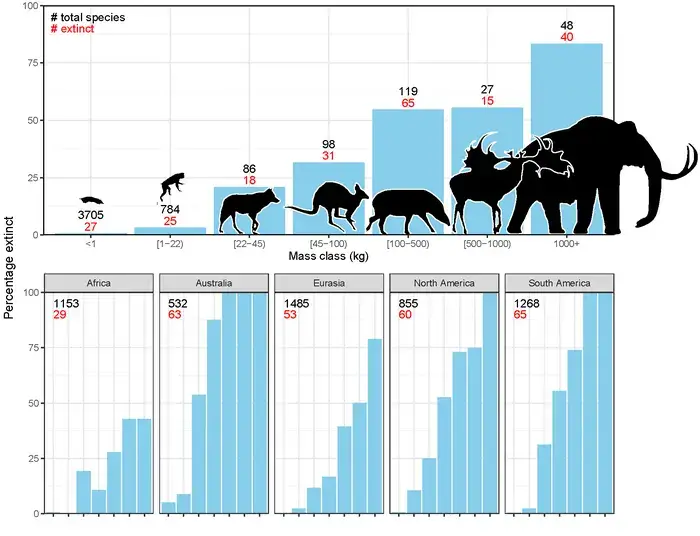
The study reveals that at least 161 species of mammals were driven to extinction during this period, based on the remains found so far. The largest animals were hit the hardest — land-dwelling herbivores weighing over a ton, known as megaherbivores. Fifty thousand years ago, there were 57 species of megaherbivores. Today, only 11 remain, with even these survivors experiencing drastic population declines.
This figure shows how the extinction of large mammals during the late Quaternary period is related to their body size. At the top, you can see the global percentage of species that went extinct based on their size. The bottom part breaks it down by continent. The black numbers represent the total number of species that lived during this time, including those that are still around and those that have gone extinct. The red numbers show the species that went extinct. (CREDIT: Aarhus University ECONOVO / Cambridge Prisms: Extinction)
Interestingly, regions where humans had a longer evolutionary history with large animals saw less severe extinction events. In Africa and parts of Asia, where hominins had been present for millions of years, fewer megafauna species went extinct compared to the Americas and Australia. This suggests animals in Africa and Asia may have developed behaviors to avoid human predators over time. The researchers found evidence of human hunting prowess in the archaeological record.
“Early modern humans were effective hunters of even the largest animal species and clearly had the ability to reduce the populations of large animals,” notes Svenning. “These large animals were and are particularly vulnerable to overexploitation because they have long gestation periods, produce very few offspring at a time, and take many years to reach sexual maturity.”
The loss of these ecosystem giants had profound impacts that are still shaping our world today. Large herbivores like mammoths and ground sloths played crucial roles in maintaining open habitats and dispersing nutrients across landscapes. Their disappearance likely contributed to the spread of forests and changes in fire regimes in many regions.
“Species went extinct on all continents except Antarctica and in all types of ecosystems, from tropical forests and savannas to Mediterranean and temperate forests and steppes to arctic ecosystems. Many of the extinct species could thrive in various types of environments. Therefore, their extinction cannot be explained by climate changes causing the disappearance of a specific ecosystem type, such as the mammoth steppe – which also housed only a few megafauna species,” Svenning emphasizes.
The authors argue that understanding this extinction event is crucial as we face a biodiversity crisis today. By recognizing humans’ long history of impacting animal populations, we can better inform conservation efforts. They even suggest “rewilding,” reintroducing large animals to restore lost ecological functions, as a potential conservation strategy.
“Our results highlight the need for active conservation and restoration efforts. By reintroducing large mammals, we can help restore ecological balances and support biodiversity, which evolved in ecosystems rich in megafauna,” Svenning concludes.
The researchers conducted an extensive literature review, examining evidence from paleontology, archaeology, genetics, and ecology. They analyzed patterns of megafauna extinctions across different continents, time periods, and body size classes. The team also evaluated various hypotheses for the extinctions, including climate change and human impacts, against the observed patterns. Their review incorporated several research fields, including studies on the timing of species extinctions, animal dietary preferences, climate and habitat requirements, genetic estimates of past population sizes, and evidence of human hunting.
Results
The study found that megafauna extinctions were global in scope but varied in intensity across regions. They were strongly biased towards the largest species and temporally linked to human arrival in new areas. The extinctions were not well-explained by climate change alone. The researchers observed that at least 161 species of mammals were driven to extinction during this period, with land-dwelling herbivores weighing over a ton (megaherbivores) being the most severely affected.
Limitations
Among possible limitations of this study, the fossil record is incomplete, especially for smaller species, which can bias our understanding of extinction patterns. The dating of extinction events and human arrivals can be imprecise, making it challenging to establish exact temporal relationships. Additionally, complex interactions between humans, climate, and ecosystems are difficult to fully disentangle, especially over such long time scales.
The researchers conclude that human hunting and ecosystem modification were likely the primary drivers of late Quaternary megafauna extinctions. They argue this event marks an early example of human-driven environmental change on a global scale. The study emphasizes that humans have been shaping ecosystems for tens of thousands of years and that large animals are particularly vulnerable to human impacts. The loss of megafauna had cascading effects on landscapes and ecosystems, altering vegetation structures, seed dispersal patterns, and nutrient cycling. The authors stress the importance of understanding past extinctions to inform modern conservation efforts. They suggest that rewilding with large animals may help restore lost ecological functions and support biodiversity in ecosystems that evolved with megafauna.
Painted lady butterflies venture far and wide with their impressive migratory patterns that stretch for thousands of miles — but they often travel across land, so they can stop to rest.
Scientists have now found evidence that a group of the winged travelers flew over 2,600 miles (about 4,200 kilometers) across the Atlantic Ocean without stopping, according to a new study published June 25 in the journal Nature Communications.
The finding ends a decade-long mystery that began when entomologist and lead study author Dr. Gerard Talavera came across around 10 painted lady butterflies, known by the scientific name Vanessa cardui, on a beach in French Guiana in October 2013. The insects, which are not usually found in South America, were worn out with holes and tears in their wings.
“They looked exhausted. They even couldn’t fly very much — they kind of jumped instead of flying,” said Talavera, a Spanish National Research Council senior researcher at the Botanical Institute of Barcelona. “The only explanation that came to my mind was that these were long-distance migrants.”
But crossing an entire ocean was unheard of for butterflies, even ones as worldly as the painted ladies. Talavera, along with his colleagues, had to rule out a few factors before concluding that these butterflies accomplished what was previously thought impossible.
How far a butterfly can fly
An October 2016 study that Talavera coauthored found that painted ladies from Europe migrate in great distances of around 2,500 miles (about 4,000 kilometers) to sub-Saharan Africa, facing obstacles such as the Mediterranean Sea and Sahara Desert. But even so, the butterflies remain mostly over land where they can “stop and refuel, feed on flowers and then get energy to keep going,” Talavera said.
Crossing the Atlantic would take a painted lady butterfly five to eight days, depending on different variables, according to the new study.
Based on analyses of the energy constraints, researchers concluded that the butterflies could fly a maximum of 485 miles (780 kilometers) or so without stopping, but favorable wind conditions are what allowed them to complete the lengthy journey, Talavera said.
“This is actually kind of a record for an insect, especially for a butterfly, to perform such a long flight without possibilities to stop,” said Talavera, who also leads the Worldwide Painted Lady Migration Project, a global citizen science project that tracks the migratory routes of the insects.
There have been other instances in which experts suspect butterflies and other migratory insects of traveling longer distances than usual, turning up on boats, remote islands or countries where they are not usually found, Talavera said.
The researchers believe that these butterflies took part in their annual migration south from Europe but got lost when the wind blew them into the ocean, he added. The butterflies then likely rode out the trade winds, which blow east to west near the equator, until they reached land in South America.
“Getting suspended in the air column at just the right height to take advantage of the trade winds is nothing short of remarkable,” said Dr. Floyd Shockley, collections manager for the department of entomology at the Smithsonian National Museum of Natural History in Washington, DC, who was not part of the new study. “It kind of begs the question, have they been doing this for a long time, and we just never documented it because we weren’t looking for it in South America?”
The discovery of around 10 out-of-place butterflies, versus the occasional discovered singleton that was likely caught up in storms, could be sufficient evidence that this was a coordinated migratory event for the group of insects, Shockley said.
Tracking a butterfly
Researchers took a few crucial steps to confirm these out-of-place butterflies really did travel across the ocean.
First, to rule out that the insects did not travel over land from North America, the researchers analyzed their DNA, finding it to match with that of European-African populations. Next, the team used a technique known as isotope tracing that looks at the composition of the butterflies’ wings for evidence of the types of plants they ate as caterpillars, said study coauthor Dr. Megan Reich, a postdoctoral fellow at the University of Ottawa in Ontario. By this method, the scientists concluded the butterflies’ birthplace to be in either Western Europe, North Africa or West Africa, she added.
Scientists concluded the butterflies’ birthplace to be in either Western Europe, North Africa or West Africa by using isotope tracing that looks at the composition of the butterflies’ wings for evidence of the types of plants they ate as caterpillars. – Gerard Talavera
But the real key to finding the route the butterflies took was a method first described in a September 2018 study led by Talavera that found that pollen clinging to butterflies can be telling of their migratory journey through the plants on which they fed. The butterflies spotted in October 2013 had the pollen of two West African plants, Guiera senegalensis and Ziziphus spina-christi. The tropical shrubs flower through August and November, according to the study, and this blooming season lines up with the timeline of the butterflies that Talavera discovered in South America.
Additionally, an analysis of weather data from 48 hours before the discovery of the beached butterflies had shown to be “exceptionally favorable for the butterflies to disperse across the Atlantic from West Africa,” the authors noted in the study.
If the insects traveled from their likely birthplace of Europe, then to Africa and South America, the butterflies’ journey could have consisted of 4,350 miles (7,000 kilometers) or more.
“A lot of people think of butterflies as really fragile creatures. I think this really shows how strong and resilient they are and these amazing journeys that they take — they really shouldn’t be underestimated,” Reich said.
The researchers hope to use the same techniques to investigate the migration patterns of other species of butterflies, she added.
“This is just the first step in sort of a long process of trying to understand why this happened and how this happened,” Shockley said.
If future research finds that the butterflies’ journey is likely a regular migration pattern, it’s among the longest insect migrations in the world, he added.
For more CNN news and newsletters create an account at CNN.com
As Florida’s ban on “lab-grown” meat is set to go into effect, manufacturer Upside Foods hosted a last hurrah — at least for now — with a cultivated chicken-tasting party in Miami. (AP video by Daniel Kozin)Photos
12
BY DAVID FISCHERUpdated 1:25 AM PDT, June 30, 2024Share
MIAMI (AP) — As Florida’s ban on “lab-grown” meat is set to go into effect next week, one manufacturer hosted a last hurrah — at least for now — with a cultivated meat-tasting party in Miami.
California-based Upside Foods hosted dozens of guests Thursday evening at a rooftop reception in the city’s Wynwood neighborhood, known for its street art, breweries, nightclubs and trendy restaurants.
“This is delicious meat,” Upside Foods CEO and founder Uma Valeti said. “And we just fundamentally believe that people should have a choice to choose what they want to put on their plate.”
The U.S. approved the sale of what’s now being called “cell-cultivated” or “cell-cultured” meat for the first time in June 2023, allowing Upside Foods and another California company, Good Meat, to sell cultivated chicken.
Earlier this year, Florida and Alabama banned the sale of cultivated meat and seafood, which is grown from animal cells. Other states and federal lawmakers also are looking to restrict it, arguing the product could hurt farmers and pose a safety risk to the public.
ADVERTISEMENT
While Florida cattle ranchers joined Gov. Ron DeSantis when he signed the ban into law in May, Valeti said Florida officials never reached out to his company before passing the legislation.
A federal lawsuit over whether wolf and coyote traps should be limited because they also ensnare endangered grizzlies will go to trial, possibly the first week of December.
The Daily Montanan reports that at a hearing Wednesday in U.S. District Court in Missoula, Judge Donald Molloy said he would not grant either party summary judgment. He directed the lawyers to propose trial dates.
Molloy also told the lawyers that it would be helpful for them to discuss coyote traps.
In November 2023, the judge temporarily limited Montana’s wolf trapping season in response to a request for a preliminary injunction from conservation groups.
The judge agreed that wolf and coyote traps injure grizzlies, and that any capture is an illegal “take” under the Endangered Species Act.
However, the judge did not stop coyote trapping in his earlier order. He said coyote trapping is regulated differently, and the groups hadn’t tied their arguments closely enough to coyote trapping regulations.
Previously, the judge limited the wolf trapping season this year from Jan. 1 to Feb. 15, when bears are mostly in their dens. The order covered more than half of the state from the western border, or Regions 1-5.
The wolf trapping season had been roughly after Thanksgiving through March 15.
In April, the 9th Circuit Court of Appeals affirmed the timeframe the judge set but said the lower court order should apply only to areas where bears are known to live.
In September 2023, the Flathead-Lolo-Bitterroot Citizens Task Force and WildEarth Guardians had sued the state of Montana as well as Fish and Wildlife Commission Chairwoman Lesley Robinson and Gov. Greg Gianforte.
The conservation groups alleged an expanded trapping season and doubling the number of wolves that could be trapped increased the potential harm already facing endangered grizzly bears.
They also argued Montana officials are violating the law by permitting activities that are “reasonably certain” to result in the accidental killing or a “taking” of a threatened species.
(To “take” is defined as “to harass, harm, pursue, hunt, shoot, wound, kill, trap,” according to the ESA.)
The state argued Montana’s trapping regulations minimize the capture of grizzly bears, and a “floating start date” for trapping based on real-world conditions helps avoid the accidental trapping of bears. They also said the plaintiffs exaggerate harms to grizzlies.
Other parties have intervened in the case. The Montana Stockgrowers Association, Montana Wool Growers Association, and Montana Farm Bureau Federation, Montana Trappers Association and Outdoor Heritage Foundation also are participating.
Wednesday, lawyer Lawson Fite, representing the Montana Stockgrowers Association, told the court he believes the conservation groups still haven’t connected their allegations of harm to grizzlies with the coyote trapping regulations at issue — as the judge earlier found.
Fite, with Schwabe Williamson & Wyatt of Portland, Oregon, also said the record has “scant evidence” of injuries to grizzly bears from coyote trapping. He said just three incidents have been recorded in the last decade.
However, Fite also said an appropriately set trap is not a threat to a grizzly bear.
But Molloy had questions: “What is a properly set trap, and who determines if it’s properly set?”
As an aside, the judge said regulations exist about shooting grizzly bears too, but bears seem to end up getting shot anyway.
Coyotes aren’t part of the updated wolf trapping rules the Fish and Wildlife Commission adopted in its 2023 Wolf and Furbearer Trapping and Hunting Regulations.
However, Fite said state statute governs coyote trapping. He said the law provides criminal penalties for violators who illegally trap and snare coyote.
He also noted the law says traps can’t unduly endanger “livestock,” but Molloy had another question.
“What about bears?”
Fite said the traps won’t unduly endanger grizzly bears either. By comparison, he said adult sheep can break free from traps.
He argued bears that have been caught have been released, and records indicate onsite releases show a lack of injury to them.
Molloy also asked the lawyers about an “incidental take” allowance. Agencies that want to take actions that might buck the Endangered Species Act need to check in with federal officers for approval of unintended harms or kills.
“Isn’t that sort of the resolution of the whole darn thing?” Molloy said.
The plaintiffs also had alleged an “incidental take statement” is required under the Endangered Species Act. In those statements, federal authorities specify impacts and mitigations on threatened species, but the state hasn’t applied for one.
Gary Leistico, representing the Montana Trappers Association, also argued coyote traps weren’t a problem. For one thing, he said, they’re much smaller than wolf traps.
“It’s not reasonably likely that a grizzly bear is going to be trapped in a coyote trap,” said Leistico, of Leistico & Esch of Clear Lake, Minnesota.
But it has, in fact, happened, said Tim Bechtold, representing the conservation groups.
The complaint said since 2010, the state of Montana reported three grizzlies captured in traps set for wolves and four in traps set for coyotes. The state also has found severed grizzly bear toes in a trap.
“There are instances of ‘take’ resulting from a coyote trap,” said Bechtold, of the Bechtold Law Firm in Missoula.
In his preliminary injunction, the judge agreed that widespread coyote trapping “likely presents a significant risk” of grizzly bear “take” in violation of the Endangered Species Act, as the conservation groups argued.
The order also noted coyotes are “predatory” animals under Montana law, which means they can be trapped without a license all year.
After their arguments, Molloy said lawyers had raised some “significant issues,” although he still believes an “incidental take” allowance from federal authorities would solve the problem.