Rhode Island lawmakers approve bill to ban “captive hunting” operations
Reply

1 of 2
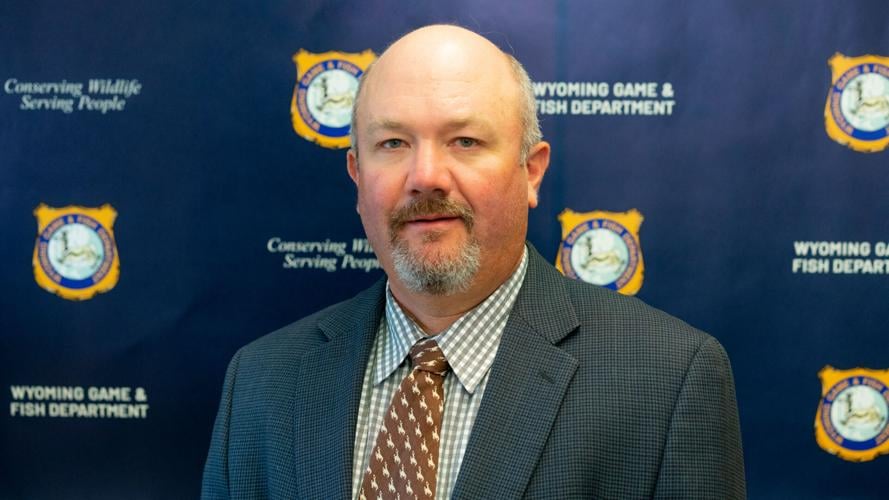
Wyoming Game and Fish Director Brian Nesvik.

Cody Roberts of Daniel poses for a photograph with a live gray wolf that he allegedly hit with a snowmobile and then took into a local bar.
The $250 fine that Cody Roberts paid for his now internationally infamous wolf torment incident was not the steepest penalty that Wyoming Game and Fish Department law enforcement could have pursued for his crime.
The warden who cited Roberts for illegal possession of warm-blooded wildlife in March had the authority to instead compel Roberts’ appearance before a judge, where he could have faced up to $1,000 in fines and six months in jail if convicted.
That revelation came Tuesday from Game and Fish Director Brian Nesvik as he answered questions from fellow members of the Treatment of Predatory Animals working group, which was formed in response to the incident. Prior to Nesvik’s comments Tuesday, there was little, if any, public awareness that Game and Fish could have brought steeper punishment. The agency, instead, suggested in its public statements that it had employed all the tools legally at its disposal.
Up Next – Hurricane Beryl strengthens to Category 3 storm
Up Next – Hurricane Beryl strengthens to Category 3 stormclose
https://imasdk.googleapis.com/js/core/bridge3.647.0_en.html#goog_2114592273
Ad 1 of 1 (0:08)
Next
Stay


volume_off
-0:08
fullscreen
Auto (225p)
225p
360p
Subtitles Off
Subtitles EN
UP NEXT

French voters in far-right bastion hope for change
1:42

French Leaders Cast Votes in First Round of Elections
2:12

Kevin Yu’s tee shot to 8 feet yields birdie at Rocket Mortgage
0:33

Hurricane Beryl strengthens to Category 3 storm
1:15
Greek firefighters battle to tame new wildfire
0:37

Zach Johnson sticks wedge tight to set up birdie at Rocket Mortgage
0:38
Nate Lashley gets up-and-down for birdie at Rocket Mortgage
0:39

Zach Johnson holes out from 82 yards for birdie at Rocket Mortgage
0:22

Zach Johnson makes birdie at Rocket Mortgage
0:26
Ben Griffin uses nice approach to yield birdie at Rocket Mortgage
0:25
arrow_back_ios_new
arrow_forward_ios
Roberts is alleged to have run down a yearling female wolf with a snowmobile, attached a muzzle and shock collar to the injured animal and paraded it in a Daniel bar, where it was filmed and photographed, before killing it.
Amid the global fury that exploded in the wake of the event, critics complained Wyoming’s punishment was inadequate given the cruel nature of the behavior.
In Wyoming, it is legal to take wolves, by nearly any means, without a license in predator zones. In addition, there’s a dispute over whether the state’s animal cruelty laws apply to predators like wolves — Game and Fish has taken the position that they do not. Meanwhile, the practice of running down predators using snowmobiles and other motorized vehicles is legal. Those factors, wildlife officials have said, limited their options in the Roberts case.
When asked to explain the judiciary process of a wildlife violation during the working group meeting in Lander, Nesvik, who joined remotely via Zoom, said wardens have several options.
The most common is to issue a forfeitable citation, which means the person can either pay it or plead not guilty and dispute the matter in court. That is what happened with Roberts, who paid.
But for a repeat offense or for a crime the warden believes is “more serious,” he or she has the ability to require a suspect go before a judge and face criminal prosecution, according to Nesvik. “In those cases … oftentimes the warden will make the decision to arrest the person, take them to jail and make them go to court, and they can post the bond and then go to court later.”
Wardens can also work with local law enforcement to press county-level charges, Nesvik said.
Wyoming Stockgrowers Association Executive Vice President Jim Magagna, a working group member, asked a pointed question about the Daniel wolf case: “Did the warden have the option under the current law that he could have required that individual to appear in court?”
“Yes,” Nesvik answered, “the warden in this case could have done that and decided not to.”
The decision to issue a forfeitable citation “was a collective decision made by the wardens and their respective supervisor,” Game and Fish Public Information Officer Breanna Ball told WyoFile in an email Wednesday. “At question in this case was the illegal possession of live wildlife, not animal cruelty or the illegal take of a wolf.”
Roberts was cited under Wyoming statute 23-3-402. He paid the $250 ticket five days later, according to Sublette County Circuit Court records.
Transparency and public outrage
WyoFile did not locate any instances of Game and Fish previously asserting that the $250 fine was the maximum penalty at its disposal. The agency repeatedly cited the role of state law, which is beyond its control, in determining the penalty.
On March 26, in response to an emailed question from KHOL reporter Emily Cohen, who first reported the incident, “What was the citation amount?” Ball replied, “A violation of the Chapter 10 regulation carries a $250 fine and misdemeanor charges.” An April 4 department press release stated that “Misdemeanor fines are set in state statute.”
In an official Game and Fish Commission statement on April 16, the agency’s governor-appointed board stated: “We’re satisfied that every tool we have available was used, and used to the best of our ability. The Department has acted with transparency and in compliance with Wyoming law.”
Later in Tuesday’s meeting, Magagna asked if in the Daniel incident, the warden had the discretion to require Roberts to appear in court, which would have made him subject to higher penalties.
Game and Fish Chief Warden Rick King answered as Nesvik had to leave the meeting early.
“In regards to the penalty, like Director Nesvik explained, game wardens have the discretion to either make a citation forfeitable or ‘must-appear,’” King said. “If they write the citation to be a must-appear citation, that means the defendant has to appear in court, and if they’re found guilty, then the judge can use his discretion in setting a penalty, both a fine and potential jail term. And then the judge has the latitude that’s in the penalty statute to go up to $1,000 and up to six months in jail for a low misdemeanor.”
Ball confirmed the leeway allowed to wardens. “Game and Fish law enforcement officers are given the discretion to consider the facts and circumstances before them and make a decision,” she wrote.
Reporting indicates that Nesvik and King’s Tuesday testimony were the first admissions in a public forum that the agency could have pursued more severe punishment.
Pushes for reform
When the wolf incident was publicized about a month after it occurred, it spread like wildfire and provoked fierce and widespread condemnation and a boycott of Wyoming. The state temporarily halted tourism promotion as a result.
The outrage that Wyoming laws did not penalize Roberts further contributed to the creation of the working group. The Legislature’s Travel, Recreation, Wildlife and Cultural Resources Committee created the group in May to examine current state penalties regarding predators.
During Tuesday’s meeting, Wyoming Department of Agriculture Director Doug Miyamoto, a member of the working group, said that from his perspective, “this event alone probably did change the viewpoint of game wardens and how they might handle a citation from this point and going forward. It certainly would for any of our inspectors.
“Just generally speaking, I think, job done on that front,” Miyamoto said.
The group on Tuesday agreed to draft bill language that would make it illegal to allow taken animals — regardless of whether they are predators — to suffer or live unduly before dispatching them. It did not take action on the practice of running down predators with snowmobiles, however.
by: Davis Nolan
Posted: Jun 27, 2024 / 05:00 AM CDT
Updated: Jun 27, 2024 / 01:54 PM CDT
SHARE https://www.wkrn.com/special-reports/white-tailed-deer-fawns-not-allowed-to-be-rehabilitated-in-tn/
NASHVILLE, Tenn. (WKRN) — The Tennessee Wildlife Resource Agency is dedicated to the preservation, conservation and protection of wildlife in the Volunteer State. If you find an injured or abandoned wild animal, the TWRA can even help you find a licensed rehabilitator.
However, that’s no longer the case for some deer in Tennessee.
Because of the spread of diseases like Chronic Wasting Disease, which has been found in 17 counties in Tennessee, wildlife rehabilitators are no longer allowed to accept white-tailed deer fawns.What to do if you find a baby bird on the ground?
Barry Cross, TWRA Communications and Marketing Manager for Region 2 explains:

“We don’t want to possibly spread disease across the state because that animal would have to be transported by someone to a location and that location would rehab it and transport it back, Cross said. So, that’s a lot of movement.”
People often think a tiny fawn has been abandoned by its mother when they see it alone. But that’s usually not the case.
“What happens is mom will leave the baby somewhere that she feels is safe,” Cross explained. “And she will go off and browse and feed. At dark usually, she will come back and take care of the baby. They don’t have babysitters out in the wild. And so, they have to do what they can to protect their young. The mother has a lot of scent. The baby does not. So, when she puts it in a place, it will lay there motionless for the day and you might think it’s been left alone, and you need to pick it up. That’s not what you need to do. You need to leave that baby there. You can watch from a distance. You’ll probably even get to see mom come back.”
⏩ Read today’s top stories on wkrn.com
The TWRA also says rehabilitated fawns show changes in behavior that make them more vulnerable to predators. They also can get too used to being around humans. Their greatest chance for survival is without human intervention.
For more information click here.
JUN 29, 2024
YOUNGSTOWN — Hunters wishing to participate in the lottery part of the deer reduction program for the Mill Creek MetroParks this fall can visit the ODNR website to apply for a permit starting Monday, said Geoff Westerfield, assistant wildlife management supervisor for the Ohio Department of Natural Resources Division of Wildlife.
“The recreational hunting part is set,” Westerfield said last week. “It will be operated the same as it was last year.” The application period will be Monday to July 31, and the ODNR will draw the names of those selected to hunt in early August.
Nick Derico, MetroParks natural resources manager, confirmed by email that the MetroParks plans to carry out a similar deer reduction program this year as last year.
The hunting portion of the program that involves hunters being selected through an ODNR lottery could result in more or fewer deer being removed depending on the number of hunters who participate and weather conditions, Derico stated. It will begin Sept. 29 this year. That is the first Sunday of the statewide deer archery season.
Westerfield said it is too soon to speculate on the number of deer that will be removed through a program that involves U.S. Department of Agriculture sharpshooters killing deer at night. Last year, that part of the program was carried out only in a part of Mill Creek Park near the Mill Creek Park Golf Course in Boardman, north of U.S. Route 224.
But it could also be carried out in Hitchcock Woods and Huntington Woods, which are south of U.S. Route 224 in Boardman.
As with last year, sharpshooters may be deployed there depending on the number of deer removed from those parks through the ODNR lottery system, Derico said.
Derico said a decision on whether to deploy USDA-employed sharpshooters in the Hitchcock Woods and Huntington Woods preserves will not be made until after the ODNR hunting program in those parks in December.
But he said he thinks the number of deer that will be removed through the use of sharpshooters will be larger than the 38 removed last year using that method.
The MetroParks’ announcement of a deer-reduction program last year sparked angry protests at MetroParks board meetings and resulted in a lawsuit in Mahoning County Common Pleas Court. The suit was decided in the MetroParks’ favor, but it is under appeal with the 7th District Court of Appeals.
Last year’s program resulted in 204 deer being removed from the MetroParks from Oct. 1 to late January. Of the 204 deer, 38 were through the sharpshooters program over two nights near the golf course.
Westerfield said it’s too soon to say how many deer he will allow the MetroParks to remove through the sharpshooters program. The MetroParks does not have to submit its request for the number of deer it wants to remove by sharpshooters until 30 days before the date they plan to start shooting.
Westerfield said he is likely to receive a written request for those reductions no sooner than late August.
Westerfield noted the MetroParks has updated its deer management plan on its website with the results of a new aerial survey that was done on four dates in January and February, similar to the surveys done in 2022.
DRONES
One thing that is new this year is deer surveying using drones.
“In a continued effort to explore and utilize all possible survey methods, the MetroParks (tried out) the use of drones equipped with … thermal technology to survey the deer population at the McGuffey Wildlife Preserve and Springfield Forest in the early spring of 2024,” the updated management plan states. The plan was updated June 7, according to the document.
“These properties were selected due to their smaller size as a cost-effective way to (try out) the technology,” it states.
“This survey method detected 14 deer at McGuffey Wildlife Preserve and 19 deer at Springfield Forest, with these numbers being nearly identical to those produced by the 2024 aerial infrared survey flown by airplane (11 McGuffey, 21 Springfield),” the document states.
It adds that the MetroParks Board is “confident in the use of both survey methods moving forward. As an added benefit, the drone technology … had the ability to switch from a thermal camera to a standard camera with 200x zoom, which allowed the pilot to examine each thermal signature and confirm the presence of a deer.”
Members of the Save the Deer of Mill Creek Park group and others resoundingly criticized the 2022 aerial surveys, which estimated that the MetroParks contained an average of 387 deer per square mile. The newer aerial survey estimates there were 187 deer per square mile.
Derico said he cannot say for certain why the 2024 aerial survey showed fewer deer than the 2022 survey, but some possible reasons are weather conditions at the time of the survey, changes in the availability of food and the “newly introduced hunting pressure” from the deer reduction program.
He added that it is “important to remember that any survey method is simply a snapshot in time,” and “as time progresses and more data is collected using multiple survey methods, these trends will become more apparent.”
He said the deer-population data contained in the new aerial survey, trail cameras and drone usage — coupled with the data regarding the health of the vegetation in the parks — “tells us that continued (deer reductions) is needed.”
PLANT-DAMAGE SURVEYING
The updated MetroParks deer management plan states that the MetroParks staff initiated an ecological survey in June of 2023 aimed at quantifying the amount of plant damage the deer are causing on MetroParks properties. It looked at Mill Creek Park, Huntington Woods and Hitchcock Woods. But “moving forward, micro plots will be established and monitored at additional MetroParks facilities as staff availability allows,” the plan states.
Westerfield said the number of deer that he will approve for U.S.D.A. sharpshooter removal will partially be decided based on “what (the MetroParks) are seeing with vegetation, and they are still doing their vegetation surveys right now.”
Westerfield said he expects the MetroParks to ask for permission to remove 30 to 40 deer through sharpshooting, similar to last year.
“But you can’t hold me to that number because that is simply just looking at the surveys from this year,” he said. “But it’s not until I see everything in front of me will I make that full decision on what that number will be.”
In addition to what the MetroParks submits to him, “I do site visits. I do stuff that paints a picture of whether I am going to permit the number they requested or a higher or lower number. Ultimately we work together to come up with an agreed upon number,” he said.
He will continue to conduct site visits at the Mill Creek MetroParks, and he will make his decisions based on “what I am seeing on the ground and seeing the damage and seeing change since last year.”
It is too soon to do site visits because this is “fawning season,” so female deer may be having fawns outside of the park. He has to wait until the deer start coming back in the late summer. “Then I will do those assessments (based on) what I am seeing number wise, the amount of deer (markings), the amount of (vegetation) damage.”
He said he visited Mill Creek Park three to four weeks ago to look at the vegetation. He said it will be up to the MetroParks to determine whether the park vegetation improved as a result of the deer reductions last year.
“I put that on the park to do the quantifiables and do the survey and actually get data. They are supplying that to me,” he said.
He looks at the parks this time of the year “so that when I get the data, I can make some sense of what I saw in the summer and what I am seeing in the fall. There was deer damage there for sure.” He said plant life in the parks is just starting to “germinate and start growing just like your garden. It takes some time for that to start growing and take off.”
He said he has not heard any discussion of trying to do any deer reductions in the part of Mill Creek Park in the Youngstown city limits.

