Gang convicted of training and fighting dogs across Europe
Reply

By Helen Branswell April 5, 2024Reprints

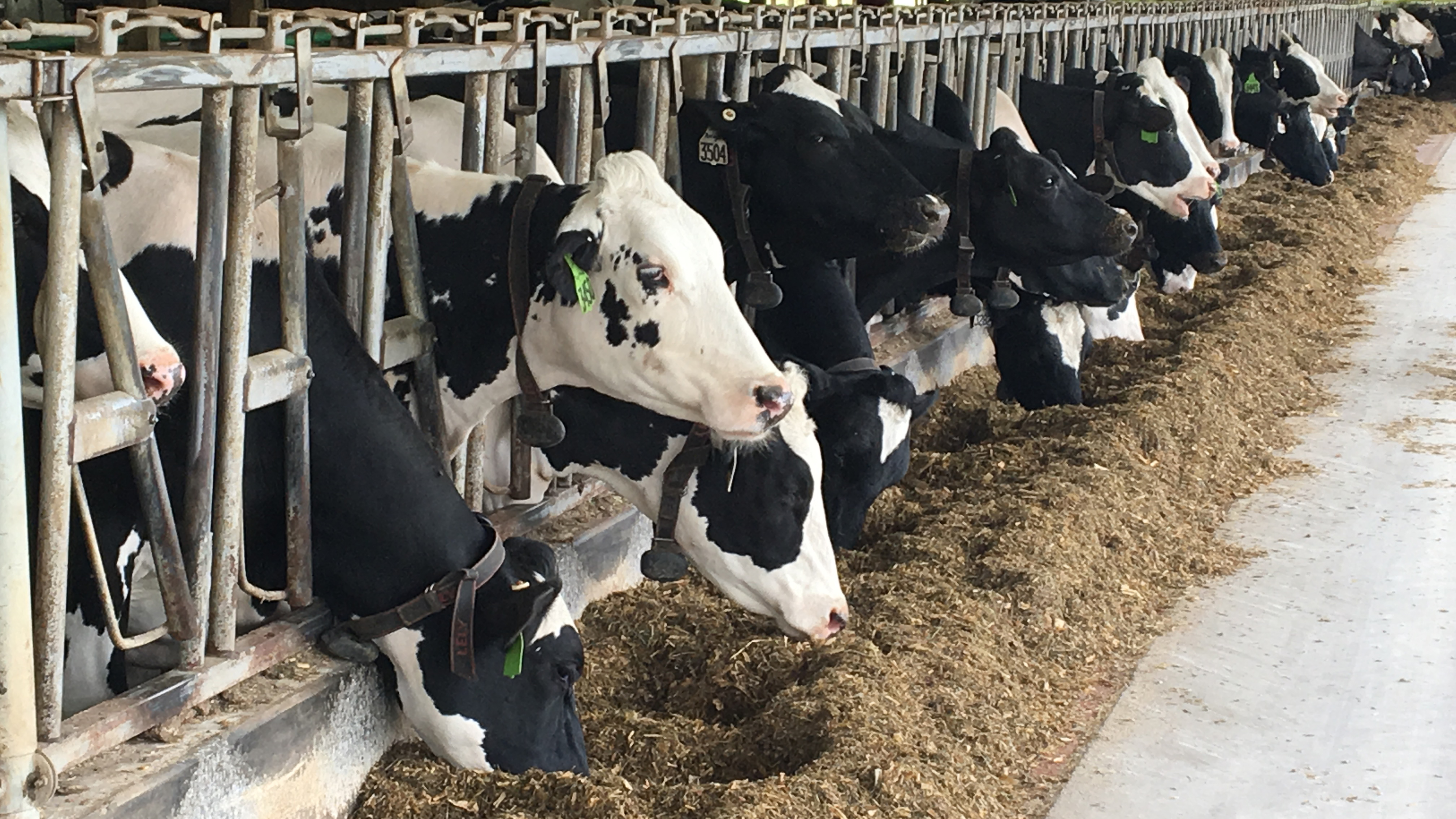
News that H5N1 avian influenza has breached another mammalian species — this time dairy cows — has taken the flu science community aback. Though cows previously had been seen to be susceptible to human flu viruses, and could be experimentally infected with H5 in a lab, the absence of cow involvement until now in H5’s nearly 30-year history lulled scientists into thinking the species was outside the virus’s remit.
Further elevating the concern this discovery has triggered is the fact that a dairy farm worker in Texas was infected with H5N1, though the unnamed individual’s only symptom was conjunctivitis.
ADVERTISEMENT
To put these developments in perspective, STAT turned to Dutch virologist Ron Fouchier, a leading expert on H5N1, for his assessment of these latest twists in the H5 saga. Fouchier, who studies avian influenza at the Erasmus Medical Center in Rotterdam, was at the center of a controversy about H5N1 in 2012, when a U.S. scientific advisory group moved to restrict publication of research he and a team at the University of Wisconsin-Madison had done — separately — to see what mutations would be needed for the virus to be able to spread efficiently among people, so-called gain of function research.
Fouchier takes little solace from the fact that current versions of H5N1 seem to infect people less frequently, and to cause mostly mild illness when they do. The global range of H5 viruses — the sheer volume of the virus in nature — and the numbers of mammals H5 has shown itself capable of sickening is unprecedented, he said, making anticipating its future path harder than ever to gauge.
All the health and medical news you need today, in one email
A transcript of the conversation is below. It has been lightly edited for length and clarity.
ADVERTISEMENT
(Note: A zoonosis or zoonotic event is the infection of a person with an animal virus, in this case H5N1. Reassortment is a process by which flu viruses swap genes in an infected species, giving rise to hybrid viruses that could behave differently than their parent viruses.)
Is it possible that we’ve seen the H5N1 evolve to become more dangerous to a bunch of other species, but less dangerous to us?
It’s what I’d like to think.
In the years after the first human cases of infections in Hong Kong in 1997 right up to 2015, we saw relatively large numbers of zoonotic events with H5N1, ending in 2015, with very large numbers in Egypt. There were quite large numbers of human cases, despite restricted replication of the virus around the globe.
Then, from 2014 onwards, the virus really started to spread massively with wild birds into Europe, crossing over into the U.S. two times now, also landing in Africa, spreading throughout Asia, all in wild migratory birds. We’ve never seen such big outbreaks all across Europe and the Americas. And we see the number of zoonotic events decrease.
You have massive outbreaks in wild birds. It spreads over into poultry quite easily. But in humans we see lower numbers, and that to me suggests that the zoonotic risk has decreased. And I am more or less supported by that by noticing that in the Western world — in England, in Russia, and in the U.S. — most of the [human] cases that we have seen were not particularly severe.
After 2015, one thing that has happened is that these H5 viruses have continuously reassorted with wild bird avian influenza viruses. So what I think has happened is that these viruses are now better adapted to wild birds, but less adapted to poultry and to humans.
That increases the environmental load of virus on occasion. There’s different species, time and time again, where you see massive bursts of virus. And carnivores, they feast on [dead birds]. It could also increase the environmental virus load on grasslands where birds poop or in surface waters. And that could increase the risk even to non-carnivorous mammals like goats or cows.
That kind of gives me a feeling of reassurance.
It just provides an explanation where you wouldn’t have to really take into account yet an increased zoonotic risk.
Of course, when we see this virus in a milking farm and you see incredibly high virus load in some milk cows and their milk, that is a new risk. Because I’m not sure how familiar you are with the milking procedures, but there’s very little that people do to prevent human contact with milk. During the milking process, there’s massive generation of aerosol formation. If you have high amounts of aerosol with virus, the chances increase that you will get conjunctivitis.
There’s very little hygiene to protect the farmers that are milking.
If people aren’t washing their hands a lot and somebody’s infected with conjunctivitis, you could see how that could spread, couldn’t you?
When we had an outbreak of [H7N7] bird flu in the Netherlands in 2003, we had 89 cases of human infection.
Is that when a veterinarian died?
Yes. The majority of cases then were conjunctivitis cases. There were very few respiratory illnesses, except for that one fatal case. But the cases of conjunctivitis were linked to direct contact with poultry, and not with human-to-human transmission.
There was only one investigation where two household members got conjunctivitis, and they shared a towel to wash their face. I think it is not very likely that you will see massive spread of conjunctivitis due to avian influenza. I don’t think that it’s likely that it will spread human to human. It’s more likely that it will spread from the animal source into humans.
I think you disagreed earlier when I used the word “reassuring.” But to me this pattern of becoming much better at infecting wild birds, and seemingly less inclined to infect people seems reassuring.
Well, let me explain why I don’t think it’s too reassuring.
We have never seen this scale of infections in mammals, and in such diversity of mammals. We have now seen more than 40 species of mammals infected during the last outbreaks, which is unprecedented. We know that flu is unpredictable. But we also know that adaptation of virus to mammals is not a good thing.
Many of the adaptive mutations that you see occur when H5 has infected marine mammals, or foxes or martens or minks have been seen with the viruses that caused previous human pandemics. And that I find not reassuring. And with 40 species happening at the same time all over the world, sometimes with little option to intervene, that is not so reassuring to me.
What do you mean by options to intervene?
Well, if there are infections in cows, we can offer personal protective equipment to the milkers and we can offer antiviral drugs to people who start to develop symptoms or conjunctivitis. But when tens of thousands of seals wash up on your shore, what are you going to do? And how are you going to prevent onward spread?
And these are the animals that we see. What about the animals that we don’t see so easily, like rats or mice? What’s happening? The large species we now know get infected easily. But the small species, we don’t even know.
And so the high presence in nature, and the large number of infections I find concerning, despite the fact that we think current zoonotic risk is low. And that’s because these viruses are changing. And we have no experience [of how H5 behaves] in all these species. We can’t predict what’s going to happen.
One of the things H5 has taught me is that it’s ever-changing, and just because it seems to infect people less frequently right now, that doesn’t mean it’s always going to be that way.
Also the fact that the first human now is diagnosed with conjunctivitis is not a guarantee. There’s a small chance that if you have an infection in the eye, that you will actually get virus also in your respiratory tract. And then we know that if the virus ends up in your lower airways, you could develop pneumonia.
One case in a farmer who only develops conjunctivitis is not a reason to celebrate the fact that this virus is not virulent. Let’s be careful now, and monitor the people and treat them with drugs as soon as you see that there’s something more happening.
What are you working on now? What are you looking for?
I would like to know if there is indeed decreased zoonotic risk through the reassortment patterns.
How do you investigate that question?
We identified reassortment patterns. And then we take one of the earlier parental viruses that didn’t spread so well in wild birds and compare it to the current versions and inoculate different bird species, including ducks, or cell cultures. And you can look for all of the different variants, and how they vary in their replicative capacity in wild birds.
We can inoculate human organoid cells and see how permissive the cells are to the different variants, whether the early Asian variants that caused many zoonoses, whether they were, in fact, more prone to infect human tissue than the current viruses.
And if you see those same opposing patterns — so more adaptation to wild birds, less efficient in infecting human cells — that would explain the current situation compared to what we’ve seen before.
But of course, it’s important to note that we’re all doing our research with our hands tied behind our back because of the gain-of-function issues. We have to be careful in what we do and how we design the experiments. So we can take natural viruses and show that the old viruses were less likely to infect wild birds and more likely to infect human cells, and the current virus is the other way around. But really getting to the bottom of things is getting harder and harder.
Is there anything you’ve been waiting for a chance to say but I haven’t asked the right question to elicit it?
Well, the questions are really about what’s going on with the cows. And U.S. scientists and officials are hopefully going to resolve that quickly. How does this virus enter cows?
If there is cow-to-cow transmission, how does it work? It’s clear that it’s dairy cows, and it could be that it’s due to the milking instruments that do not get cleaned enough. It’s human driven cow-to-cow transmission. And if that’s the case, you can stop it. You can try to actually clean your machine. So I’m really looking forward to in-depth investigations, epidemiological investigations of how the cows get this disease.
It could also be from a common feeding source. So what are these cows being fed? Do they eat fresh grass? Do they eat hay from a common source that has been contaminated by birds being out there? I think this is really crucial information, because this is going to lead to what are the options to stop this outbreak.

Posted: April 3, 2024
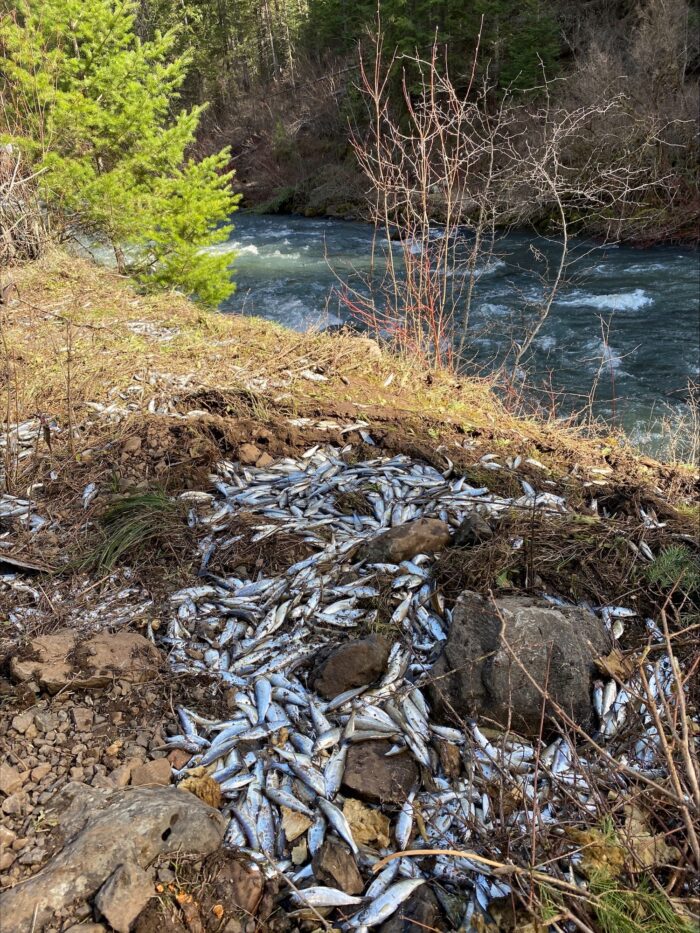
On March 29 near Lookingglass Hatchery in northeast Oregon, a fish tanker truck was involved in an accident while transporting approximately 102,000 spring Chinook smolts for release in the Imnaha River.
The ODFW employee who was driving the truck is safe but received minor injuries. The accident occurred on a sharp corner with the 53-foot truck rolling onto the passenger side, skidding on its side on the pavement, and then going over a rocky embankment causing it to roll onto its roof.
The accident occurred alongside Lookingglass Creek, a tributary of the Grande Ronde River. About 77,000 smolts made it into the creek when the tanker overturned but 25,529 smolts died and their carcasses were recovered either in the tanker or on the streambank.
The Union County Sheriff’s department responded immediately and assisted with on-scene assessments and vehicle recovery operations. Small amounts of diesel fuel were quickly contained and did not result in a hazardous material spill response.
Lookingglass Hatchery raises spring Chinook as part of hydropower mitigation under the Lower Snake River Compensation Plan, for tribal and sport harvest, and to supplement the wild population on the Imnaha which is listed as Threatened.
ODFW also notified fishery co-managers, the Nez Perce Tribe (NPT), and the Confederated Tribes of the Umatilla Indian Reservation (CTUIR) when the incident occurred. NPT staff responded and provided additional assistance by helping to collect, count and scan dead fish for PIT tags (Passive Integrated Transponders). Information collected from PIT tags, including those that weren’t released, will help ensure the best possible estimates of survival and future adult returns.
The smolts lost represent about 20 percent of the total that will be released into the Imnaha River this year. Fishery managers expect to see about 500-900 fewer adult fish returning in 2026 and 2027 due to the loss. The 77,000 fish that made it into Lookingglass Creek will likely return there and produce approximately 350-700 additional adults.
“We are thankful the ODFW employee driving the truck was not seriously injured, said Andrew Gibbs, ODFW fish hatchery coordinator for Eastern Oregon. “This should not impact our ability to collect future brood stock or maintain full production goals in the future.”
FeaturedNeurosciencePsychology
·April 2, 2024
Summary: Dogs possess a ‘g factor’ akin to humans, illuminating the hierarchical structure of canine intelligence and its implications for aging. By evaluating 129 family dogs over two and a half years, the team identified broad cognitive domains—problem-solving and learning ability—that interlink to form a canine general cognitive factor.
This ‘g factor’ not only correlates with traits like exploratory behavior, novelty interest, and trainability but also declines with age, particularly in dogs with poorer health. These findings not only advance our comprehension of canine cognition and its parallels with human intelligence but also underscore the potential of dogs as model species for aging research.
Key Facts:
Source: ELTE
The quest to understand intelligence and unravel the workings of the mind has always been considered the holy grail of natural sciences. While we’re still uncovering many mysteries, animals can provide valuable insights into the origins and organisation of both mind and intellect.
In their latest, study researchers at the Department of Ethology at Eötvös Loránd University (ELTE) discovered that dogs may possess a key component of intelligence known as the ‘g factor’. Importantly, this factor shares many characteristics with its human counterpart, including its ageing patterns.
These findings could bring us closer to understanding how dog (and human) cognition is organised, and how cognitive decline progresses with age.
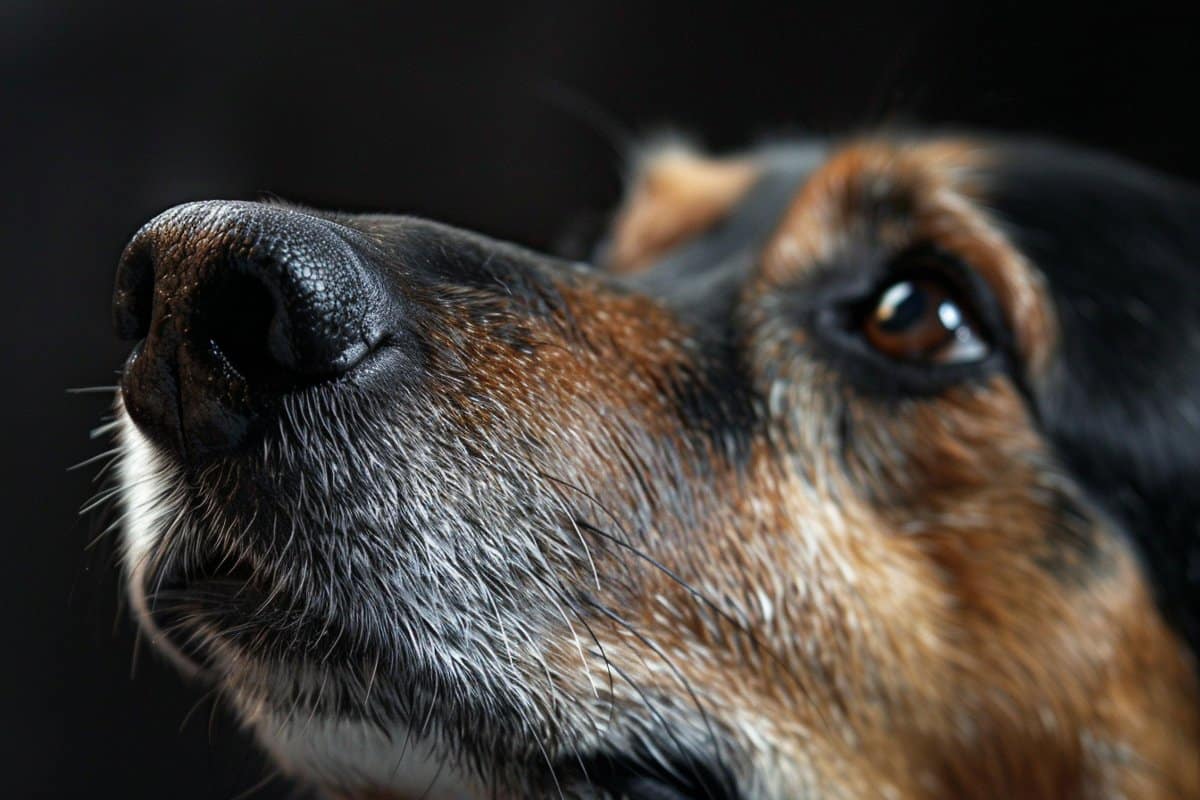
In humans, success in various cognitive tests tends to correlate positively; individuals who e.g. excel in math may also ace their literature essay. Human cognitive abilities are thus somewhat centralised, but also organised hierarchically, from specific task performances to broader cognitive domains. At the apex of this hierarchy lies the so-called general cognitive factor, or the ‘g factor’.
This ‘g factor’ is a fundamental component of intelligence, it encompasses and influences all underlying cognitive abilities, and is also closely related to academic, workplace, and career success.
In their latest research, researchers at the Department of Ethology at ELTE inquired about the existence of such a general cognitive factor in the case of dogs.
‘The cognitive and socio-cognitive performance of dogs is a highly popular topic in scientific literature, yet most studies are comparative, focusing on how well dogs perform as a species.
Surprisingly, these studies have largely overlooked the individual differences in specific skills and the reasons behind them.
As a result, we know very little about how dogs’ cognitive abilities are structured,’ said Borbála Turcsán, one of the lead authors of the study published in GeroScience.
To investigate this, researchers compiled a series of seven tasks to assess the cognitive performance of 129 family dogs aged between three and fifteen years, tracking them over two and a half years. The performances in these tests formed a hierarchical structure similar to the one seen in human cognition.
Researchers identified two broad cognitive domains: Independent problem-solving, which included tests of persistence, problem-solving, and memory, and Learning ability, which encompassed associative learning and one-trial learning tests.
These domains were interconnected, indicating that dogs with better problem-solving skills generally learned new tasks more quickly, confirming the existence of a higher-order, general cognitive factor that ties them together. Drawing from human literature, the authors referred to this as the ‘canine g factor.’
The researchers were not satisfied with just finding the ‘canine g factor’; they also wanted to confirm if it has a predictive power similar to that described for g in humans.
‘To confirm that we have indeed identified the general cognitive factor, we examined whether this factor correlates with individual characteristics known from the literature of humans and other animal species to be associated with the ‘g factor,’ explained Tamás Faragó, researcher at the ELTE Department of Ethology.
The results revealed that dogs with high ‘g factor’ scores were more inclined to explore unfamiliar environments, showed greater interest in novelties, and performed better in new learning situations
than dogs with lower scores. Moreover, the dogs’ g score was also related to their personality which was measured using a questionnaire filled out by the dog owners. High ‘g factor’ score was associated with higher levels of activity, training level, and trainability.
These findings confirmed that the ‘canine g factor’ resembles the human g factor not only in the structure but also in external correlations.
In addition to the numerous parallels between canine and human g factors, exploring the correlations of canine cognitive abilities has opened new perspectives in the field of ageing research. ‘It is well-known that as dogs age, their attention, learning ability, and memory naturally decline.
“However, if cognitive abilities are interconnected, it’s plausible that their decline with age is not independent but rather linked to a common underlying factor behind the deterioration of various abilities,’ – emphasised Zsófia Bognár, PhD student, the other lead author of the study.
The researchers also tracked the changes in the dogs’ cognitive performance over two and a half years and based on this longitudinal assessment they demonstrated that indeed, there is a global cognitive decline, the ‘canine g factor’ score decreased with age.
However, this decline was influenced by the health status of the dogs: dogs in poorer health exhibited a faster decline in the ‘g factor’ value with age, whereas no significant change with age was observed in dogs in good health.
While this global decline affected all cognitive abilities, the results also revealed that age-related changes in memory and associative learning abilities are influenced by other factors, leading to diverse ageing dynamics.
“This aging-pattern resembles human aging, and it is an important finding for later efforts to identify the molecular and neurological causes of cognitive decline.”
‘This new research highlights intriguing parallels between human and canine ageing, further strengthening the argument that dogs serve as an excellent model species for aging research,’ – emphasised Enikő Kubinyi, leader of the MTA-ELTE Companion Animal Research Group and the Senior Family Dog Program.
‘Moreover, our findings support the existence of the ‘canine g factor’, suggesting that dogs can also help in understanding the evolution and background of human intelligence.’
Author: Sara Bohm
Source; ELTE
Contact: Sara Bohm – ELTE
Image: The image is credited to Neuroscience News
Original Research: Open access.
“Age-related effects on a hierarchical structure of canine cognition” by Borbála Turcsán et al. GeroScience
https://www.nbcdfw.com/news/local/texas-news/avian-flu-found-in-chicken-eggs-in-texas/3504517
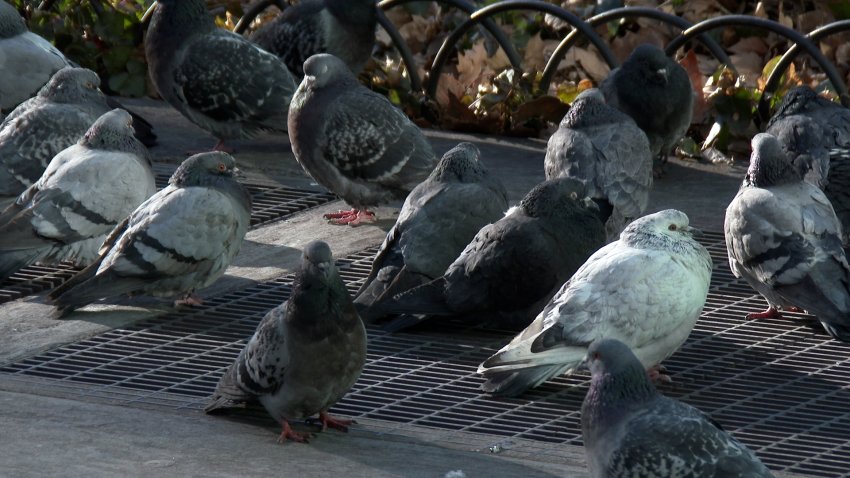
The largest producer of fresh eggs in the United States said Tuesday that it has stopped production at a Texas plant after bird flu was found in chickens there.
Ridgeland, Mississippi-based Cal-Maine Foods, Inc. said in a statement that approximately 1.6 million laying hens and 337,000 pullets, about 3.6% of its total flock, were destroyed after the infection, avian influenza, was found at the facility in Parmer County, Texas.
This is absolutely devastating news for Cal-Maine and the entire Panhandle region which has already suffered so much already. Given this latest development, all producers must practice heightened biosecurity measures. The rapid spread of this virus means we must act quickly.Commissioner Sid Miller, Texas Department of Agriculture
The plant is on the Texas-New Mexico border in the Texas Panhandle about 85 miles southwest of Amarillo and about 370 miles northwest of Dallas.
“The company continues to work closely with federal, state and local government officials and focused industry groups to mitigate the risk of future outbreaks and effectively manage the response,” according to the statement. “Cal-Maine Foods is working to secure production from other facilities to minimize disruption to its customers.”
The company said there is no known bird flu risk associated with eggs that are currently in the market and no eggs have been recalled. Miller echoed the statement, saying the risk to the public is minimal.
“The current risk to the public remains minimal,” Miller said. “It is important for us as an industry to maintain a high level of vigilance. State and national agencies will continue to provide updated guidance as developments warrant.”
Eggs that are properly handled and cooked are safe to eat, according to the U.S. Department of Agriculture.
The announcement by Cal-Maine comes a day after state health officials said a person had been diagnosed with bird flu after being in contact with cows presumed to be infected, and that the risk to the public remains low.
The human case marks the first known instance globally of a person catching this version of bird flu from a mammal, federal health officials said.
Dairy cows in Texas and Kansas were reported to be infected with bird flu last week — and federal agriculture officials later confirmed infections in a Michigan dairy herd that had recently received cows from Texas.
Cal-Maine sells the majority of its eggs in the Southwestern, Southeastern, Midwestern and mid-Atlantic regions of the United States, the company said.
ANIMALSAPR 2
TEXASMAR 25
HEALTHAPR 1
NBC 5 and The Associated Press
BY CLAYTON VICKERS – 04/02/24 6:27 PM ET
SHAREPOST https://thehill.com/policy/healthcare/4570623-second-bird-flu-case-human-us/
Current Time 0:54
/
Duration 1:00
Loaded: 100.00%CaptionsFullscreenSharePause

Federal authorities are downplaying the public health risk after the second ever case of a human contracting the “highly pathogenic” bird flu in the United States was confirmed in Texas on Monday.
The infected man was exposed while he worked as a dairy worker, the Texas Department of State Health Services said. The person had minor symptoms but has received treatment, state health officials said.
“This infection does not change the H5N1 bird flu human health risk assessment for the U.S. general public, which CDC considers to be low,” the Centers for Disease Control and Prevention (CDC) said in a statement on Monday.
The CDC added that people with “close or prolonged, unprotected exposures to infected birds or other animals (including livestock), or to environments contaminated by infected birds or other animals” are at greater risk of infection.
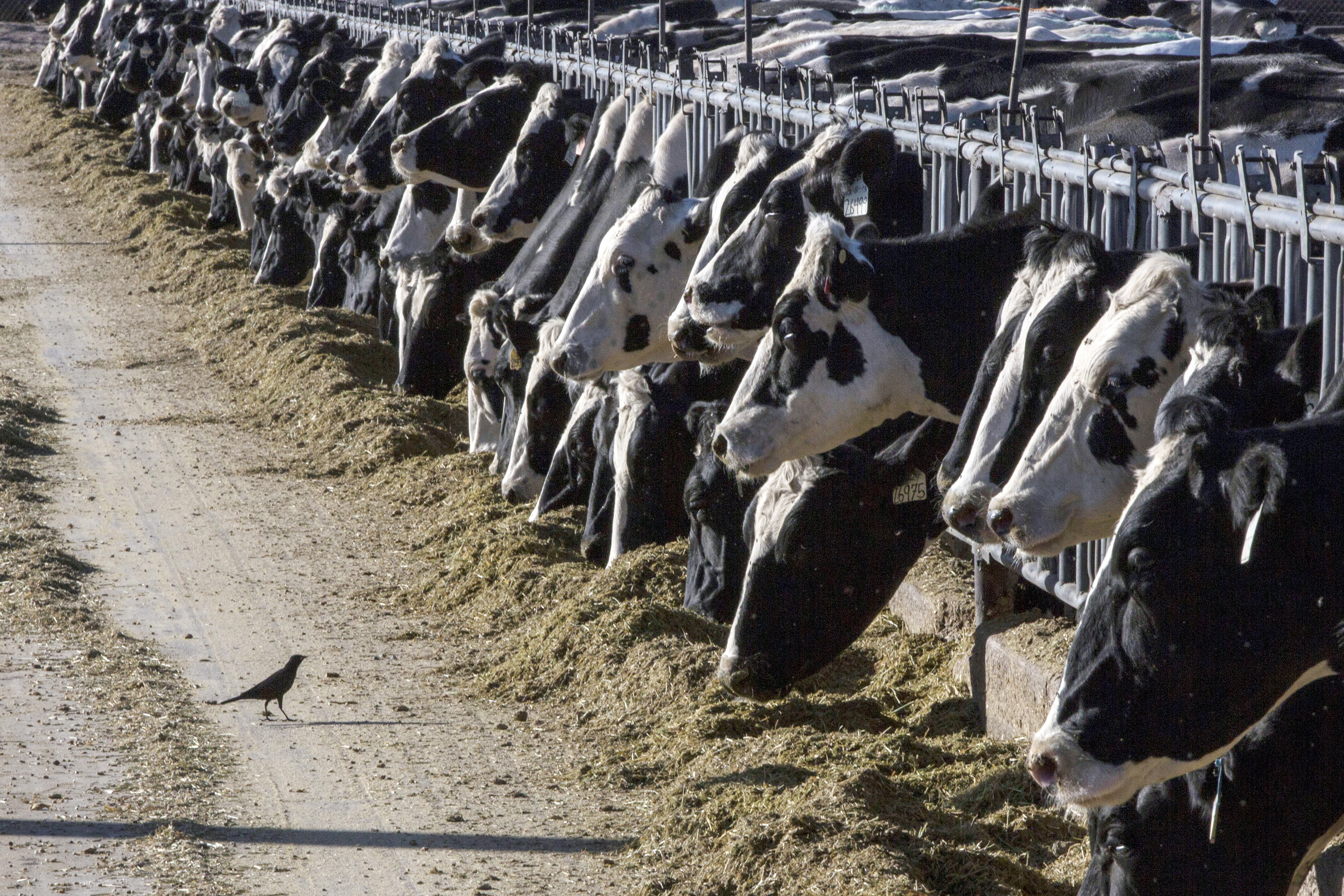
USDA has confirmed infections of dairy cattle herds in five states — Texas, Kansas, Michigan, New Mexico — with results in Idaho “presumed” to be positive.
The movement of cattle across state lines, especially from Texas, has accounted for the spread, according to CDC. States like Nebraska have issued temporary restrictions on cattle imports because of the bird flu.
Here’s what to know.
Bird flu, also known as H5N1 or avian influenza, has ravaged billions of dollars of poultry across the world, but mass infections of cattle — and human infections — are rare.
The avian flu’s modern history in humans begins in China in 1996, where it spread from geese to people in Hong Kong the following year. In a two month period, it killed a third of the 18 people it infected, according to the CDC.
The Hong Kong outbreak showed for the first time that the virus could transmit from birds to humans directly. Direct, prolonged contact with or consumption of infected birds has often explained avian flu transmission in the nearly three decades since.
However, cases of humans contracting the disease since have been sporadic and isolated. The worst fear among public health experts is human-to-human transmission of the virus, which has yet to occur.
Still, the virus has killed more than 50 percent of its human victims from 2003 to 2016, according to a study published by the National Institute of Health (NIH).
The infection of the Texan dairy worker is the second–ever infection in the U.S., but the first contracted from cattle.
In 2022, a Colorado prisoner, participating in a work program at a poultry facility, contracted the virus after killing infected birds.
Neither the Texas dairy worker nor the Colorado prisoner experienced serious symptoms, and both have recovered after treatment, according to the CDC.
In the U.S, the highly pathogenic avian influenza (HPAI) has spread to affect 82 million birds in 48 states, resulting in massive culls of commercial poultry and billions of dollars in losses — the worst outbreak of bird flu in U.S. history, according to the USDA.
Just a day after the dairy worker infection, Cal-Maine Foods, a major poultry producer, was ordered to “depopulate” nearly 2 million chickens after a positive test for HPAI at their facility in Farwell, Texas.
Sid Miller, commissioner of the Texas Department of Agriculture, ordered the plant’s temporary closure and called on producers to act.
“Given this latest development, all producers must practice heightened biosecurity measures. The rapid spread of this virus means we must act quickly,” he said.
Because the virus is an influenza variant with a “natural reservoir” in wild aquatic birds, it is impossible to eradicate and zoonotic infections will continue, according to the World Health Organization (WHO).
The CDC has labeled the risk to the public “low” after finding no mutations for human transmission, and has said commercial products like milk, eggs and poultry remain safe.
The spread of avian influenza has public health officials on guard.
WHO has called for extensive monitoring of all cases of HPAI, animal or human, for signs that it may be mutating to threaten humans.
“The emergence of an influenza A virus with the ability to infect people and sustain human-to-human transmission could cause an influenza pandemic,” WHO said. “[The] human population has little to no immunity against the virus,” it added.
The CDC has recommended people practice good hygiene, avoid sick or dead animals, animal fecal matter and consumption of untreated or uncooked animal products like raw milk or raw eggs.

