Is Nevada’s Wildlife Commission on the brink of extinction?

Board sides with ranchers, hunters on wild horse roundups and coyote killing contests 

BY: DANA GENTRY – MARCH 12, 2024 5:00 AM


 The Nevada Wildlife Commission’s lopsided membership, critics say, renders the board ineffective and preoccupied with looking out for ranchers and hunters at the peril of the wildlife it is charged with protecting. (Nevada Division of Wildlife Photo)

The Nevada Wildlife Commission’s endorsement Friday of a plan to remove 75% of wild horses and burros from the state’s public lands, along with its refusal to consider a ban on controversial coyote killing contests, are both out of step with the desires of residents and tourists and could hasten efforts to revamp the board, say critics. 

The Commission is dominated by hunting and ranching interests under a statutory scheme that requires it to have five “sportsmen,” i.e. hunters, fishermen or trappers who have purchased a license in three of the past four years, one rancher, one farmer, one conservationist, and one member of the public.  

The lopsided membership, critics say, renders the board ineffective and preoccupied with looking out for ranchers and hunters at the peril of the wildlife it is charged with protecting.

“You’ve got five representatives on this board that represent three and a half percent of Nevada,”  former Nevada Republican legislator turned lobbyist Warren Hardy, referring to the percentage of Nevadans who purchase hunting licenses each year, told the commission Friday during a meeting in Las Vegas. 

A presentation from the Humane Society of the United States, which is represented by Hardy, asserted changing times and perceptions of animal rights have diminished tolerance of wanton killing contests among residents and visitors, and are compromising the integrity of the state’s legal gambling industry, thereby posing a threat to the economy.  

In 2019, hoping to dry up prize money for the events, opponents unsuccessfully argued to Nevada gaming regulators that the contests violate gambling laws. 

Commissioners widely applauded the HSUS presentation as the best they’ve seen, however, they suggested nothing has changed since the Commission last discarded a proposal in 2021 to end the contests. 

Other efforts to end the contests have also failed. In 2015, the Wildlife Commission voted 7-1 to reject a petition seeking to ban killing contests. 

The board’s allegiance to hunting and ranching interests disregards the desires of the vast majority of the state’s population, complained Hardy.

“This is petitioning that is worthy of a conversation, no matter how long, or how hard it is. This is the democratic process. And you are the board that we are rightfully in front of, not the legislature,” Hardy said. “In my legislative career, I’ve had at least three occasions to vote to change the makeup of this commission. And all three times I voted no or declined to vote at all because I firmly believe in this process,” 

Hardy added the commission’s refusal to engage in rulemaking left him no option but legislative action. A 2023 bill to prohibit the contests died in committee.

“For you guys to say ‘we’re not going to the rulemaking process so you can make your case’ is  frankly not only repugnant, but unprecedented,” Hardy said, suggesting their refusal amounted to political cowardice. “You’re saying ‘we’re not going to get consensus, so we’re not going to do this.’ So why do you exist?”

The Commission is the “the least democratic of all state boards or commissions which provide oversight to a public resource,” says Dr. Donald Molde of the Nevada Wildlife Alliance. 

A legislative effort last year to take a closer look at four commissions that regulate natural resources, including the Wildlife Commission, failed when it was vetoed by Gov. Joe Lombardo. However, the Joint Interim Standing Committee on Natural Resources is scheduled to delve into the Wildlife Commission’s actions on April 5.  

“This will be our first chance to go before a Legislative interim study committee and make our pitch,” says Molde, noting a number of states, such as Washington, New Mexico, and Vermont are questioning whether wildlife regulation is evolving with changing attitudes about conservation.

Commissioners complained they were hearing from extremists on both sides, but not from the center.

“We are the center,” Hardy responded, noting HSUS had already compromised by advocating for an end to coyote contests, but not a ban on hunting the animals.

The America’s Wildlife Values studies of 2018 and 2021 found that about 22% of the U.S. population holds a traditional view that wildlife should be managed and used for the benefit of humans, while 44% believe humans and animals should coexist.  

“This was a disappointing outcome but completely unsurprising,” Patrick Donnelly of the Center for Biological Diversity said following the meeting. “Frankly, I don’t think this petition ever had a chance. The wildlife commission is hopelessly biased toward people who kill wildlife. Until we reform the commission’s composition to truly represent all Nevadans, it will never be a venue for conservation.”

‘Failed approach to wild horse management’

Also Friday, the Wildlife commission joined a campaign to urge the federal government to escalate controversial wild horse roundups conducted by the Bureau of Land Management, in a renewed effort to remove about three-quarters of horses and burros from public lands. 

The Commission endorsed a letter to BLM director Tracy Stone-Manning from the Coalition for Healthy Lands  – ranchers, trappers, and hunters seeking federal funding to remove tens of thousands of wild horses from the state’s public rangelands and put them in holding pens for life. 

A Senate Joint Resolution with similar goals died in the 2021 Nevada Legislature.  

The U.S. has close to 70,000 wild horses roaming on BLM land, the government estimates. More than two-thirds – about 45,000, plus another 4,500 burros, are in Nevada. That’s four times as many animals as the state’s appropriate management level (AML) as calculated by the BLM. The 1971 Wild Free-Roaming Horses and Burros Act says animals that exceed AML are to be removed from the range. 

About 62,000 horses and 2,500 burros rounded up by government contractors are already in BLM holding facilities for the rest of their lives. 

Helen Foley, a lobbyist for the American Wild Horse Conservation, noted the Coalition’s initiative would require the removal of well over 40,000 animals at a cost of $40 million and another $2 billion to maintain them in holding facilities for their lifetimes. 

Foley noted that would leave “a density of one horse on 1,100 acres of land, making these significant ecotourism attractions difficult, if not impossible to find for people visiting and spending money. …Wild horse roundups and removals represent a failed approach to wild horse management.” 

Foley and others support sterilization of horses rather than removal.  

Fertility control has not been used on a widespread basis, animal advocate Fred Voltz told the commission. Voltz suggested “a reasonable path forward for BLM to find more money” would be to increase the cost of grazing to market rates, noting livestock “represent more than 10 times the number of wild horses and burros.” 

Nevada has about half a million cattle grazing on federal land. The BLM’s grazing charge is $1.35 a month per animal unit – the estimated amount of forage required to feed a 1,000 pound animal. 

The extent of damage to Nevada’s public lands from livestock and wildlife is largely a mystery because the BLM, which is charged with assessing and addressing the impacts, has reviewed less than half of the land allotted to ranchers in the state, according to data obtained through a public information request by Public Employees for Environmental Responsibility.

The next pandemic? It’s already here for Earth’s wildlife

  1. Arts + Culture
  2. Economy
  3. Education
  4. Environment + Energy
  5. Ethics + Religion
  6. Health
  7. Politics + Society
  8. Science + Tech
  9. Podcasts

Sea lions killed by bird flu in Chile, April 2023. Patricio Banda/EPA-EFE

Published: March 11, 2024 1:18pm EDT

https://theconversation.com/the-next-pandemic-its-already-here-for-earths-wildlife-222306

Author

  1. Diana BellProfessor of Conservation Biology, University of East Anglia

Disclosure statement

Diana Bell does not work for, consult, own shares in or receive funding from any company or organization that would benefit from this article, and has disclosed no relevant affiliations beyond their academic appointment.

Partners

University of East Anglia provides funding as a member of The Conversation UK.

View all partners

CC BY NDWe believe in the free flow of information
Republish our articles for free, online or in print, under a Creative Commons license.

Republish this article

 Email

 X (Twitter)

 Facebook11

 LinkedIn

 Print

I am a conservation biologist who studies emerging infectious diseases. When people ask me what I think the next pandemic will be I often say that we are in the midst of one – it’s just afflicting a great many species more than ours.

I am referring to the highly pathogenic strain of avian influenza H5N1 (HPAI H5N1), otherwise known as bird flu, which has killed millions of birds and unknown numbers of mammals, particularly during the past three years.

This is the strain that emerged in domestic geese in China in 1997 and quickly jumped to humans in south-east Asia with a mortality rate of around 40-50%. My research group encountered the virus when it killed a mammal, an endangered Owston’s palm civet, in a captive breeding programme in Cuc Phuong National Park Vietnam in 2005.

How these animals caught bird flu was never confirmed. Their diet is mainly earthworms, so they had not been infected by eating diseased poultry like many captive tigers in the region.

Don’t let yourself be misled. Understand issues with help from experts

Get the newsletter

This discovery prompted us to collate all confirmed reports of fatal infection with bird flu to assess just how broad a threat to wildlife this virus might pose.

This is how a newly discovered virus in Chinese poultry came to threaten so much of the world’s biodiversity.

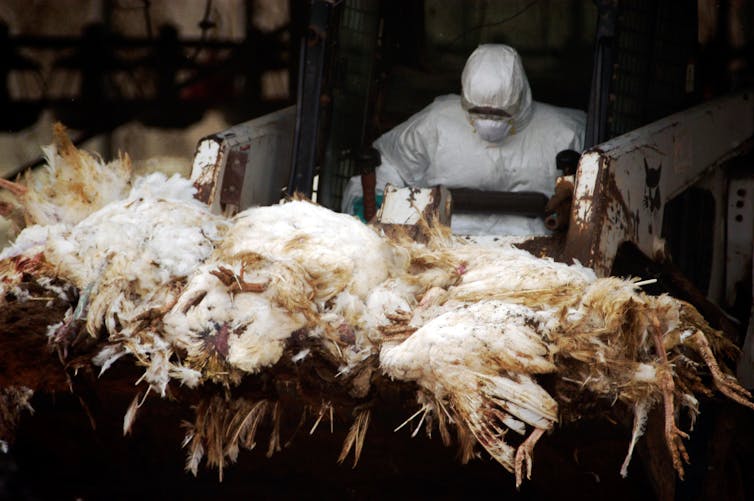
A person in white overalls operates a forklift carrying dead turkeys.
H5N1 originated on a Chinese poultry farm in 1997. ChameleonsEye/Shutterstock

The first signs

Until December 2005, most confirmed infections had been found in a few zoos and rescue centres in Thailand and Cambodia. Our analysis in 2006 showed that nearly half (48%) of all the different groups of birds (known to taxonomists as “orders”) contained a species in which a fatal infection of bird flu had been reported. These 13 orders comprised 84% of all bird species.

We reasoned 20 years ago that the strains of H5N1 circulating were probably highly pathogenic to all bird orders. We also showed that the list of confirmed infected species included those that were globally threatened and that important habitats, such as Vietnam’s Mekong delta, lay close to reported poultry outbreaks.

Mammals known to be susceptible to bird flu during the early 2000s included primates, rodents, pigs and rabbits. Large carnivores such as Bengal tigers and clouded leopards were reported to have been killed, as well as domestic cats.

Two tigers eating a chicken.
Zoo animals eating infected poultry were among bird flu’s early victims. Lou Linwei/Alamy Stock Photo

Our 2006 paper showed the ease with which this virus crossed species barriers and suggested it might one day produce a pandemic-scale threat to global biodiversity.

Unfortunately, our warnings were correct.

A roving sickness

Two decades on, bird flu is killing species from the high Arctic to mainland Antarctica.

In the past couple of years, bird flu has spread rapidly across Europe and infiltrated North and South America, killing millions of poultry and a variety of bird and mammal species. A recent paper found that 26 countries have reported at least 48 mammal species that have died from the virus since 2020, when the latest increase in reported infections started.

Not even the ocean is safe. Since 2020, 13 species of aquatic mammal have succumbed, including American sea lions, porpoises and dolphins, often dying in their thousands in South America. A wide range of scavenging and predatory mammals that live on land are now also confirmed to be susceptible, including mountain lions, lynx, brown, black and polar bears.

The UK alone has lost over 75% of its great skuas and seen a 25% decline in northern gannets. Recent declines in sandwich terns (35%) and common terns (42%) were also largely driven by the virus.

A small black and white bird in pain on the shore.
A guillemot dying from bird flu in Berwickshire, England. June 2022. Roy Waller/Alamy Stock Photo

Scientists haven’t managed to completely sequence the virus in all affected species. Research and continuous surveillance could tell us how adaptable it ultimately becomes, and whether it can jump to even more species. We know it can already infect humans – one or more genetic mutations may make it more infectious.

At the crossroads

Between January 1 2003 and December 21 2023, 882 cases of human infection with the H5N1 virus were reported from 23 countries, of which 461 (52%) were fatal.

Of these fatal cases, more than half were in Vietnam, China, Cambodia and Laos. Poultry-to-human infections were first recorded in Cambodia in December 2003. Intermittent cases were reported until 2014, followed by a gap until 2023, yielding 41 deaths from 64 cases. The subtype of H5N1 virus responsible has been detected in poultry in Cambodia since 2014. In the early 2000s, the H5N1 virus circulating had a high human mortality rate, so it is worrying that we are now starting to see people dying after contact with poultry again.

A person in mask and overalls sprays surfaces in a coastal wetland.
A quarantine official disinfects a wintering site for migratory birds in Jeju, South Korea. February 2024. EPA-EFE/Yonhap

It’s not just H5 subtypes of bird flu that concern humans. The H10N1 virus was originally isolated from wild birds in South Korea, but has also been reported in samples from China and Mongolia.

Recent research found that these particular virus subtypes may be able to jump to humans after they were found to be pathogenic in laboratory mice and ferrets. The first person who was confirmed to be infected with H10N5 died in China on January 27 2024, but this patient was also suffering from seasonal flu (H3N2). They had been exposed to live poultry which also tested positive for H10N5.

Species already threatened with extinction are among those which have died due to bird flu in the past three years. The first deaths from the virus in mainland Antarctica have just been confirmed in skuas, highlighting a looming threat to penguin colonies whose eggs and chicks skuas prey on. Humboldt penguins have already been killed by the virus in Chile.

A colony of king penguins.
Remote penguin colonies are already threatened by climate change. AndreAnita/Shutterstock

How can we stem this tsunami of H5N1 and other avian influenzas? Completely overhaul poultry production on a global scale. Make farms self-sufficient in rearing eggs and chicks instead of exporting them internationally. The trend towards megafarms containing over a million birds must be stopped in its tracks.

To prevent the worst outcomes for this virus, we must revisit its primary source: the incubator of intensive poultry farms.

Iditarod reports second dog death of this year’s race

By

 Tegan Hanlon, Alaska Public Media – Anchorage

 –

March 11, 2024

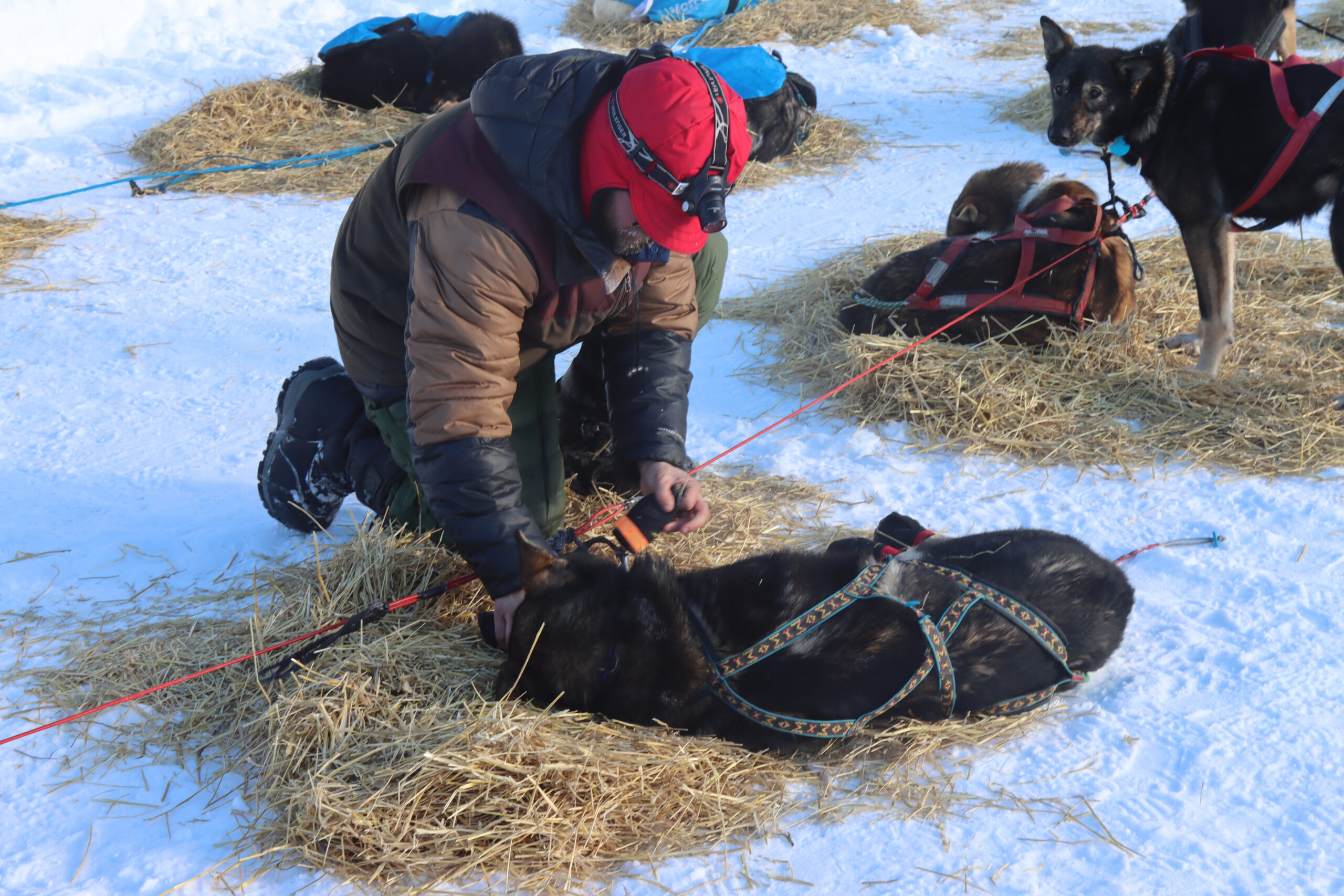
a musher removes a dog booty from a paw
Knik musher Hunter Keefe removes a booty from one of his dogs at the Ruby checkpoint in the Iditarod Trail Sled Dog race Friday, March 8, 2024. (Casey Grove/Alaska Public Media)

A 4-year-old dog in the Iditarod Trail Sled Dog Race collapsed and died Sunday morning, according to race officials. It is the second dog death of the 2024 race.

In a statement, officials said the dog, named George, was on musher Hunter Keefe’s team. The dog collapsed around 10 a.m., about 35 miles outside of Kaltag — roughly 660 miles into the 1,000-mile race.

“Attempts to revive George were unsuccessful,” the statement says.

Keefe dropped out of the Iditarod at the next checkpoint, Unalakleet, at 11:30 p.m., according to officials. 

Under race rules, if a dog dies, the musher must voluntarily scratch from the race or they will be withdrawn unless the dog died due to an “unpreventable hazard” like a moose encounter.

Keefe was racing in his second Iditarod with Raymie Redington’s dog team. Redington’s father helped found the Iditarod and one of his sons, Ryan, won last year’s race. In an interview at the race’s ceremonial start, Keefe had said George was part of a dog litter named after the Beatles. He said George had a lot of energy and barked nonstop.

Race officials say a pathologist will conduct a necropsy on George to try to determine what caused his death.

The Iditarod had also reported Sunday that 2-year-old Bog on Isaac Teaford’s team collapsed and died around 9:45 a.m. outside of the Nulato checkpoint, just under 600 miles into the race.

RELATED: Iditarod reports first dog death of this year’s race

Race officials said the cause of Bog’s death remained undetermined after a necropsy and further testing will be conducted.

PETA, which has long protested the Iditarod, issued statements Sunday and Monday following the news of the dogs’ death, calling for an end to the race and urging sponsors to pull their support.

Bog’s and George’s deaths are the first dog deaths the Iditarod has reported since 2019. That year, Richie Beattie’s dog, Oshi, died two days after crossing the Nome finish line. Veterinarians had noticed Oshi showing signs of pneumonia during post-race checkups. Beattie was withdrawn from the race.

This is a developing story. Check back for updates.