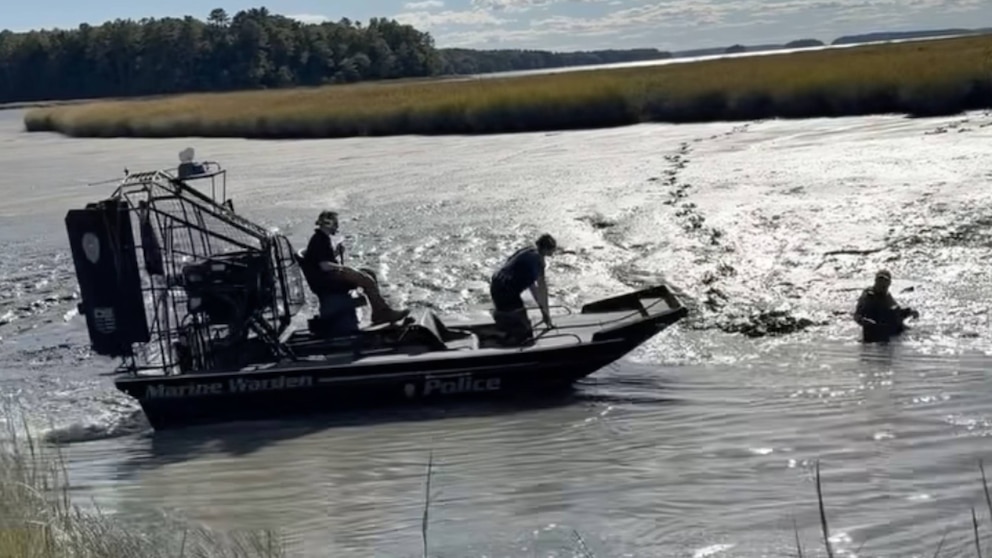
Maine hunter rescued after getting stuck in ‘quicksand’-like mud up to his waist

“The more he struggled, the deeper he became,” local police said.

ByJack Moore

October 2, 2025, 8:49 PM

1:31

about:blank

Hunter rescued after getting stuck in ‘quicksand’-like mud up to his waistA man who was duck hunting in coastal Maine had to be rescued after getting stuck in quicksand-like mud that reached up to his waist, local authorities said. 

A man who was duck hunting in coastal Maine had to be rescued by police after getting stuck in quicksand-like mud that reached up to his waist before help arrived, local authorities said. 

It happened Wednesday afternoon near Wharton’s Point on Maquoit Bay in southern Maine, according to a news release from the Brunswick Police Department. 

The 31-year-old hunter, who had been standing on an embankment over the area’s mud flats, “started walking across the mud to retrieve the ducks when he suddenly sank,” Brunswick Police said in a news release. “He was unable to move and the more he struggled, the deeper he became.” 
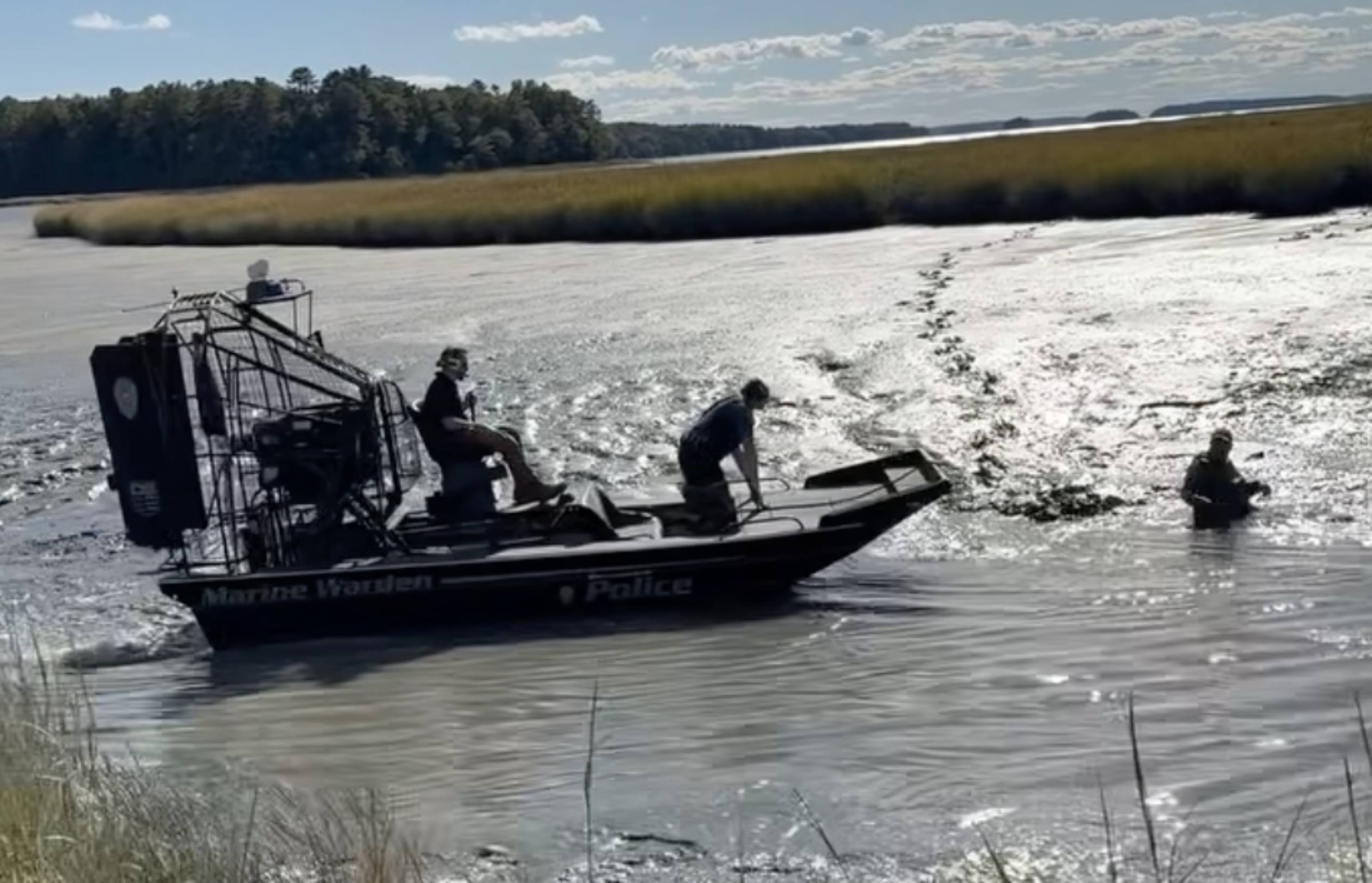
In this still image from a video, police from the Brunswick Police Department rescue a man who got stuck up his waist in mud while duck hunting.Courtesy Brunswick Police Department

The man was able to call 911 and officers arrived in a police boat to rescue him, according to the release. 

The department said it took two officers to “pull and break the suction” in order to free the hunter, who was taken to the hospital due to the amount of time he was exposed to the ocean water. 

Local police warned residents that mud flats along the coast are very unstable and often contain “honey pots” — pockets of quicksand-like mud “which cannot be seen until too late.” 

“The more a person moves, the deeper they become,” police said in the news release. 

In addition to rescuing the hunter, police said they also retrieved the ducks the man had shot before he became enmired.


Michigan City Animal Control addresses illegal trapping of cats

Previous

Michigan City Animal Control says they have been made aware of illegal trapping of cats going on in the city. If you see unauthorized people trapping, please contact animal control or the non emergency police at 219-874-3221.

Michigan City Animals Control also said the following:

“Reminder: per ordinance no. 4025,  Sec 14-8

(a) It shall be unlawful for any person to set, trigger, activate or otherwise use, or cause to be set, triggered, activated or used, any traps except cage-type live traps within the city. Such traps must be placed in a shaded area and must be checked no less than every 24 hours. These traps shall be registered with the animal control department prior to being placed. Registration information shall include:

Owner’s name and contact information;

Location and duration that the trap is to be set; and purpose of the trap being set.

Please do not allow people to set traps on your property for the time being. If you see traps being placed, PLEASE contact us or the police station.”

October 2nd, 2025|Local News

Avian flu confirmed in fighting birds in Mexico

Two flocks in Nezahualcóyotl that collectively included 49 birds are involved.

https://www.wattagnet.com/poultry-meat/diseases-health/avian-influenza/news/15768487/avian-flu-confirmed-in-fighting-birds-in-mexico

Roy Graber

October 2, 2025

Flag 815077 1280

mediosaudiovisuales | Pixabay

The presence of highly pathogenic avian influenza (HPAI) has been confirmed in two flocks of fighting birds in Mexico, according to a report from the World Organisation for Animal Health (WOAH).

Both flocks are in an urban area in Nezahualcóyotl, and the two affected premises are about 11 kilometers away from the nearest poultry production unit, the WOAH report stated.

One of the flocks included 40 birds, 27 of which had died. The other had nine birds, two of which had died.

According to WOAH, birds in the larger flock were exhibiting signs consistent with HPAI, including diarrhea, cyanosis in the crests and wattles, sudden death, pale livers and congested tracheas and lungs. The owner of those birds notified veterinary authorities in a timely manner, WOAH stated.

Birds in the smaller flock also exhibited signs consistent with HPAI, including respiratory distress, ruffled feathers, diarrhea, anorexia, prostration, death, hemorrhagic trachea and duodenal loop.

Depopulation activities took place at each property, as well as the following measures: quarantine, surveillance within and outside of the restricted zone, disinfection and official disposal of carcasses, by-products and waste.

WOAH listed these two flock infections in the same report as other cases of H5N1 HPAI, but it also reported that sequencing also detected genes corresponding to serotype H5N2.

The two fighting bird flocks were included in a WOAH report concerning the HPAI situation in birds classified as “non-poultry including wild birds.” WOAH also has an active report on instances of HPAI in commercial poultry, but the most recent case in that report was confirmed in May.

View our continuing coverage of the global avian influenza situation

To learn more about HPAI cases in commercial poultry flocks in the United States, Mexico and Canada, see an interactive map on WATTPoultry.com.