On Friday, Sept. 26, around 11:23 p.m. local time, officials got a call for help from a group of hunters located in a “remote” section of the South San Juan Wilderness, the southeastern portion of the San Juan Mountain Range, the Conejos County Sheriff’s Office said in a release. Authorities were told that “CPR was in progress.”
When responders from the Conejos County Search and Rescue Team arrived, they found that the hunter had died, the sheriff’s office said. However, due to “hazardous nighttime conditions,” it wasn’t safe to conduct a recovery mission with a helicopter, they said.
By the first light of the next morning, search teams and an air ambulance went back to the command post and were able to recover the body of the victim, a 54-year-old man from Tennessee. Officials said they won’t be releasing the hunter’s name until his family is notified.
The Conejos County Sheriff’s Office had no further information to add, and the El Paso County Coroner’s Office did not immediately respond when contacted by PEOPLE.
An image of Rio Grande National Forest. Brandon Bell/Getty
His death came two weeks after 25-year-old hunters Andrew Porter and Ian Stasko first went missing while elk hunting in the Rio Grande National Forest, prompting a search by the sheriff’s office on Saturday, Sept. 13. Their bodies were found days later, two miles from the Rio de Los Pinos Trailhead on Thursday, Sept. 18.
The Conejos County Coroner Richard Martin previously confirmed to PEOPLE that the men died after being struck by lightning.
“They didn’t do anything wrong, they didn’t feel fear or pain,” wrote Porter’s fiancée, Bridget Murphy, on social media the day he was found and said that the two accomplished hunters were seemingly attempting to get back to their car when the storm blew through on Sept. 12.
“It was out of everyone’s hands, and I am so grateful we found them so they can be at peace,” Murphy continued. “He was an experienced outdoorsman who was in the wrong spot at the wrong time.”
The Rio Grande National Forest — which has four wilderness areas, including South San Juan — is made up of 1.86 million acres and is bordered on the west by the Continental Divide, according to the National Forest Foundation.
“Ages of volcanic activity followed by the carving of glaciers left the rough, imposing terrain of the remote South San Juan Wilderness, an area characterized by steep slopes above wide U-shaped valleys cut deeper by eroding streams,” the U.S. Department of Agriculture’s Forest Service writes of the region. “You’ll find high peaks and cliffs, as well as jagged pinnacles and ragged ridges, making travel difficult. Elevations rise as high as 13,300 feet.”
Never miss a story — sign up for PEOPLE’s free daily newsletter to stay up-to-date on the best of what PEOPLE has to offer, from celebrity news to compelling human interest stories.
Conejos County Sheriff Garth Crowther reminded people who enter “the wilderness to please be cautious and well-prepared for the challenges of the backcountry.”
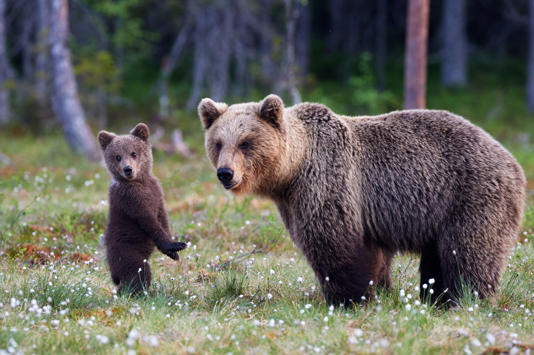
More than 50,000 grizzly bears roamed across the lower 48 states, but today fewer than 2,000 bears occupy less than 4% of their historic habitat. (Adobe Stock)
Wyoming’s Rep. Harriet Hageman, R-WY, has introduced the House version of the Grizzly Bear State Management Act of 2025, which would remove Endangered Species Act protections.
But Bradley Williams, deputy legislative director for wildlife and public lands with the Sierra Club, said the work to fully recover grizzlies is far from over.
Scientists have warned that the Greater Yellowstone Ecosystem population’s gene pool is dangerously shallow, and they need federal protections to connect with bears in other states.
Williams said he believes decades of recovery work would be at risk if the bear is turned over to state management.
“We could very likely see the bear back in a place that it was in the 1970s, where it’s at these very bare minimum numbers,” said Williams. “And if any kind of catastrophic event, genetic or disease event happens to a population of bears, we could see them at a point where they are not able to be recovered.”
The measure, which has cleared the House Natural Resources Committee, would reinstate a delisting rule passed under the first Trump administration that was tossed out by the courts, and would bar any future judicial review.
Proponents claim the species has already met population recovery goals set in 1993, and say delisting grizzlies will cut through red tape at the U.S. Fish and Wildlife Service that slows oil and gas development, a Trump administration priority.
Delisting has also been a priority for Wyoming’s powerful livestock industry. There are 2.2 million head of cattle in Wyoming, and last year 91 were lost to grizzlies, a record high.
Wyoming ranchers are fully reimbursed for those losses at market rates.
Williams pointed out that Fish and Wildlife has never had the resources to complete legally required environmental analysis at the pace of proposed energy projects.
“If Congress wants to do something to help industry and to help ease the red tape, then we need to fully fund the Endangered Species Act,” said Williams, “and appropriate that money, instead of focusing on delisting individual species that are inconvenient.”
Historic grizzly populations were upwards of 50,000 across the lower 48 states, but due to human development and hunting, fewer than 1,000 remained when the Endangered Species Act was implemented in 1975.
Today, fewer than 2,000 bears occupy less than 4% of their historic habitat.
Thomas Jacob Sanford rammed his Chevy Silverado truck into the building before opening fire on worshipers at a Sunday service at the Church of Jesus Christ of Latter-day Saints in Grand Blanc Township, Michigan.
The vehicle had two large American flags behind the cab and a set of deer antlers attached to the bumper.
Thomas Jacbob Sanford, a Marine and Iraq War veteran.Facebook/Jake SanfordIn this image taken from video released by Julie J, @Malkowski6April, massive flames and smoke rise from the Church of Jesus Christ of Latter-day Saints in Grand Blanc, about 50 miles north of Detroit, Sunday, Sept. 28, 2025.AP
A firefighter facing a vehicle that rammed into the church building.AP
He also set the church ablaze, causing the entire structure to burn down. Authorities fear there may be more victims in the fire.
A Facebook post by Sanford’s mother says the gunman — who died at the scene in a shootout with cops — served in Iraq from 2004 to 2008.
He was killed minutes after the first 911 call came in. A Department of Natural Resources officer and a local township cop responded in about 30 seconds, authorities said.
At least four people have died and nine others were wounded in the attack on Sunday.Facebook/Grand Blanc Residents UncensoredThomas Jacob Sanford’s Chevy Silverado pickup truck flying two American flags.Facebook/Jake SanfordSmoke fills the air around the Church of Jesus Christ of Latter-day Saints with visible damage to the building.AP
Authorities later confirmed that Sanford, from nearby Burton, Michigan, is the lone suspect.
The source of the blaze was not immediately known, but sources told The Post that authorities found improvised explosive devices on church property, which a bomb squad was investigating.
A bomb squad was also searching Sanford’s house.
Cops said there were hundreds of worshippers inside the church when the attack began, with aerial footage showing an enormous plume of choking black smoke rising from the structure as it burned.
Social media accounts believed to be connected to Sanford show he was a family man, with a wife and young son.
The pickup truck surrounded by smoke and debris after ramming into the Church of Jesus Christ of Latter-day Saints building.APThe source of the blaze was not immediately known, but sources told The Post authorities found several improvised explosive devices on church property, which a bomb squad was investigating.Facebook/Grand Blanc Residents UncensoredCops said there were hundreds of worshippers inside the church when the attack began, with aerial footage showing an enormous plume of choking black smoke rising from the structure as it burned.AFP via Getty Images
A dormant GoFundMe page from 2015 raised more than $3,000 for the couple’s now-10-year-old son, who was born with congenital hyperinsulinism, or CHI, a rare genetic condition in which the pancreas releases too much insulin.
Pictures from the Sanfords’ Facebook page show the family smiling, posing in the beds of pickup trucks or in a field of tall sunflowers.
Follow The Post’s coverage of the Michigan church shooting
An unnamed witness told Fox 2 Detroit that the attack started just after the congregational hymn, when hundreds of people were inside the building for the 10 a.m. service.
Churchgoers reportedly heard a loud bang as the attacker crashed his truck into the building.
“We at first thought someone had accidentally crashed into the church, so we went out to help him,” the man told the local TV station.
Paul Kirby, 38, who also ran outside to render assistance, believing it to be an accident, told the New York Times he saw the man getting out of the truck from about 10 to 20 yards away before he realized what was happening.
“He started shooting at me,” Kirby said, adding that a bullet whizzed through a nearby glass door, clipping his leg with a piece of shrapnel.
He rushed inside the church to find his wife and two sons before they fled through the back and loaded as many people into their car as they could before speeding away.
Grand Blanc resident Tony Deck told USA Today that he drove by the church after hearing sirens and saw “at least four yellow canvases over dead bodies.”
Thomas Jacbob Sanford in his Marine uniform.Facebook/Jake Sanford
Aerial photos showed the massive fire that started during the attack fully engulfing the house of worship.
Meanwhile, detectives are probing whether the mass shooting and fire has any connection to the death of longtime national LDS church president Russel M. Nelson, who died Saturday in Salt Lake City at age 101, according to a source briefed on the investigation who spoke to ABC News.
Advocate staff photo by BILL FEIG — Chaz Messina, wearing hunter orange, in a tree stand to show how concealment and cover makes a difference in hunting for deer and waterfowl.▲
Six more of Louisiana’s 10 deer hunting areas open for the archery season Wednesday after four opened Sept. 19.
Since most archery hunters hunt from a stand, tree-stand safety is a must if these folks want to run the season’s course and not spend time under a doctor’s care — or worse.
First, file a plan, something to let someone else know where you’re hunting, what time to expect a return, the make and color of your vehicle, your cellphone number and any other details emergency responders might need to track you down.
If you haven’t checked your stand from past year, make sure you do before climbing a ladder. If you use a climbing stand, make sure all fittings are secure and the frame is capable of bearing your weight — and pick a live, straight tree, one capable of supporting you and the stand.
About 20 years ago, full-body safety harnesses were made for climbing to avoid falls going up and down to and from a stand, and avoid going too high in the tree.
The bow and the arrows need to be left on the ground. Attach a length of rope to your harness, the bow and the quiver then pull them up after you’re situated in the stand.
Remember the “three” rule. Always have one hand or two feet, or two hands and one foot on the ladder at all times.

:max_bytes(150000):strip_icc():focal(708x503:710x505):format(webp)/Rio-Grande-National-Forest-Colorado-092925-02-2e023c58276a450aae912ebcfa139f63.jpg)
:max_bytes(150000):strip_icc():focal(717x531:719x533):format(webp)/Rio-Grande-National-Forest-Colorado-092925-01-d8f0bf8d09094b7bb6ba1edb743c8bb4.jpg)
:max_bytes(150000):strip_icc():focal(767x314:769x316):format(webp)/Andrew-Porter-Ian-Stasko-091725-0ecdb7d1d8ea475f80169ee96e0d0abb.jpg)
:max_bytes(150000):strip_icc():format(webp)/missing-hunters-c1b01083511946529fef2a842ef980dd.jpg)



 Exposing the Big Game