The archery hunting season opens this weekend across all of West Virginia PHOTO: WVDNR
ROMNEY, W.Va. — A couple of key factors led West Virginia Division of Natural Resources wildlife staffers to predict the 2025 whitetail deer harvest will be down. As the archery hunting season opens this weekend statewide, the first pattern hunters will follow for deer will be food sources.
The 2025 Mast Survey produced by the DNR revealed, hard mast, which is a preferred staple of the whitetail diet, will be abundant.
“The oak did do really well, in fact all hard mast did really well overall. Combined all hard and soft mast, we’re about two percent above our long-term statewide average and about 16 percent above what we were seeing in 2024,” said Avery Korns who coordinates the annual mast survey for the agency.
The increased acorn production was dramatic. White oak was up 46 percent from 2024 and up 46 percent over the yearly average. Black oak acorns jumped up 41 percent, Scarlet oak was up 29 percent. Scrub Oak was up 100 percent and the chestnut oak acorns were elevated by 119 percent over 2024. Korns said weather probably played a key role in that jump in hard mast production.
“We had a lot of rain up until about August when it started to dry up and that helped them recover from last year’s drought,” she said.
But all of that early rain is believed to have been counter productive for soft mast species. All of the soft mast which is listed annually took a step dive from 2024.
“With all that rain, they didn’t do as well overall and then when the drought hit they started dropping their fruit a little early in August.,” she said.
The survey revealed all soft mast species had a significant drop from 2024. Apple was down 14 percent, wild black cherry dropped 63 percent. The rest of the soft mast species included in the annual survey were all negative as well including blackberry, crab apple, dogwood, grapes, greenbrier, Hawthorne, sassafras, and yellow poplar.
Conversely the hard mast species just like the oak mast soared. Beech production was up 268 percent from last year and 84 percent from the all-time average. Black walnut production jumped 161 percent from 2024 and 54 percent over the long term average. The squirrel favorite hickory nut also saw a tremendous jump from 2024 with a 76 percent improvement over last year’s crop. Those numbers will likely reflect a huge jump in squirrel numbers for next fall. A strong mast year will often provide enough nourishment for female squirrels to bare two sets of offspring in the coming year.
But the overall hunting success isn’t expected to be a big mover from last year. With so much mast on the ground, deer probably won’t have to move much and that will keep them relatively safe from hunters. Korns added the EHD outbreak in the western counties of the state will be a factor.
“For all of the deer seasons combined we expect to see a lower harvest, just because of how the oak species and all of the hard mast species produced. It’s going to be harder to find those deer because they’re not going to move as much,” she said.
Korns acknowledged the EHD could impact the harvest, but not because there are fewer deer. It’s more because hunters THINK there are NO deer.
“We know in those areas if they’ve been hit particularly hard, some of our hunters aren’t going to go out this year or they may self regulate how many deer they take. That can affect the harvest,” she said.
The overall hunting outlook in the publication anticipated a lower success rate not only for whitetails, but also for rabbits, racoons, and quail. Hunter success was predicted to be about the same as 2024 when hunting both fox squirrels and gray squirrels, wild turkey, and wild boar. The only species expected to see an increased harvest during the coming hunting season is black bear. Korns said the archery harvest may not be up, but they anticipate because of the high level of mast bears will go to the den far later and the gun season in December will feature a lot of bears still on the landscape for hunters to enjoy the pursuit.
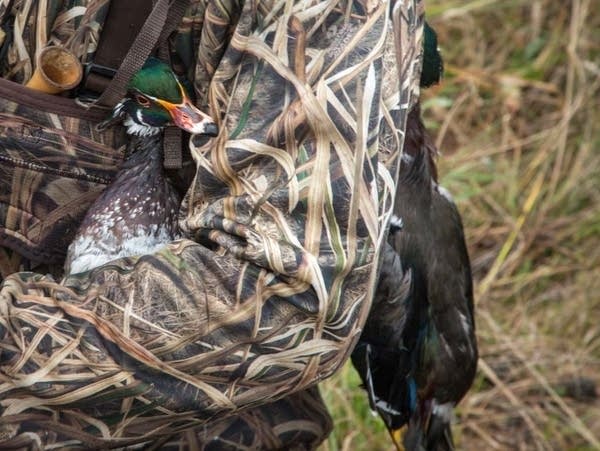
Minnesota duck hunters may see slightly more birds than last year, but the waterfowl populations are threatened as last year’s drought dried up wetlands across the state, reducing habitat that the birds need for nesting and breeding.Monika Lawrence for MPR News file
As the duck hunting season opens in Minnesota this weekend, the state Department of Natural Resources says waterfowl populations are slightly higher than they were a year ago. But the DNR says the populations are significantly lower than they were years ago as waterfowl habitat dries up.
Dry conditions across Minnesota this past year have reduced the amount of wetlands in the state, which waterfowl need to breed. Even with less of its vital habitat, bird populations remain steady from the previous year, thanks to last-minute rainfall during the nesting season.
The Minnesota Department of Natural Resources reports shallow wetlands decreased by 73 percent from last year. More than half of the state had been suffering in drought conditions up until April.
Losing that habitat could’ve been devastating for duck populations, Nate Huck, the migratory game bird specialist for Minnesota DNR, said. But the very wet late spring helped restore some of that habitat.
“Last year, we did get some rain, later in the nesting season that allowed birds nest successfully,” Huck said. “This year settling conditions weren’t as good. But again, we got rain late.”
Thanks to that rain, duck populations, excluding scaup, were about 8 percent higher than last year. However, they remain 32 percent below the long average.
“We’ve been trending drier and drier and drier since at least the last 10 years,” Huck said. “And so that’s going to drive those populations down quite a bit.”
Duck hunting season begins thirty minutes before sunrise on Saturday, Sept. 27th. Huck says if people want to continue enjoying the plentiful waterfowl, it’ll be crucial to advocate for Congress to continue funding protections for wetlands.
Protections like the Conservation Reserve Program, which allows landowners to set aside some of their property to convert into grasslands for wildlife use.
“We peaked in 2017 when CRP peaked and we’ve come down since then,” Huck said. “The availability of those grasslands is so important for so many species that hunters choose to pursue.”
The Department of Natural Resources utilizes banding programs to monitor waterfowl populations. However, to maintain the accuracy of other game population data, Huck encourages hunters to keep a log of their hunting locations and the number of animals they encounter.
(ABC 6 News) – Hunting in Minnesota provides multiple different paths for those interested from pheasants and turkeys to white tail deer and even bear.
But there’s one that’s even more unique than the others: elk.
Hunting an elk in Minnesota is truly a once in a lifetime experience that draw thousands of Minnesotans every year, each vying for the chance to bag one.
The only elk hunting range available this year was all the way up in Kittson County on the Canadian border, about seven hours away from Rochester.
That’s where George Clements, a long time hunter and one of only four hunters who acquired a tag this year, found himself for a week.
To say he was excited when he got the news would be an understatement.
“You might ask my wife; she said I was literally jumping up and down,” he said. “She said I had the biggest smile she’d ever seen on my face.”
Elk, and many other types of big game, aren’t new to Clements.
“The other elk that I shot was a cow, I got that with a bow and arrow in Colorado,” he said. “And that’s when I got my first taste of elk and decided that I wanted to do this again.”
But elk hunting in Minnesota, even in a good year, is a rarity.
Over the last few years, the numbers of available licenses have dwindled.
In 2020, there were 44 up for grabs, but only the four in 2025.
That mostly has to do with the elk population, carefully managed by the state’s Department of Natural Resources.
“In the wintertime, we get up. We do an aerial survey and we count how many elk we have on the landscape,” said Kelsie LaSharr, Minnesota’s elk coordinator. “Based on that number, we are legislatively mandated to maintain certain population limits. And so that’s really where hunting comes into play. Elk harvest helps us maintain them if the populations are growing.”
Except those populations haven’t been growing, hence the lack of tags.
“While this does feel disappointing for hunters, it’s also an opportunity for us to apply less pressure to those elk herds so that they have the opportunity to grow and thrive,” LaSharr said.
It also makes getting a tag such a big deal for someone like Clements, who turned 69 during his hunting trip.
“Climbing to 8,000 or 10,000 feet in Colorado’s probably not in my recipe file any longer,” Clements said. “It is almost a spiritual experience for me. I spent a lot of time sitting there quietly. Many times I’ll pray. And it’s part of life.”
A Washington Department of Fish and Wildlife biologist collects a dead snow goose on a Camano Island near Skagit Bay during an avian influenza outbreak in northern Puget Sound in December 2022. (WASHINGTON DEPARTMENT OF FISH AND WILDLIFE photo)
In the past three years, scientists have documented a slow but steady increase in the number of Pacific Northwest species that are dying from avian influenza, commonly known as bird flu.
Wild birds have long carried low pathogenic strains of avian influenza. When it spread to domestic birds, the virus sometimes mutated into more severe strains, called high pathogenic avian influenza—or HPAI.
For decades, HPAI was a disease that largely affected domestic poultry, and sometimes the people who handle them. But in a paradigm shift, the strain started spreading back to wild bird populations in 2002.
Now, the latest strain of HPAI H5N1—emerging in 2021—is proving to be especially worrisome to wild birds, and potentially to other wildlife.
In 2022, some migratory birds that spend time in Washington and Oregon started getting sick and dying—sometimes by the hundreds, and in at least one case, more than a thousand. And, for the first time, wild mammals ranging from cougars and bobcats to weasels, skunks and raccoons began perishing from the virus in the Pacific Northwest and across the country.
But HPAI is also a serious threat to certain types of wild birds, despite their having a long history of exposure to bird flu. Scientists believe that most other wildlife is catching the disease after scavenging on wild birds that died of bird flu.
Excepting poultry-farm workers, the disease is still not a large risk to people.
But the extent of bird flu in wild mammals is understudied.
How bad is it?
The Washington Department of Fish and Wildlife has reported that since April 2022, when a snow goose in Walla Walla County was confirmed to have died from a strain of HPAI, more than 400 wild animals are known to have died from the disease in the state.
But these are just confirmed cases.
“The tip of the iceberg,” WDFW Veterinarian Katie Haman tells Columbia Insight.
In the spring and fall of 2023 and 2024, WDFW documented large die-offs of Canada geese, snow geese, swans and other birds.
So, what does “large die-off” mean in terms of actual numbers?
“That’s the million dollar question,” says Haman.
One of the most well documented die-offs occurred in 2023 on Rat Island, off the Washington coast near Port Townsend.
Volunteers helped count nearly 1,600 dead Caspian terns, including 1,101 adults. But only a small fraction of those birds were tested and confirmed to have died from the disease.
Additionally, the total estimate doesn’t include birds that may have died but weren’t counted because they washed out to sea.
“That confirmed number is a very gross underestimate of how many birds died (in this die-off),” says Haman.
Further study found that 56% of the Caspian tern colony on the island died from the 2023 outbreak. Since then, no birds have successfully bred there.
Because it was such a large colony, that die-off is estimated to have wiped out 10-14% of the entire Caspian tern population in the Pacific Flyway.
It’s catastrophic—especially since older birds that should have had some immunity died along with chicks that had never been exposed.
At the same time that WDFW was collecting dead Caspian terns near Port Townsend, a separate outbreak ravaged Caspian terns at the mouth of the Columbia River.
Other regional outbreaks have been documented.
One of the largest was north of Salem, at Staats Lake, where about 300 snow geese died in 2023.
As with other mass die-offs, the state confirmed the disease in a small number of the birds, and assumed the rest also died from the flu.
Oregon Department of Fish and Wildlife Veterinarian Dr. Julia Burco Speten calls the small lake “an early warning system.” That’s because it’s surrounded by homes, and is a documented stopover for migratory ducks, geese and swans. Residents report dead birds.
“It’s pretty publicly visible,” says Speten.
At other stopover sites, significant numbers of cackling geese—a subspecies of Canada geese—have died from the disease.
A cluster of roughly seven sandhill cranes died last fall from HPAI in eastern Oregon’s Malheur County.
Mammals infected
In the last three years, state wildlife agencies have received reports of dead mammals and birds of prey—including bald eagles and red-tailed hawks—though numbers are relatively small.
Oregon and Washington have confirmed HPAI in skunks, raccoons, red fox, cougars, bobcats and weasels.
In 2024, 20 big cats—including cougars, lynx and bobcats—died of HPAI at a big cat sanctuary in Shelton, Washington. Investigators believe the outbreak was associated with contaminated food.
Excepting harbor seals, Haman believes other wildlife and raptors that have died from avian flu probably died after scavenging on infected birds.
The major die-off of Caspian terns in Washington in 2023 resulted in a study that also found the H5N1 virus was transmitted to harbor seals (15 of them) for the first time on the northeastern Pacific Coast.
NOAA testing has found some harbor seals positive for highly pathogenic avian influenza H5N1. (OREGON DEPARTMENT OF FISH AND WILDLIFE photo)
“It is unlikely that multiple seals acquired the viruses through predation or scavenging of an infected source (such as an infected bird) at this scale, as birds are not a typical food source for harbor seals,” NOAA Fisheries reported.
Exactly how the seals contracted the disease is being investigated. But scientists believe it initially came from exposure to infected Caspian terns through respiratory droplets or exposure to their feces.
“Once a new variant of influenza has entered into a seal population, it is then often able to spread from seal to seal,” according to the NOAA Fisheries statement.
Cloudy numbers
State and federal agencies rely on the public to report wildlife fatalities.
Most animals that die in the wild are probably not found or reported by the public.
As a result, government researchers don’t have accurate numbers of how many animals are dying—or the impacts to populations—of avian influenza.
Since state agencies don’t have the resources to conduct widespread surveys across many species, they don’t know if any wild mammals are catching the disease and surviving.
The upshot?
“We really don’t have a good idea of the impact on a lot of species,” says Haman.
Positive trend?
Despite an uptick in cases in December 2024, Haman and Speten say they have had fewer reports and confirmed deaths in wild birds or mammals so far this year,
“I would say this spring was a little better” compared with 2024 or 2023, says Haman.
However, she says, there’s usually a lull in reported cases in the summer, since migrating birds in the Pacific Flyway generally stop in this region in the spring and fall.
“We’re just not getting a lot of reports of dead birds right now,” she says.
“The promising news is, we really have had a decrease” in reported cases, says Speten. She believes this could be evidence that wild populations are developing a resistance.
“With any pathogen you would expect birds to start mounting an immune response. Hopefully, that’s what we’re beginning to see,” she says.
The real test will be if the drop-off continues through this fall, when wild ducks, geese, swans, shorebirds, terns and seabirds most susceptible to the disease stop at Pacific Northwest lakes and estuaries for extended time.
With bird migration season approaching, wildlife agencies in Oregon and Washington will be relying on the public to report wildlife fatalities.
“The information goes into a database,” says Haman. “By reporting wildlife mortality events or even single cases, that’s really useful information for us.”
“How it evolves in wildlife is going to impact whether or not it’s going to spill over into humans,” says Haman. “I think that’s the big part we’re going to be missing with not doing surveillance for it.”
Haman says unlike in domestic poultry—where infected flocks would be euthanized to prevent continued spread and mutations—HPAI is now being maintained in wildlife populations.
“It’s just kind of always here,” she says. “I think people should be prepared for it being on our landscape for the foreseeable future.”
Speten advises that despite the unsettling progression of the disease, people shouldn’t be fearful of HPAI as a human health risk. However, common precautions—like not handling dead wildlife—should be taken.
She, too, urges residents to report wildlife fatalities.
ODFW dead bird reporting hotline: 866-968-2600 (10)
WDFW has an online link for reporting sick, injured or dead wildlife.
K.C. Mehaffey has been writing about the environment from her home in Twisp, Washington for nearly 40 years.
Columbia Insight, based in Hood River, Oregon, is a nonprofit news site focused on environmental issues of the Columbia River Basin and the Pacific Northwest.
And the outbreak of epizootic hemorrhagic disease (EHD) is so bad that officials at the Ohio Department of Natural Resources Division of Wildlife are proposing hunting season rule changes to cope with the death toll.
More than 7,000 sick or dead deer have been reported to the Division of Wildlife, with hundreds of those in the southeast Ohio counties of Athens, Meigs, Washington and Morgan, where the outbreak is the largest, the Dispatch reported previously.



 Exposing the Big Game