Shane Zoglman, who describes in Poultry Press working earlier in his life on a battery-caged hen farm and a turkey farm, shot this footage of turkey concentration sites and killing locations, and scenes of them freezing in trucks where he lives, in Dubois County, Indiana. He sent his video to us November 22nd to share as we wished.
In “I Feel So Bad for These Turkeys Hauled on Freezing Nights,” Shane told UPC: “These days I do not buy guns and ammo to kill animals with. I buy binoculars to enjoy watching them with, and instead of putting effort into killing, I put effort and money into taking in animals that need a home as well as trying to spread some of the message in my own way that things need to change.”
I posted a thought on the YouTube channel featuring Shane’s video. Feel free to add your own. — Karen Davis, United Poultry Concerns
This commentary is by Barbara Felitti, a resident of Huntington who retired after working for 28 years at the Institute for Sustainable Communities in Montpelier and as a consultant for international community development and NGO support work.
It’s time for the Vermont Fish & Wildlife Department and elected state officials to act on the wishes of the majority of Vermonters and ban recreational and fur trapping for furbearers (bobcat, otter, fisher, coyotes, beaver, red and gray fox, muskrat, raccoon, opossum, weasel, mink and skunk).
Fish & Wildlife recently commissioned a survey of Vermont residents on furbearer trapping. A majority of Vermonters oppose recreational and fur trapping — 68% disapprove of recreational trapping (only 26% approve) and 62% disapprove of fur trapping (only 31% approve). This is consistent with the 2017 Vermont Center for Rural Studies survey finding that 75% of Vermonters want trapping banned. (See page 49 of the draft document “Vermont Residents’ Attitudes Towards Furbearer Management” 2022 by Responsive Management. The document was obtained from Fish & Wildlife through a public records request.)
So why are Fish & Wildlife and elected officials ignoring the wishes of a majority of Vermonters?
Arguments against a recreational and fur trapping ban fall along some predictable lines:
Tradition. Trapping is a Vermont “tradition.” However, traditions can and do change with time. Dogfighting and cockfighting were once “traditions” that are now banned throughout the U.S., as they were recognized as a form of legalized animal abuse. There is no legitimate need in the 21st century for trapping wildlife in painful ways so someone can kill them for recreation or fur.
Flatlanders. Some feel if you haven’t lived in Vermont for generations, you shouldn’t try to change traditions. This ignores the fact that some hunters and lifelong Vermonters are part of the 62% to 68% supporting a recreational and fur trapping ban.
Additionally, I seem to have missed the place in the Vermont Constitution where rights are assigned to people based on how long they’ve lived in the state. Are people who have not lived in Vermont for generations second-class citizens?
Misdirection. Inevitably, the issue of banning recreational and fur trapping raises the topic of the much maligned beaver and damage to infrastructure. Nuisance damage from beavers can be managed in nonlethal ways. More importantly, banning recreational and fur trapping under 10 App. V.S.A. § 44 will not disallow nuisance trapping under 10 V.S.A. § 4828.
Guaranteed rights. Fish & Wildlife’s website wrongfully states that trapping is protected by the Vermont Constitution. It is not. The constitution guarantees the right to “hunt and fowl,” which have distinctly different definitions than trapping under Vermont regulations.
“Detractors.” Unfortunately some Fish & Wildlife staff see disagreements with department policy as having to deal with “detractors” who are discrediting their work (Fish & Wildlife staff email Oct. 20, 2021, obtained through a public records request). This is a disingenuous and dismissive response by public officials that ignores the legitimate right of citizens to question and petition for changes to department policy.
Sadly, ignoring majority public opinion on trapping extends to the Legislature. Last legislative session, S.201 proposed a ban on leghold traps. Instead of a ban, the Legislature passed a bill to establish “best management practices” for trapping. Trappers in a working group to advise on best management practices wouldn’t even agree to limit killing of trapped animals to gunshot only. They still want to be able to use inhumane methods — for example, bludgeoning, stomping, or choking — to kill trapped wildlife. A best management practices-approved leghold trap can still maim an animal and will not prevent indiscriminate trapping of pet dogs and cats, raptors, or endangered species. Is this really “best”?
The opening weekend of Wisconsin’s deer season was marred by the fatal shooting of an 11-year-old boy by a member of his hunting party.
Officials are asking all hunters continuing in the nine-day gun deer season, which opened Saturday, to follow thefour basic rules of firearm safety, including always being aware of where the gun’s muzzle is pointing.
On Sunday in Green Lake County, a 41-year-old man was attempting to unload his gun to place it in the back seat of the vehicle when the gun went off, hitting the 11-year-old in the chest. The boy was flown to a nearby hospital, where he died.
Wisconsin Department of Natural Resources officials…
On Sunday, Nov. 20, 2022 around 9:45 a.m., Wahkiakum County Emergency Management Services and Sheriff’s Office and Washington Department of Fish and Wildlife Police responded to a report of a hunting incident in Cathlamet at the Elochoman Slough. A shotgun discharge seriously injured a 53-year-old male from Cowlitz County.
It was reported that the two friends were duck hunting in a small boat that morning and, while retrieving ducks from the water, the shooter’s shotgun fell over from a propped-up position. In an attempt to retrieve the shotgun, the shooter fired the firearm striking the victim.The shooter immediately called 911 and transported the victim to the Cathlamet Marina where he met medical aid. The victim was transported to Longview and then flown to Vancouver’s SW Medical Center where he is currently in stable condition recovering from his injuries.
In a letter to the New York State Department of Agriculture & Markets, local and national animal protection organizations are calling on Commissioner Richard Ball to suspend operations at the 87 live animal markets across the state that sell live animals to the public and slaughter them on the premises. The calls come amid an avian flu outbreak at a Queens live poultry market that led to the temporary closure of 34 similar markets in New York and New Jersey. Approximately 170 birds were killed in the Queens facility where the flu was found.
Deckhands aboard the crab boat Arctic Hunter in the Bering Sea off Alaska separate male and female snow crab, March 21, 2013. There will be no Bering Sea red king crab or snow crab harvests this year.Steve Ringman/The Seattle Times/TNS
Signed-in readers now can bookmark stories to read later.
Last week, there was mass confusion as to why Alaskan snow crabs have disappeared.
This week, there may be a plausible answer as to why crab legs will be so hard to get your hands on.
According toYahoo, climate change may be the prime suspect in a mass die-off of Alaska’s snow crabs, experts say, after the state took the unprecedented step ofcanceling their harvest this seasonto save the species.
Here’s the thing.
There’s an annual survey of the Bering Sea floor carried out…
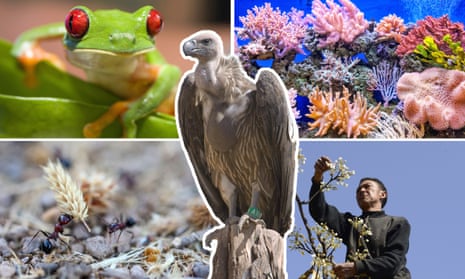
Clockwise from top left: a frog from Panama; a close-up of coral; hand-pollinating pear trees in China; pest-eating ants; and an Indian white-rumped vulture.Photograph: Alamy, Getty Images, Shutterstock
Seven ways in which our destruction of the natural world has led to deadly outcomes
1.As Indian vultures decline, the number of rabies cases rise
In the early 1990s, vultures across India started dying inexplicably. Long-billed, slender-billed and oriental white-backed vultures declined to the brink of extinction, with the number of India’s most common three vulture species falling by more than97% between 1992 and 2007. Six other species were in sharp decline too. Scientists started testing the dead birds and worked outthey had been exposed to diclofenac, an anti-inflammatory drug routinely given to cattle in south Asia…
One of the largest volcanoes on Venus is the 2-mile-tall Maat Mons, which has lava flows spilling for hundreds of miles around it.(Image credit: NASA/JPL)
Massive global volcanism that covered 80% of Venus’ surface in lava may have been the deciding factor that transformed Venus from a wet and mild world into the suffocating, sulfuric, hellish planet that it is today.
The surface temperature onVenusis a sweltering 867 degrees Fahrenheit (464 degrees Celsius), hot enough to melt lead, and there’s a crushing pressure of 90 atmospheres underneath the dense clouds of carbon dioxide laced with corroding sulfuric acid. Often decried asEarth‘s “evil twin,”…