Readers are unconvinced by a ‘liberal’ hunter’s line of defence and consider the wider ethics of killing for foodThu 4 Sep 2025 12.13 EDTShare
This long pro-hunting piece (I’m a liberal who loves hunting. Allow me to change your mind, 31 August) is full of the usual defences: that hunters are the ones who really care about wildlife and who protect it with their taxes and their efforts, and that hunting is a more ethical and humane means of consuming meat than store-bought factory-farmed. It conveniently overlooks the fact that hunters lobby government wildlife offices, hunters manage wildlife populations so that there is always a surplus of the kinds of animals they want to kill, and that hunters hold vast (usually right-leaning) political power in the US.
And the fact is that hunters not only eat their “reverential” kills but also readily eat the “ethically inferior” often factory-farmed meat; the author makes brief mention of that in admitting her weakness for store-bought poultry. Frankly, hunted meat may normally be less cruel than meat produced by animal agriculture, but there is overlap in their government lobbying efforts – for example, both want wild horses removed from public lands and both want hunting seasons on wild predators such as wolves and bears. Kim Bartlett President, Animal People Inc
If you must murder, murder softly (or so runs Jessica Reed’s defence of hunting). Forgive me for being dissatisfied with this defence. For it leaves unanswered the crucial question: why must you murder at all? Sasha Arridge Oxford
50-year-old Khet Singh was attacked with sharp weapons while he was sleeping in his field. His brother’s complaint alleges he was killed because he stopped a group of armed men from hunting deer days earlier.
Written by Parul Kulshrestha Jaipur | September 6, 2025 02:33 PM IST
Jaisalmer SP Abhishek Shivhare said that three accused, Ladu Khan, Alam Khan and Khete Khan, have been detained and their vehicle seized. (Photo: X/@ANI)
The village of Dangri in Rajasthan’s Jaisalmer district has remained tense since a 50-year-old farmer was murdered earlier this week, allegedly after he tried to stop people from hunting deer.
According to police, Khet Singh was attacked with sharp weapons while he was sleeping in his field on the night of September 2. Seriously injured, he lay unattended the entire night until village residents found him in the morning and rushed him to the Fatehgarh government hospital. Doctors later referred him to Barmer in critical condition, where he died during treatment.
Jaisalmer SP Abhishek Shivhare said that three accused, Ladu Khan, Alam Khan and Khete Khan, have been detained and their vehicle seized.
“We have detained three accused and the role of another person is still under investigation. If proven, then he will be arrested as well. We are yet to conclude that this incident happened because of deer hunting. The investigation is still on,” the SP said.
Following the murder, angry villagers set fire to four cabins, including a tyre tube shop linked to the accused. Police immediately deployed personnel in the area, erected barricades and restricted the entry of outsiders to maintain peace. The SP appealed to villagers to remain indoors and warned against spreading misinformation online, saying that strict action would be taken against those trying to disturb communal harmony.
The victim’s brother, Swaroop Singh, has lodged a complaint at Sangar police station, saying that 10 days ago, Ladu Khan and Alam Khan had come armed with guns to hunt deer and argued with Khet Singh when he opposed them. Swaroop alleged that the same men, along with accomplices, attacked and killed his brother on September 2.
Police said the situation in Dangri village remains tense but under control as of Saturday.
FAYETTEVILLE, Ark. — Every year, waterfowl hunters, biologists, and conservationists across North America pay close attention to the U.S. Fish and Wildlife Service’s breeding population and May pond survey. It is the gold-standard snapshot of duck numbers and habitat conditions, shaping everything from federal hunting regulations to the strategies of conservation organizations.
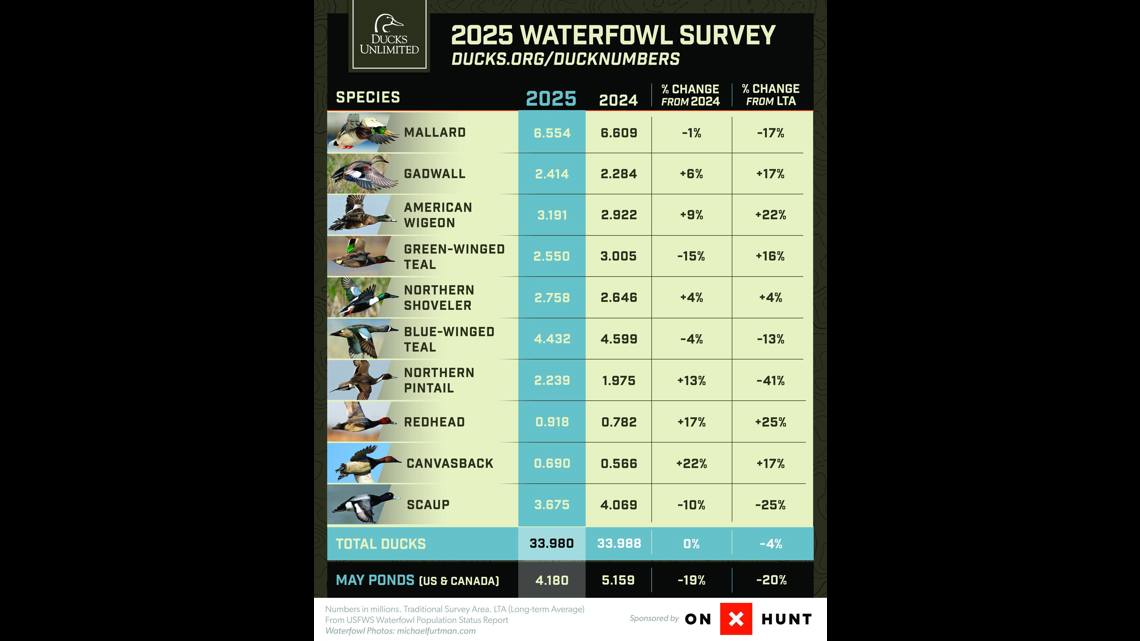
The 2025 report, released earlier this week, shows total duck populations at roughly 34 million, virtually unchanged from last year. While that figure is still about 35–40% lower than the record highs of the late 2010s, experts say the stability is noteworthy given years of drought across the Prairie Pothole Region, the most critical breeding ground for ducks.
“It’s a story of resilience,” said Dr. Mike Brasher, senior waterfowl biologist with Ducks Unlimited and host of the Ducks Unlimited Podcast. “We’ve seen long-standing drought on the prairies, yet duck populations have essentially held steady the past few years. These birds are finding habitat elsewhere and are able to maintain themselves, even if they can’t grow in numbers without consistent wet conditions.”
Credit: Ducks Unlimited
Why It Matters
The survey covers nearly every species of duck and goose in North America and is the primary dataset used to set hunting regulations. While this fall’s hunting season is based on last year’s numbers, this year’s data will influence the 2026 frameworks.
According to Brasher, the accompanying Adaptive Harvest Management report confirms that hunters can expect liberal seasons across all four flyways again next year, including:
Continuation of the three-pintail daily bag limit.
A four-mallard bag limit in the Atlantic Flyway.
A shortened teal season in some areas due to slightly lower blue-winged teal numbers.
“In large part, regulations will look very similar next year,” Brasher said. “The science supports it, and the collaborative process between the Fish and Wildlife Service and state agencies ensures hunters have opportunity while protecting populations.”
Conservation Challenges
Despite stable numbers, long-term concerns remain. Brasher emphasized that ongoing habitat loss across the prairies — through grassland conversion, reduced CRP acreage, and wetland drainage — threatens future rebounds.
“When the rains return, and they will, we’re all anxious to see how strong the response will be,” Brasher explained. “We know ducks can bounce back, but with less habitat on the landscape than in decades past, recovery may not be as dramatic or as fast.”
Ducks Unlimited, with partners in the U.S., Canada, and Mexico, continues to focus on conserving and restoring habitat across the continent. The Prairie Pothole Region remains its top priority, along with the Canadian boreal forest and key wintering grounds in Mexico. Much of this work happens in cooperation with farmers, ranchers, and private landowners.
“Conservation is a team effort,” Brasher said. “Ducks Unlimited doesn’t do this alone. We work alongside agencies, corporations, and especially the people who live and work on the land.”
Looking Ahead
While the numbers may not represent a dramatic rebound, Brasher encourages hunters to see them as evidence of resilience and a reminder of the importance of habitat.
“Mallards, in particular, continue to show their adaptability,” he noted. “They’re stable and widespread, which keeps hunting opportunities strong even during dry years. But for long-term growth, we need wet prairies and healthy grasslands.”
As fall approaches and hunters prepare for another season, the data offers a balanced message: populations are holding steady, opportunities remain strong, and the future of waterfowl depends on continued conservation.


 2 min read
 Jaisalmer SP Abhishek Shivhare said that three accused, Ladu Khan, Alam Khan and Khete Khan, have been detained and their vehicle seized. (Photo: X/@ANI)

 Exposing the Big Game