https://www.cnn.com/2020/06/17/business/meat-prices-beyond-patties/index.html
(CNN Business)With meat prices on the rise, a plant-based protein purveyor is making a play for consumers’ pocketbooks.
https://www.cnn.com/2020/06/17/business/meat-prices-beyond-patties/index.html
(CNN Business)With meat prices on the rise, a plant-based protein purveyor is making a play for consumers’ pocketbooks.
Donald Trump is launching what reports have branded the ‘biggest attack in centuries‘ on the giants of the U.S. meat industry.
The Department of Justice is launching a probe into beef companies, following beef prices almost doubling earlier this year, after more than 20 slaughterhouses across the U.S. were forced to shutter due to COVID-19 outbreaks.
Bloomberg reports that ‘regulators are also scrutinizing potential price manipulation, and on Capitol Hill, lawmakers are clamoring for a crackdown’, adding that ‘farmers have long complained about the dominance of just a handful of companies in beef and poultry markets, but antitrust enforcers haven’t before taken significant action against the companies’.
The probe follows reports that while consumers were paying these staggeringly high prices for meat, meat packing giants were extremely low prices to ranchers and farmers.
The probe will investigate whether these meatpacking companies are manipulating prices. If so, they could be violating antitrust laws – aka competition laws – statutes developed by the U.S. government. They were put in place to protect consumers by ensuring that fair competition exists in an open-market economy
Ben Gotschall is interim executive director for the Organization for Competitive Markets, which advocates against consolidation in agriculture.
He told Bloomberg: “The market’s been broken for a long time, and the pandemic has just made it worse. Meatpackers are making record profits, and the ranchers are going out of business.
“Whatever Trump’s motivation might be, if he does the right thing you have to take it. I hope it’s more than just lip service.”
United Poultry Concerns <http://www.UPC-online.org>
June 7, 2020
JUNE 6, 2020
UPC President Karen Davis’s Letter to the Editor appears in the printed and
screen versions of Virginia’s *Eastern Shore Post* this week.
Dear Editor:
The coronavirus pandemic focuses our attention on the link between
cleanliness
and avoidance of disease. As much as possible, people are sanitizing their
hands, social distancing, and covering their faces to prevent the virus from
spreading. Yet most people consume products from chickens and other animals
who
have spent their life in polluted, overcrowded facilities.
Infectious microbes are drawn to population density, dirt, and weakened
immune
systems – the perfect conditions in which to spread in animals and humans
alike.
One of the worst things we do to animals in industrial farming is to prevent
them from practicing hygiene.
When chickens come to our sanctuary from a confinement facility, their
first act
in being placed on the ground is to take a dustbath. They instinctively
want to
clean their skin and feathers with particles of earth. This, for them, is
comparable to a waterbath for us.
Forcing animals to live in filth and breathe air rife with pathogens is an
experience they would not choose on their own.
Recognizing the importance of hygiene and staying healthy, we need to
remember
that the same link between health and hygiene applies to other species.
Animals
in nature would never survive if they carried the load of diseases and
immunological weaknesses that characterize modern farmed animals.
Let us think carefully about our food choices. A plant-based diet free of
animal
products is increasingly desirable and obtainable in today’s society. While
providing an opportunity for a more peaceful world, it is also an
intelligent
food safety choice.
A plant-based diet will not sacrifice jobs or hurt the economy. As long as
people exist, the same amount of food will be produced and consumed. Just
because we stop eating animal products doesn’t mean we stop eating.
Karen Davis, President
United Poultry Concerns, Machipongo
*Eastern Shore Post:*
It’s Time to Rethink Our Food Choices
<https://www.easternshorepost.com/2020/06/06/its-time-to-rethink-our-food-choices/

A man prepares Impossible Pork, a new plant-based pork product by Impossible Foods, at the 2020 … [+]
AFP VIA GETTY IMAGES
Impossible Foods has no interest in making a veggie burger that tastes like meat, its founder and CEO said Friday.
Veggie burgers don’t serve the company’s goal, said Patrick Brown—to solve “the catastrophic impact of the use of animals as a food technology”—because veggie burgers cater to vegetarians, not carnivores.
“All the plant-based foods that have been produced in the past—if you look at what was in the heads of the people who produced them—their target consumer was someone who is looking for an alternative, i.e. people who want to have a more vegetarian diet or something like that,” Brown said in a Zoom webinar. “If that’s your consumer, you’re not going to have any effect on the climate issues because that’s a very small population.”
When Marketing Professor Sanjog Misra asked Brown about making a veggie burger that tastes like meat, Brown interrupted him:
“That was not at all what we were trying to do,” Brown said. “It was to make the most delicious meat on earth directly from plants. What we think of ourselves as doing is making meat—a better way of making meat.”
The Stanford University emeritus biochemistry professor took an 18-month sabbatical in 2009 to solve the most important problem he could think of, which he determined was the impact of animal agriculture on greenhouse gas emissions, water pollution, water consumption and land use.
“If you could vaporize that industry today, which I would do in a heartbeat,” he said, “and let the biomass on that land recover, it would outpace fossil-fuel emissions. It would literally begin to reduce the atmospheric CO2 concentrations, and you can do the math on that. We desperately need that.”
But Brown doesn’t expect carnivores to eat plant-based meat to mitigate climate change.
“It had been framed as we’ve got to get people to change their diets, or we have to compel that business to stop doing it and so forth, and that’s just like crazy. That is never going to work,” he said at the webinar hosted by the University of Chicago’s Rustandy Center for Social Sector Innovation.
“People are very wedded to the foods that they prefer. The pleasure that they get from eating the foods that they love is a huge part of the pleasure of life. It’s unreasonable to think you can ask them to give that up. And that defined the problem very crisply for me, which is that it’s a technology problem.”
Animal agricultural is a $1.5 trillion prehistoric technology, Brown said, that’s vastly inefficient and hasn’t significantly improved in millennia. So it’s a “sitting duck” for disruption.
He assembled a team of 80 research scientists to solve the technology problem, to make a plant-based meat that’s more affordable, more nutritious and more delicious than animal meat.
Plants already offer the advantage of nutrition and affordability, he added, so the challenge—what he called “the most important scientific question”—has been deliciousness.
“We’re not going to solve this problem by mushing a bunch of peas and carrots together and forming it into a patty,” he said. “We have to deliver for a committed meat eater, who is not looking for an alternative, they’re just looking for the most delicious, healthy, affordable meat they can buy given their taste.”
Brown doubts anyone can convince consumers to compromise what they want. The producer has to give them what they want. So the Impossible goal has been “to make the most delicious meat on earth directly from plants.”


(CNN)Coronavirus came for Americans’ hamburgers in early May.
Sign up here to get The Results Are In with Dr. Sanjay Gupta every Tuesday from the CNN Health team.
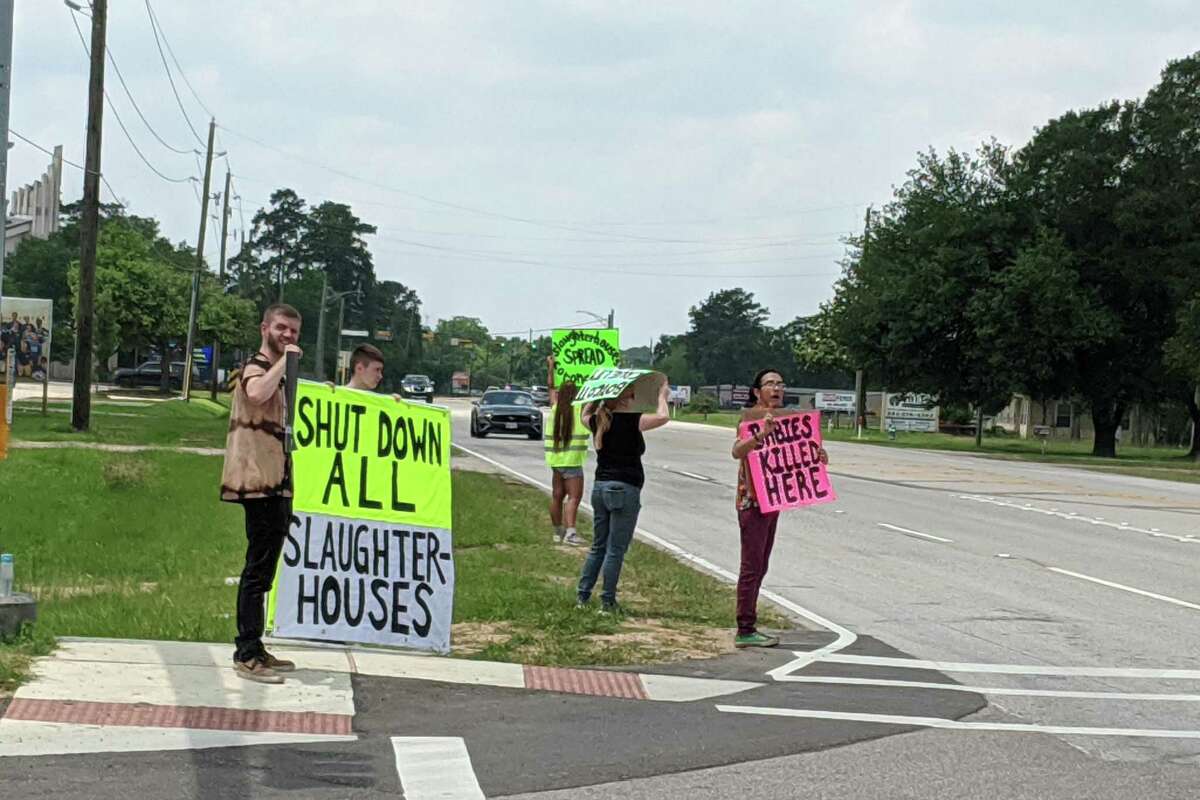
Around a dozen protesters were camped out at the intersection outside the Fisher Ham and Meat Co. headquarters in Spring on Friday, demanding the meat processing facility be shut down amid the coronavirus pandemic.
Dani Alexander, one of the organizers of the event, called factory farms and slaughterhouses breeding grounds for new strains of dangerous bacteria and viruses, likening the spread of coronavirus from animals-to-humans to diseases such as bird flu and swine flu.

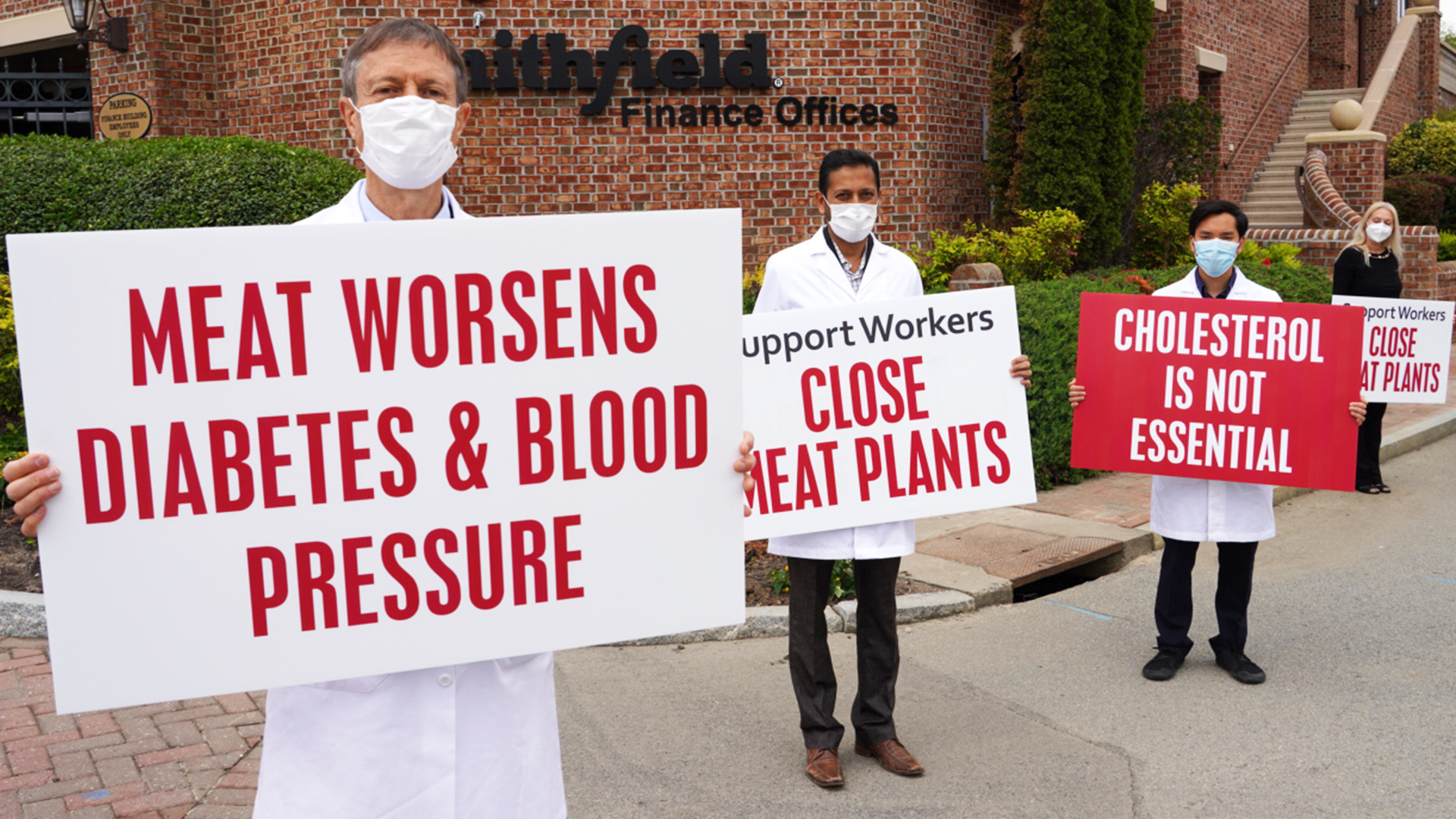
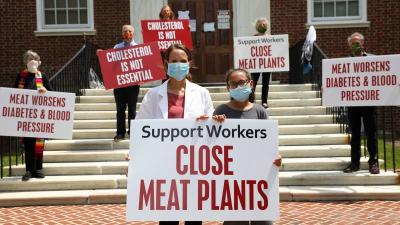
SMITHFIELD, Va.—Doctors with the Physicians Committee for Responsible Medicine called for the closure of meatpacking plants during a demonstration on May 14. The doctors will held signs reading “Support Workers, Close Meat Plants,” “Meat Worsens Diabetes & Blood Pressure,” and “Cholesterol Is Not Essential.” They maintained social distance while protesting outside of Smithfield Foods Headquarters, 200 Commerce Street, Smithfield, VA 23430, at the corner of Commerce Street and Luter Drive.
“Keeping Smithfield plants open harms the health of workers, the surrounding community, and consumers—all to line the pockets of the meat industry,” says Neal Barnard, MD, FACC, president and co-founder of the Physicians Committee for Responsible Medicine.
More than 15,500 meat plant workers are infected with COVID-19, and at least 60 have died. With workers lined up in close proximity, viruses are easily spread within the slaughterhouse environment. Although studies show that infectious viruses easily survive during refrigeration and freezing, meat companies do not routinely test the extent to which meat products are contaminated with the virus.
Meat consumption raises the risk for many of the underlying medical conditions—diabetes, hypertension, obesity, and chronic obstructive pulmonary disease—that can make COVID-19 infections more deadly. A recent study found that regular consumption of processed meat, red meat, or poultry increases the risk for cardiovascular disease. Research also links red meat, poultry, and fish to an increased risk for diabetes.
Founded in 1985, the Physicians Committee for Responsible Medicine is a nonprofit organization that promotes preventive medicine, conducts clinical research, and encourages higher standards for ethics and effectiveness in education and research.
For Immediate Release:
May 14, 2020
Contact:
Megan Wiltsie 202-483-7382
Norfolk, Va. – Swine flu, bird flu, SARS, and now COVID-19 have all been linked to confining animals for consumption—but that point is often missed in conversations about preventing future pandemics. To put animals on the table, in the right way, PETA has hit The Washington Post, the Los Angeles Times, The New York Times, The Boston Globe, and other major dailies with full-page ads that urge people to think about the filth and cruelty inside factory farms and slaughterhouses—and consider being part of the solution by going vegan. Copies of the ads are available here.
“No one needs meat,” the ads underscore. “Eat as if everyone’s life depends on it, because it does.”
“From swine flu to SARS to COVID-19, it’s as clear as the gloved hand in front of your masked face that eating animals is killing us,” says PETA President Ingrid Newkirk. “PETA’s ads directly tell the public that it’s about more than social distancing and hand sanitizer—it’s about what, or who, we’re putting on our plates.”
The Hill, the Washington Examiner, The San Diego Union-Tribune, and The Seattle Times also ran PETA’s ads, and others are pending approval. The New York Times and the Chicago Tribune rejected a version that ran in the Los Angeles Times. Other papers that rejected PETA’s ads include the Toronto Star, the National Review, and the New York Post.
To help everyone go vegan, PETA is offering free vegan starter kits, its one-on-one Vegan Mentor Program, and a list of vegan-friendly restaurant chains, many of which are still offering takeout during the pandemic, among other resources.
PETA—whose motto reads, in part, that “animals are not ours to eat”—opposes speciesism, which is a human-supremacist worldview. For more information, please visit PETA.org.

https://futuretv.in/plant-based-meat-is-a-trend-investors-should-not-ignore/
CNBC’s Jim Cramer said Wednesday that investors cannot ignore the rising popularity of plant-based meat products.
“This movement is happening. You’ve got to get on the bus or … get left behind,” Cramer said on “Squawk on the Street.”
Cramer acknowledged there are not huge sales just yet for a company like Beyond Meat, which after-the-bell Tuesday reported quarterly revenue of $97.1 million, a 141% increase from a year ago.
“It starts like this. It doesn’t begin with a billion dollars. This is not blockbuster drug, but watch this trend,” Cramer said. “I think it’s very exciting for investors.”
Shares of Beyond Meat were up about 17% on Wednesday morning to around $118 each.
Beyond Meat, at a $7.2 billion market value, has been at times one of Wall Street’s hottest stocks but also one of the most volatile since its May 2019 initial public offering. Priced at $25 per share, the stock saw a meteoric rise to nearly $240 by last July. But come December, it had lost about 70% of its value. In the early part of this year, the stock rebounded before falling off a cliff, bottoming at about $48 in mid-March. Since then, the stock has more than doubled.
On Tuesday evening, in addition to strong revenue, Beyond Meat posted quarterly net income of $1.8 million, up from a net loss of more than $6 million last year. It did warn of a hit to its restaurant business due to the coronavirus pandemic.
However, the “Mad Money” host said he believes the plant-based meat industry may ultimately be beneficiaries of the Covid-19 crisis.
Meatpacking plants across the U.S. have seen significant virus outbreaks, forcing some to slow down production or temporarily close as workers became sick. The developments ignited concerns about the country’s food supply, although President Donald Trump signed an executive order last week requiring the plants to remain open during the coronavirus pandemic.
“I think there are people who are getting appalled by what’s happened at the meat packers. … I think these stories make you become not necessarily vegetarian but to think twice about beef,” Cramer said. “If you think twice about beef and then you try to Beyond, you kind of realize it’s very, very similar.”
While plant-based meat options have typically been more expensive than traditional meat, Cramer said the rising costs of beef, in particular, due to the coronavirus represents an opportunity for alternative producers.
One of Beyond Meat’s chief rivals in the plant-based meat category, Impossible Foods, is not publicly traded. But it is widely available as well. Grocery store chain Kroger also has launched private-label beef options.
Cramer noted that food giant such as Nestle have entered the plant-based burger market. He said the plant-based meat industry is “a really important ethos, not a hobby.”
New York (CNN Business)Warnings of potential meat shortages in the United States because of food processing closures have led to a boom for Beyond Meat’s stock. New deals to sell plant-based food in China are helping too.