November welcomes World Vegan Month, and with it comes a new perspective on a lifestyle that holds individuals accountable for what they eat.
Vegans have to dodge relentless stereotypes — but these people are not the grass-eating hippies many make them out to be. Veganism promotes a healthier and sustainable lifestyle that seeks to eliminate a dependency on animals, and instead supplement meat with plant-based protein. This protein comes in many forms, such as fruits, vegetables, beans and nuts.
While this may seem extreme to some, vegan products have expanded greatly to fit the need of the market. Milk, meat and cheese substitutes are found on grocery store shelves everywhere, and vegetarians and vegan consumers are able to find food sections dedicated to fit their needs.
Five percent of Americans identify as vegetarians and about half of these individuals follow a vegan-based diet, according to most recent data published by The Vegetarian Resource Group.
+2
Piles of vegetables were cooked for the after cook-off festivities on Wednesday, June 26, 2013 in Athens, Ga. (Photo/Erin O. Smith, eosmit8@uga.edu)
Erin O. Smith
Though many vegans adopt their eating habits to enjoy a diet that is free from guilt in regards to animals, it is not the only reason to quit frequenting Chick-Fil-A and the like.
The desire to go vegan can stem from a number of reasons — including wanting to become healthier and more energized, lessening one’s carbon footprint and also eliminating one’s part in the tons of crops and water it takes to raise farm animals, according to PETA.
Vegan or not-vegan, the decision to cut out animals from a diet raises important questions about the apparent disconnect between humans and the food on their dinner plate. Before we pull into the drive through of the nearest fast food joint, we don’t stop to think about how the meat we are about to consume was produced, and whether there was malpractice involved.
Overwhelmingly, 79 percent of American consumers believe producing healthy choices is important for farmers and ranchers to consider when planning their production practices, yet 72 percent of consumers know nothing or very little about farming or ranching, according to research conducted by the U.S. Farmers and Ranchers Alliance.
With a nation uninformed, fast-food industries and major corporate chains are able to get away with mass producing meat products while cutting corners. Seventy percent of all antibiotics important to human medicine in the United States are sold for use in animal agriculture, according to a report by Friends of the Earth, an environmental and consumer advocacy organization.
These drugs are used unnaturally to stimulate growth in animals, fed routinely and misused to stimulate an industry that overlooks the process of how a chicken sandwich became a chicken sandwich. The money we spend on a lunch break doesn’t just feed us, it feeds an industry of neglect.
The same fast food restaurants frequented by the masses are receiving failing grades on their use of antibiotic policies, according to the same report by Friends of the Earth. Olive Garden, Starbucks, Chilis and Burger King are just a few on a long list of companies that are less than transparent about how they feed their customers — receiving an F on the 2016 scorecard by FOE.
+2
According to Mother Earth Living, this fabulous herb has been spicing up our lives for centuries, but did you know that basil can be used to treat arthritis thanks to its anti-inflammatory properties? Basil is also proven to help slow the process of aging and contains a vast array of antioxidants. For non-vegetable lovers, basil can be added to any soup, salad or pasta dish.
Courtesy commons.wikimedia.org
While these facts are alarming, and prove the overwhelming detachment between consumers and their meals, it does not mean that one has to jump on the vegan bandwagon to take a stand. Companies like FOE enact several petitions towards companies that engage in this malpractice in order to spread the word, and encourage many to be apart of the movement.
NPR also lists a number of apps available to consumers that provide information on food and products that are produced through sustainable practices.
While veganism is not for everyone, it sheds a light on how we see our food, and quite frankly — what we don’t see.
Next time someone hands you a flyer in tate that advocates for Meatless Mondays, think twice before throwing it away. Do research on the companies you frequent and become informed about better choices, because until we do, it is those without a voice that bear the burden.
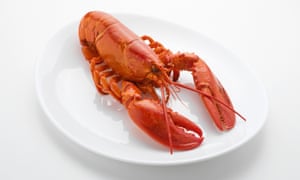
‘Lobsters have a long childhood, an awkward adolescence and feel pain.’ Photograph: Getty Images/Image Source
Michele Hanson
Monday 12 September 2016
Iwas in the local fish shop buying my dinner when another customer in front held up two live lobsters that he had just bought. He needed some advice about what to do with them. “I’m going to boil one today,” said he, “but how long can I keep the other before I boil it? Will it last two days?”
There were the poor lobsters, held aloft, waving their arms about in a frenzy. Did they know what awaited them? Horrible. I suddenly remembered those Buddhist monks who saved hundreds of lobsters in July – bought them, carefully untied their claws and set them free again. They probably knew that lobsters “have a long childhood and awkward adolescence” and feel pain. So that cheered me up a bit – not all humans are greedy, heartless bastards. But it means no more lobsters for me, and perhaps I should cut out fish, too, and be a proper vegetarian. Or even a vegan, because once you start on this road, there’s no way back.
And it’s difficult, because I was brought up eating meat. Lovely tasty stews, roast dinners, bacon for breakfast, and shellfish. My mother cooked it all, in defiance of Jewish dietary laws and her own ferociously kosher mother. But those were more innocent and ignorant times, when we didn’t know about how dairy cows suffer, or eat such gigantic chunks of everything; when there was no Twitter, Facebook and endless campaigns against eating, boiling and torturing dogs, pigs and more or less anything that moved, and we just thought animals wandered freely around fields or spacious pens and didn’t miss their children, or mind being slaughtered, or feel anything much. And we didn’t yet know that the planet was almost totally buggered.
“This is a middle-class activity,” says Fielding harshly. “And remember, you live in Islington. People will mock.” Who cares? I’m not claiming to be saintly. I have lapses; I eat Olivia’s heavenly roast chicken, pretending to myself that I’m just being polite. Daughter’s making more effort than me, often turning to tofu. Perhaps the next generation will do better than us, and save the world. If they still have time.
Veganism is all about reducing the harm we cause to sentient beings to the best of our ability. This is why we don’t eat animal products. It’s impossible to take the body part or secretion of a living being without exploitation and pain.
Or is it? If meat and other animal products could be made without harming animals, would there finally be such a thing as vegan meat? [tweet this] When it comes to lab grown meat, there are vegans on both sides of the debate. With the potential for massive reductions in the environmental impact of animal agriculture and an end to the suffering and death of trillions of animals every year, why wouldn’t every vegan be championing the cause for test tube meat?
Well like most topics I set out to cover, cultured meat production is far more complicated than it may first appear. We’re going to cover some of the pros and cons of cellular agriculture and why it’s a hot button within the vegan community.
As always, I’ll be barely scratching the surface, so you can dig into the citations and resources at the base of this post for more information.
The concept of growing and maintaining muscle outside of the body is not new. Starting in 1912, biologist Alexis Carrel kept cells from an embryonic chicken heart beating in a nutrient bath in his laboratory for more than 20 years.[1] In 1931, Winston Churchill wrote in a predictive essay optimistically entitled Fifty Years Hence that, “We shall escape the absurdity of growing a whole chicken in order to eat the breast or wing, by growing these parts separately under a suitable medium.”[2]
Over the decades from NASA-backed fish fillets made of goldfish cells[3][4] to the 2013 taste test of the first lab-grown burger,[5][6] the cultured meat, well, culture, continues to grow. [See a brief but thorough timeline in the ‘In-Vitro Meat” section of this essay][7]
The advantages of this method of meat creation are obvious. Despite the efforts, hopes and dreams of vegans and activists alike, the global demand for meat is on the rise with India and China leading the charge.[8][9]
A 2011 study concluded that, “cultured meat involves approximately 7–45% lower energy use … 78–96% lower GHG emissions, 99% lower land use, and 82–96% lower water use depending on the product compared.”[30] While these numbers sound promising, the study was largely criticized for basing its numbers on a not-yet-proven method of cultured meat growth.
While still theoretical, a 2014 study accounting for other potential production methods found that energy use for cultured meat actually exceeded current levels for beef production, but had significantly lower greenhouse gas emissions and land usage and was only higher than poultry in water usage.[31]
The reality is that the actual environmental impact of cultured meat remains unknown because it’s still in such an experimental phase. The ground meat grown for 2013’s seminal burger was a relatively simple creation of pure protein. It lacked any of the fat and blood that give meat its flavor or the firmness of once-active muscle tissue. In order to create meat products of more substance, the muscle, which is what meat is after all, has to be exercised and provided with artificial blood flow, oxygen, digestion and nutrition. [32][33][34][35] Some scientists speculate that this increased energy demand may negate any reduction in land usage and agricultural input. [36][37]
Basically, when it comes to the environmental benefits, it’s still too early to know.
Here is where cultured meat has the potential to shine.
Maybe. Eventually.
There are several significant hurdles to overcome before lab-grown meat can be called anything near “cruelty and animal-free.” The major issues on the ethics end are establishing self-renewing stem cells and finding plant-based materials for the growth medium and scaffolding.
To understand what that means, I’ll give a very simplified version of in-vitro meat production. Initially, cells are taken via biopsy from a living animal and deposited into a growth medium where they proliferate and grow. Eventually, in order to produce meat products with more structure than the ground patty, they will need a form of scaffolding to hold their shape.
The first ethical issues arise when considering the long-term viability of the initial harvested cells. Professor Mark Post, the man behind the famous taste-tested burger, has said that, “the most efficient way of taking the process forward would still involve slaughter,” with a “limited herd of donor animals” kept for stock.[38] Others in the movement envision the establishment of a self-renewing stem cell line, meaning only an initial biopsy would be required at which point the cell line would replicate indefinitely.[39][40][41]
Yet another concern is that, given humanity’s love of the new, different and exotic, we may start breeding specialty animals for cell harvesting, which would still require the confinement and reproductive control of sentient beings.[42]
As a side-note, Post’s famous burger was made with egg powder to enhance the taste, introducing another level of animal suffering.[43] This is by no means, however, a necessary practice.
The second major ethical issue and one that isn’t widely addressed in most of the news reports on cultured meat, is the growth medium into which the cells are deposited. At the moment, the most widely used medium is bovine fetal serum. Fetal serum from an array of animals is commonly employed in a wide range of experiments, including those for tampons, which I covered in my “Are Tampons Vegan?” video.
The harvesting of bovine fetal serum is far from transparent. One study reached out to 388 harvesting entities with only 4% responding with any kind of methodology data. Five sources explicitly declared their harvesting methods to be confidential.[44]
Of those that did respond, the typical procedure for fetal serum harvesting was “by cardiac puncture” meaning a needle directly into the beating heart of the fetal cow. They specify that, “Fetuses should be at least 3 months old; otherwise the heart is too small for puncture.” The general process is as follows:
“At the time of slaughter, the cow is found to be pregnant during evisceration (removal of the internal organs in the thorax and abdomen during processing of the slaughtered cow) … The calf is removed quickly from the uterus [and] a cardiac puncture is performed by inserting a needle between the ribs directly into the heart of the unanaesthesised fetus and blood is extracted.” This bleeding process can take up to 35 minutes to complete while the calf remains alive. Afterwards, “the fetus is processed for animal feed and extraction of specific substances like fats and proteins, among other things.”[45]
The study continued with a detailed debate as to whether the fetal cows can feel this procedure and their possible slow death from anoxia, meaning lack of oxygen, from placental separation, and estimated that between 1 and 2 million fetuses are harvested annually for serum.[46]
All in all, fetal serum from any animal is not, by any stretch of the imagination, cruelty-free. The good news is that the champions of the cultured meat movement seem to be invested in finding plant-based medium alternatives with both algae and mushrooms providing promising options.[47][48][49][50][51] Fetal serum’s drawbacks don’t stop at the ethical line. There are scientific concerns as batches vary considerably in their composition. It also poses the threat of pathogen introduction, is not environmentally friendly and is cost-prohibitive. Dr. Neil Stephens of Cardiff University states that: “Everyone in the field acknowledges this as a problem … It currently undermines a lot of the arguments that people put forward in support of in vitro meat.”[52]
This leads into two of the additional pros of cultured meat, both revolving around human health. Though I personally believe that health is the last worry when it comes to producing a possible alternative to mass animal slaughter, it’s worth noting that the composition of cultured meat can be altered to provide superior nutritional benefits. The level of fat and type of fat can be selectively controlled. The threat of food contamination and spread of pathogens would also be greatly reduced, as cultured meat would not involve all the biohazards of traditional slaughter.[53][54][55]
So if scientists are able to create a self-replicating cell line, thus eliminating the enslavement and potential slaughter of animals, and find a suitable plant-based growth-medium and scaffolding, thus eliminating the cruelty of fetal serum and other animal byproducts, what objections remain against going after this concept in full force?
Two of the largest are cost and what’s best described as “the ick factor.” Surveys involving every range of dietary practice seem to indicate that the majority of people are put off by the concept of lab-grown meat.[56][57][58][59][60] Interestingly enough, those people with the highest rates of meat consumption appear to be the most sensitive to disgust.[61]
Of course cultured meat proponents emphasize that “lab-grown” is a bit of a misnomer. While in the testing stages, the meat is grown in laboratories. However, were it to go to commercial production, it would be made in factories just like all of our packaged food items, and some could argue, would be more natural than other chemical concoctions the public readily consumes. [see[62] for an illustration of potential production methods].
Also, given what all we inject into our food animals from hormones to antibiotics, to our outright manipulation of their genes, one could ask just how natural “standard” animal products really are.
While cultured meat doesn’t require the use of GMO’s, it’s possible that genetically modifying cells may allow them to reproduce faster and thus prove more economical.[63]
Speaking of cost, Mark Post’s initial burger in 2013 cost approximately £250,000 (over $350,000) to produce.[64] However, by 2015, Post stated that the cost is now down to £8.00.[65][66]
As with any new technology, the initial cost investments will be steep, but Post and others in the movement see cultured meat eventually attaining a competitive price to traditional products, though most likely not for at least another decade.[67]
The vegan community is most dramatically torn on either side of this issue. [ See [68] for examples]Some feel that any product derived from an animal remains a form of exploitation. Others believe that with the insurmountable fight against the ongoing animal holocaust and more non-vegans being born every day, we need to search for practical and viable solutions to replace humanity’s rising demand for meat.[69] The vegans on the pro-cultured meat side I’ve come across through my research say their motivation is putting the animals’ interests above all else. They believe it’s unrealistic to expect humanity on a global scale to cease or even reduce their consumption of animals. Thus, providing an alternative that not only looks and tastes like but actually is meat could be, with the proper harvesting method and growth medium, the most immediate path to animal liberation currently available. With the concurrent rise of research into milk and egg-producing yeast and leather and other animal byproducts,[70] could it be that the laboratory and not the picket line will be the ultimate genesis of a vegan world? [tweet this]
I’d love to hear your thoughts on this hot debate in the comments below. Check out resources below for more on cultured meat and other animal-free animal products.
This video took approximately 64 hours to produce. If you’d like to help support Bite Size Vegan so I can keep putting in the long hours to bring you this educational resource, please check out the support page where you can give a one-time-donation or receive perks and rewards by joining the Nugget Army on Patreon. I’d like to give a special thanks my $50 and above patrons and my whole Patreon family for making this and all of my videos possible.
If you enjoyed this post, please give the video a thumbs up and share the post around to spark debate. You can use the share buttons at the base of this post or any of the pre-made tweetables throughout this post.
If you’re new, I’d love to have you as a subscriber. I put out fresh vegan content every Monday, Wednesday, and some Fridays.
Now go live vegan, put the animals first, and I’ll see you soon.
“Meat is horrible,” a new article in The Washington Post, highlights the negative impacts of a Western diet.
Author Rachel Premack discusses the environmental, ecological, and health reasons Americans must give up or cut back on meat. Featuring multiple graphs, her compelling argument destroys common myths and seems to support a meat tax.
Premack writes:
By 2050, scientists forecast that emissions from agriculture alone will account for how much carbon dioxide the world can use to avoid catastrophic global warming. It already accounts for one-third of emissions today — and half of that comes from livestock.
She also notes that it takes “48 times as many liters of water to produce the same amount of beef as veggies” and we could save “a collective $730 billion in health care by reducing meat consumption.”
The debate over climate change and animal agriculture’s role in it is over. We know how raising animals for food damages our planet, and it’s time world leaders took action.
In the meantime, you can help protect the planet, your health, and animals by switching to a plant-based diet.
Click here to order your FREE Vegetarian Starter Guide.
The militant cattle ranchers currently occupying Malheur National Wildlife Refuge have appealed for snacks, and PETA is answering the call with a hand-delivered package of vegan jerky that contains more protein than beef does. The PETA staffers, who will bear signs reading, “The End (of Animal Agriculture) Is Nigh: Get Out Now!” are suggesting that militia members learn to raise crops, not cows—allowing the many species of wild animals the refuge was designed to protect to thrive.
“People from all walks of life are increasingly appalled by the idea of slaughtering animals and realize, too, the harmful impact that animal agriculture has on the environment, so it’s time to face facts,” says PETA President Ingrid Newkirk. “These ranchers may have a beef with the feds, but their water use and the cattle’s production of methane mean that the world needs them to get out of the beef business.”
As PETA notes, the Worldwatch Institute estimates that animal agriculture is responsible for 51 percent of human-caused greenhouse-gas emissions and the University of Chicago determined that switching to a vegan diet is more effective in countering climate change than switching from a standard American car to a hybrid.
Meat production is one of the planet’s largest causes of environmental degradation and most significant threats to wildlife.
And the problem is rapidly getting worse: Production of beef, poultry, pork and other meat products tripled between 1980 and 2010 and will likely double again by 2050. This increasing meat consumption in a world of more than 7 billion people is taking a staggering toll on wildlife, habitat, water resources, air quality and the climate. Meanwhile, Americans eat more meat per capita than almost any other country in the world.
By signing the pledge below to reduce meat consumption by one-third or more, we can start to take extinction off our plates. Join the Center’s Earth-friendly Diet Campaign today.
Already a vegetarian? Then you’re a valuable wildlife advocate who can help others join the movement. Spread the word by taking the pledge and asking your friends to sign.
Protect wildlife — pledge today to eat an Earth-friendly diet.
We, the undersigned, pledge to take extinction off our plates by reducing the amount of meat we consume and/or telling our friends to join the Earth-friendly Diet campaign.
By cutting just one-third of the meat from our diets, we can each save as much as 340,667 gallons of water, more than 4,000 square feet of land, and the greenhouse gas equivalent of driving 2,700 fewer miles a year.
Many of our current environmental crises are either directly caused by or worsened by our culture’s dependence on meat. By meating less, we give the world and wildlife a break.
When I read the news yesterday that an analysis by the World Health Organization (WHO) concluded that red and processed meats increase the risk of cancer, my first thought was: The medical community has known this for some time.
Studies going as far back as the 1970s have shown an increased risk of colon and rectal cancers (colorectal cancers) with meat intake. In 2007, a joint international panel convened by the World Cancer Research Fund and the American Institute of Cancer Research (WCRF/AICR) evaluated hundred of studies. (1) This panel found that the evidence that red and processed meats cause colorectal cancer is “convincing,” the highest rank of association. This was damning evidence in 2007. The question isn’t whether or not the WHO is right. The question is why did it take more than eight years for the WHO to make its announcement?
In our current hyper-polarized atmosphere with a never ending stream of competing talking-heads, the reaction to WHO’s finding has, not surprisingly, been mixed. Many researchers have argued that the evidence is not conclusive and the risk of colorectal cancer from eating meat is not nearly as strong as the risk of lung cancer from smoking. These statements are correct to some degree.
But that argument misses a vital point: the evidence between meat and colorectal cancer might not be as strong in part because the wrong studies were evaluated in the first place.
It appears that the major category of studies that the WHO panel assessed mostly investigated the risk of cancer among people who ate more red meat compared with people who ate less red meat, but still consumed other animal products. The second group of studies they investigated were largely animal experiments. Here are the problems with these studies:
First, the human studies largely relied on the participants to report how much meat they consumed. People are notoriously poor at reporting this type of information. Participants in such studies either cannot accurately recall or quantify their consumption habits or they misreport due to an unconscious or conscious effort to make their diets appear healthier than they actually are.
Second, and more importantly, the human studies mostly assessed degrees of meat intake of all kinds. One of the main reasons why the evidence for the risk of lung cancer among smokers was so strong is that in so many studies, the comparison groups were non-smokers. So the contrast was more black and white: smokers versus non-smokers. And, study participants can much more accurately state whether they smoked or didn’t smoke, rather than attempt to quantify their degree of smoking.
Using comparison groups that starkly contrast in the one factor that is being investigated can help clarify the evidence and strengthen it (you want the groups to be as similar as possible in all other respects). Cancer is complicated and we know so little about how it develops. Foods that cause one type of cancer may play a role in promoting other types of cancers as well. Studies have routinely suggested that any animal product — red meat, processed meat, chicken, and dairy — increases the risk of certain forms of cancer.
Thus, comparing groups of people who all ate animal products complicates factors. If the WHO panel solely assessed the studies that compared people who ate red meat versus people who ate no animal products at all, the evidence for the risk of cancer among meat eaters would likely be much stronger.
Third, animal experimentation can give you any result you want. You want to prove meat causes cancer? Animal experiments can show you that. You want to prove that meat does not cause cancer? Well, animal experiments can show you that, too.
Animal experiments can easily be manipulated and, as I have mentioned in previous posts, animal experiments are extremely poor at predicting human findings. The WCRF/AICR report recognized this and stated that the limitations of the animal experiments are “their artificiality and the fact that no effect on rodents, however unequivocal, can be assumed to apply to humans.”
Cancers take a long time to develop, usually decades. While humans have been eating meat for centuries, we are now living longer and that allows more time for cancer to manifest. So the result of our meat-heavy diets is finally emerging: cancers. Diets largely based on plant foods are not only less risky in terms of cancer development, but they are actually protective. They protect us from developing cancer.
The WCRF/AICR report stated that the majority of cancers are not inherited, but are caused by changes and damage to our DNA. Plant foods not only help prevent damage to our DNA, they actually promote DNA repair. The report stated:
An integrated approach to the evidence shows that most diets that are protective against cancer are mainly made up from foods of plant origin.
Unsurprisingly, one of the WCRF/AICR report’s main recommendations is to consume a diet of mostly plant-based foods to reduce the risk of many forms of cancer. While every type of study conducted will have it’s limitations, there is sufficient evidence to suggest that plant-based diets are the healthiest overall.
Given all that we don’t know about cancer, we should pay close attention to what we do know: MEAT CAUSES CANCER
References:
1. World Cancer Research Fund / American Institute for Cancer Research.Food, Nutrition, Physical Activity, and the Prevention of Cancer: a Global Perspective. Washington DC: AICR, 2007
…and from the Onion: Experts: Bacon, Hot Dogs Can Cause Cancer
According to the World Health Organization, there is sufficient evidence to link processed red meats to the development of colorectal cancer, which means foods such as hot dogs and bacon will be added to the WHO’s list of known carcinogens. What do you think?






 Exposing the Big Game


