Why beef is the new SUV

The word sickening just dropped out of my mouth, involuntarily…Then I puked!

http://www.cnn.com/2015/09/29/opinions/sutter-beef-suv-cliamte-two-degrees/index.html

CNN columnist John D. Sutter is reporting on a tiny number — 2 degrees — that may have a huge effect on the future. He’d like your help. Subscribe to the “2 degrees” newsletter or follow him on Facebook, Twitter and Instagram. He’s jdsutter on Snapchat.

Lexington, Texas (CNN)This is the story of a giant pile of beef.

Well, 1.27 pounds (0.58 kilos) of brisket, to be exact.

But before I get into the business of explaining where this meat came from, and why eating this stuff has a massive, unexpected effect on climate change, I feel the need to confess something: That huge slab of brisket, which came to me by way of Snow’s BBQ, a delightful shack of a place out here in the heart of Texas beef country, easily was one of the most food-orgasm-y things I’ve tasted.

The phrase “OHMYGOD” dropped out of my mouth, involuntarily.

And I don’t eat much meat.

A colleague of mine had a better line.

“I mean, f— Al Gore, right?”

I write about climate change for a living and appreciate what the former U.S. vice president has done (or has tried to do, in his own wooden way) to raise awareness about what I consider to be one of the most critical issues facing the planet and people. But, in that moment, I had to laugh and agree with my co-worker.

Forget the climate.

This stuff was too good

Daniel Vaughn, BBQ editor at Texas Monthly, and the No.1 carnivore I know — this is a man who has developed white bumps on his tongue, apparently from failing to eat nonmeat food groups — helped me dissect the meal. Note the salt-and-pepper “bark” at the edge of the meat, the red tree rings where the smoke that cooks the beef, slowly, overnight, has left its artistic mark. The cloudlike strips of beef were so tender locals insist you peel them apart with your fingers, not a fork and knife.

Knowing the beef’s backstory only adds to the experience.

The barbecue “pitmaster” at Snow’s is 80-year-old Norma Frances Tomanetz. White hair, red apron. Everyone calls her “Tootsie.” Tootsie’s shift starts at 9 p.m. and ends the next day after about 600 pounds of beef have been served. Her recipe is simple: salt and pepper. And, in addition to working here — again, at age 80 — she also serves as a middle-school custodian, helps manage a cattle ranch and takes care of two sick family members. (They could use your prayers, by the way.)

Texas beef people are lovably tough.

You want to root for them.

But there’s “an inconvenient truth” about beef consumption, too, as I would discover on a trip through the supply chain of that meal: Beef is awful for the climate.

Don’t blame me alone for bearing the bad news. In a Facebook poll, thousands of you overwhelmingly voted for me to report on meat’s contribution to climate change as part of CNN’s Two° series. You commissioned this highly personal topic over more widely feared climate change bad guys such as coal, deforestation and car pollution.

Cattle and climate?

They’re not often used in the same sentence.

But eating beef, as I’ll explain, has come to be seen, rightly, in certain enviro circles, as the new SUV — a hopelessly selfish, American indulgence; a middle finger to the planet. It’s not the main driver of global warming — that’s burning fossil fuels for electricity, heat and transportation — but it does contribute significantly.

Globally, 14.5% of all greenhouse gas pollution can be attributed to livestock, according to the U.N. Food and Agriculture Organization, the most reputable authority on this topic. And a huge hunk of the livestock industry’s role — 65% — comes from raising beef and dairy cattle.

Take a look at how beef compares with other foods.

The world is faced with the herculean task of trying to limit warming to 2 degrees Celsius, measured as an increase of global temperature since the start of the Industrial Revolution, when humans began burning fossil fuels. That’s the point at which climate change is expected to get especially dangerous, leading to megadroughts, mass extinctions and a sea-level rise that could wipe low-lying countries off the map. That one little number — 2 degrees — is the subject of international negotiations in December in Paris, which are critical if we’re to avert catastrophe.

We’ve already warmed the atmosphere 0.8 degrees Celsius since the Industrial Revolution; and the World Bank says we’re locked in to at least 1.5 degrees Celsius of warming based on the pollution we’ve already put into the atmosphere.

It will be hard to meet the 2-degree goal no matter what; it will be impossible if livestock pollution isn’t part of the mix, said Doug Boucher, a PhD ecologist and evolutionary biologist who is director of climate research and analysis at the Union of Concerned Scientists.

“We can’t hit that goal without it,” he told me.

In Texas, as in most places, however, no one seems too worried.

“Everybody here in Central Texas goes for beef,” Tomanetz told me. “People are gonna eat what they wanna eat — what their appetites call for.”

Any vegetarians around?

None she’s knows, personally.

“They won’t eat their beef,” she said with a grin, “so somebody else will.”

70-mile meal

It wasn’t long before I wished somebody else had.

The night after I ate at Snow’s, it felt like a grapefruit was trying to climb out of my esophagus. I ate 0.61 pounds of the beef I was served, leaving 0.66 pounds of the stuff on my tray. I gave the leftovers to a guy at the hotel desk because I couldn’t stand to look at it anymore. I felt so crazy-uncomfortable, so full.

The next morning, over a decidedly small, vegetarian breakfast, I calculated the climate change pollution associated with my massive meal. I did so with the help of data from the U.S. Environmental Protection Agency and from Anne Mottet, livestock policy officer at the FAO.

Result: Nearly 29 kilograms of CO2-equivalent gases.

O'Brien Meats in Taylor, Texas, supplies high-quality beef to Snow's BBQ.

<img alt=”O'Brien Meats in Taylor, Texas, supplies high-quality beef to Snow's BBQ.” class=”media__image” src=”http://i2.cdn.turner.com/cnnnext/dam/assets/150924120934-03-two-degrees-beef-large-169.jpg”>

From the atmosphere’s perspective, that’s about the same as burning enough fuel to drive an average American car 70 miles, or 113 kilometers.

A 70-mile meal.*

That’s San Antonio to Austin, Texas.

Granted, this is a beyond-ridiculously-oversized portion of meat. And, depending on how you calculate beef’s climate footprint (Mottet, from the FAO, provided me with her organization’s estimate for beef cattle raised in feedlots in North America), you could arrive at very different results.

Regardless of the exact mileage, however, this is illustrative of an indisputable fact: Beef contributes to climate change in a substantial and outsize way.

More: http://www.cnn.com/2015/09/29/opinions/sutter-beef-suv-cliamte-two-degrees/index.html


Petition for a California Water “Meat, Dairy and Eggs Tax”

264431_455824994498980_1177070538_n

http://petitions.moveon.org/sign/california-water-meat.fb51?source=s.icn.fb&r_by=13178783

California Water “Meat, Dairy and Eggs Tax” (fee)

To be delivered to The California State House, The California State Senate, and Governor Jerry Brown

Petition Statement

Due to the California Water Crisis it is time for a California Water “Meat, Dairy and Eggs Tax” (fee) to be established at time of purchase.

There are currently 304 signatures. NEW goal – We need 400 signatures!

Petition Background

This is a proposal for a ‘Water Consumption Tax’ when purchasing meat, dairy and eggs. A person consuming meat, dairy and eggs is responsible for massive amounts of water usage for the production of the animal products, far more than a person living a plant based lifestyle. In some cities, households are limited to only 50 gallons of water usage per person a day and fined if they exceed that amount. The same should apply to omnivores who eat animal products without consequence for the water crisis. The standard diet of a person in the United States requires 4,200 gallons of water per day (for animals’ drinking water, irrigation of crops, processing, washing, cooking, etc.). A person on a vegan diet requires only 300 gallons a day. It takes approximately 660 gallons of water to produce one quarter pound hamburger patty. At those numbers, it takes 2640 gallons of water to produce one pound of beef. Using that estimate it would take 6,600,000 gallons of water to produce one ton of beef; which would be equivalent to filling a 40 gallon bathtub 165,000 times. It is time for people who are consuming animal products to pull their own weight and to start being responsible for their impact to California’s water crisis.

Petition: http://petitions.moveon.org/sign/california-water-meat.fb51?source=s.icn.fb&r_by=13178783

Sneak preview of new documentary from creators of “Forks Over Knives”

T. Colin Campbell PhD, co-author of the extraordinary China Study, and his son Nelson Campbell, are hosting a sneak preview of the new documentary “PlantPure Nation.” They are on a multi-city tour before the movie premieres in July.  “PlantPure Nation” was written and produced by the same team that made the acclaimed documentary “Forks Over Knives.”

“PlantPure Nation” sneak preview
Tuesday, June 2
7:00 PM – 9:00 PM
Regal Meridian 16 movie theater
501 7th Ave, Seattle, WA  98101
Here is a link to the website with a 2-minute short about the movie:

Morrissey’s open letter to Al Gore and Live Earth

http://www.gigwise.com/news/100119/read-morrisseys-open-letter-to-al-gore-and-live-earth

He demands that no meat be served at this year’s Live Earth festival

29th April 2015 by Rebecca Schiller

Morrissey has written an open letter to Al Gore and Live Earth co-founder Kevin Wall, demanding that they do not serve meat at this year’s Live Earth event.

“Serving meat and dairy products at an event to combat climate change is like selling pistols at a gun-control rally,” he wrote in the letter, which was published via Rolling Stone. “Your responsibility is to alert people to a crisis, not sell out to the vendors responsible for it.”

“Since you can’t miss the fact that meat consumption is killing the planet-your own sponsor organization, the United Nations, states this-and since venues can and will cater vegan food for events, if you choose to serve animal flesh at Live Earth, you’ll be making a mockery of the very concept of the event, in which case it should be renamed ‘Dead Earth: We Contributed!’”, he continued.

Morrissey is no stranger to voicing his contempt for venues that serve meat. Most recently, he canceled a show in Iceland because the venue refused to go vegetarian for the evening. He was meant to perform at Harpa Concert Hall in Reykjavik, but said of the cancellation: “I love Iceland and I have waited a long time to return, but I shall leave the Harpa Concert Hall to their cannibalistic flesh-eating bloodlust … ”

You can read Morrissey’s full letter to Al Gore and Kevin Wall below:

Dear Mr. Gore and Mr. Wall,

I am writing to ask you to do the one thing that will do the most good for the planet and the majority of its inhabitants: not serve meat or dairy products at Live Earth 2015. I don’t mean offering a vegan option-I mean not serving animal products at all. Otherwise, the event will make no sense-it’ll be “greenwashing.” Serving meat and dairy products at an event to combat climate change is like selling pistols at a gun-control rally. Your responsibility is to alert people to a crisis, not sell out to the vendors responsible for it.

Not only is it possible for venues to provide a 100 percent meat-free menu-as is done now at every concert venue in which I perform, including Madison Square Garden, where I have a show at the end of June-it’s also a moral duty.

We already know that raising animals for food is a leading cause of climate change and that moving toward a vegan diet is necessary to combat climate change’s worst effects. Animal agriculture severely affects the world’s freshwater supply and is a major contributor to global greenhouse-gas emissions, deforestation, loss of biodiversity, and air and water pollution, among many other harmful effects.

Since you can’t miss the fact that meat consumption is killing the planet-your own sponsor organization, the United Nations, states this-and since venues can and will cater vegan food for events, if you choose to serve animal flesh at Live Earth, you’ll be making a mockery of the very concept of the event, in which case it should be renamed “Dead Earth: We Contributed!”

Don’t be a denier of the causes of climate change. You know the facts. Make the right choice.

Sincerely, Morrissey

Morrissey wrote the above letter on behalf of PETA, who have previously requested that Gore and Wall serve only vegan food at Live Earth. “Live Earth can’t be a leader in fighting climate change if it betrays its own values by failing to offer only vegan food at everything associated with this event,” PETA President Ingrid E. Newkirk said in a statement. “Animal agriculture is as toxic to the soil, water, and air as it is to animals’ and humans’ health. PETA is encouraging organizers to practice what Live Earth preaches by leaving animals off their menu.”

Rolling Stone reports that Live Earth representatives did not immediately respond for a request for comment regarding the open letter.

10405311_308608659330466_3235603653435958062_n

Jane Goodall: “We’re Destroying the Planet”

Jane Goodall: “We’re Destroying the Planet”

April 21, 2015 by

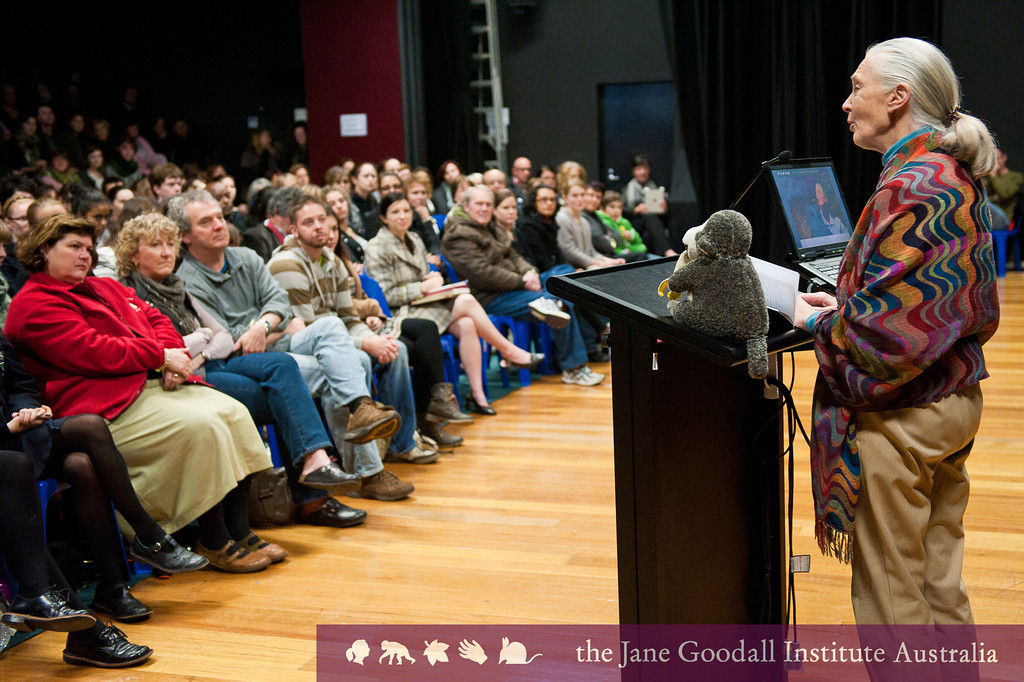
On the topic of our planet’s future, Jane Goodall, the legendary chimpanzee researcher, does not mince words: “How is it possible that the most intellectual creature that has ever walked on planet earth is destroying its only home?” Dr. Goodall, who is 81, spends 300 days year traveling the world in an effort to save it. The biggest problem, she says, is climate change. And the biggest culprit? Animal agriculture.

Jane-Goodall

In a lecture to hundreds of fans in NYC on April 15th, Dr. Goodall explained that agribusinesses are clearing rainforests in the Amazon to graze cattle and grow crops to feed them. Without rainforests – the “lungs of the earth” – the planet’s ability to convert carbon dioxide (CO2), a greenhouse gas, into oxygen is compromised.

Clearing Amazon rainforest for cattle grazing (photo: Universal Images Group/Getty Images)

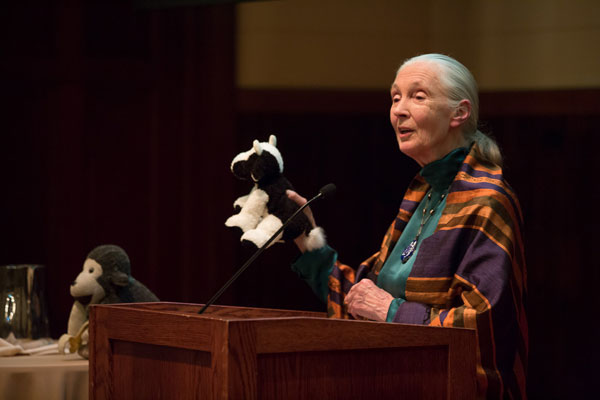
Even more harmful than CO2, Goodall said, is the methane gas emitted in cow farts. As developing countries adopt Western diets heavy in animal protein, more methane and CO2 are released into the atmosphere, further warming the planet and jeopardizing our ability to inhabit it.

Jane Goodall uses a stuffed cow to point out that methane gas is emitted in cow farts.

During her talk, Dr. Goodall described some of the other destructive effects of animal agriculture, including land and water pollution, antibiotic resistance, depletion of fresh water resources and animal cruelty, which is was motivated her to go veg. In a recent interview with the Toronto Globe & Mail, she said, “I became a vegetarian because of the horrendous suffering on factory farms and in abattoirs.”

Jane Goodall paints a grim picture of the state of the planet, but she is hopeful that humans will work together to save ourselves from ourselves. And she offers some advice that each of us can put into action today:

  • Go vegetarian.
  • Consume less. The more we buy, she argues, the more natural resources we extract from the planet. How much stuff do we really need?
  • Improve the environment in our own communities. Goodall’s Roots & Shoots program, which has chapters in 130 countries, is helping people plant trees, clean rivers and perform other community services in their own backyards.

Roots & Shoots has chapters in 130 countries

At the end of her presentation, Dr. Goodall showed a video of a newly-released captive chimpanzee hugging her when she emerged from her crate and realized she was home in the jungle. Goodall uses this remarkable event to point out that, as intelligent as chimps are, their brains are far less powerful than those of humans. And she left the audience with a challenge — to harness the brainpower that we’ve used to damage the planet to save it.

The Modern Savage: A New Book Questions Why We Eat Animals

https://www.psychologytoday.com/blog/animal-emotions/201504/the-modern-savage-new-book-questions-why-we-eat-animals

There’s a good life beyond beef and after meat

Dr. James McWilliams (link is external)‘ new book called The Modern Savage: Our Unthinking Decision to Eat Animals (link is external) is a very thoughtful work about our meal plans in which he covers the ecological and ethical reasons for not eating nonhuman animals (animals), and shows that labels such as “cage free,” “free range,” and “humanely raised” are not necessarily sound and ethical (the Kindle edition can be found here (link is external)). Furthermore, more “personal” backyard farming in which humans form close relationships with other animals who are usually named before they’re killed for food also raises deep ethical questions.

The book’s description captures what Dr. McWilliams’ book is all about: “In the last four decades, food reformers have revealed the ecological and ethical problems of eating animals raised in industrial settings, turning what was once the boutique concern of radical eco-freaks into a mainstream movement. Although animal products are often labeled ‘cage free,’ ‘free range,’ and ‘humanely raised, can we trust these goods to be safe, sound, or ethical? In The Modern Savage, renowned writer, historian, and animal advocate James McWilliams pushes back against the questionable moral standards of a largely omnivorous world and explores the ‘alternative to the alternative’–not eating domesticated animals at all. In poignant, powerful, and persuasive prose, McWilliams reveals the scope of the cruelty that takes place even on the smallest and–supposedly–most humane animal farms. In a world increasingly aware of animals’ intelligence and the range of their emotions, McWilliams advocates for the only truly moral, sustainable choice–a diet without meat, dairy, or other animal products.”

I fully understand that some people will be tempted to write off The Modern Savage as just another radical’s rant about animal rights, how people who eat other animals are “bad people,” etc. etc. However, I hope they don’t do this before reading the book because this is not what this book is all about. And, whether you agree or disagree with Dr. McWilliams’ analyses and messages, I can’t imagine that his book won’t force you to re-evaluate your values and views on the lives of other animals and perhaps discuss them with other people.

Dr. McWilliams also provides a large number of scientific references for his claims about why eating other animals are environmentally and ethically unwise choices, and I hope readers will take his message seriously and at least begin a move away from eating other animals and animal products. The last paragraph of The Modern Savage says it well: “What I’m asking you to imagine is thus a movement that requires us to become more emotionally in ntune with animals, ethically consistent in our behavior, and better informed about the evolutionary heritage we share with sentient creatures. This movement, whether we join it all at once or gradually, with immediate zeal of reluctantly, will, in the end, triumph over industrial agriculture because it will be, above all else, a bloodless revolution based on compassion for animals, the environment, and ultimately ourselves.”

Dr. McWilliams is right on the mark here and throughout his book. It’s clearly true, and solid science clearly shows, that factory farming is not sustainabile and is an utter waste of water, land, other resources, and of course, the lives of billions of animals. The award-winning documentary “Cowspiracy (link is external)” is a great source for viewing these data (link is external) objectively.

When read with an open mind, I think that The Modern Savage could be a game-changer, especially for those who have resisted making changes to their meal plans because they were unaware of the ecological and ethical issues or because they wrote them off as being sensationalist — radical — fiction. They’re not.

Marc Bekoff’s latest books are Jasper’s story: Saving moon bears (with Jill Robinson), Ignoring nature no more: The case for compassionate conservationWhy dogs hump and bees get depressed, and Rewilding our hearts: Building pathways of compassion and coexistence. The Jane effect: Celebrating Jane Goodall (edited with Dale Peterson) has recently been published. (marcbekoff.com; @MarcBekoff)

10 Animals You Should Love, Not Eat

10 Animals You Should Love, Not Eat

Most people like to think of themselves as animal lovers. We think negatively about people who say they don’t like animals. I always called myself an animal lover yet I ate animals. I wasn’t lying. I’m pretty sure that if I had to personally choose the animal that would be slaughtered for my dinner and see her killed with my own eyes, I would have opted for salad. The problem is that most of us don’t see the billions of animals that are bred, held captive and killed for our food. They are a nameless, faceless mass that are out of sight and out of mind. What happens when we stop to look and think about the animals we eat as individual beings who feel pain and joy, who love and mourn, who cherish and lose families, who die yet want to live? It might seem strange to have to convince people of reasons why any living being should be allowed to live and yet the reality is that we do. Here are just 10 of the animals we should love, not eat.

1. Cows

7-Grieve-loved-ones


Cows are gentle animals who are affectionate, emotional and intelligent. Mahatma Gandhi described a cow as “a poem of compassion.” Cows are certainly deserving of our compassion as well as our understanding and respect. Cows are very intelligent, curious, communicative, able to think critically, problem solve and have very good memories. They are highly emotional, forming friendships and close bonds. Cows have strong maternal bonds and are attentive, protective and loving parents. When a calf is taken away, the mother will cry and bellow for hours, even days, and fall into a deep depression. Mother cows will search for their babies, visibly distressed, just as the calves cry for their mother.

Cows can live up to 20 years but cows raised for meat are slaughtered when less than two years old and calves killed for veal don’t get to live more than a few months. If you think just being meat-free is enough, think again. Dairy cows are sent to slaughter when their milk production slows, usually around the age of four. There is no reason to eat cows or their body fluids when there are so many amazing vegan meats and non-dairy milks and cheeses available. Read more in 10 Things to Love about Cows.

2. Pigs

cute-pig-460x287


In the Chinese zodiac, the pig represents fortune, honesty and happiness. How appropriate for this honest, happy animal that is smart, lovable and forgiving. Scientists have determined that not only are pigs smart, they are smarter than dogs, some primates and three-year old children. They are ranked as the fourth most intelligent creature on Earth! There are some bad stereotypes out there about pigs like how they are sloppy or eat too much. None of that is true. In fact, pigs are very clean animals who can live indoors just like dogs and cats. They can be very picky eaters. They eat slowly, nibbling and savoring their food and like to eat a variety of foods. Pigs are highly social, playful and form close bonds. They are very good mothers and are anxious when separated from their babies. Pigs are compassionate, forgiving and are highly emotional beings.

However, pigs do not get to be clean, happy or raise their families. They could live 10-12 years but are slaughtered at six months old because too many people think “everything is better with bacon.” Instead, eat any of the many types of vegan bacon and learn more in 10 Phenomenal Reasons to Love Pigs.

3. Chickens

july-18-2012-killer-and-hen-sma


I used to think I couldn’t live without chicken but I learned that it is the chickens who couldn’t live with me eating them. Chickens, which are descended from dinosaurs, are amazing, intelligent and affectionate animals. Chickens are intelligent animals who can solve complex problems, understand cause and effect, and anticipate and plan for the future. Chickens dream, have great memories and complex communication systems. They are also good teachers as mother hens begin to teach calls to their babies while they are still in their eggs. Hens are loving and affectionate toward their chicks and show empathy for them as well for other hens. Mama hens also defend their babies from predators.

Sadly, there are more chickens raised and killed for food than all other animals combined. In the U.S alone, over eight billion chickens are killed each year – that’s almost 300 per second! The natural life span of a chicken can be up to 10 years but chickens bred for meat are usually killed as babies at less than two months old.  Egg-laying hens are slaughtered when they no longer lay enough eggs at around one to two years old. Read 10 Things to Love about Chickens while you enjoy some Crispy Tofu Nuggets and Chicken-Less Burgers.

4. Turkeys

11-Fun-Facts-About-Turkeys


Every year 45 million turkeys are killed in the U.S. just for Thanksgiving alone. On a holiday that is about giving thanks and being grateful, we should be celebrating life, not taking it away and that number does not include all the turkeys killed the rest of the year. Too many people think turkeys are just “dumb” birds but that is completely wrong. Turkeys are quite intelligent, good at geography and can solve problems. They are curious, inquisitive and communicate with over 20 calls. Turkeys are sensitive with good and bad moods. Turkeys are social, playful birds who have distinct personalities just like dogs and cats. The mother turkeys are protective, staying with their babies at ground-level to keep them safe and warm until they learn to fly and roost up in the trees.

Turkeys can live up to ten years, but these beautiful birds are killed when they are only a few months old. Before their deaths, they are confined to filthy, small spaced and bred to be so big, their skeletons cannot support their weight. Why not try a more compassionate option for holiday meals and eat an Unturkey Roast. Learn more about 10 Reasons to Love Turkeys and 11 Fun Facts about Turkeys you may not have known.

5. Lambs and Sheep

Lambs1


The Egyptians believed sheep were sacred and the ancient Sumerians immortalized sheep in the form of gods. In the Chinese zodiac, sheep represent righteousness, sincerity, gentleness and compassion. Sheep are intelligent, able to solve problems and almost as smart as pigs. They have good memories, recognize faces and facial expressions. Sheep are emotional and display emotions with their ears. Sheep are social and like to be in groups. Ewes are very protective and caring mothers to their lambs and form deep bonds with them. They can recognize their own lambs by the sound of their bleats.

Lambs are often taken away from their mothers, though, and used for meat, dairy, and wool. Sheep can live 12-14 years but are often killed at just 6-8 months of age. Instead of eating these adorable animals, indulge in this Vegan Irish “Lamb” Stew or this Bad Ass “Lamb” Burger and Meet the 6 Happiest Little Lambs in the World.

6. Goats

goat1


In the Chinese zodiac, goats represent creativity, shyness, introversion and perfectionism. If you’re a Capricorn, maybe you know that “capra” is the root of the word “capricious” which means quirky, whimsical, and fanciful which perfectly describes the cuties that are goats. Goats are highly intelligent, inquisitive and curious. They love to explore everything which is probably why people think they are such trouble-makers. Goats communicate with each other and while they are social, they don’t flock together as much as sheep do. They have great balance and coordination; they can climb trees and jump over 5 feet high! Mother goats are protective and call to their kids to keep them close. Kids love to be close to their mothers and wean after six months.

Unfortunately, the kids don’t get to reach six months or spend what little time they do have with their mothers. These kids are killed when they are babies, less than five months old, when their meat is most tender. Goat meat is common in several cuisines and goat milk has become more and more popular. Choose any non-dairy milk instead and sip a glass while watching this video of Benjamin the Orphaned Pygmy Goat Gets to Go to Work With Dad.

7. Rabbits

Rescue-Rabbits


Everyone thinks bunnies are adorable, right? From Bugs Bunny to the Easter Bunny, we all smile when we see rabbits. Renaissance artists painted rabbits to represent purity, unquestioning faith and gentleness. In the Chinese zodiac, rabbits represent sensitivity, compassion, tenderness and kindness. They are also symbols of fertility and rebirth which makes them even more popular at Easter time. Rabbits are affectionate, social animals that enjoy being around humans as well as other rabbits. They are not shy about showing their joy as they run, jump in the air and twist their bodies. If they like you, they might say it with a low humming sound. Rabbits are more commonly being kept as companion animals. They are easy to care for but do need proper care to be happy and healthy including companionship, a good diet, exercise and indoor shelter. They also need mental stimulation and social interaction as they can get bored easily.

Rabbits can live up to 12 years but many will not be allowed to live more than 12 weeks. Rabbits are killed for meat and their fur. Many are used in experiments, tortured in labs for products we support with our dollars. Learn more about which companies use animals in testing and 5 Hopping Good Reasons to Adopt a Rescued Rabbit. Rather than buying rabbits to eat at the supermarket, check out these 5 Adorable Rock Star Rabbits.

8. Geese

Geese


We have all seen a gaggle or group of geese. Geese like to hang out together and work well together too. When flying, they take turns in the lead position giving each other time to rest. That honking you hear while they are flying might be the gaggle telling the geese in front to speed it up. Geese are affectionate and kind-hearted. They take care of each other when one is sick or wounded. Geese select their mates at three years old and then often mate for life. The couples live together and have baby goslings which they care for together. The males are caring and protective of their female partners and will defend them to the death. When the mother goose leaves her eggs, she covers them with sticks to protect them while the daddy goose keeps predators away. Once goslings hatch, they are taught to swim the next day and to fly at three months old. Geese have great instincts about geography and prefer to live where they were born. Geese have been known to fly 3000 miles just to return to a familiar place. That sense of home and loyalty keeps young geese with their parents even after they are independent.

Geese can live 8-15 years in the wild but many don’t get a chance to have a loving home and family and don’t live longer than 15-20 weeks. Geese are used for their eggs, plucked raw for their feathers (down) and killed for their meat. Then there is the whole issue of foie gras, the “delicacy” that has been banned in some places and fought about in others. To make foie gras which is basically chopped liver, geese are torturously force-fed multiple times each day for three weeks with a metal rod in order to fatten up their liver to 10-12 times its normal size. The geese are unable to walk or stand, kept in tiny cages and then slaughtered so people can feel snooty about eating something so expensive. Instead, make my vegan Mushroom and Walnut Pate and enjoy it while watching this video about Davina and Maisy, the Blind Goose and Dog who are BFFs!

9. Fish and Sea Animals

why_you_should_skip_fish-e1421078637622


Fish and sea animals are the animals that people seem to care the least about. They are the only animals that are shown being killed on TV cooking shows. People talk about fishing like it’s a sport and not killing innocent lives. Maybe it’s because fish are not soft and cuddly, or that we don’t interact much with them, or that they can’t cry and scream that makes us feel less kind toward them. Fish are actually intelligent animals with good memory and recall and ability to solve problems. Fish communicate with each other and speak with sounds humans can only hear with special instruments. They like physical contact with other fish and rub up against each other. Fish flirt and woo potential partners. They are sensitive and have personalities. Fish know pleasure and they feel pain. According to Vegan Peace, lobsters “have a sophisticated nervous system that allow them to sense actions that will cause them harm and feel pain. Lobsters don’t have an autonomic nervous system that puts them into a state of shock when they are harmed. For this reason, they will feel pain until their nervous system is completely destroyed.”

According to ADAPTT (animals deserve absolute protection today and tomorrow), an estimate of 90 BILLION marine animals are killed each year. Free From Harm estimates 500,000,000,000 fish die a painful death every year to feed humans food we don’t need. Fish are subjected to factory farming just like other animals and if you think eating fish is healthy, you might want to think again. These six fish can tell you why. Read 7 Great Reasons Why You Should Skip Fish at Your Next Meal and then Learn How to Make Vegan Seafood Dishes at Home without the Fish.

10. Dogs and Cats

catanddog


Are you surprised to see dogs and cats on this list? I’m sure I don’t have to write all the reasons we should love dogs and cats rather than eat them. We all know they are intelligent, loving, loyal animals who love their babies and feel pleasure, joy, happiness, pain, sorrow and fear. Many of us consider our dogs and cats family and celebrate their birthdays and adoption days. Most of us would not ever contemplate eating them.

However, there are many countries that do kill dogs and cats for their fur and their meat. Consumption of dogs and cats is legal in some countries including most states in the U.S. Other countries are trying to make it legal to cull privately-owned animals while protesters run “Say No to Dog and Cat Meat” campaigns in countries across the globe. Hopefully, attitudes toward eating dogs and cats will change toward compassion.

Showing Compassion for all Living Beings

These are just 10 of the many animals that are killed for food; there are many more like ducks, deer, frogs and alligators. We all rejoice when animals are saved from being killed for meat in other countries or when an individual cow or pig escapes slaughter, probably while we are eating a burger or chicken wings. Hopefully, this article will make you see that there are similarities between the animals we eat and call dinner and those we love and call family. Every living being deserves to live in peace and happiness and be loved, not eaten.

Lead Image Source: What We Can Learn About Parenting From Farm Animals