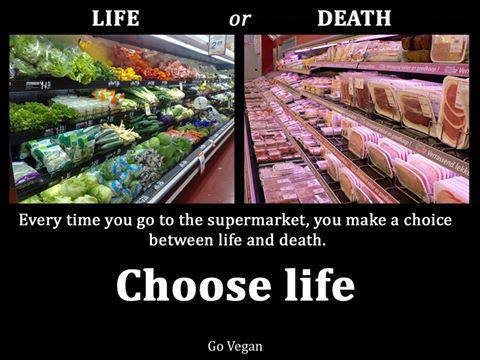
Go Vegan or Die

10959824_10152683692271188_8744564479023804055_n

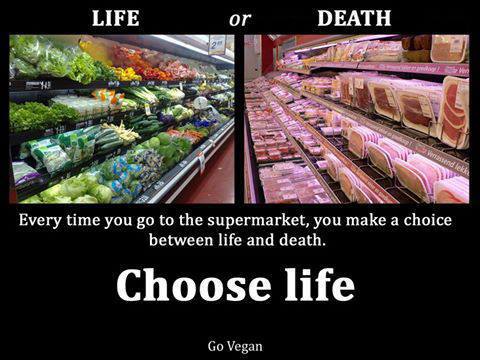
On the tip of one my K2 Apache Outlaw skis is a sticker of a skull and crossbones with the shocking statement, “Go Vegan or Die.” That sentiment might seem mean-spirited unless taken as fair warning about the very real health risks associated with eating meat—such as the greatly increased risk of cancer.

Like the anti-smoking campaign slogan, “Quit Smoking or Die,” “Go Vegan or Die” is simply good advice for people seeking longevity. (Stone-age meat-eaters seldom lived past 30, after all.)

There’s also a less-charitable motive for the slogan on the sticker. Anybody who has been the victim of thoughtless mockery from a meat-eater for the selfless act of eschewing animal flesh would be tempted to use the slogan, “Go Vegan or Die,” as would anyone frustrated by the results of their futile attempts to help others see that animal slaughter is cruelty and humans can live quite happily on a plant-based diet—sans the complicity in causing animal suffering.

Indeed, “Go Vegan or Die” could be a message to Homo sapiens that if they don’t want to exceed their carrying capacity, and ultimately join the list of species headed for extinction, they must change their murderous ways.

Displayed on the left-hand column of the home page of my wildlife photography site, “Animals in the Wild,” is a kill counter that continually adds to the ever-growing list of animals slaughtered for the sake of human hedonism.

If you ever need a starkly chilling reminder of why someone might utter the shocking slogan, “Go Vegan or Die,” stop in for a visit and watch how fast the numbers fly…

………………………………

Animals Slaughtered:

Number of animals killed in the world by the fishing, meat, dairy and egg industries, since you opened this webpage.

1,516,838 marine animals
773,503 chickens
38,123 ducks
20,966 pigs
14,444 rabbits
11,646 turkeys
8,983 geese
8,680 sheep
5,815 goats
4,921 cows / calves
1,095 rodents
1,062 pigeons / other birds
388 buffaloes
270 dogs
67 cats
67 horses
51 donkeys and mules
34 camels / camelids

View in real-time here.

Last Train to Delusionville

10615414_311553309030149_2346944286901096966_n

This article brings up a lot of great points, but I would argue that it isn’t just the vegans, it’s the animals themselves, who are the last fair game for socially-acceptable persecution…

         ……

People Hate Vegans, Freud Could Explain Why

How much your meat addiction is hurting the planet

http://www.washingtonpost.com/blogs/wonkblog/wp/2014/06/30/how-much-your-meat-addiction-is-hurting-the-planet/

June 30, 2014

The environment doesn’t appreciate our meat obsession.

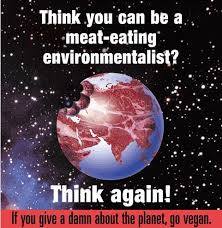
The average meat-eater in the U.S. is responsible for almost twice as much global warming as the average vegetarian, and close to three times that of the average vegan, according to a study (pdf) published this month in the journal Climatic Change.

The study, which was carried out at Oxford University, surveyed the diets of some 60,000 individuals (more than 2,000 vegans, 15,000 vegetarians, 8,000 fish-eaters, and nearly 30,000 meat-eaters). Heavy meat-eaters were defined as those who consume more than 3.5 ounces of meat per day—making the average American meat-eater (who consumes roughly four ounces per day) a heavy meat-eater. Low meat-eaters were those who eat fewer than 1.76 ounces. And medium meat-eaters were those whose consumption fell somewhere in between.

The difference found in diet-driven carbon footprints was significant. Halve your meat intake, and you could cut your carbon footprint by more than 35 percent; stick to fish, and you could cut it by nearer to 50 percent; go vegan, and the difference could be 60%.

The variations were so drastic that the study’s authors suggested that countries should consider revising their definition of a sustainable diet. “National governments that are considering an update of dietary recommendations in order to define a ‘healthy, sustainable diet’ must incorporate the recommendation to lower the consumption of animal-based products,” the study says.

The livestock industry is responsible for roughly 15 percent of global carbon emissions. And the resources necessary to produce even the smallest amounts of market ready meat—like, say, a quarter pound hamburger—are staggering.

The good news is that while Americans might still eat more meat than mother nature would prefer, they are scaling back, and especially so with the most environmentally unfriendly kind—per capita beef consumption has fallen by 36 percent since its peak in 1976, according to data from the USDA. The bad news is that the rest of the world appears to be headed in the opposite direction. Global demand for meat is expected to grow by more than 70 percent by 2050, largely driven by burgeoning middle classes in the developing world.

More: http://www.washingtonpost.com/blogs/wonkblog/wp/2014/06/30/how-much-your-meat-addiction-is-hurting-the-planet/

Why Do Right-Wing Adherents Engage in More Animal Exploitation and Meat Consumption?

http://spot.humaneresearch.org/content/why-do-right-wing-adherents-engage-more-animal-exploitation-and-meat-consumption

Why Do Right-Wing Adherents Engage in More Animal Exploitation and Meat Consumption?

Submitted on Jan 26, 2015 (Original item from 2014)

Even though a number of studies have established a link between right-wing ideology and meat-eating, there is a dearth of literature addressing why those with right-wing beliefs are more likely to consume animals. Recognizing the gap, this study of Dutch and Belgian adults begins to address the question of why, and finds that people with right-wing beliefs tend to staunchly oppose any movement that threatens traditions, or perceived human superiority. Though it is only an initial foray into right-wing psychology and its tendency towards animal exploitation, the authors establish a strong link between the two and encourage further inquiry.


Abstract:


When it comes to right-wing ideology, past research has identified two “dispositional dimensions” that are the primary lenses through which adherents see the world: Right Wing Authoritarianism (RWA), defined by a strong belief in cultural traditions, submission to authority, and aggression towards disobedience; and Social Dominance Orientation (SDO), a desire for your group to be dominant, and belief that there is a fundamental inequality among social groups. At the beginning of their paper, the authors note that “Few studies have investigated relations between social-ideological orientations and exploitative attitudes and behaviors toward animals. […] Yet existing evidence reveals positive associations between right-wing ideologies such as RWA and SDO, and attitudes toward the exploitation of animals as objects for human benefit.” Even though it is established that having a right-wing orientation means that a person is more likely to self-identify as a meat eater and consume meat in their daily life, there is little evidence as to why this is the case. In this study, researchers hypothesized that the link between meat-eating and right-wing beliefs is caused primarily by “a sense of threat from increasingly popular non-exploitive ideologies toward animals (i.e., veg(etari)anism),” as well as “human supremacy beliefs.”


Conducting two separate surveys with Dutch and Belgian adults respectively, researchers established the link, finding that “those higher (vs. lower) in RWA or SDO demonstrate greater acceptance of animal exploitation and greater animal consumption.” However, more importantly, they were able to “reveal that right-wing ideologies predict animal exploitation and consumption through two psychological processes: the perceived threat that animal-rights ideologies pose to the dominant carnist ideology, and the belief in human superiority over animals.” Even when researchers replicated their first study with a second group, sampling a greater proportion of non-meat eaters, and controlling for the possibility that meat-eaters simply like the taste of meat, researchers still found that the basis of meat-eating for right-wing respondents was ideological in nature. Again, they found that for right-wingers, meat-eating behavior was “clearly ideological in nature, referencing power, might, and greater ‘rights’ over animals, plus an active push-back against movements advocating for the under-powered (i.e., non-human animals).”


Through this study, the authors hope to inspire further inquiry and note that their work indicates that it is “increasingly clear” that right-wing thought has “much broader implications” for the propagation of meat-eating. Given the strength of ideological beliefs, it might be wise for animal advocates to undertake further research into how their messages target and impact right-wing adherents. Furthermore, if right-wing ideology is such a strong predictor of a steadfast belief in the rightness of consuming animals, it may be more effective to target meat-eaters who do not disagree with veganism/vegetarianism on such fundamental, visceral grounds.


Original Abstract:

Despite the well-documented implications of right-wing ideological dispositions for human intergroup relations, surprisingly little is understood about the implications for human–animal relations. We investigate why right-wing ideologies – social dominance orientation (SDO) and right-wing authoritarianism (RWA) – positively predict attitudes toward animal exploitation and meat consumption. Two survey studies conducted in heterogeneous community samples (Study 1, N=260; Study 2, N=489) demonstrated that right-wing ideologies predict greater acceptance of animal exploitation and more meat consumption through two explaining mechanisms: (a) perceived threat from non-exploitive ideologies to the dominant carnist ideology (for both SDO and RWA) and (b) belief in human superiority over animals (for SDO). These findings hold after controlling for hedonistic pleasure from eating meat. Right- wing adherents do not simply consume more animals because they enjoy the taste of meat, but because doing so supports dominance ideologies and resistance to cultural change. Psychological parallels between human intergroup relations and human–animal relations are considered.


http://www.sciencedirect.com/science/article/pii/S0191886914

http://spot.humaneresearch.org/content/why-do-right-wing-adherents-engage-more-animal-exploitation-and-meat-consumption

Adult Onset Hedonism

264431_455824994498980_1177070538_n

Practically everywhere you look lately are signs of a growing backlash against the progressive vegan movement. It seems people, many who’ve never tried going a day without eating animal products, are tired of being told vegetarian is healthier than flesh-eating and veganism is better still—its carbon footprint being only a fraction of the gargantuan impact of the standard American diet. Plus, vegans have the benefit of a clearer conscience than a person who contributes to animal suffering on a daily basis (assuming said person cares at all about animals). But many are comfortable with their meat addiction and don’t see any reason to ever change. And though they’re still the vast majority and therefore have nothing to fear from the efforts of outnumbered do-gooders, they see it as an attack on their right to be as hedonistic as they so desire and have begun a collective counterattack, just to show ‘em.

A prime example is the subject of a December 4, 2014, article in UT-San Diego. The piece by Michele Parente, cleverly entitled, “Meat trend has some seeing red,”

As in other major cities across the country, San Diego’s current mania for all things meat defies that other growing trend of eating only plant-based food. “I ordered double sausage out of spite,” one diner posted on Facebook, along with a photo of people eating at sidewalk tables, inches away from picketers. “For every animal you don’t eat, I’m going to eat three,” posted another.

Parente started the article out (glibly),

Meat is all the rage in San Diego right now and that’s got some people broiling.

A proliferation of pork-centric places has sprung up all over the county, along with eateries serving up all manner of beef, game, organ and exotic meats. Hungry for a meatier experience? How about a pre-dinner demonstration on how to butcher a whole animal or even the opportunity to slaughter your entrée yourself? And while the current carnivore craze is sating foodies…

What?! Wait a minute. Slow down there and let us un-hipsters catch up; just what the hell is a “foodie,” anyway? It sounds like some kind of baby talk to me. Well, I looked it up and as it turns out that’s not far off. According the Urban Dictionary’s first two definitions, a “foodie” is,

  1. Foodie: A douchebag who likes food.

Douchebag – “I’m a big foodie.”

Non-doucher – “Really? I like food too, but I’m not a tool.” 

  1. Foodie: A dumbed-down term used by corporate marketing forces to infantilize and increase consumerism in an increasingly simple-minded American magazine reading audience. The addition of the long “e” sound on the end of a common word is used to create the sensation of being part of a group in isolationist urban society, while also feminizing the term to subconsciously foster submission to ever-present market sources.

Though the terms “gastronome” and “epicure” define the same thing, i.e. a person who enjoys food for pleasure, these words are perceived by the modern American consumer as elitist due to their Latin root forms and polysyllabic pronunciation

If you’ve ever heard the postpartum cries of a newborn unwillingly evicted from the warmth of a watery womb, or witnessed the incessant tantrum of a terrible two-year old, you know that babies can be a bit self-centered. They don’t really seem to care about others around them; they just want whatever they don’t have, and you’d better figure out what that is—and fast. Meanwhile, in a similarly self-absorbed manner, “foodies” believe they are entitled to make the art of stuffing their gullet an “adventure,” eating whatever they want—or whomever they want—the rights or interests of the victims of their carnivorous quests be damned.

Popular pulp among narcissistic “locavores” is new book touting the alleged virtues of “adult onset hunting.” At the height of hedonism, these nouveau-savage self-actualizers not only find fulfillment in consuming wild animals but also in all forms of related carnage, including (but not limited to) stalking, shooting, snuffing out, dismembering and butchering them first.

Parente’s article continues,

…a small group of animal-rights activists holding “Meat is Murder” signs has been picketing S&M Sausage & Meat each week since it opened in Hillcrest about a month ago.

A recent DIY butchery event, provocatively called Death For Food, was canceled after an online campaign launched by lawyer and seal defender Bryan Pease attracted about 2,500 protesters and threats of a potential boycott against Suzie’s Farm, where the farm-to-guillotine-to-table dinner was scheduled to be held. 

The restaurant, whose logo is a hog on its back, feet in the air and apple in the mouth, is an unabashed haven for adventurous meat eaters, offering everything from kangaroo hotlinks to alligator-antelope Andouille sausage and fried pig ears. “Anything we can find that used to be breathing… Its customers are equally unapologetic.

 “The audience is quite frankly demanding and wants to be part of the experience,” Freeman said. “They want the thrill and adventure of dining they get with whole-animal (butchery).” “…it gives you an experience.”

The otherwise nauseating article does include a good quote from Stephanie Shaw, a PETA spokeswoman, that sums up the vegan message in a nutshell.

“Any restaurant that serves meat, whether it’s farm to table, whole-animal butchers or McDonald’s … is supporting the violent and untimely or unnecessary death of an animal that wanted to live,” Shaw said. “With every meal, we have the opportunity to choose cruelty or kindness.”

10390198_10203908802183160_4406257953417926087_n

Big Mayo Blows It; Bullying Tactic Backfires

10671222_10202527690853624_1897035803926677117_n

Unilever’s Bullying Backfires, Boosts Hampton Creek ‏

Fri 11/14/14

Negative media coverage of Big Mayo lawsuit goes viral in case study of PR blunder

 Business schools love a good case study, especially when a big corporation blows it. Now they can add Unilever’s colossal public relations mistake to their list. Wall Street Journal tech columnist Christopher Mims summed it up with this tweet: “Giant Corporation Generates Huge Quantities of Free Advertising and Brand Equity For Tiny Rival by Suing It”.

As I predicted earlier this week in my post about the maker of Hellmann’s suing start-up Hampton Creek over egg-free mayonnaise, the press and social media firestorm in just the past few days has already given Unilever a black eye, while the Just Mayo brand enjoys free positive PR. Almost all of the stories (of more than 200) I saw online were in Hampton Creek’s favor, framing the lawsuit as a classic David versus Goliath fight, at times mocking Unilever.

The Washington Post was perplexed, running the headline, “Big Food’s weird war over the meaning of mayonnaise” and calling the case “a strangely defensive stance for Unilever, a Big Food titan that made more than $64 billion last year selling foodstuffs in nearly 200 countries (including I Can’t Believe It’s Not Butter!, a spread that is not butter”).

Here are a few more examples of media hits:

·         The subtitle of the Fortune coverage was “Owner of Hellmann’s lashes out at a startup that is taking market share from the giant”

·         Forbes reported that “A big guy is suing the little guy, and someone is going to end up with egg on their face”

·         Time.com’s subhead read “In a David vs. Goliath battle over sandwich spread labeling, things could get messy”

·         The Politico headline read “Food Startup Battles ‘Big Mayo’ Amid Policy Push” and called Hampton Creek a “tiny Silicon Valley startup” (actually San Francisco)

·         The Los Angeles Times started its story with “Big Tobacco, Big Oil, now Big Mayo?”

·         The UK’s Daily Mail’s coverage began “It is a classic David and Goliath Fight”

Even business-friendly television outlets favored Hampton Creek over Unilever, including Morning Joe and CNBC’s Closing Bell, where the lawsuit was mocked by a host noting how the Mayo Clinic does not have egg in it either, so maybe Unilever will go after them next. While CEO Josh Tetick was explaining his company’s mission, the program ran background footage of cute children spreading Just Mayo on sandwiches.

Several stories also went out of their way to beat up on Unilever for poor economic performance. For example, the international business paper, Financial Times explained how Unilever’s food division “experienced a fall in sales in the first six months of the year.” The Wall Street Journal painted a contrast of the success of Hampton Creek with the decline of Unilever:

In less than a year, Just Mayo has landed shelf space in major retailers such as Whole Foods Market and Wal-Mart Stores, responding to consumer demand for foods perceived as healthier with simpler ingredients and better for animal welfare and the environment. The company expects Just Mayo to be sold in 39,000 locations by start of next year.

This paragraph was immediately followed by:

Unilever’s food business, which accounts for about 27% of its revenue, has struggled in recent years as it has focused on higher-margin personal-care products that appeal in emerging markets. In the last two years, the company has sold underperforming food brands including Skippy peanut butter and Ragu pasta source. In its most recent quarter, food was the only one of Unilever’s four divisions to have slower sales growth.

Just Mayo images splashed everywhere

Every story I saw also spoke glowingly of Hampton Creek’s financial backing and fast rise to success. Adding insult to injury for Unilever, almost every media outlet used pictures such as those above of the Just Mayo product or an image of the photogenic CEO Josh Tetrick alongside his Just Mayo brand, as did even the Wall Street Journal.

And this local San Francisco area TV news report shows lots of energetic activity at the startup’s facility. A story atBBC.com uses the subheads of “Horse and buggy definition” to describe FDA’s recipe for mayonnaise that Unilever relies on, and describes Hampton Creek’s response to the lawsuit: “Antiquated thinking won’t feed the world or strengthen the planet.” The article also shows this image from Hampton Creek’s website.


In more free advertising, Business Insider used this image for its story.


Further aiding Hampton Creek’s cause, many articles ended with a reference to the Change.org petition started by celebrity chef Andrew Zimmern, and several included the petition’s title, “Stop Bullying Sustainable Food Companies”. (The number of signatures now tops 24,000.)

A small company like Hampton Creek can’t pay for the positive press this lawsuit has generated. And according to their Twitter feed, they received 51,000 messages of support and most importantly, sales were higher than they’ve ever been. (Hampton Creek tweeted this picture of what looks like a Costco shelf showing Just Mayo almost sold out, right next to a full pallet of Best Foods mayonnaise.)

On my own blog post and on Twitter, several people responded by saying they had never heard of Just Mayo, but would now try it, some out of sheer spite. For example one said, “Because of a frivolous lawsuit I now have Just Mayo on my radar. Look forward to trying it.” And another, “Thanks Unilever. I had never heard of this Mayo, now I can’t wait to try it.”

Unilever’s media team MIA

Unilever compounded how much Hampton Creek owned the media by going radio silent. According to several news outlets and two reporters I spoke to, Unilever was non-responsive. See for example, the New York Times(“Unilever did not immediately respond Monday to requests for comment”), Forbes (“Officials at Unilever who were contacted by email did not respond to requests for comment”), and Fortune (“Unilever has not responded to requests for comment”).

On Monday, the Washington Post said “messages were not returned”, but then on Tuesday the paper added this emailed statement from a nameless and faceless Unilever spokesperson: “Our concern here is not about innovation, it is about misleading labelling. We simply wish to protect both consumers from being misled and also our brand.”

A pretty tepid response for the world’s second largest consumer packaged corporation. And it was too late.

The Washington Post also noted that “The suit comes at a touchy time for Unilever, which just launched an ad campaign promoting itself as devoted to sustainability.” Indeed, this week Unilever launched its “Project Sunlight”, which appears to be about child hunger, but I can’t tell what Unilever is doing about it except creating a nicewebsite and ad campaign touting its previous donations. Talk about bad timing. A Google news search for “Unilever” results in only eight articles about Project Sunlight, compared to 265 mostly unflattering articles about the Big Mayo lawsuit.

And on Unilever’s Facebook page, Project Sunlight’s warm and fuzzy posts about child hunger are getting drowned out by angry comments reacting to the lawsuit. One suggests a better use of resources:

Unilever is stifling innovation and competition by suing a small smart-up which has developed a more affordable, sustainable Mayo than Hellmann’s. If Unilever were truly committed to causes like ending child hunger, perhaps they would have redirected the costs of this lawsuit that way rather than in pursuit of this frivolous claim.

Numerous commenters say they will no longer buy Unilever products. Here is one example:

If this lawsuit story is indeed accurate, I will purge my entire household of any Unilever product, make it a priority to never buy anything made by Unilever again, and tell every single person I know why. Petty is a fitting word to describe such a lawsuit.

In another sign the right hand doesn’t know what the left hand is doing, Hampton Creek CEO Josh Tetrick shared an email with Fortune that he received from Unilever’s Global VP of marketing just days after the suit was filed. It read: “Love what you are doing…Very much in line with our Unilever Project Sunlight #brightfuture philosophy.”

Unilever’s future is not looking so bright right now.

Failure to communicate

How did this happen? How did a huge company that decided to go on the offensive and file a lawsuit get caught unprepared by the resulting media firestorm, while a startup being accused of alleged wrongdoing was happy to talk to the press, ran with it, and came out looking like a hero?

The first rule of public relations is get out in front of the story to control the message. Unilever didn’t even bother to try. Perhaps the legal department filed the lawsuit and figured it would stay quiet, or just never even thought to run it by communications. The company’s lawyers filed the case in New Jersey federal court on October 31. That’s when the press release should have gone out, to tell their story first. Instead, Unilever let their target, who they claim is in the wrong, garner all of the media sympathy. And when asked for comment, Unilever still couldn’t be found, and when they finally did respond, it was weak. That’s failing public relations in three different ways: not being proactive, the dreaded refusal to comment, and then offering an ineffective response.

Perhaps it’s a sign of a corporation so huge that the right people don’t even talk to each other anymore. That nobody at Unilever anticipated this media reaction is also a troubling sign of being out of touch. Unilever executives should take a hard look inward. Time will tell if the company is able to recover from this massive PR blunder. Meanwhile, Hampton Creek can enjoy the bump, courtesy of Unilever. Self-inflicted wounds hurt the most.


Soaring Meat Production Threatens Global Environment, Warns Report

http://www.businessweek.com/articles/2014-08-27/too-much-meat-says-worldwatch-institute

By August 27, 2014

The world is eating too much meat, and that’s bad news for the earth’s forests, arable land, and scarce water. That’s the conclusion of a report released yesterday by the Washington-based Worldwatch Institute.

Global production of meat hit a new high of 308.5 million tons last year, up 1.4 percent, according to the United Nations Food and Agriculture Organization (FAO), the report notes. “In response to growing purchasing power, urbanization, and changing diets, meat production has expanded more than fourfold over just the last five decades. Even more startlingly, meat production has grown 25-fold since 1800,” says a news release accompanying the report, entitled “Peak Meat Production Strains Land and Water Resources.”

While average consumption of meat in 2013 reached 42.9 kilograms per capita, many people still consume far less, which means production growth is unlikely to stall soon. People in developing countries are eating less than half the quantity of meat consumed by those in developed nations—33.7 kg. as compared to 75.9 kg., the report points out.

Not surprisingly, Asia, home to the fast-growing, populous countries of China and India, has already become the world’s largest meat-producing region. In 2013, it produced 131.5 million tons of meat, about 43 percent of world output. Europe, by contrast, accounted for 58.5 million tons, North America, 47.2 million, and South America, 39.9 million. “China single-handedly accounted for nearly half of global pig meat production,” the report says.

Raising all that livestock requires lots of land and water. More than two-thirds of all agricultural land is used for animal pasture, with an additional 10 percent used to grow feed grains consumed by meat- and dairy-producing animals. Agriculture overall consumes about 70 percent of the world’s fresh water; a third of it goes to grow feed grain. Particularly resource-intensive is beef production: Raising cattle requires up to five times as much land as that needing to produce pigs or chickens—for the same amount of protein.

“Industrial methods in the livestock sector cut down forests to expand grazing lands and use large quantities of water. Production uses grains (such as corn or soybeans) for animal feed and relies on heavy doses of antibiotics in animals,” writes Worldwatch Institute Senior Researcher Michael Renner. “Limiting these environmental and health impacts requires not only a look at how much meat people eat, but also at the kind of meat that they consume worldwide.”