Scientists Put a Human Intelligence Gene Into a Monkey. Other Scientists are Concerned.

#9 in our top science stories of 2019.
By Teal BurrellDecember 29, 2019 2:00 PM
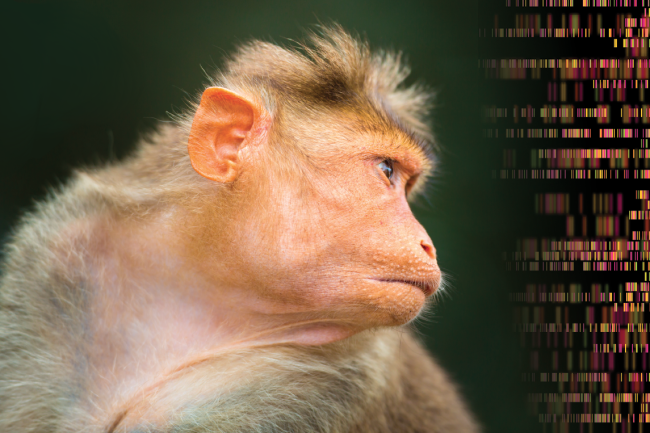
Monkey Barcode - Shutterstock
(Credits: Macaque, Glass and Nature/Shutterstock; DNA Barcode, Zita/Shutterstock)
Scientists adding human brain genes to monkeys — it’s the kind of thing you’d see in a movie like Rise of the Planet of the Apes. But Chinese researchers have done just that, improving the short-term memories of the monkeys in a study published in March in the Chinese journal National Science Review. While some experts downplayed the effects as minor, concerns linger over where the research may lead.

The goal of the work, led by geneticist Bing Su of Kunming Institute of Zoology, was to investigate how a gene linked to brain size, MCPH1, might contribute to the evolution of the organ in humans. All primates have some variation of this gene. However, compared with other primates, our brains are larger, more advanced and slower to develop; the researchers wondered whether differences that evolved in the human version of MCPH1 might explain our more complex brains.

Su and his team injected 11 rhesus macaque embryos with a virus carrying the human version of MCPH1. The brains of the transgenic monkeys — those with  the  human  gene —  developed at a slower pace, akin to that of a human, than those in transgene-free monkeys. And by the time they were 2 to 3 years old, the transgenic monkeys performed better and answered faster on short-term memory tests involving matching colors and shapes. However, there weren’t any differences in brain size or any other behaviors.

But the results aren’t what has the scientific community buzzing. Some individuals question the ethics of inserting a human brain gene into a monkey — an action Rebecca Walker, a bioethicist at the University of North Carolina, argues could be the start of a slippery slope toward imbuing animals with humanlike intelligence. In a 2010 paper, James Sikela, a geneticist at the University of Colorado School of Medicine, and coauthors asked whether a humanized monkey would fit into its society, or would  live in inhumane conditions due to its altered genes.

To justify the work, Su and his co- authors suggested that it could provide insights into neurodegenerative and social disorders — but they don’t describe what those applications might be. “I don’t really see anything in the paper that would make me think that [the experiment] was necessarily a good idea,” says Walker.

Su declined Discover’s request for comment, but said in an article for China Daily, “Scientists agree that monkey models are at times irreplaceable for basic research, especially in studying human physiology, cognition and disease.” And in the research paper, the authors contend that the “relatively large phylogenetic distance (about 25 million years of divergence from humans) … alleviates ethical concerns.” (Rhesus macaques are less like humans in terms of social and cognitive capacities than primates such as chimpanzees, which are more closely related to us.) This greater  evolutionary distance suggests it would be harder to wind up with a macaque that acts like a human.

But that reasoning falls flat for Walker. “It doesn’t really matter when they became differentiated from humans on the phylogenetic tree,” she says. “They’re talking about improved short-term memory, which would be putting them sort of closer to us in terms of those cognitive abilities.” She thinks manipulating these skills makes the work ethically dubious and requires stronger justification.

“While monkeys and humans have similar genomes,” Su said in the China Daily article, “there are still tens of millions of genetic differences. Changing one gene carefully designed for research will not result in drastic change.”

Sikela agrees that such a change may be minor. Still, he wonders about the possibility of finding a gene with a large effect on cognition.

“There’s some risky elements to going down this road,” Sikela says. “One needs to think about the consequences of where this is leading and what’s the best way to study these kinds of questions.”

Walker also worries about where this work leads. “Could we enhance human brains through these methods?” she asks. While she thinks we’re nowhere close to that yet, she notes that science can advance surprisingly quickly. For instance, CRISPR — the gene-editing technique that once seemed far removed from human research — was used in China to edit the genomes of twins in 2018. (See our No. 11 story of the year, page 32.)

“It does feel worrisome to be doing this research in primates,” Walker says. “And then potentially thinking about how that could be used in humans.”

Charges: Ex-animal rights activist caught with machine gun

[It takes all kinds. The things done to animals for product testing could make anyone crazy. Still, If they want to find arsenals, they’d should check the homes of poachers and other hunters.]

http://www.komonews.com/news/local/Charges-Ex-animal-rights-activist-caught-with-machine-gun-256365611.html

By Levi Pulkkinen, seattlepi.com staff   Apr 23, 2014

SEATTLE – A onetime radical animal rights activist now faces federal gun charges after investigators claim he was caught bragging to an informant about his “baby” – a machine gun.

Previously caught hacking a phone line to harass a pharmaceutical company executive, Nathan Brasfield is alleged to have shown a fully automatic rifle to an FBI informant while offering to sell the man pistols. Brasfield, 35, was arrested Tuesday after the FBI searched his Lake Forest Park home and seized the suspected machine gun.

Investigators contend Brasfield, a nine-time felon, was caught on tape expounding on his right to possess the modified weapon, which he kept loaded in a hallway closet at his home.

“I still have the legal right to possess and bear firearms, guaranteed to me by the Constitution no matter what the (expletive) government says about it,” Brasfield was caught on tape telling the informant, according to charging papers.

First convicted of property crimes at age 20, Brasfield was dubbed a political prisoner in radical animal rights circles in 2003 after he was caught sending “black faxes” opposed to a former executive of a firm that tested drugs on animals.

The faxes, sent from a Tukwila phone line Brasfield had broken into, targeted a Kirkland man who previously directed the pharmaceutical testing firm. At the time, the man was drawing fire from the Animal Liberation Front, an animal rights group opposed to testing on animals and meat production whose members engaged in burglaries, arson and sabotage.

Sentenced to a year in state prison for breaking into the phone line, Brasfield was caught with stolen checks, computers and construction equipment in 2011.

A Seattle police detective searching the Lake City home described an “enormous” number of tools scattered around the home; Brasfield claimed he was working as a computer consultant and electrical contractor. Most of the items appeared to have been taken in burglaries in and around Bellevue.

Brasfield ultimately pleaded guilty to possession of stolen property and was sentenced to three months on work release.

As currently charged, Brasfield faces up to a decade in prison if convicted. He could face even more prison time, though, if investigators’ suspicions that his short-barreled rifle was fully automatic prove true following tests by the Bureau of Alcohol, Tobacco, Firearms and Explosives.

Writing the court, an FBI special agent said an informant first claimed to have seen Brasfield with the automatic rifle in July 2012.

According to the informant’s account, Brasfield said he wanted to show the informant “something cool” and pulled a rifle from the trunk of his Mercedes sedan. The informant said Brasfield explained he’d modified the weapon to allow for automatic fire.

Federal law heavily restricts access to automatic weapons. Though they look nearly identical on the outside, essentially all AR-15-style or AK-47-style rifles sold to civilians are semi-automatic. As a convicted felon, of course, Brasfield wasn’t allowed to possess even a musket.

During that early interaction with the informant, Brasfield explained he believed the Second Amendment meant the government couldn’t keep him away from firearms, the Seattle-based special agent said in court papers. Brasfield is alleged to have discussed shooting the machine gun on properties in Kitsap and Snohomish counties.

In February 2013, the informant met Brasfield at a Kenmore home where he was then living. Brasfield had apparently forgotten he’d shown the rifle to the informant previously, the FBI agent said, and did so again.

“Did I ever show you my, my, my baby?” Brasfield is alleged to have told the wire-wearing informant as he pulled a Vector Arms .223 cal. rifle from a closet.

“That’s my home defense weapon,” he continued, according to charging papers. “If somebody’s gonna break in here, out in the middle of nowhere … they’re not gonna find the body.”

Brasfield is alleged to have gone on to regale the informant with a host of other firearms crimes he claimed to have committed.

According to the FBI agent’s statement, Brasfield claimed to have made silencers and shortened the machine gun’s barrel so he could carry it under a coat. Investigators contend Brasfield had a pistol and rifle modified to accept silencers.

Brasfield is also alleged to have explained he was able to buy “door-breaching” shotgun ammunition and armor-piercing rifle rounds online despite his criminal history. Apparently, his seller didn’t bother with background checks.

Early this month, Lake Forest Park police received a report that Brasfield was growing marijuana in the basement of his home there. FBI agents searched the home on Tuesday and arrested Brasfield.

Agents recovered the Vector Arms rifle as well as two handguns, including a Fabrique Nationale Herstal pistol designed to penetrate body armor, according to charging papers. Also seized were a rifle scope and several flash suppressors, as well as boxes of ammunition.

On initial inspection, the rifle appeared to be shorter than allowed under federal law, the agent said in court papers. The ATF will now examine the weapon to determine whether it is in fact a machine gun.

Brasfield appeared Tuesday afternoon in U.S. District Court at Seattle. He is expected to return to court next Tuesday for a preliminary hearing.