The death of two whales caused by entanglement in octopus traps in recent weeks has caused an uproar among marine conservationists and local residents. A petition doing the rounds, to suspend exploratory fishing for octopus ,has gathered thousands of signatures.
On Friday, Minister of Environment, Forestry and Fisheries, Barbara Creecy announced the decision to temporarily suspend exploratory fishing for octopus with immediate effect.
Creecy’s decision comes after talks with operators in the False Bay Area.
“Our decision is taken following widespread public concern regarding recent whale entanglements in the False Bay area which has resulted in the untimely and cruel death of these magnificent creatures.”
The statement Creecy released explains how the traps came into existence.
A calf died this week after getting tangled in an octopus trap. Picture: Emma Raisun
“In 2014, the Department established an octopus exploratory fishery that is operating in Saldanha, False Bay and Mossel Bay. This programme aims to gain scientific knowledge regarding octopus harvesting, with a view to enhancing job creation and economic development in coastal areas. Meaningful data has been collected between 2014 and 2018, and will continue until 2021 in order to ensure a solid statistical time series of catch and effort data.
“Once enough data has been collected, it will be analysed and subjected to proper scientific scrutiny and review, after which a recommendation will be made regarding the viability of establishing a new commercial fishery. Such a recommendation will also consider mitigating measures in the operations of octopus fishery,” read the statement.
Throughout the process, the Department has been leading with permit holders to ensure whales do not get caught in the nets.
After today’s meeting, operators will start the process of removing the gear from False Bay, focusing on the areas where the whales were harmed first.
From today, Japan’s whalers are officially permitted to hunt and kill whales following Tokyo’s controversial decision to quit an international ban on commercial whaling. The move triggered upset among environmentalists worldwide.
According to a government decision announced last year, Tokyo is leaving the International Whaling Commission (IWC), which placed a ban on commercial hunting of the endangered species back in 1986. The withdrawal came into effect on June 30. This means that, from that day, Japanese whalers will be able to resume the killing of whales for meat. However, Japan will be restricted to hunting the mammals only in its exclusive economic zone and territorial waters.
ALSO ON RT.COM122 pregnant whales among the 300+ killed by Japan for ‘science’Tokyo’s withdrawal from the IWC takes effect right after the world leaders’ G20 Summit in Osaka. In an open letter published Friday, a number of environmentalist and global welfare organizations urged G20 leaders to condemn Japan’s “cruel assault on whales” and called for an “an immediate end to all commercial whaling.”
“Japan leaving the IWC and defying international law to pursue its commercial whaling ambitions is renegade, retrograde and myopic….” Kitty Block, president of Humane Society International, one of the contributors to the letter, said in a statement.
Whaling is a sensitive issue in Japan, where eating whale meat is a cherished cultural tradition. Japan is not the first country to resume commercial whaling – Iceland and Norway are also openly against the IWC’s ban as well.
For years the octopus-trapping ropes set up in False Bay have led to a number of marine animals, whales in particular, getting entangled and killed. The recent death of a trapped Bryde’s whale just days after a humpback calf was trapped in the same ropes has pushed the public over the edge.
Members of the community took to social media to share their outrage over the incident and have joined together to see that something is done about these needless and preventable deaths.
An official petition has been created to raise awareness around the harm caused by octopus traps as well as develop safer conditions for marine life.
“We request an immediate moratorium [ban] on all octopus trapping in the False Bay area until such time as stakeholders and concerned citizens are consulted and can agree on a safe operating standard/procedure for the use of traps used in the octopus trapping fishing industry and that the Department uses this period of Moratorium to gather much-needed information on stock levels and the impact of octopus trap fishing on the environment,” the petition reads.
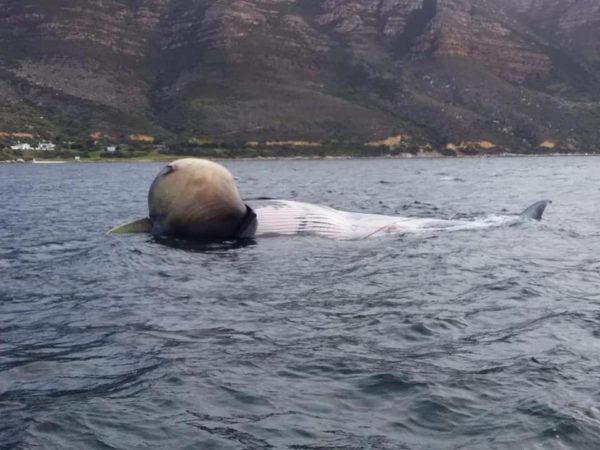
The Bryde’s whale carcass floating on the water’s surface. The whale died after it got caught in octopus-trapping ropes.
For years permits for octopus trapping have been casually issued, and these traps have lead to numerous entanglements and deaths of marine animals.
The community feels the Department of Agriculture, Fisheries and Forestry has approved a number of permits without proper consideration or updated data.
Octopus traps consist of long ropes tied to buoys that float just above the water surface, and are not only a danger to whales but also to dolphins, boats and ships.
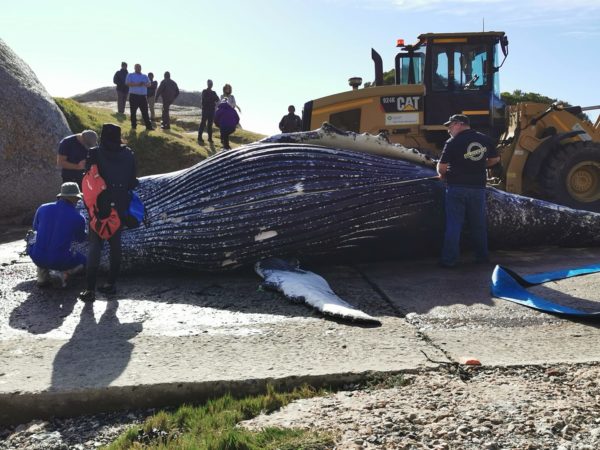
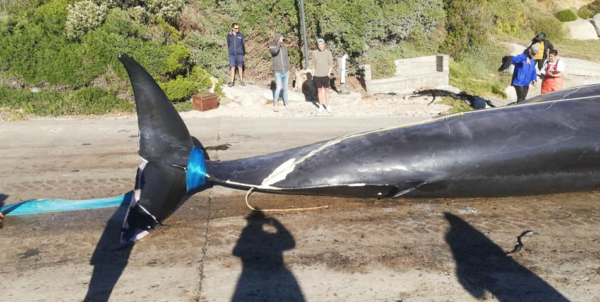
The Bryde’s whale carcass was hoisted ashore.
False Bay is home to the South African Navy and octopus traps also often endanger those on board boats in the bay, as the traps no longer include sonar reflectors or lights as they once did.
If a submarine accidentally catches one of the ropes in its propellers, a dire situation could develop.
Recently two whales were caught in the same octopus trap near Millers Point on June 8 and 10, leading to the death of one of them.
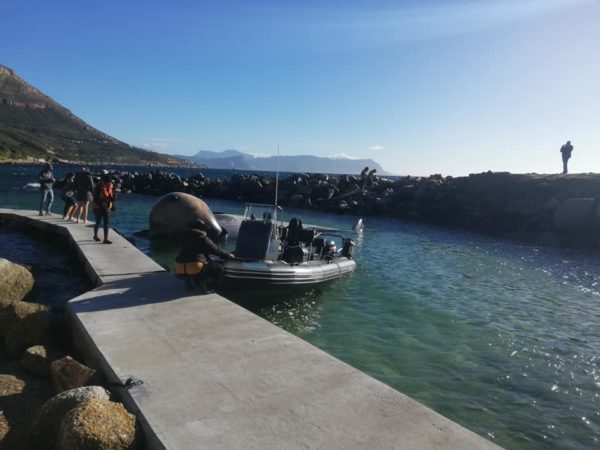
The carcass of the Bryde’s whale being towed into the harbour.
The creators of the petition, dubbed “Save our whales: Stop Octopus Trapping in False Bay, Cape Town”, are imploring the Honourable Minister to place an immediate ban on all trapping in the False Bay Area until a safer operating procedure can be put in place. A safer procedure would include compulsory 24-hour monitoring at sea of octopus traps and sufficient visible signalling on the traps’ buoys to avoid endangering any more marine or human life.
The community hopes that the department will also take time to assess the current stock levels and update any information they may need to make educated decision when issuing permits.
Dr. Kathy Burek, a veterinary pathologist, slices through the blubber layer on a gray whale that was beached outside Anchorage, Alaska, earlier this month. Scientists are trying to figure out why so many gray whales are dying.
Nat Herz/Alaska’s Energy Desk
Cutting through a 6-inch-thick layer of blubber demands a sharp knife.
But as veterinary pathologist Kathy Burek prepared to slice into the abdomen of a dead gray whale, many of her knives were dull. Burek had used them two days earlier to collect samples from a different gray whale, 100 miles away. Then, another whale beached outside Anchorage, Alaska.
“I didn’t have time. That’s what our problem is right here,” Burek said as she struggled to pull off a slab of blubber.
As of the end of May, four dead whales had been found thus far in Alaska. But those come after at least 60 other whale deaths along the West Coast this year, according to the National Oceanic and Atmospheric Administration. That is the highest number in two decades.
Scientists say more deaths are likely in Alaska, since each spring, gray whales swim 5,000 miles from Mexico to their Arctic feeding grounds.
“The level of strandings we’ve seen on the West Coast means Alaska should brace itself for probably some significantly elevated numbers of gray whale strandings,” said John Calambokidis, a research biologist at the Washington state-based Cascadia Research Collective.
A dead whale at the mouth of the Placer River, at the eastern end of the Turnagain Arm, near Anchorage, Alaska. The deaths of at least 60 whales along the Pacific Coast this year have scientists concerned and looking for answers.
Nat Herz /Alaska’s Energy Desk
Burek was hired by NOAA to take samples from the stranded whale outside Anchorage. The whale had been floating for nearly two weeks, and Burek wasn’t planning an extensive necropsy — the animal version of an autopsy.
“It’s just not worth the time and effort because once we get inside the abdomen — the kidneys, the liver are just going to be kind of liquefied,” she said.
The whale, she added, looked “skinny.”
Experts say it appears that many of the other gray whales died of starvation. But scientists aren’t sure why.
Reaching “carrying capacity” or climate change?
Gray whales were once hunted nearly to extinction by whalers. But they were protected by the Endangered Species Act, and the eastern North Pacific population rebounded and was removed from the endangered species list in 1994.
But researchers are also asking whether recent warming trends in the Arctic and reduced sea ice may have affected the whales’ prey.
“We have to really be on top of: Is there any relationship to climate change? And does this link to any other factors that might be affecting other species as well?” Calambokidis said. “Could gray whales be an early warning sign of other things that we need to be watchful for?”
Each spring and fall, the whales swim on one of the longest known mammal migrations — between their winter area in Baja California, Mexico, and their summer feeding grounds in the Chukchi, Beaufort and Bering seas in the Arctic. They primarily eat tiny, shrimplike creatures called amphipods, sucking them off the ocean floor and filtering mud and seawater out through their baleen.
NOAA surveys the gray whales’ feeding patterns each summer. Last year’s survey results are now getting scrutinized to see whether they can help explain this year’s deaths, said Michael Milstein, a NOAA spokesman.
“The scientists that do those surveys are going back through their records and trying to understand if there was something unusual about when and where the whales were feeding,” he said.
Enlarge this image
A sample of abdomen muscle from a beached whale in Alaska. The sample will be tested for potential clues to the whale’s death.
Nat Herz/Alaska’s Energy Desk
Milstein said they’ll be doing another survey this year, trying to determine whether more whales are competing for limited resources. Or if, for some reason, the food is less nutritious or not providing whales the energy needed to sustain them on a long migration.
NOAA also hopes to gather information from dead whales, like the one beached outside Anchorage. Initially, Burek wasn’t optimistic about the quality of samples she would get, but it turned out that the whale was in better shape than she thought.
After cutting and peeling a swath of blubber off one side, Burek cut into the whale’s abdomen, which released periodic spurts of gas and a foul smell. Internal organs slowly slid out of Burek’s incision.
“Ooh, guess what that is — that’s the kidney!” Burek said, as she sliced into the big red mass. “We got kidney!”
Burek placed tiny chunks into bags and vials — muscle, testicle, even poop. They’ll be tested later, as potential clues for researchers trying to solve the mystery of why whales are dying.
ANCHORAGE, Alaska (Reuters) – U.S. government biologists have launched a special investigation into the deaths of at least 70 gray whales washed ashore in recent months along the U.S. West Coast, from California to Alaska, many of them emaciated, officials said on Friday.
A stranded dead gray whale is pictured at Leadbetter Point State Park, Washington, U.S. in this April 3, 2019 handout photo. John Weldon for the Northern Oregon/Southern Washington Marine Mammal Stranding Program under NOAA Fisheries Marine Mammal Health and Stranding Response Program/Handout via REUTERS
The National Oceanic and Atmospheric Administration (NOAA) declared the whale die-off an “unusual mortality event,” a designation that triggers greater scrutiny and allocation of more resources to determine the cause.
So far this year, 37 dead gray whales have turned up in California waters, three in Oregon, 25 in Washington state and five in Alaska, say officials of NOAA’s National Marine Fisheries Service. Five more were found in British Columbia.
The most recent dead whale in Alaska was spotted last week near Chignik Bay on the Alaska peninsula.
Many have little body fat, leading experts to suspect the die-off is caused by declining food sources in the dramatically warming waters of the northern Bering Sea and Chukchi Sea off Alaska.
The gray whales summer there, consuming most of a year’s worth of nourishment to pack on the blubber they need to carry them through the migration south to wintering grounds off Mexico and back north to feeding grounds off Alaska.
Sea ice has been at or near record lows in the Bering and Chukchi, and water temperatures have been persistently much higher than normal, an apparent consequence of human-caused climate change, scientists say.
The conditions the whales encountered last summer could be hurting the animals now as they make their annual migration north, said scientists assembled by NOAA for a teleconference on Friday.
“The Arctic is changing very, very quickly, and the whales are going to have to adjust to that,” Sue Moore, a University of Washington oceanographer, told reporters.
Lack of sea ice may be reducing supplies of the tiny crustaceans known as amphipods that are the gray whales’ prime food source, Moore said.
A photo from the scene on Friday shows several people in the water of Boundary Bay, B.C., near the animals. (David Houston/Facebook)
54
comments
It just might be the happiest whale tale since Free Willy: a pair of grey whales stranded on the low-tide mudflats of Boundary Bay in B.C.’s Lower Mainland have escaped.
A rescue effort sprang into action Friday afternoon after the two whales — a mother and a calf — became beached near Centennial Park in Boundary Bay in Delta about a 40 minute drive south of Vancouver.
Fisheries and Oceans Canada led the effort with refloatation devices — large, inflatable airbags to lift the animals up — and a vessel. The Vancouver Aquarium was also on scene to handle any medical setbacks the animals may have suffered.
“It’s absolutely fantastic,” said Martin Haulena, the Vancouver Aquarium’s head veterinarian. “A very, very good ending.”
Haulena said the animals got stuck at approximately 2 p.m. PT. They were freed by about 6:30 p.m.
Fortunately for them, the tide was coming in to help their escape. A cheer rose from about 100 assembled onlookers as the whales began to move freely, flapping their fins.
Watch as the whales begin to right themselves in the rising tide:
CBC News Vancouver at 6
Whales get free in Delta, B.C.
WATCH
00:0000:34
After being stranded for much of Friday afternoon, a grey whale and her calf start to right themselves in the rising tide of Boundary Bay. 0:34
Dangerous position
Haulena said Boundary Bay — a wide, shallow bay straddling the Canada-U.S. border — is a place where grey whales could easily get stranded.
He described the animals as bottom feeders: they skim along the ocean floor filtering organisms from the sandy bottom through their mouths. He thinks they were likely foraging when the tide went out and became stuck.
As the tide rolled in the whales began to flap their fins and get free. (CBC)
Once out of the water, he continued, their large bodies put them in danger.
“They were never designed to bear weight,” he explained. “That can compress their lungs. They can’t breathe right. Their circulation gets very altered … it’s a very big deal potentially.”
He added that the whales are not out of the woods yet.
If they were injured too severely by their ordeal, they may still die.
Friday’s dramatic scene is one that has been happening all over the west coast of North America this year as an unusual number of grey whales have become stranded and died on their migration from their southern calving waters in Mexico to their northern feeding waters.
Some researchers are pointing to a lack of food as the cause.
Haulena said beachings tend to happen cyclically, with some years being worse than others, but agreed the population may be exhausting its food sources.
Responders examine a malnourished adult gray whale in April after it was towed to a remote beach after initially being found floating near downtown Seattle.
Cascadia Research Collective
An unusually large number of gray whales are washing up dead on their northbound migration past the Oregon and Washington state coasts this year.
The peak stranding time for gray whales in the Pacific Northwest is normally April, May and June. But the federal agency NOAA Fisheries has already logged nine dead whales washed ashore in Washington state and one in Oregon. That’s on top of 21 strandings on California beaches since the beginning of the year.
There were 25 dead gray whale strandings on the entire West Coast in all of 2018.
One 39-foot-long dead adult whale was found floating in Elliott Bay this month, right in front of downtown Seattle.
“This is looking like it is going to be a big year for gray whale strandings,” said Jessie Huggins, stranding coordinator for the Olympia-based Cascadia Research Collective.
Since February, Huggins has participated in necropsies of malnourished, mostly adult, gray whales on Whidbey Island and the Key Peninsula to Ocean Shores and Long Beach, Washington.
“We’re seeing very thin whales with little to no food in their stomachs,” Huggins said. “This is kind of leading us to believe that this is an issue of nutritional stress with a few normal-type strandings mixed in.”
Huggins said these whales probably didn’t get fat enough on their summer feeding grounds in Alaskan waters last year.
Responders in rain gear and elbow-high rubber gloves cut into the massive carcasses to examine the animals’ fat reserves and internal organs. Multiple whales exhibited dry fibrous blubber. The responders noted ribcages and vertebra sticking out, measured healed scars and took tissue samples for later analysis for contaminants.
Despite the unusual number of dead whales found, NOAA Fisheries spokesman Michael Milstein said the overall population of gray whales is fine, “probably as big as it’s ever been” in modern times.
Eastern Pacific gray whales were taken off the endangered species list in 1994. The population is now estimated at 27,000, which may be around the carrying capacity of their ocean territory.
“They’ve been coming back strong,” Milstein said.
Gray whale and humpback whale casualties from entanglement in commercial and tribal fishing gear have been a growing concern for federal officials, certain environmental groups and the fishing industry lately. None of dead gray whales found this spring on Oregon and Washington state beaches were entangled in fishing or crabbing lines, however.
Crabbers and fishing boat owners are scheduled to meet with researchers and government representatives when two separate work groups convene next month along the Oregon and Washington state coasts to hear updates about entanglement risk reduction strategies.
Sometimes it takes a village to examine and pull samples from a decomposing whale. Huggins said she has worked alongside colleagues this winter and spring from Portland State University, Seattle Pacific University, the nonprofit SR3, Washington Department of Fish and Wildlife and World Vets.
Two major Canadian tourist attractions are sending beluga whales outside the country as a new federal law looms that would ban exports on marine mammals, The Canadian Press has learned.
Fisheries and Oceans Canada said it has approved permits for Marineland to move two belugas from the Niagara Falls, Ont., facility to Oceanografic in Valencia, Spain. The Vancouver Aquarium says it owns the two marine mammals that are being cared for by Marineland, and operates the Spanish park where they’re being transferred.
“These two aquarium-born belugas will receive exceptional care at Oceanografic, where they will join a small social grouping of whales already in care there,” Vancouver Aquarium said in a statement, adding that the deal would not cost the Spanish facility any money.
Marineland has also applied to move five more belugas to the United States, but neither Fisheries nor Marineland would divulge where in the U.S. they’re headed if the permits are approved.
“Our Marine Mammal Welfare Committee, which includes independent, accredited experts, recently recommended that Marineland Canada re-home some of our beluga whales to accommodate belugas we expect to be born in 2019 and 2020,” Marineland said in a statement.
“Relocations to the United States are being undertaken to ensure that the best care possible is provided for our beluga whales.”
Neither facility would identify which belugas were being moved, nor how long the two facilities had this arrangement.
The moves come as a new bill banning whale and dolphin captivity is nearing law — its third reading in the House of Commons is set for debate next week.
“Our government agrees that the capture of cetaceans for the sole purpose of being kept for public display should be ended,” said Jocelyn Lubczuk, a spokeswoman for Fisheries Minister Jonathan Wilkinson.
The bill bans imports and exports of the mammals with exceptions only for scientific research or “if it is in the best interest” of the animal, with discretion left up to the minister, thereby clamping down on the marine mammal trade.
It will also change the Criminal Code, creating new animal cruelty offences related to the captivity of cetaceans. It also bans breeding.
The bill includes a grandfather clause for those animals already in facilities in Canada and permits legitimate research, as well as the rescue of animals in distress.
Both Marineland and Vancouver Aquarium said the anti-captivity bill had nothing to do with their decisions to move the whales.
“The decision to move them was made in their best interest, not because of politics,” the Vancouver Aquarium said.
The Vancouver Board of Parks and Recreation passed a bylaw amendment in 2017 banning cetaceans being brought to or kept in city parks after two beluga whales held at the aquarium died. The aquarium, which is located in Stanley Park, announced last year that it would phase out whale and dolphin display.
There are currently no whales at the Vancouver Aquarium.
“We do not believe that the passage of (the bill) will impact Marineland Canada’s ability to do what is right for our whales in the years to come,” Marineland said.
Marineland, which has more than 50 belugas, has taken issue with the breeding ban. The facility said in a letter to the fisheries minister that the park would be in contravention of the Criminal Code when the bill comes into force because some belugas are pregnant and set to give birth this summer after the bill becomes law.
“There is no easy or thoroughly effective birth control medication for beluga whales,” Marineland wrote in March. “In order to control breeding by Bill S-203, existing social family groups must be separated.”
The park wants more time to ensure it is in compliance with the law.
The United States is considering similar legislation and France has banned the captivity of all whales, dolphins and porpoises.
The whales appear emaciated but whether from decline of food supply or overpopulation is unclear
Clare Hennig · CBC News ·
Every spring, the grey whales migrate from Mexico to the North Pacific. (Craig Hayslip/Oregon State University Marine Mammal Institute)
41
comments
An unusually high number of grey whales are washing up dead on West Coast shorelines on their annual migration north and B.C. is the next stop, warns a U.S.-based marine biologist.
More than 20 grey whales were stranded ashore in California this spring, and, further north along the coast in Oregon, several more have washed up recently.
Eleven whales were recently stranded in Washington state. Only one survived.
“We’re already beyond what we would typically consider high numbers and this is still early in our stranding season,” said Jessie Huggins, stranding co-ordinator for the Cascadia Research Collective.
in one of the longest migrations of any mammal, grey whales migrate from their wintering areas near Mexico to their summer feeding grounds in the North Pacific every year.
“They’re heading towards Canada,” Huggins told CBC’s On The Island.The whales are expected to pass by Vancouver Island.
Young grey whale pictured washed up on Ucluelet beach on Vancouver Island in 2016. (Les Doiron)
Food shortage
From necropsies on the animals, Huggins said it appears that food shortage is an underlying cause of the deaths.
“We’ve been seeing a lot of emaciated animals,” she said.
Grey whales feed on sediment along the ocean floor, which brings them closer to shore than other types of whales. Their proximity to land means they are more likely to wash ashore and for their deaths to be noted.
“Many other whales, when they die further off-shore, we never see them,” Huggins said.
“Especially skinny ones because they tend to sink first.”
Thanks to wildlife protection measures like the Marine Mammal Protection Act, grey whales became a “success story” and their numbers increased over the last decades.
The research hasn’t concluded whether the recent deaths are due to a decline in food sources or an overpopulation of grey whales or some combination of both.
“It’s difficult for us to tell at the moment, but we do know that, for the last year or two, there have been a number of very skinny whales,” Huggins said.
“They didn’t get enough food last summer and, along their normal migration patterns, are just not able to make it all the way to Alaska.”
On The Island
Dozens of grey whales washing up dead along migration route – and B.C. is their next stop
LISTEN
00:0006:53
An unusually high number of grey whales are washing up dead on West Coast shorelines on their annual migration north and B.C. is the next stop, warns a U.S.-based marine biologist. 6:53
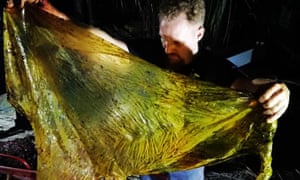
Darrell Blatchley pulling plastic out of the juvenile male Cuvier’s beaked whale Photograph: Darrell Blatchley/D’ Bone Collector Museum Inc.
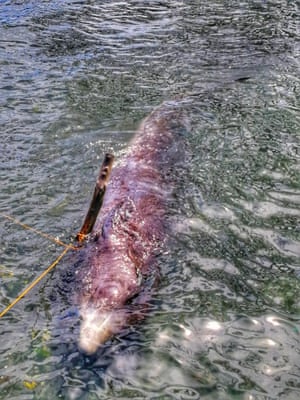
A young whale that washed up in the Philippines died from “gastric shock” after ingesting 40kg of plastic bags.
Marine biologists and volunteers from the D’Bone Collector Museum in Davao City, in the Philippine island of Mindanao, were shocked to discover the brutal cause of death for the young Cuvier’s beaked whale, which washed ashore on Saturday.
In a damning statement on their Facebook page, the museum said they uncovered “40 kilos of plastic bags, including 16 rice sacks. 4 banana plantation style bags and multiple shopping bags” in the whale’s stomach after conducting an autopsy.
Images from the autopsy showed endless piles of rubbish being extracted from the inside of the animal, which was said to have died from “gastric shock” after ingesting all the plastic.
The juvenile male curvier beaked whale died from ingesting plastic bags Photograph: Darrell Blatchley/D’ Bone Collector Museum Inc.
The D’ Bone Collector Museum biologists who conducted the autopsy said it was “the most plastic we have ever seen in a whale”.
“It’s disgusting,” they added. “Action must be taken by the government against those who continue to treat the waterways and ocean as dumpsters.”
The use of single-use plastic is rampant in south-east Asia. A 2017 report by Ocean Conservancy stated that China, Indonesia, the Philippines, Thailand, and Vietnam have been dumping more plastic into the ocean than the rest of the world combined.
Marine biologist Darrell Blatchley, who also owns the D’Bone Collector Museum, said that in the 10 years they have examined dead whales and dolphins, 57 of them were found to have died due to accumulated rubbish and plastic in their stomachs.
In June last year, a whale died in southern Thailand after swallowing more than 80 plastic bags, which weighed up to 8kg (18lb) in the creature’s stomach, and marine biologists estimate around300 marine animals including pilot whales, sea turtles and dolphins, perished each year in Thai waters after ingesting plastic.





 Exposing the Big Game