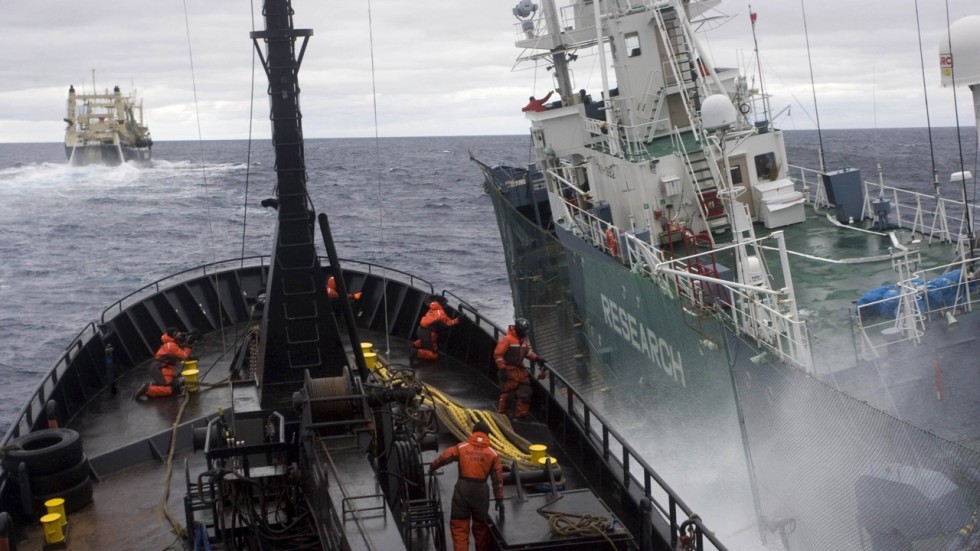
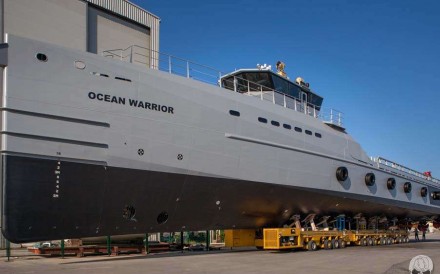
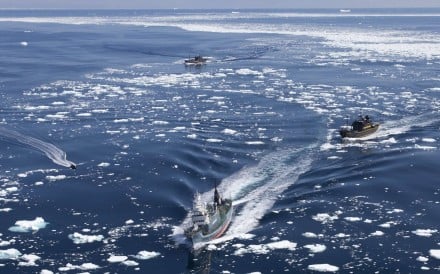
The anti-whaling vessel Sea Shepherd will not contest the Southern Ocean against Japanese whalers this season, Captain Paul Watson has announced, accusing “hostile governments” in the US, Australia and New Zealand of acting “in league with Japan” against the protest vessel.
Sea Shepherd has been obstructing Japanese whaling vessels in the Southern Ocean each year since 2005, but Watson said the cost of sending vessels south, Japan’s increased use of military technology to track them, and new anti-terrorism laws passed specifically to thwart Sea Shepherd’s activities made physically tracking the ships impossible.
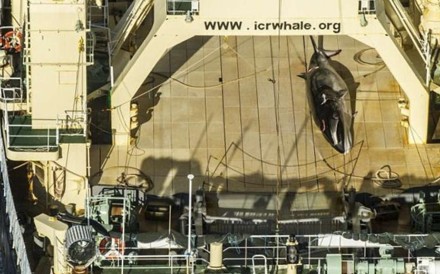
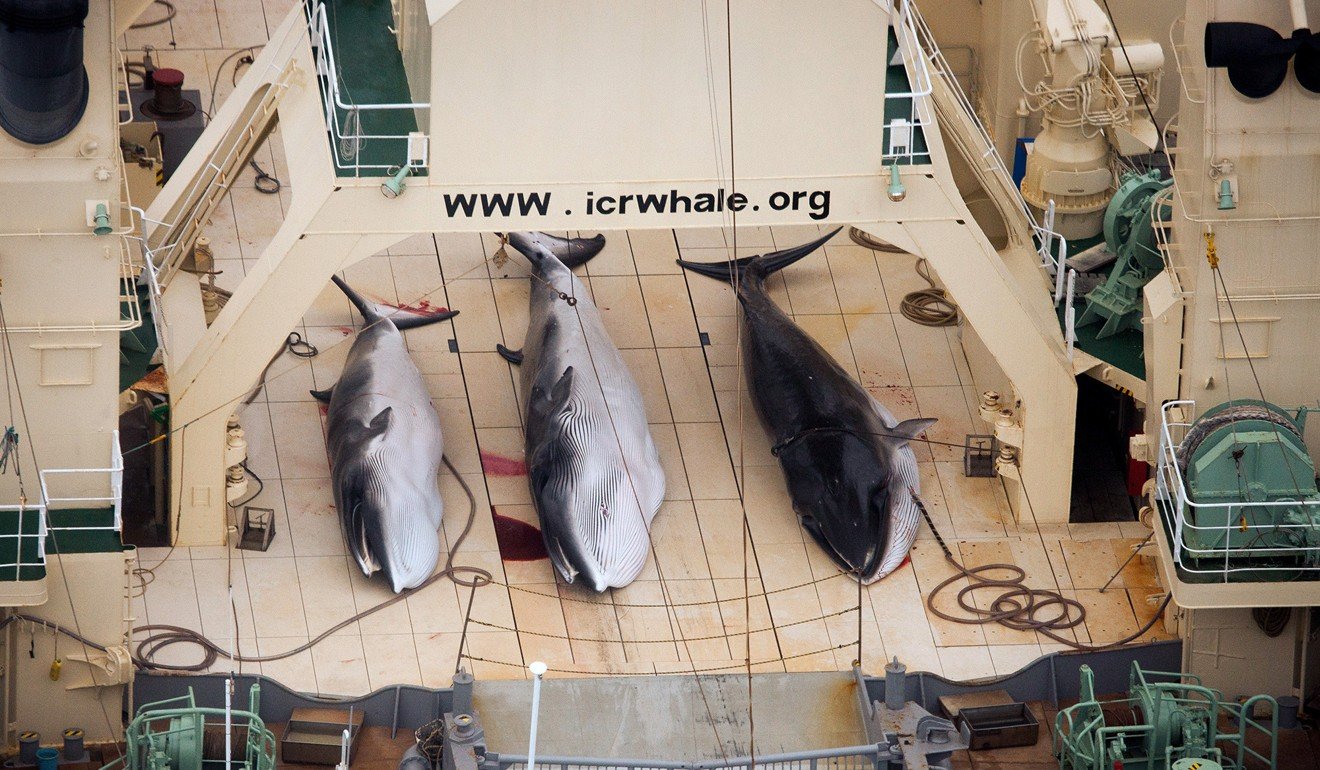
Australia took Japan to the international court of justice over its Southern Ocean whaling programme in 2014, winning a judgement that condemned Japan’s whaling programmes as being in breach of the International Whaling Commission’s ban on commercial whaling. The court rejected Japan’s argument that its whaling was for “scientific” purposes.
Watson said his volunteer organisation could not compete with Japanese military satellite technology, which tracked Sea Shepherd in the ocean. Japan has also passed anti-terrorism laws that make protest ships’ presence near whalers a terrorist offence.
“We’re just a group of volunteers trying to do the impossible, trying to do the job Australia and New Zealand and the United States and all these others countries should be doing but they’re too busy appeasing Japan.”
In a statement on Monday, Watson said the Japanese whaling companies “not only have all the resources and subsidies their government can provide, they also have the powerful political backing of a major economic superpower. Sea Shepherd however is limited in resources and we have hostile governments against us in Australia, New Zealand and the United States.”
Speaking on radio in Australia, Watson accused the Australian government of acting in league with Japan, indirectly supporting whaling by obstructing Sea Shepherd’s activities.
“Australia is definitely in league with Japan,” he said.
“When our ships come in we’re harassed, we’re investigated, we’re searched, when our crew come in from other countries they have problems getting visas. We’ve been applying for charity status for 10 years – they won’t give it to us. This has been extremely hostile.”
The Sea Shepherd’s pursuit of whaling vessels has also attracted criticism. The Japanese government has described Sea Shepherd as “ecoterrorists” and sought to have Watson placed on an Interpol watchlist.
A group of men from Port au Choix, on Newfoundland’s Northern Peninsula, spent a cold 45 minutes in the water this week trying to help a beached minke whale get back out to sea.
‘I just went in with my pants, a pair of jeans and my sneakers on.’ – Todd House
Todd House and two others ventured into the frigid water near an area known as Eastern Point on Monday night to try to rescue the whale.
“I just went in with my pants, a pair of jeans and my sneakers on,” he told the Corner Brook Morning Show.
“At that time I didn’t know what to do. One of the young men there was actually grabbing it by its back fin and trying to push it out by himself.”
House says the minke whale was clearly distressed and running low on energy as they tried to get it back out in the open waters of the North Atlantic. (Brenda’s Photography)
House said the whale was visibly distressed and quite tired-looking, and he and the other men weren’t having much luck getting it to move across the sand and farther out.
With stamina running low, House got the idea to run ashore and find a few pieces of two-by-four to try to lift the whale off the ground.
“That’s what we used, just to slowly put it in under so far and just push the whale so much,” he said.
The three men used two-by-fours to try and dislodge the whale from the sticky sand below. They managed to get it out farther than it had been but had to give up their efforts after 45 minutes. By the morning, the whale was gone. (Brenda’s Photography)
After 45 minutes up to their knees in the icy waters — and having moved the whale only a few feet — the three men finally gave up, with the hope that the tide would come in and help the whale get free. They went home, and agreed they would keep an eye on it.
When they returned the next morning, the whale was gone, presumably having swam off in deeper waters.
A wildlife officer on the beach told them if the whale was wounded or sick it would likely return to the beach to die, but so far that hasn’t happened which is a good sign.
House said he’s content knowing the men may have played a role in saving the whale’s life.
“I felt good about it,” he said. “I’d do it all over again.”
Image copyrightSILVERBACK FILMS/BBCImage captionBeing big means they can maximise the opportunities where they exist
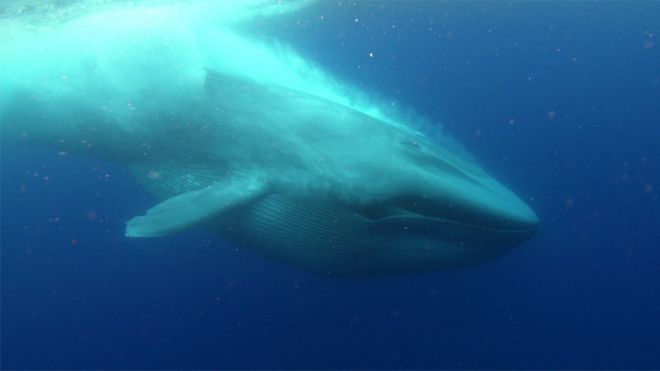
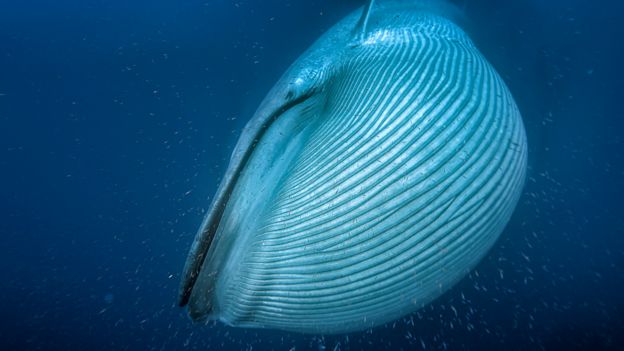
Blue whales are the biggest animals that have ever existed on Earth but they only recently* got that way.
This is the extraordinary finding from a new study that examined the fossil record of baleens – the group of filter feeders to which the blues belong.
These animals were relatively small for most of their evolutionary existence and only became the behemoths we know today in the past three million years.
That is when the climate likely turned the oceans into a “food heaven”.
Favoured prey – such as krill, small crustaceans – suddenly became super-concentrated in places, allowing the baleens with their specialised feeding mechanism to pig-out and evolve colossal forms.
“Some of the dinosaurs were longer, but these big whales even outweighed the largest dinosaurs. And isn’t that surprising? People kind of think of gigantism as being a fact of the geologic past. But here we are, living in the time of giants on Planet Earth,” he told BBC News.
*Whales have been around for about 50 million years – a blink of the eye in the 4.6-billion-year history of the Earth.
Dr Pyenson is publishing the new research – conducted with Graham Slater from the University of Chicago and Jeremy Goldbogen from Stanford’s Hopkins Marine Station – in a journal of the Royal Society called Proceedings B.
It is based on a deep analysis of the Smithsonian’s extensive collection of cetacean bones, and in particular of whale skulls which are a good indicator of overall body size.
The team estimated the lengths of 63 extinct species, including some of the very earliest baleens that swam in the oceans more than 30 million years ago. And combined with data on modern whales, this investigation was then able to establish the evolutionary relationships between whales of different sizes.
What emerges from the research is a picture showing not only that gigantism is a recent phenomenon but that this bigness arises independently in the different baleen lineages.
The smaller whale species that had previously persisted start to go extinct within the last three million years, right at the same time as the giants begin to appear.
Image copyrightGETTY IMAGESImage captionThe baleen plates that hang from the upper-jaw filter prey from a gulp of seawater
It all points to a major shift in the environment and the team suggests the best explanation is the onset of ice ages at the end of the warm Pliocene Epoch, the beginning of the Pleistocene.
The existence of major ice sheets would have restructured the oceans, changing the way water and nutrients were distributed.
“This period sees some dramatic changes, including the closure of the Panamanian isthmus, shutting off connection between the Atlantic and Pacific,” explained Dr Slater.
“Ice sheets in the north develop a lot of cold water that sinks and is then transported around the globe. And what you get are intense upwellings that bring that nutrient-rich cold water back to the surface. That allows algae to go crazy and that allows krill to feed and to form really dense aggregations.”
It is not the abundance of prey per se that favours large baleens, but rather the prey’s patchy, concentrated nature. And with their filter-feeding system of eating, the big whales are able to take maximum advantage.
“They can travel from one feeding zone to the next very efficiently because their big size means their ‘miles per gallon’, their MPG, is very high. And they seem to know precisely the right time to turn up at these feeding grounds,” Dr Slater added.
Image copyrightSILVERBACK FILMS/BBCImage captionBlue whales can reach over 30m in length, although this is rarely seen nowadays
Two points are worth noting. First, commercial whaling in the last century decimated baleen populations and very probably removed most, if not all, of the ultra-giants out there. Few blues now exceed the 30m lengths that were often recorded at processing factories.
Thanks to the international moratorium on whaling, the true giants could yet return. But this raises the second issue: the changing climate.
If the experts are right, we are heading back towards the Pliocene. Increased carbon dioxide levels in the atmosphere could well see global temperatures in the next century that are three or four degrees warmer than they are today. This would almost certainly trigger further ocean changes.
“We’re playing with the dials on ‘Spaceship Earth’,” commented Dr Pyenson.
“We don’t know how things are going turn out, especially for these food resources which may or may not be persistent in space and time. There are some baleens that we think might be more flexible. Gray whales, for example, appear to have a very broad feeding range; blue whales not so much – they really need their krill.”
Image copyrightMARIA TERESA LARAImage captionWhat will happen to the oceans if the global climate returns to the Pliocene?
Richard Sabin is the curator of marine mammals at London’s Natural History Museum.
He called the research “compelling and important” and also highlighted the ecological knife-edge on which some of these animals must live: “There are 90 or so cetacean species. They’re a very diverse group and some of them are very specialised.
“So, you have creatures like the river dolphins that use echo-location to find their prey and the blue whales that are very specialised feeders with their krill. These animals have evolved within systems that they now depend on remaining stable.”
The near-4.5-tonne specimen has been hung from the ceiling in a lunge-feeding pose, mouth open.
The display is under wraps for the moment, but a big unveiling is promised in the next few weeks.
“The visualisations that we released give you an idea, but they don’t really do it justice. She looks spectacular. You get so many different perspectives from the different angles, and you get a real sense not just of her size but of her dynamism as well.”
London’s Natural History Museum will also stage a new exhibition on whales to coincide with the unveiling.
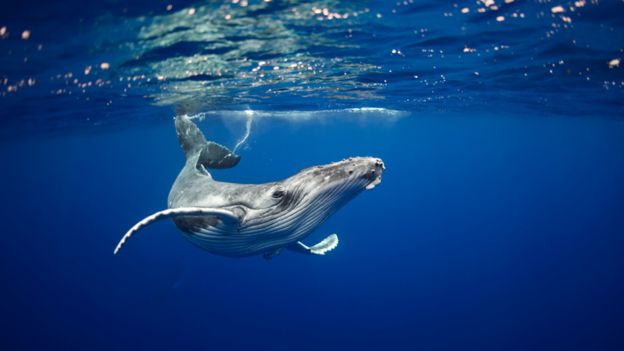
VENTURA, Calif. — A humpback whale that made a big splash with boaters after wandering into a Southern California harbor was on the move again Sunday after finding its way back to the open ocean.
“We have great news,” an ecstatic Ventura Harbormaster John Higgins told The Associated Press. “The whale was able to find its way out.”
Authorities may have helped it on its way by playing a continuous loop of humpback whale feeding sounds overnight near the harbor’s entrance-exit point.
The idea was to draw the whale toward the open water under the belief there would be something good to eat.
The 40-foot-long creature had wowed boaters and passers-by on shore for hours Saturday after it arrived in the small fishing harbor north of Los Angeles.
People stood on small boats and docks watching it swim back and forth and occasionally surface.
Whale experts told Higgins it appeared to be a healthy juvenile, although he didn’t know its age.
The Coast Guard, National Parks Service, authorities and volunteers spent hours trying unsuccessfully to shepherd it back to the ocean.
After blocking its path with boats and banging on pipes failed to work, they tried the whale feeding sounds. The tactic finally succeeded after they cleared everyone out of the area and moved the underwater speakers closer to the ocean.
Authorities discovered the whale had left on its own when they returned in the morning, Higgins said.
As far as he knows, the young humpback was the first to pay a visit to Ventura Harbor.
“We’ve had California grey whales just peek into the harbor as they’re going up and down the coast,” he said. “But none have ever gone into the harbor.”
A dead whale calf was examined by researchers on May 4 after being towed to an island in the Columbia estuary.
LONG BEACH, Wash. — An entangled gray whale calf died after being caught in crab pot lines, Olympia-based science group Cascadia Research Collective reported following an examination.
The whale, a 20-foot-7-inch male born this calving season, was initially reported dead in late April, anchored in place half a mile off of the Seaview beach approach. On May 1, it was discovered the whale was entangled in apparent commercial crab pot gear, researchers said.
The whale was towed to a remote island inside the mouth of the Columbia River.
A necropsy last week showed the whale was at the age when mothers with calves migrate north from their winter breeding and calving grounds in Baja to feeding areas primarily in Arctic waters. This migration is often close to shore and through commercial crabbing grounds.
“The whale was entangled in numerous areas including through the mouth and showed bruising around these areas indicating it was alive when it became entangled (and) had died as a result of the entanglement,” researchers said. “The whale was in excellent body condition with a large and oily blubber layer and even fat reserves around the heart all indicating it had been in good health prior to experiencing a more sudden death. Many of the internal organs were decomposed likely as a result of rapid decomposition due to the insulating blubber layer.”
Whale entanglements have increased in recent years along the West Coast, most dramatically with humpback whales off California, and have been of growing concern, according to Cascadia Research. Authorities are on the lookout for another gray whale first spotted off California that has its head stuck in a metal framework.
These incidents have prompted increased efforts to identify solutions as well as help disentangle whales when encountered still alive, the scientists said. Another threat to whales was highlighted by a boat strike on a well-known adult gray whale in Puget Sound, caught on video in April. Fortunately, that whale survived, though the full extent of its injuries are not yet known, researchers said.
There are an estimated 26,000 gray whales that migrate off the West Coast, according to the World Wildlife Fund, which calls their recovery “a great conservation success story.”
Gray whales were removed from the Endangered Species List in 1994.
Baby humpback whales use quiet sounds to keep close to their mothers on the long migration to feeding grounds in cooler waters, according to research published Thursday in the journal Functional Ecology. (David Gray/Reuters)
Newborn humpback whales “whisper” to their mothers to avoid being detected by predators such as killer whales, new research suggests.
Never captured before, the baby whale call recordings were collected using tags placed temporarily on the whales by a team of ecologists in Denmark, Australia and Scotland. Their findings were published Thursday in the journal Functional Ecology <http://onlinelibrary.wiley.com/doi/10.1111/1365-2435.12871/full> .
Lead author Simone Videsen, a marine biologist from Aarhus University in Denmark — along with colleagues from Murdoch University in Australia and the University of St. Andrews in Scotland — tagged eight humpback calves and two mothers with suction-cup-like devices that record sound and movement for 48 hours before floating to the surface.
They found that the young whales communicated with their moms using quiet grunts and squeaks much different than the long, haunting songs heard in previous humpback recordings.
“We know humpback whales are known for their long songs. These are short and sporadic compared to these long songs,” said Videsen in an interview with CBC News.
The calls are used to keep the mother and calf together in the murky waters of their breeding ground in the Exmouth Gulf in Western Australia, where visibility is only two to three metres, she said.
Videsen said the quiet calls may be used to prevent detection by predators.
Killer whales hunt young humpback calves in this region. “One hypothesis could be that they produce weaker signals to avoid predation by killer whales,” she said.
Dead-beat whale dads
The low-volume communication may also help the mother-and-child pairs avoid another problematic interruption of baby’s nursing time: the approach of male humpbacks who want to mate with the nursing females.
Male humpback whales are opportunistic breeders who compete for mating partners and don’t play a role in the lives of their young. In fact, they get in the way of newborn whales who need to suckle.
Humpback whales spend their summers in the food-rich waters of the Antarctic or Arctic. In the winter they migrate to the tropics to breed.
The migration out of the tropics is demanding for the young calves, who must travel more than 8,000 kilometres through rough seas.
Tracking the behaviour patterns of the newborns, particularly their nursing relationships with their mothers, will help scientists to better target conservation efforts, says Videsen.
Shipping traffic in busy seaways can disrupt whale migration and potentially separate calves from their mothers by masking the sounds they use to stay together, according to the research by ecologists in Denmark, Australia and Scotland. (Mathieu Belanger/Reuters)
“From our research, we have learned that mother-calf pairs are likely to be sensitive to increases in ship noise. Because mother and calf communicate in whispers, shipping noise could easily mask these quiet calls.”
Humpbacks are slow to reproduce. Pregnancy lasts for about a year and calves stay with their mothers for their first year of life.
‘It’s crucial for them to gain a lot of weight to be able to survive the migration back.’ – Simone Videsen, marine biologist
While in tropical waters, the babies must gain as much weight as possible — growing as much as a metre per month — in order to endure their first long swim to cooler waters.
“It’s crucial for them to gain a lot of weight to be able to survive the migration back,” said Videsen.
There are two major humpback whale populations, one in each hemisphere.
Shipping problems
The humpback whale population that feeds in North Atlantic waters each summer was removed from the Endangered Species Act last year.
Still, the whales remain vulnerable to boat traffic.
U.S. government scientists launched an investigation on Thursday into an unusually large number of humpback whale deaths from North Carolina to Maine, the first such “unusual mortality event” declaration in a decade.
Forty-one whales have died in the region in 2016 and so far in 2017, far exceeding the average of about 14 per year, said Deborah Fauquier, a veterinary medical officer with National Oceanic and Atmospheric Administration Marine Fisheries in Maryland.
Ten of the 20 whales that have been examined so far were killed by collisions with boats, something scientists are currently at a loss to explain because there’s been no corresponding spike in ship traffic.
The investigation will focus on possible common threads like toxins and illness, prey movement that could bring whales into shipping lanes, or other factors, officials said.
Videsen said that moms and their calves often lie on the surface of the water where they can be prone to ship collision, adding she hopes research like theirs can be used to help inform the shipping industry.
Workers inspecting a dead humpback whale that washed up on Rockaway Beach in Queens this month.CreditSpencer Platt/Getty Images
Humpback whales have been dying in extraordinary numbers along the Eastern Seaboard since the beginning of last year. Marine biologists have a term for it — an “unusual mortality event” — but they have no firm idea why it is happening.
Forty-one whales have died in the past 15 months along the Atlantic coast from North Carolina to Maine. In a news conference on Thursday, officials from the National Oceanic and Atmospheric Administration Fisheries said that they had not identified the underlying reason for the mass death, but that 10 of the whales are known to have been killed by collisions with ships.
The agency is starting a broad inquiry into the deaths.
These whales “have evidence of blunt force trauma, or large propeller cuts,” said Deborah Fauquier, a veterinary medical officer at the agency’s Office of Protected Resources. These collisions with ships were “acute events,” Dr. Fauquier said, and were being treated as the “proximate cause of death.”
Dr. Fauquier said that the number of whale strandings was “alarming,” and that she hoped the investigation might give a sense of what kind of threat this presents to this population of humpback whales and those around the world.
COn average, eight humpback whales are stranded each year from Maine to Virginia, and fewer than two are hit by ships, according to data from NOAA.
An unusual mortality event is a specific designation under the Marine Mammal Protection Act, and is defined as “a stranding that is unexpected, involves a significant die-off of any marine mammal population, and demands immediate response.”
Whale or other marine mammal die-offs are often poorly understood by scientists, and this case is no exception. Officials from NOAA Fisheries could not explain why the animals were coming into greater contact with vessels, or if there were any human-caused or climate-related disturbances that had changed their behavior.
Gregory Silber, marine resources manager in the agency’s Office of Protected Resources, said that there had not been any increase in ship traffic in the region, and that the whales might be following their prey — they mostly eat krill and small fish — to areas where there could be more shipping.
Ten whales other than those killed by ships have been examined, but officials have not yet determined the cause of death. There is no indication that they were killed by disease.
Humpback whales — which can be as long as 60 feet, weigh as much as 40 tons and can live for 50 years — are found in all of the world’s oceans. There are 14 distinct population segments — groups that follow certain migration and breeding patterns — of humpback whales, some of which are classified as endangered or threatened. The population along the Atlantic coast, which winters in the Caribbean and summers in the North Atlantic or Arctic regions, is not now considered threatened under the Endangered Species Act.
Around the world, there are an estimated 30,000 to 40,000 humpback whales, about a third of its original population. The Atlantic population is around 10,000.
Scientists have suggested that some whale deaths could be a result of marine noise, often a result of military activity, offshore drilling or exploration, which can disorient the animals and send them in the wrong direction, possibly toward beaches where they get stuck instead of into the deeper ocean. Mr. Silber, the NOAA manager, said he was not aware of a connection between ocean noise and these strandings.
A recent study has shown that dolphins, when escaping predators or the source of marine noise, might shoot up from a dive more quickly than they otherwise would, switching from slow, deliberate strokes to faster, longer ones, which can cause them to use double the energy they normally do, and exhaust them.
The last major mass casualty event for marine mammals in this part of the world took place from 2013 to 2015, when a resurgence of the morbillivirus killed thousands of bottlenose dolphins on the Eastern Seaboard.
Among humpback whales, there was an unusual mortality event in 2006, following others in 2005, which involved other large whales, and 2003, which was primarily humpback whales. In each investigation, the cause was undetermined, officials said.
For 200 years this incredible whale has swum through the waters of the Arctic Ocean.
200 HUNDREDS YEARS!!
Two centuries ago it was 1817. This whale was alive before the American Civil War. This whale was alive before Thomas Jefferson died. This whale was alive before the ship ESSEX was sunk by a Sperm whale. This whale is older than the Mormon church!
When this whale was born, African Americans were just commodities to be bought and sold. When this whale was born, women had very few rights and Native Americans were being slaughtered. well, because of manifest destiny, killed because of White American culture.
And now some 16-year old kid is a frigging “hero” for snuffing out the life of this unique self aware, intelligent, social, sentient being, but hey, it’s okay because murdering whales is a part of his culture, part of his tradition.
He went out in his “traditional” metal boat, powered by a “traditional” outboard motor, armed with a “traditional” exploding harpoon and “traditional” high powered rifle and they all hauled the great grandmother of a whale into the shore with a “traditional power” winch.
I don’t give a damn for the bullshit politically correct attitude that certain groups of people have a “right” to murder a whale.
Their so called “right” is not as important as the right of the whales to live, survive and to thrive.
TWO HUNDRED GODDAMN YEARS and this little prick snuffs out her life just because because he legally can. I hope he chokes on the blubber.
People like the Yupik, the Faroese, the thugs in Taiji, the Orca killing scum in St. Vincent and the whaling gangsters of Iceland, Norway and Japan are despicable murderous bastards all justifying their cruel infliction of death in the name of this mother of all justifications – culture.
Am I angry? Damn right I am. Enough is enough. I don’t care what self righteous ethnic label anyone may want to pin on themselves, killing a whale can never be justified in the name of tradition or culture.
TWO HUNDRED GODDAMN YEARS!! WTF!!
And for those who demand that I respect anyone’s “right” to kill a whale or a dolphin, my answer is I have never, I do not and I will never respect the infliction of suffering and death to any cetacean.
And for those who say, well you eat meat? No I don’t, and I would no more respect this horrific murder of this incredible sentient being than I would of the culture of cannibalism.
And by the way I have been to Gambell in 1981 where I saw the Yupik shooting walrus with M-16 rifles just for the ivory. The number of stinking rotting Walrus bodies I saw that summer was obscene.
The fragile population of Bryde’s whales in the Gulf of Mexico declined by almost 20 percent in the Deepwater Horizon oil disaster and another 20 percent are estimated to have suffered health and reproductive effects as a result. Fewer than 100 of these whales are believed to be alive in the region.
Their limited year-round habitat is once again being targeted by oil and gas developers, putting them at risk of extinction if more isn’t done to protect them.
Please urge the National Marine Fisheries Service to list Bryde’s whales in the Gulf of Mexico as “endangered” under the Endangered Species Act in order to safeguard their future.
A juvenile humpback whale that had become “anchored” to the sea floor by fishing ropes has been rescued off the Boston area.
Ropes attached to submerged fishing traps were wrapped around the base of the whale’s fluke, or tail. While the mammal could surface to breathe, it struggled to swim.
The whale had been in this perilous situation since at least last Thursday, when it was discovered by commercial fishermen. “The whale had likely been anchored by its entanglement for the better part of a week,” the Center for Coastal Studies said in a statement posted Monday.
Rough weather hampered the rescue effort until the weekend, but on Sunday a team involving the CCS, Massachusetts Environmental Police, and U.S. Coast Guard completed a successful disentanglement.
Rescue work was performed from an inflatable vessel. The team used a hook-shaped knife attached to a 30-foot pole to remove ropes from the whale’s injured fluke
After the 30-foot whale was freed, the team followed the cetacean for two hours and reported, “While the prognosis for the whale is now much better, it will take time for it to heal.”





 Exposing the Big Game