Exposing the Big Game

Forget Hunters' Feeble Rationalizations and Trust Your Gut Feelings: Making Sport of Killing Is Not Healthy Human Behavior

Exposing the Big Game

Gruesome photos of entangled whale show need for reporting, DFO says

Rescuers say a humpback whale entangled off the coast of Bella Bella was one of the worst cases they’ve ever seen.

Gord Kurbis, Comox Valley Videographer

Tuesday, September 14, 2016 4:15PM PDT

Warning: Some of the images in this story are graphic.

Rescuers have come to the aid of yet another humpback whale entangled in debris left in B.C. water, and photos show it’s one of the most severe cases yet.

Photos taken by a wildlife tour guide show the humpback completely wrapped up in ropes and in need of desperate assistance.

“This animal was definitely in major distress, and just with the ropes, the tight tension, that were wrapping around the animal and seeing the skin and the abrasions and the bleedings, it was awful to see,” said Paul Cottrell of the Department of Fisheries and Oceans.

“This animal definitely couldn’t have survived too long under that kind of tension.”

Experts say the whale may have already been entangled in debris when it got snagged on an anchor line at an empty Marine Harvest fish farm near Bella Bella.

“There was a rope through the animal’s mouth and wrapped around the head,” said Cottrell.

The whale was tangled up at the farm for hours when help finally arrived and freed it. Photos show multiple bloody abrasions on its body and a thick rope wrapped around its head.

entangled whale bella bella keyed version

Photos show the damage done to a humpback whale that became entangled in debris off the Bella Bella coast. Sept. 12, 2016. (Photo courtesy Philip Charles)

“This if the first time this has ever happened to us,” said Marine Harvest spokesman Ian Roberts. “So we’ll review the situation and see how our anchor lines may have contributed to this event, and if we need to make changes to our farms, we’ll make them across all our farms if that’s needed.”

Marine educators say it appears a staggering 47 per cent of humpbacks in B.C. waters have been entangled at one time or another.

They also say the two most important messages to get out after the most recent incident is making sure the public knows to report entanglements to the marine mammal hotline – and to not attempt a rescue themselves.

“If we get the call and we can get there, our success rate is huge,” said Cottrell. “It’s all about the 1-800 number, and not having people engage with the animal and trying to cut gear off, because that’s made situations worse in the past.”

The DFO believes the freed whale will stay in the general area for the foreseeable future and said staff will monitor the animal’s recovery and health over the next several weeks.

In June following another whale entanglement, Cottrell said he’s seen an increase in entanglements in recent months, but that could be because of increased reporting.

Anyone who sees an entangled marine mammal is asked to report it to the 24/7 hotline at 1-800-465-4336.

entangled whale bella bella keyed

An anchor line became wrapped around the head of a humpback whale off the Bella Bella coast. Sept. 12, 2016. (Photo courtesy Philip Charles)

http://vancouverisland.ctvnews.ca/gruesome-photos-of-entangled-whale-show-need-for-reporting-dfo-says-1.3070951#_gus&_gucid=&_gup=twitter&_gsc=UcDHBUU

British Columbia Humpbacks May Soon Lose Ocean Quiet

Off the coast of British Columbia, Canada, humpbacks are making a comeback. A proposed supertanker highway, however, could change that. ©From the video “Whale Haven” by Pacific Wild

Off the coast of British Columbia, Canada, humpbacks are making a comeback. A proposed supertanker highway, however, could change that. ©From the video “Whale Haven” by Pacific Wild

by Candice Gaukel Andrews August 4, 2016

http://goodnature.nathab.com/video-british-columbia-humpbacks-may-soon-lose-ocean-quiet/

In some of the last quiet, pristine waters on the British Columbia Coast, humpback whales are making a comeback. In the mid 1960s, when Canada stopped whaling on its West Coast, there were only about 1,500 of them left in the North Pacific. Ten years ago, a study estimated that their numbers had multiplied to about 22,000.

Today, however, these whales are facing another huge menace: a proposed supertanker highway through one of their few remaining peaceful havens. A massive liquefied natural gas (LNG) project that’s being planned for the northern part of the province and possible bitumen oil pipelines from the Alberta tar sands to the B.C. Coast would route a potential 2,000 to 3,000 tankers through the Great Bear Sea per year, putting whales in daily risk of ship strikes.

A quiet ocean is essential for humpbacks; they largely use sound instead of sight to navigate, avoid predators, forage for food and find mates. ©From the video “Whale Haven” by Pacific Wild

A quiet ocean is essential for humpbacks; they largely use sound instead of sight to navigate, avoid predators, forage for food and find mates. ©From the video “Whale Haven” by Pacific Wild

That’s not the only danger the tankers would pose. If the pipelines are approved, each ship would carry over two million barrels of oil—the equivalent of 127, Olympic-size swimming pools. These colossal quantities of oil traveling along one of the world’s most dangerous shipping routes means that there’s a high risk of spillage. Smaller leaks and spills and the introduction of invasive, exotic species are additional threats these huge boats would bring to the waters of the Great Bear Sea. And, supertankers are the loudest marine vessels on Earth. Here, where current low noise levels allow the whales to communicate and forage successfully, the thunder of these carriers could displace the whales again.

http://goodnature.nathab.com/video-british-columbia-humpbacks-may-soon-lose-ocean-quiet/

Video: Sea Shepherd Saved a Life Today‏

AN IMPORTANT MESSAGE
From Captain Oona Layolle

————————————-

Dear Friends,

While patrolling the vaquita refuge for illegal gillnets this weekend, we discovered a humpback whale hopelessly entangled in a gillnet. We knew that it was a race against time to save this exhausted humpback. Our crew jumped into action to rescue the whale from drowning and I notified the Mexican Navy and the Federal Attorney for Environmental Protection (PROFEPA).

Since mid-January, the crews of the R/V Martin Sheen and M/V Farley Mowat have worked tirelessly to find illegal gillnets and remove them from the Vaquita Refuge in the Gulf of California. Removing gillnets is vital to the survival of both the vaquita and the totoaba bass.

Gillnets are nets of death, trapping any marine life that comes into contact with them. The crew of both vessels have worked to develop net retrieval devices that uncover the sunken gillnets. Search teams from the ships, drag the net retrieval devices in search patterns to find nets daily. Once a net is located by the search teams, I notify the Mexican Navy so that we can remove the nets and the Navy can seize the illegal fishing gear.

With your continued support, the life-saving work of our crews, and our continued partnership with the Mexican Navy, we can save the vaquita from the brink of extinction.

For the oceans,

Captain Oona Layolle

————————————-

WATCH THE COMPELLING VIDEO
Sea Shepherd Saves Humpback Whale

————————————-

READ CAPTAIN OONA’S FULL REPORT
Learn More About the Rescue

Entangled Whale Partially Freed off California Coast

http://abcnews.go.com/US/wireStory/entangled-whale-partially-freed-off-california-coast-34877294

Rescuers who removed 150 feet of rope from a humpback whale entangled in fishing gear off the California coast said Saturday that they hoped to remove the rest of the netting but weren’t sure if the animal would resurface close enough to shore.

A rescue team with the National Oceanic and Atmospheric Administration was able to cut away some of the line late Friday after hours of trying, but about 100 feet of rope is still trailing from the whale. Rescuers are especially concerned because the rope appears to be stuck in the whale’s mouth, which will make it hard for it to eat, Jim Milbury, a NOAA spokesman, said Saturday.

The whale dove deep after the team did its work, and authorities aren’t sure where it will show up again — if at all.

A whale watching vessel reported the entangled whale Friday morning.

Rescuers are asking boaters to notify authorities if they spot the whale over the weekend.

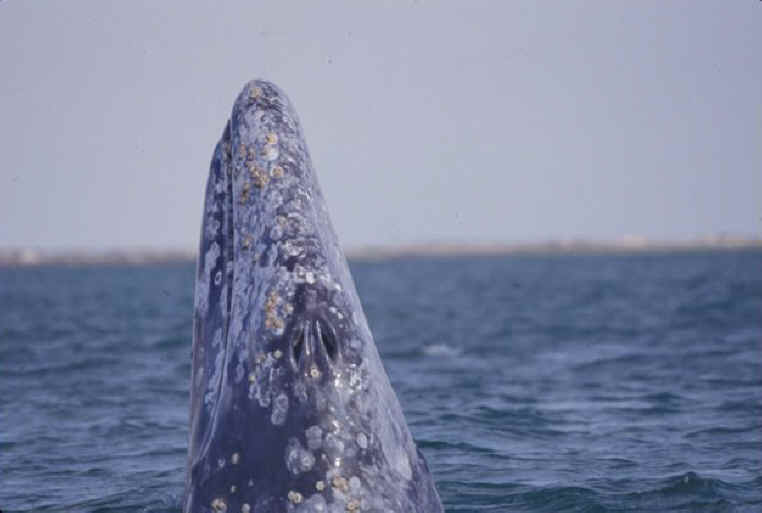
Save the Wild Chukchi Sea—Not Just for You and Not for Me

What a strange time we live in. While Earth’s ecosystems are collapsing, both on land and throughout the sea, the same human greed that’s killing the planet is being planned for the future—as if we’re all that matters.

But as the pack ice melts earlier each year, the thing almost no one mentions is that the portion of the Arctic Ocean known as the Chukchi Sea has been claimed for centuries as strategic and crucial summer feeding grounds for grey whales. These ocean giants only want the amphipods and other benthic crustaceans they can find burrowed in the sand below the cold waters in a region nobody else wanted until now.

If things go as some people plan, Shell and others will soon follow the whales’ ancient migration route north with their oil drilling rigs and deafening seismic cannons for some human business as usual, without stopping to think about the one spill that could send the place to hell. Amphipods cannot live in oil-soaked sand, and whales cannot live without them.

After surviving the barbaric, rapacious whaling era, how sad for the grey whales to simply starve to death as a result of human actions that so many knew should never happen.

Unless the general consensus is that the planet’s going to die anyway (thanks to the likes of them) so why stop now, what are these greedy little monsters thinking? Anything?

I don’t know if there are enough folks who care about others besides themselves or their species to prevent the status quo from destroying the sea, the land, and the atmosphere we all live in, but a lot of lives depend on it.

Text and Wildlife Photography ©Jim Robertson, 2015 All Rights Reserved

Text and Wildlife Photography ©Jim Robertson, 2015 All Rights Reserved