Exposing the Big Game

Forget Hunters' Feeble Rationalizations and Trust Your Gut Feelings: Making Sport of Killing Is Not Healthy Human Behavior

Exposing the Big Game

NOAA proposes de-listing Humpback Whales

Agency proposes taking humpbacks whales off endangered list

By Caleb Jones
Star Advertiser
Associated Press

POSTED: 07:52 a.m. HST, Apr 20, 2015
LAST UPDATED: 08:56 a.m. HST, Apr 20, 2015

< http://www.staradvertiser.com/multimedia/photo_galleries/viewer?galID=300684361>
ASSOCIATED PRESS
A humpback whale jumps out of the waters off Hawaii in this undated photo.
(AP Photo/NOAA Fisheries)

The federal government on Monday proposed removing most of the world’s
humpback whale population from the endangered species list, saying they
have rebounded after 45 years of protections.

National Oceanic and Atmospheric Administration Fisheries wants to
reclassify humpbacks into 14 distinct populations, and remove 10 of those
from the list.

“As we learn more about the species — and realize the populations are
largely independent of each other — managing them separately allows us to
focus protection on the animals that need it the most,” Eileen Sobeck,
assistant NOAA administrator for fisheries, said in a statement.

Humpbacks were listed as endangered in 1970, four years after the
International Whaling Commission banned commercial whaling.

The whales have rebounded in the North Pacific since the listing, which
requires federal approval for federally funded or authorized activities
that could harm whales or their habitat.

Last year, the state of Alaska filed a petition to remove some North
Pacific humpback whales from protection under the Endangered Species Act.
That population, estimated at more than 5,800, feeds in Alaska in the
summer and breeds in Hawaii in winter.

Environmental groups have said North Pacific whales continue to be
vulnerable to factors including increased shipping, climate change and
ocean acidification, which affects the prey stock.

The NOAA said in a release announcing its proposal that protection and
restoration efforts have led to an increase in humpbacks in many areas.

Under the plan, two of the populations would be listed as threatened, in
Central America and the Western North Pacific. The agency said these whales
at times enter U.S. waters.

The other two populations — in the Arabian Sea and off Cape Verde and
northwest Africa — would remain listed as endangered.

Humpbacks are found around the world. They weigh 25 to 40 tons and can grow
up to 60 feet long, according to NOAA’s website. The whales are primarily
dark gray with some white spots, and their pectoral fins can get as long as
15 feet.

If the proposal passes, the humpback populations that are removed from the
endangered list would still be protected under the Marine Mammal Protection
Act.

The public has 90 days to comment on the recommended changes.

Tell Yahoo! to stop featuring endagered whale products on its site

Goal: 15,000 Progress: 12,919
Sponsored by:The Animal Rescue Site

It wasn’t all that long ago that online retail giant Amazon was in hot water for its sale of whale products from Japan. Now, Yahoo! is under fire for doing the exact same thing.

Yahoo! Japan features products like whale jerky, bacon, and canned whale meat from endangered whale species. Yahoo! has banned the sale of endangered animal products from its other sites, but continues to profit from the sale of whale commodities on its Japanese site. Many of the products come from species of whales that are protected by the International Whaling Commission — regulations that Yahoo! is blatantly shirking.

As one of the Internet’s most prominent corporations, Yahoo! should know better than to sell products that are harmful to any animal species. Tell Yahoo!’s CEO Ross Levinsohn to obey the international moratorium and to stop selling endangered animal products immediately.

 http://theanimalrescuesite.greatergood.com/clickToGive/ars/petition/YahooWhaleProducts
&amp;amp;lt;div class=”scriptWarning”&amp;amp;gt;JavaScript is required to sign this petition!&amp;amp;lt;/div&amp;amp;gt;

Makah Whaling – Whales Must Be Protected in U.S. Waters

Makah Whaling – Whales Must Be Protected in U.S. Waters

March 11, 2015 

http://www.seashepherd.org/commentary-and-editorials/2015/03/11/makah-whaling-whales-must-be-protected-in-us-waters-692

Commentary by Sea Shepherd Founder, Captain Paul Watson

Gray WhaleGray Whale
Photo courtesy of Wiki media commons.

Sea Shepherd Legal (SSL) will make a presentation on April 27th in Seattle at a hearing to be held by NOAA Fisheries on the proposal by the Makah Tribe to kill gray whales in the waters off Washington state. SSL’s position is that this permission should not be granted and that whales must be protected 100% in U.S. waters.

SSL is also exploring legal avenues of opposition to this proposal. Tradition and culture must never be a justification for the killing of whales and dolphins or for violating international conservation law.

In 1998, Sea Shepherd exposed documents released under the Freedom of Information Act that exposed negotiations between the Makah and the Japanese whaling industry that would have sold meat from the “traditional” hunt to the Japanese market.

As Makah Tribal Elder Alberta Thompson said at the time, “This is not tradition. It was part of our culture to weave baskets and to pick berries in the mountains. It was part of our culture to speak our language. No one want to weave baskets or to speak Makah. What they want to do is to kill a whale with an anti-tank gun – and that has never been a part of Makah culture.”

Sea Shepherd Legal is a 501(c)(3) entity, operating separately from Sea Shepherd Conservation Society.

Makah tribe grey whale hunt question reopened by NOAA report

Whales, fed up with being fished, take revenge on fishermen

BBC.com

what a moby dick

Whales, fed up with being fished, take revenge on fishermen

http://grist.org/list/whales-fed-up-with-being-fished-take-revenge-on-fishermen/?utm_source=newsletter&utm_medium=email&utm_term=Weekly%2520Feb%252010&utm_campaign=weekly

Humans! For centuries you hunted my kind, stabbed us with your little toothpicks, stripped us of our tasty, tasty blubber, and then, probably, danced merry jigs on our corpses. In an act of true hubris, you even wrote it all down.

Well, joke’s on you, because we’re smart fuckers and now we’re getting our revenge — best served cold-as-Arctic-waters, where sperm whales have learned to strip the fish right off of fishermen’s lines. From the BBC:

This giant animal’s deft trick was filmed for the first time by a group of scientists based in Alaska … It shows a sperm whale using its long jaw to create tension on the line, which in turn snaps fish off the hooks. This feeding behaviour is called depredation and experts think it is learned by the whales.

“I don’t know how to quantify their intelligence but their effectiveness is almost perfect,” says Stephen Rhoads, a boat skipper who has been fishing in the area for 20 years.

Damn straight it is. You think we’d bother to dive and catch our own fish when you are basically unspooling miles of free buffet each time you let out all that longline? In short: You trippin’, particularly if you think we are leaving you with any black cod (our fave!).

The scientists hope to eventually tag 10 individuals – known as the ‘bad boys’ – who are seen around boats most often. One of the most regular visitors has even earned the name Jack the Stripper after being seen nine out of the last 10 years in the same part of the Gulf.

‘Strips’ to his friends — but fishermen, it should go without saying, are not his friends.

120 sperm whales have been observed, all of which are male, scientists estimate there may be 235 in total. Up to 10 whales have been seen around fishing boats, which is unusual as adult males usually hunt on their own and could also point towards depredation being socially transmitted between whales.

They also discovered that the whales, who hunt using echolocation, are alerted to the fact fishing is taking place by the sound of boat engines shifting gear as the crew haul in the catch, this can be detected from several miles away.

Maybe if you humans weren’t so effing loud, we’d leave some cod for you. (Ha! Just kidding.) But no — you have to stomp all over the place, broadcasting your wretched presence.

“Now the tables have turned, whaling is banned, and sperm whales are returning and learning to take on fishermen in bold and surprising ways – and so far there is very little the fishermen can do about it.

I only have one question left for you pathetic buffoons: You need some ice for that burn? Too bad, because we’re running out of that, too. (And that’s also your fault, morons.)

Sincerely,

A Whale

Protesters in contempt of court for anti-whaling campaign

http://www.komonews.com/news/national/Protesters-in-contempt-of-court-for-anti-whaling-campaign-286457501.html

Protesters in contempt of court for anti-whaling campaign
File – In this Feb. 20, 2013 file photo provided by Sea Shepherd Australia, the Japanese whaling vessel Nisshin Maru, right, collides with the Sea Shepherd ship Steve Irwin in waters near Antarctica. (AP Photo/Sea Shepherd Australia, Tim Watters, File)
SAN FRANCISCO (AP) – Radical environmentalists who threw acid and smoke bombs at Japanese whalers were found in contempt of court for continuing their relentless campaign to disrupt the annual whale hunt off the waters of Antarctica.

The 9th U.S. Circuit Court of Appeals Friday ordered a commissioner to determine how much Paul Watson and members of the Sea Shepherd Conservation Society he founded owe Japanese whalers for lawyer fees, damage to their ships and for violating the court order to stop their dangerous protests.

The Japanese whalers are demanding $2 million in addition to their attorney fees and damage and cost to their ships for warding off the protests.

The environmentalists’ exploits have been documented on the long-running Animal Planet reality TV series “Whale Wars.”

Sea Shepherd said in a statement it is disappointed with the ruling and considering its legal options.

“We are considering our legal options at this time, including the possibility of an appeal,” it said.

In 2012, the court ordered Sea Shepherd to stay at least 500 feet from Japanese whalers and to halt dangerous activities like attempting to ram the whalers and throwing smoke bombs and bottles of acid at their ships. The crews of Sea Shepherd ships also drag metal-reinforced ropes in the water to damage propellers and rudders, launch flares with hooks, and point high-powered lasers at the whalers to annoy crew members.

The Japanese whalers filed a lawsuit in Seattle in 2011 seeking a court order halting the Sea Shepherd’s campaign.

The 9th Circuit in December 2012 ordered the Sea Shepherd’s to stop harassing the Japanese fleet and for the group’s four ships to stay at least 500 feet from the whalers.

Watson then transferred all of Sea Shepherd’s U.S. assets to foreign entities controlled by the group. Sea Shepherd has organizations in Australia, Belgium, France, Germany, the Netherlands and the United Kingdom.

Watson also stepped down from the board of directors of Sea Shepherd organizations in the U.S. and Australia. Sea Shepherd Australia took over management of “operation zero tolerance,” the group’s annual harassment campaign of the whalers in the Southern Ocean.

Watson also resigned as captain of the Sea Shepherd’s flagship the “Steve Irwin,” but remained aboard as an “observer.”

In February 2013, the 9th Circuit appointed a commissioner to investigate whether Watson and members of the Sea Shepherd should be held in contempt. The commissioner concluded on Jan. 31 that the Sea Shepherd wasn’t in violation of the court order because the harassment campaign was being managed outside the United States. The same month, the group’s “Steve Irwin” vessel with Watson aboard collided with a Japanese whaler.

More: http://www.komonews.com/news/national/Protesters-in-contempt-of-court-for-anti-whaling-campaign-286457501.html

Urge President Obama to end the Navy’s deadly assault on whales

From NRDC.org:  How many whales have to die before the Navy reins in its use of dangerous sonar and explosives during routine training and testing exercises?

Just recently, beaked whales mass-stranded and died — for the fourth time — on the beaches of Greece during U.S. Navy joint exercises offshore. Experts are alarmed that the region’s beaked whale populations are being decimated.

As Commander in Chief, President Obama can end the Navy’s deadly assault on whales right now with one stroke of his pen. But that is unlikely to happen unless hundreds of thousands of us make our voices heard loud and clear.

Tell the President to intervene immediately and direct the Navy to put vital whale habitat off-limits during routine training.

The Navy estimates it could kill nearly 1,000 marine mammals over the next five years during training and testing with sonar and explosives. There will be more than 13,000 serious injuries, such as permanent hearing loss or lung damage.

The National Marine Fisheries Service — the agency charged with defending marine mammals — has not delivered on its promise of protective action. Instead, it has authorized the Navy to inflict an unprecedented level of harm on whales and dolphins.

It’s time for the Commander in Chief to lay down the law.

Please tell President Obama not to allow the military killing of marine mammals on his watch. Call on him to put marine mammal habitats off-limits to sonar and explosives — for good.

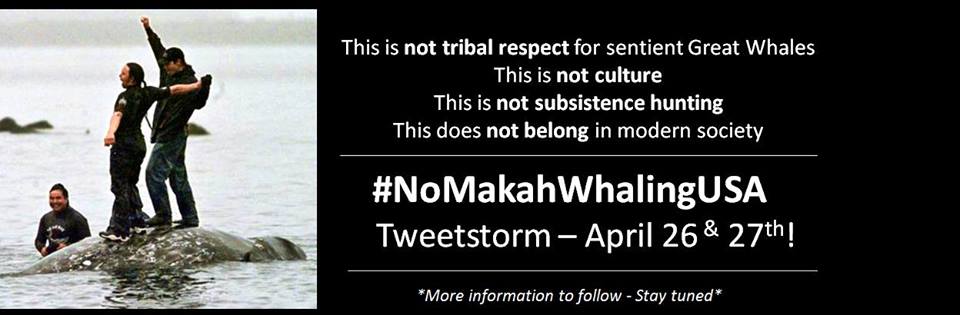
Makah Want Another Whale

Makah whalers celebrate atop a dead gray whale in Neah Bay after the successful hunt in this May 17, 1999, photo. — Elaine Thompson/The Associated Press

Makah whalers celebrate atop a dead gray whale in Neah Bay after the successful hunt in this May 17, 1999, photo. — Elaine Thompson/The Associated Press

Makah group marks anniversary of whale hunt (AP)

…Meanwhile, federal officials are in the process of finalizing an environmental review that could lead to another hunt, the Daily News reported. The tribe is currently seeking authorization from the National Oceanic and Atmospheric Administration (NOAA) Fisheries agency under the Marine Mammal Protection Act to hunt gray whales for subsistence purposes.

In 2012, NOAA scrapped a 2008 draft environmental impact statement of Makah whaling and began a new draft environmental impact statement, after new scientific information found that a group of gray whales that frequents the Washington coast may be different than the 20,000 whales that migrate past the state each year on their way between Alaskan and Mexican waters.

Donna Darm, associate deputy administrator for the NOAA’s west region, said a new statement incorporating that information should be ready for public review by the fall.

“There’s been a lot of new science that we received since the 2008 draft,” Darm told the Daily News Thursday.

That information will not necessarily affect the tribe’s hunt, but it will require that tribal hunters carefully identify what group any future whales they take come from, according to the Daily News.

“Nothing we’ve learned really changes what the tribe has proposed in the first place,” Darm said. “It just changes what we see as far as impacts.”

http://www.peninsuladailynews.com/article/20140517/NEWS/305179987/makah-group-plans-to-mark-whale-hunt-anniversary-saturday-in-neah-bay

….Animal welfare and other groups decried the 1999 killing and later sued to stop the hunts.

Legal challenges then put the whale hunts on hold.

In 2004, the 9th U.S. Circuit Court of Appeals said the Makah could not obtain a waiver under the Marine Mammal Protection Act until an environmental assessment was prepared.

An illegal whale hunt in 2007 led to the death of gray whale and federal prison sentences for two Makah tribal members, including Johnson.

Makah whalers commemorate 15th anniversary of last legal whale kill

http://www.peninsuladailynews.com/article/20140518/NEWS/305189969/makah-whalers-commemorate-15th-anniversary-of-last-legal-whale-kill

By Joe Smillie
Peninsula Daily News

Also see:  Makah group plans to mark whale hunt anniversary Saturday in Neah Bay

NEAH BAY –– Fifteen years after returning from their tribe’s last legal whale kill, some members of the crew of Makah whale hunters who led that hunt set out again into the bay aboard the Hummingbird whaling canoe Saturday.

“It gives me chills. It just gives me chills,” said Charlotte Williams King.

Descended from a long line of whalers, King thought of her ancestors as she watched the canoes paddle in Neah Bay.

Her great-grandfather, John “Hiska” McCarty, dove underwater to tie closed the mouths of harpooned whales.

“I didn’t really realize it, but 15 years is a long time,” she said.

Saturday’s paddle, which included a chase canoe, was organized by the Makah Whaling Commission.

It commemorated the anniversary of the tribe’s successful whale hunt on May 17, 1999. It was the first time in 50 years that the Makah had harpooned a whale, and it happened aboard Hummingbird.

Members of the 1999 hunt crew led by Capt. Wayne Johnson were Theron Parker, Mike Steves, Darrell Markishtum, Glenn Johnson, Keith Johnson, Arnie Hunter, Franklin Wilson, Bruce Gonzelas, Dan Greene, Gordon Parker, Andy Noel, Donald H. Swan and Greg Arnold.

Most were aboard Hummingbird on Saturday.

Keith Johnson, president of the whaling commission, recalled the controversy that surrounded the 1999 kill of a gray whale, nicknamed “May,” whose skeleton now hangs in the Makah Cultural and Research Center in Neah Bay.

“Last time we had a whaling crew in that [canoe], those terrorists, those eco-terrorists, that were out there in their Zodiacs waking our boat and throwing smoke canisters at us,” Keith Johnson remembered.

The last whale killed by Makah tribal members was in 2007, when a group of five illegally shot dead a gray whale.

Members of the 2007 crew were Wayne Johnson, Parker, Noel, Gonzales and William Secor Sr.

Wayne Johnson served five months in federal prison and Noel 90 days for their roles in the kill.

Hummingbird was retired in 2006 after it capsized, killing Joseph Andrew “Jerry” Jack, a hereditary chief of the Mowachaht/Muchalaht tribe of Vancouver Island, during an InterTribal Canoe Journey.

Some had called for Hummingbird to be burned, Keith Johnson said, saying it had been cursed.

“You don’t burn a whaling canoe,” he said Saturday. “You bless it.”

The Makah voluntarily stopped hunting gray whales in the 1920s when populations diminished. Gray whales were listed as endangered species in 1970.

When the species was taken off the list in 1994, the Makah worked to resume subsistence hunting.

In the 15 years since the legal kill, the tribe’s right to hunt whales, guaranteed in the 1855 Treaty of Neah Bay, has been embroiled in court reviews over science.

After being allowed to hunt in 1998 and 1999,which ended in the killing of one whale, whale hunts were stopped shortly thereafter by a federal court order saying the Makah needed an environmental impact statement to obtain a waiver from the federal Marine Mammal Protection Act.

The International Whaling Commission in 2007 granted the tribe the right to kill as many as 20 whales over five years — with no more than five in a single year — but it still must get a federal waiver to conduct a hunt.

“We have judges that are animal rights activists that will do anything to put a road block in front of our treaty right to hunt whales,” Keith Johnson said.

“Just leave us alone.”

Conservationists say they are pleased that it’s been 15 years since the last legal hunt.

“We feel differently about the 15th anniversary,” said Margaret Owen, who formed Peninsula Citizens for the Protection of Whales with her husband, Chuck, to speak against the tribe’s whale hunts.

“There’s 60 whales that could have been killed in that time,” Owens said.

A draft environmental impact statement underway in 2008 was stopped by new scientific information that found the group of gray whales that frequents the Washington coast has distinctive genetic markers that differentiate them from the 20,000 gray whales that migrate along the West Coast.

“Those resident whales would have been gone,” Chuck Owens said.

Donna Darm, associate deputy administrator for NOAA’s west region, said Thursday a new statement incorporating that information should be ready for public review by the fall.

Darm and Keith Johnson noted that the tribe’s hunt plan calls for kills of transient whales only.

The 1999 hunt was uplifting for many members of the tribe, according to Makah General Manager Meredith Parker.

“There’s a lot of pride that has stuck with us from that 1999 hunt,” Parker said, “because we did it the right way.”

But the rogue 2007 hunt created divisions, Keith Johnson said, pointing out there was no event to mark the 10-year anniversary of the 1999 hunt.

“Do you see the whole tribe here?” he asked as he pointed to the three dozen people on the beach before Saturday’s commemorative paddle.

Saturday’s paddle began with a prayer for more unity from Gordon Lyons and a song for good luck from Darrell Markishtum.

Keith Johnson expressed hope that divisions within the tribe could be closed.

“It’s our traditional food, and people still want it,” Johnson said. “And if for no other reason, a lot of people here will support us for the treaty right.”

Johnson also pointed to the tribe’s cohesion in 1999.

“When we all get attacked, we all stick together. Because we’re one community.”
DSC_0036


Sea Shepherd Applauds the World Court for Protecting the Whales of the Southern Ocean Whale Sanctuary

http://www.seashepherd.org/news-and-media/2014/03/31/the-whales-have-won-icj-rules-japans-southern-ocean-whaling-not-for-scientific-research-1569

The International Court of JusticeThe International Court of Justice
Photo courtesy Wikimedia Commons

In a stunning victory for the whales, the International Court of Justice (ICJ) in The Hague announced their binding decision today in the landmark case of Australia v. Japan, ruling that Japan’s JARPA II whaling program in the Antarctic is not for scientific purposes and ordering that all permits given under JARPA II be revoked. The news was applauded and celebrated by Sea Shepherd Conservation Society USA and Sea Shepherd Australia, both of which have directly intervened against Japanese whalers in the Southern Ocean.

Representing Sea Shepherd in the courtroom to hear the historic verdict were Captain Alex Cornelissen, Executive Director of Sea Shepherd Global and Geert Vons, Director of Sea Shepherd Netherlands. They were accompanied by Sea Shepherd Global’s Dutch legal counsel.

The case against Japan was heard by the ICJ in July of last year to decide whether Japan is in breach of its international obligations in implementing the JARPA II “research” program in the Southern Ocean, and to demand that Japan cease implementation of JARPA II and revoke any related permits until Japan can make assurances that their operations conform with international law.

In a vote of 12 to 4, the ICJ ruled that the scientific permits granted by Japan for its whaling program were not scientific research as defined under International Whaling Commission regulations. It ordered that Japan revoke the scientific permits given under JARPA II and refrain from granting any further permits under that program.

A minke whale spyhops in the middle of iceA minke whale spyhops in the middle of ice
Photo: Sea Shepherd
Prior to the verdict, there had been some speculation that the ICJ would not permit the hunting of endangered fin and humpback whales, but it would compromise and allow the hunting of minke whales. However, it has been Sea Shepherd’s contention all along that — no matter the species — no whales should be killed, especially in a sanctuary. Sanctuary means “a place of refuge or safety; a nature reserve” where animals are protected. To allow killing in an internationally designated sanctuary is to make a mockery of international agreements made by those countries who established the sanctuary in 1994. At that time, 23 countries supported the agreement and Japan was the only IWC member to oppose it.

Even the Ambassador from Japan to the U.S., Kenichiro Sasae, during a public meeting in Los Angeles in December 2013 attended by representatives of Sea Shepherd USA, had this to say about whales and whaling: ”As an individual, I like whales and if you go out and see the whales, there is no reason for us to kill this lovely animal. But it’s history and it’s politics, I would say. There are a small number of Japanese people still trying to get this won. But mainstream Japanese are not eating whale anymore.” At the same meeting, Ambassador Sasae stated that Japan will abide by the ICJ ruling.

Ambassador Kenichiro Sasae

Read the transcript here

Sea Shepherd Conservation Society’s international volunteer crew stood on the frontlines in the hostile and remote waters of Antarctica for eight years and then Sea Shepherd Australia took up that gauntlet for the last two years and will keep confronting Japanese whalers in Antarctica until we can once and for all bring an end to the killing in this internationally designated “safety zone” for whales. Over the years, Sea Shepherd has been the only organization to directly intervene against Japan’s illegal commercial whaling conducted under the guise of research, with their claims of research globally questioned. Indeed, Sea Shepherd has been the only thing standing between majestic whales and the whalers’ harpoons, as these internationally protected species — many of them pregnant — migrate through Antarctic waters each year.

“With today’s ruling, the ICJ has taken a fair and just stance on the right side of history by protecting the whales of the Southern Ocean Whale Sanctuary and the vital marine ecosystem of Antarctica, a decision that impacts the international community and future generations,” said Captain Alex Cornelissen of Sea Shepherd Global.

“Though Japan’s unrelenting harpoons have continued to drive many species of whales toward extinction, Sea Shepherd is hopeful that in the wake of the ICJ’s ruling, it is whaling that will be driven into the pages of the history books,” he said.

“Despite the moratorium on commercial whaling, Japan has continued to claim the lives of thousands of the gentle giants of the sea in a place that should be their safe haven,” said Sea Shepherd Founder, Captain Paul Watson. “Sea Shepherd and I, along with millions of concerned people around the world, certainly hope that Japan will honor this ruling by the international court and leave the whales in peace.”

Sea Shepherd Global will have the ships prepared to return to the Southern Ocean in December 2014 should Japan choose to ignore this ruling. If the Japanese whaling fleet returns, Sea Shepherd crew will be there to uphold this ruling against the pirate whalers of Japan.