Exposing the Big Game

Forget Hunters' Feeble Rationalizations and Trust Your Gut Feelings: Making Sport of Killing Is Not Healthy Human Behavior

Exposing the Big Game

Trail-Building: Habitat Destruction by a Different Name

Michael J. Vandeman, Ph.D.
September 2, 2017

“Impacts on and along trails result from the trampling of hikers and pack stock and the effects of trail construction and maintenance. … These impacts include the loss of vegetation and shifts in plant-species composition, exposure of bare mineral soil, soil compaction, and changes in microhabitats, including changes in draining and erosion. Where trail construction is carefully planned, most of these changes are of little concern; although pronounced. Most changes are localized and deliberate.” Dawson and Hendee, 2009, pp. 423-4

“The study revealed that almost 80% of extinction research in the country focused on cute marsupials such as kangaroos and koalas, whereas not-so-adorable critters such as bats and rodents held only 11% of research time, despite making up almost half of the species examined.” https://mygoodplanet.com/selective-fashion-going-extinct/

Scientists are generally honest, in what they say – but not in what they choose to study. Despite a diligent search in one of the world’s best libraries (the University of California, Berkeley), I wasn’t able to find a single book or article on the harm done by trail-building. I notice that whenever I see a picture of a trail, I think “Oh, a trail – so what?” It takes an effort of will to think about the wildlife habitat that was destroyed in order to build the trail. And the habitat destruction isn’t restricted to the trail bed. As Ed Grumbine pointed out in Ghost Bears, a grizzly can hear a human from a mile away, and smell one from five miles away. And grizzlies are probably not unique in that. In other words, animals within five miles of a trail are inhibited from full use of their habitat. That is habitat destruction! If there were no trails, we would be confronted by our own destructiveness every time we entered a park. It is only because the habitat has already been destroyed for us, that we can pretend that we are doing no harm.

So why do we build trails? It doesn’t take much experimenting with cross-country travel to see that it is extremely difficult. There are many kinds of hazards – biological (e.g. poison oak, poison sumac, poisonous snakes, etc.) and physical (e.g. blackberry thorns, cliffs, rivers, volcanos, etc.). It is extremely difficult to find a passable-, much less an efficient, route. It would be very difficult to communicate our location to emergency personnel, without trails. So it is unlikely that we will eliminate trails in the near future, except from areas designated off-limits to humans.

That leaves only one option compatible with wildlife conservation: minimizing the construction, extent, and use of trails. For example, banning the use of off-road vehicles, such as bicycles, skateboards, and motorcycles would greatly reduce the use of the trails, the distance that people travel, and the harm done to the soil and the small animals and plants found on, under, or near the trails. Mountain bikers complain about being thereby “denied access”, but of course they can still walk. They just can’t easily travel as far as they can on a bike. On public land, especially, all trail construction should be thoroughly studied, and should be built only when officially authorized by the land manager, and only by thoroughly educated, authorized builders.

By far the greatest threat to wildlife habitat in so-called “protected” areas would appear to be mountain biking. Motorized vehicles are generally not allowed in natural areas. The most destructive use of trails is mountain biking. Knobby tires are perfectly designed to rip up the soil. Mountain bikers, with rare honesty, call their riding “shredding”. They also have a much greater range than hikers, and probably also equestrians. They also frequently ride illegally – where bicycles are not allowed.

All of this is well known. But what isn’t so well known or understood is the mountain bikers’ drive to build ever more trails. All park users seem to have a need for a certain amount of stimulation. A hiker or equestrian can satisfy that need on a relatively short trail, because they experience it fully, through all of their senses. They can stop instantly, and turn 360 degrees, seeing, hearing, smelling, touching, or tasting anything they choose. Mountain bikers, on the other hand, tend to ride fast, often as fast as they can, seeking what they call an “adrenaline rush”. But even when riding slowly, the very nature of a bicycle requires one to focus almost 100% of his or her attention on the trail immediately in front of their front tire, or they will crash. The consequence is that they have to travel several times as far as a hiker, to have the same quantity of experience. And after riding the same trail a few times, they get bored with it and want to ride a new trail. And when they’ve ridden all their local trails, they begin demanding more trails to be built. Or, if their demands aren’t met, they begin secretly building illegal trails, or building illegal “trail features” (jumps, berms, log bridges, teeter-totters, etc.). The rain-forests of North Vancouver are the iconic example (which destruction continues to this day), but it has been emulated by mountain bikers all over the world.

If this were a matter of a few sites or a few trails, it wouldn’t be too significant. But it’s not restricted to one area. Mountain bikers, apparently ignorant of conservation biology, have destroyed thousands of square miles of wildlife habitat, and show no signs of slowing down or recognizing the harm that they are doing. IMBA (the International Mountain Bicycling Association) has been promoting mountain biking tourism, claiming that mountain biking brings economic benefits to communities that embrace it, of course ignoring the economic value of the intact ecosystems they are destroying. The mountain biking infrastructure is called “epic trails”, “ride centers”, “bike parks”, etc. They bait their demands with offers of volunteer trail-building and trail maintenance. (But, of course, their vision of a good trail (lots of humps, twists, and turns) is quite different from what the other trail users want.)

In the San Francisco Bay Area, projects were created to build two huge trails – the Bay Trail and Ridge Trail – each several hundred miles long, circling the bay near the water and along the ridgetops. The community enthusiastically voted for these projects, waxing poetic about all the “new opportunities” to “connect to nature”. Actually, no new habitat was created, and the trail construction (which still continues) destroyed an enormous amount of habitat. Nevertheless, I never heard anyone complain about this. People seem to think that trails somehow thread their way through the wilderness harmlessly, without touching it.

Haven’t we already destroyed far too much wildlife habitat? Isn’t it time we started telling the truth about trails and our construction and use of them?

Here are a few examples of the destructiveness of trail construction and use (for an online copy of this paper, where you can click on the links and won’t have to type them, see https://mjvande.info/scb9.htm ):

100 Seconds of Trail Destruction with Matty Miles:
https://video.search.yahoo.com/yhs/search?fr=yhs-adk-adk_sbnt&hsimp=yhs-adk_sbnt&hspart=adk&p=mountain+biking+destruction#id=5&vid=b8f9aa6796e6a78ebd127bca34017f48&action=click
(Can you imagine what would happen to you if you happened to be on this trail?!)

Mountain bike trail building: https://www.youtube.com/watch?v=TtZaUS8YreU

Illegal mountain bike trail construction, Hop Ranch Creek Squamish BC May 27,2014:
https://www.youtube.com/watch?v=tcwfT68fV0U&feature=youtu.be

IMBA promotes trail-building:
“Saturday is National Public Lands Day
Get connected with your local IMBA chapter or club to see if it is hosting a volunteer trail day this Saturday. Trails don’t build themselves…show some love for the places you love to ride!
Dig In Applications Open Through October 6
IMBA is currently accepting applications for its new Dig In Campaign – a grant program that directly supports local IMBA chhapters [sic] with actionable trail projects. The project list will be published in early October so stay tuned to see what’s happening near you.”
Vancouver’s North Shore – All Built Illegally! (The video is 51 minutes long, but every minute is worth watching. Very enlightening!):
https://www.youtube.com/watch?v=8mB_gOzG7Oc

IMBA wants to create 500 more miles of trail!:
https://www.imba.com/news/imba-launches-dig-in

669 miles of mountain biking trail:
https://oregontimbertrail.org/

San Francisco Bay Trail: 500 miles: http://baytrail.org/

Bay Area Ridge Trail: 375 miles, growing to 500 miles: http://ridgetrail.org/

Long-distance trails in the United States: https://en.wikipedia.org/wiki/Long-distance_trails_in_the_United_States

Examples of Destructive Trail-Building:
Illegal Trail Building in Whistler (I am in no way implying that legal trail building is acceptable! They both destroy wildlife habitat!):
https://www.piquenewsmagazine.com/whistler/wb-incorporates-dark-crystal-into-its-trail-system/Content?oid=4537412

Glorification of illegal trail building:
https://www.revelstokemountaineer.com/the-spokin-word-treading-the-high-seas/

IMBA: “IMBA is currently accepting applications for its new Dig In Campaign, a grant program that directly supports local IMBA chapters with actionable trail projects. We are committed to growing access for mountain bikers and increasing the pace of new builds in the U.S.” “It takes a village: that statement of wisdom is particularly true in the mountain bike community, where volunteers, experts and funders must come together to make great places to ride happen. In Wausau, WI, the Central Wisconsin Offroad Cycling Coalition (CWOCC), an IMBA chapter, recently completed a multi-year project that resulted in a pumptrack, four bike-optimized downhill trails of varying difficulty and a beginner-friendly loop, all designed by IMBA Trail Solutions.”

“How To Build A Legit DH Bike Trail”:
https://www.youtube.com/watch?v=uPoSchTxSs8&feature=youtu.be

Glorifying trail-building and mountain biking:
https://www.facebook.com/globalcivic/videos/1437735176244789/

Day in the life of a Trail Builder: https://www.youtube.com/watch?v=MekS557BEUo: the upbeat background music clearly indicates the mountain bikers’ attitude: trail building – legal or illegal – is fun and has no moral implications

Building a Mountain Bike Flow Trail:
https://www.youtube.com/watch?v=Ufswp1ABCLU
https://www.imba.com/resources/trail-building/10-most-common-trailbuilding-mistakes
https://mmbhof.org/north-shore-trail-builders/
https://www.singletracks.com/blog/mtb-trails/mountain-bike-trailbuilding-101/

10 Ways to Make Your Mountain Bike Trail Awesome! – Part 1: https://bikefat.com/10-ways-to-make-your-mountain-bike-trail-awesome-1/

10 Ways to Make Your Mountain Bike Trail Awesome! – Part 2: https://bikefat.com/10-ways-to-make-your-mountain-bike-trail-awesome-2/

Build a Mountain Bike Trail: http://www.instructables.com/id/Bulid-a-Mountain-Bike-Trail/
Trail Building: https://www.pinkbike.com/forum/trail-building/

OUR DIRT: Mountain Bike Trail Building Documentary: https://vimeo.com/65738812 no speed limit, will hit anything in the trail; too fast to appreciate anything; no knowledge of biology or conservation.
https://www.facebook.com/media/set/?set=a.10203947520996337.1073741831.1471603969&type=1&l=df5b117fa3

Don’t forget this one. This is what “rock armored” mountain bike trails turn into during heavy rains:
https://youtu.be/pOXYaYFfLyo
Because of all the damage done to our mountain slopes from too much trail building, they are building debris flow basins in our creeks, here — but the authorities won’t stop the mountain biking… It is costing us millions of dollars….

Here is more from British Columbia:

Delta, BC…
https://youtu.be/7q67O7r60fY (Illegal trail damage to riparian area)
This trail build was legitimate, but shows the damage done by too many people trail building, and pulling huge roots out, in a stupid kind of challenge race to see which team can build the most trail in the shortest time. Pure mayhem at work here (all through pristine area of forest, destroying the ground cover, and digging borrow pits to collect dirt and rocks to pack on the trails):
https://youtu.be/muicHp5kaKs (at the .24 mark, you can see a guy just tear out a large tree root…) “When Arc’teryx challenged MEC to a trail building competition, we jumped at the chance to get dirty… plus we couldn’t resist a little friendly competition. So on November 17, dozens of MEC staff and supporters met up with the NSMBA to dig, grub and mine for gold on the North Shore. Our goal was to build more trail than Arc’teryx over a few hours.”

Unauthorized bike trail damages “pristine habitat” in Forest Park:
https://bikeportland.org/2010/02/23/unauthorized-bike-trail-damages-pristine-habitat-in-forest-park-29920

Tracking the environmental impact of mountain biking in bushland:
http://www.abc.net.au/radionational/programs/offtrack/tracking-the-environmental-impact-of-mountain-biking/6559202

Mountain bikers are also degrading forests and thereby contributing to global warming:
https://www.theguardian.com/environment/2017/sep/28/alarm-as-study-reveals-worlds-tropical-forests-are-huge-carbon-emission-source

The damage mountain bikers do on Fromme Mtn. Seems one builder, MW, who left the NSMBA hasn’t gone away (still digging on the North Shore) — and the NSMBA continues to give a thumbs up to this sort of digging and building:
http://www.pictame.com/media/1472817891010303069_435668765

More trenches dug in the name of “sustainable” mountain biking…:
http://www.pictame.com/media/1553816771487873049_435668765

and this is what they dug up the forest to build (video of the jump structure in action):
http://www.pictame.com/media/1555623388244116041_435668765

How many buckets of gold dirt [mineral soil] and borrow pit digging was required to pack all that dirt on the eroded mtb trail on Mt. Fromme?:
http://www.pictame.com/media/1493117981432213889_435668765

This is what the NSMBA bragged about last year… How much more this year? For your trail building files/paper to show how devastating this all is:
https://twitter.com/MECraver/status/890267891144081408

Pleasanton Ridge Illegal Trails – Park Ranger Helicopter Incident 1-27-12 (NICA coaches taking high school mountain bikers on an illegal ride, in violation of their own “rules”; note the nasty comments from the mountain bikers):
https://www.youtube.com/watch?v=EJQJeB3hruA

Robert Moor: Only a single sentence negative on trails: “[W]e leave the most destructive trails, I think, of any group of animals” p.160

Proof That High School Mountain Bike Racing Is Environmentally Destructive:
https://norcalmtb.smugmug.com/2017-Race-4-Granite-Bay-Grinder-Folsom/i-WQ2zCCG
https://norcalmtb.smugmug.com/2017-Race-4-Granite-Bay-Grinder-Folsom/i-mxvW2BD
https://norcalmtb.smugmug.com/2017-Race-4-Granite-Bay-Grinder-Folsom/i-mVDCGbF

Trees are falling, due to erosion exposing their roots:
http://www.pictame.com/media/1657084424238301428_2237726428

Intact forests are the key to fresh water:

https://news.ok.ubc.ca/2017/12/07/forests-are-the-key-to-fresh-water/

http://www.euanforresterphotography.com/evidence-of-trail-fairies (click on each photo with cursor to see the story behind the illegal trail building…. some of it at night time, hiding under darkness.) This is now celebrated and applauded….wrong became a right, overnight… This is how mountain bikers won CMHC… This is the sordid history of mountain biking on our North Shore…

So much digging for dirt to pour over their ever eroding and compacted trails. The riding style seen in the last part of this video is the reason why the trails become that way, eroded and compacted. Anyone who tries to paint this MTB sport as benign as hiking, etc. needs to watch this until their eyes pop out!:
https://www.facebook.com/nsmba/videos/10155414065825036/

Illegal trail building a vexing problem for public land managers:

https://durangoherald.com/articles/214352-illegal-trail-building-a-vexing-problem-for-public-land-managers

An example of how a mountain biker role model rides:
https://nsmb.com/articles/trail-destruction-matty-miles/

Illegal mountain biking on Mount Royal is damaging its ecosystem, experts say. Repeatedly crossing the mountain’s soil loosens tree roots, affects Laurentian flora: http://www.cbc.ca/news/canada/montreal/mount-royal-mountain-biking-1.4675779

North Shore Mountain Biking Association Rationalizes Its Illegal Trail-Building:
https://nsmb.com/articles/bc-warns-illegal-building-could-bring-jail-time-10k-fine/

Illegal trail-building in Kelowna, BC: http://www.kelownadailycourier.ca/life/article_3c900d9e-8c75-11e8-9837-7b4caec74090.html

Endangered bees caught in middle of plan to add mountain biking trails in Minnetonka, MN:http://www.startribune.com/endangered-bees-caught-in-middle-of-plan-to-add-mountain-biking-trails-in-minnetonka/490114431/

Habitat destruction by mountain bikers using heavy equipment on Bowen Island, BC:https://www.instagram.com/explore/tags/goldendirttrails/?hl=en https://www.instagram.com/goldendirttrails/?hl=en

Photo showing the extra habitat destroyed by a winding vs. straight trail: https://www.stuff.co.nz/nelson-mail/news/110050760/nelson-mountain-bike-club-comes-of-age-as-a-big-cog-on-nz-landscape

A 2,000-km biking trail set to open in the Balkans:

https://www.thejakartapost.com/travel/2019/01/28/a-2000-km-biking-trail-set-to-open-in-the-balkans.html

Profiting from habitat destruction (trail-building):
https://www.bcbikerace.com/resources-to-recreation/
https://vimeo.com/278210701

Mountain bikers build illegal trails first, then ask permission only if they get caught!:
https://www.northamptonchron.co.uk/news/mountain-bikers-who-built-ramps-at-northampton-park-accused-of-vandalism-by-borough-council-1-8845649 The same thing happened in both Victoria, BC and LaSalle, Ontario. Kids built dirt jumps in parks without permission. The cities razed them and the mtb kids whined…

It’s not trails that disturb forest birds, but the people on them
https://www.sciencedaily.com/releases/2018/11/181112082417.htm
“We believe protected areas with forbidden access are necessary and important, and that new trails into remote forest areas should not be promoted. Visitors to existing forest trails should be encouraged to adhere to a ‘stay on trail’ rule and refrain from roaming from designated pathways.”

https://www.theage.com.au/national/victoria/anarchistic-mountain-bikers-threaten-inner-city-park-s-rare-plants-20190205-p50vt3.html : “Mountain bike riders are currently the park’s most destructive user group.”

References:

Dawson, Chad P. and John C. Hendee, Wilderness Management – Stewardship and Protection of Resources and Values. Golden, CO: Fulcrum Publishing, 2009.

Ehrlich, Paul R. and Ehrlich, Anne H., Extinction: The Causes and Consequences of the Disappearances of Species. New York: Random House, 1981.

Errington, Paul L., A Question of Values. Ames, Iowa: Iowa State University Press, 1987.

Flannery, Tim, The Eternal Frontier — An Ecological History of North America and Its Peoples. New York: Grove Press, 2001.

Foreman, Dave, Confessions of an Eco-Warrior. New York: Harmony Books, 1991.

Grumbine, R.E., Ghost Bears. Covelo, CA: Island Press, 1992.

Knight, Richard L. and Kevin J. Gutzwiller, eds. Wildlife and Recreationists. Covelo, California: Island Press, 1995.

Louv, Richard, Last Child in the Woods — Saving Our Children from Nature-Deficit Disorder. Chapel Hill, N.C.: Algonquin Books of Chapel Hill, 2005.

Moor, Robert (robertmoor.ontrails@gmail.com), On Trails. New York: Simon & Schuster, 2016.

Newsome D., C. Davies, “A case study in estimating the area of informal trail development and associated impacts caused by mountain bike activity in John Forrest National Park, Western Australia”. Journal of Ecotourism. 2009 Dec 1; 8(3):237-53.

Noss, Reed F. and Allen Y. Cooperrider, Saving Nature’s Legacy: Protecting and Restoring Biodiversity. Island Press, Covelo, California, 1994.

Reed, Sarah E. and Adina M. Merenlender, “Quiet, Nonconsumptive Recreation Reduces Protected Area Effectiveness”.Conservation Letters, 2008, 1–9.

Stone, Christopher D., Should Trees Have Standing? Toward Legal Rights for Natural Objects. Los Altos, California: William Kaufmann, Inc., 1973.

Vandeman, Michael J., https://mjvande.info, especially https://mjvande.info/ecocity3.htmhttps://mjvande.info/india3.htmhttps://mjvande.info/mtbfaq.htmhttps://mjvande.info/scb7.htmhttps://mjvande.info/sc8.htm, and https://mjvande.info/goodall.htm.

Ward, Peter Douglas, The End of Evolution: On Mass Extinctions and the Preservation of Biodiversity. New York: Bantam Books, 1994.

“The Wildlands Project”, Wild Earth. Richmond, Vermont: The Cenozoic Society, 1994.

Wilson, Edward O., The Future of Life. New York: Alfred A. Knopf, 2002.

[NOTE: This paper can be found at https://mjvande.info/scb9.htm, where you can follow the above links without having to type them.]

RAW VIDEO: Dog and wild coyote play together in Tempe neighborhood

https://www.azfamily.com/video/raw-video-dog-and-wild-coyote-play-together-in-tempe/video_1d81a8d1-8523-57eb-96c2-a09d49a4c6d0.html

  • Posted 
01:5904:37

spaceplay / pause

qunload | stop

ffullscreen

shift + slower / faster

volume

mmute

seek

 . seek to previous

12… 6 seek to 10%, 20% … 60%

An AZ Family viewer recorded video of a wild coyote and her neighbor’s dog playing together in a Tempe neighborhood on Sunday morning. (Source: Courtesy of Cassandra Collett)

How the sapphire trade is driving lemurs toward extinction

A rush for Madagascar’s gemstones is destroying remaining habitat for imperiled lemurs and other wildlife.

Indris, at two feet tall the largest of Madagascar’s lemurs, are big sleepers. The primates awaken two or three hours after sunrise, forage for leaves high in the canopy during the day (amid frequent naps), and choose their spot for the night well before dark.

Lemur Calls

Photographer Adriane Ohanesian recorded calls of the indri—the largest of Madagascar’s scores of lemur species—on the trail between between the mining community of Ambodipaiso and Antsevabe, which serves as the access point to sapphire mines in the Ankeniheny-Zahamena Corridor.

00:15
/
00:00

On our trek into the Ankeniheny-Zahamena Corridor, a protected area known by its French acronym, CAZ, photographer Adriane Ohanesian, translator-guide Safidy Andrianantenaina, and I often heard their calls. The sound, a bit like someone blowing a trombone for the first time, can carry up to a mile through the dense forest.

Left: Mine boss Laurence Asma shows gemstones the team of about 20 men she employs found in the Ankeniheny-Zahamena Corridor (CAZ).

Right: Red fabric tied around a tree on the trail leading to a mining site marks a doany, a

… Read More

PHOTOGRAPH BY ADRIANE OHANESIAN, NATIONAL GEOGRAPHIC

Laurence Asma, 41, stands with her pet common brown lemur outside a miner’s home at the main gem site in the CAZ, known as Tananarive.

PHOTOGRAPH BY ADRIANE OHANESIAN, NATIONAL GEOGRAPHIC

We were hiking deep into the CAZ, a 1,470-square-mile stretch of rainforest joining two national parks that enables lemurs and other animals to mingle their populations, maintaining the genetic diversity that’s essential to their survival. Our goal was to witness firsthand the effects of illegal gem mining on some of the last remaining habitat for wild lemurs.

–– ADVERTISEMENT ––

Our immediate destination, though, was the makeshift village of Ambodipaiso, a staging place for illegal sapphire mines that have turned parts of the CAZ into scarred, treeless wastes. Sapphires were discovered here seven years ago, and by 2016, tens of thousands of Madagascans had flooded in, illegally uprooting trees and diverting streams in hopes of finding gemstones to help lift them out of poverty. (Madagascar ranks 161 in the world in human development, according to the United Nations Development Programme, and 70 percent of its people live in poverty.)

Men carry a sieve, used to wash away dirt and reveal gold and gems, through the makeshift village of Ambodipaiso, a few miles from Tananarive.

PHOTOGRAPH BY ADRIANE OHANESIAN, NATIONAL GEOGRAPHIC

A hundred million dollars’ worth of sapphires and other gems were smuggled out of Madagascar in 1999 alone, according to the World Bank. (This remains the most reliable study; recent estimates suggest the value today is about $150 million a year.) Most of the gem mining is done illegally in reserves, says Christoph Schwitzer, co-vice chair of the Madagascar primate specialist group with the International Union for the Conservation of Nature (IUCN), the organization that sets the conservation status of animals and plants. The CAZ and other reserves, he says, “don’t receive anywhere near adequate protection on the ground.”

Madagascar has the third-highest rate of biodiversity on Earth, after Brazil and Indonesia. Eight of every 10 of its plants and animals are endemic. It has 300 species of reptiles and 300 of amphibians, 99 percent of them found nowhere else. Chameleons: 62 species. And along with the nearby Comoro Islands, Madagascar is the only place on the planet that’s home to wild lemurs—fully 113 species, the newest identified just last year.

The charismatic animals are a magnet for roughly 250,000 visitors a year who directly account for more than 6 percent of the country’s GDP and 5 percent of its jobs. Yet nearly all the lemur species are endangered—38, including indris, critically—and 17 have already gone extinct. Now conservationists and primatologists are gravely concerned about the effects of gem mining on remaining lemur habitat, as much as 90 percent of which has been lost to tree clearing and human incursion.

“Gems mining can be a significant driver of habitat loss,” Schwitzer says. “It can break a protected area relatively quickly.”

“People don’t care if it’s a strict protected area,” Jonah Ratsimbazafy, Schwitzer’s co-vice chair with the IUCN’s Madagascar primate specialist group, told me before I arrived in the country. “They just go—and massively—to extract stones, and nobody can stop them. It’s linked with corruption and poverty, and the laws are not really enforced. Without forest,” he added, “the lemurs cannot survive. There is no long term.”

Left: The tree canopy in Ranomafana National Park is home to 12 species of lemur, including one, the golden bamboo lemur, found only here.

Right: An indri, the largest of the remaining lemur species, clings to a tree in

… Read More

PHOTOGRAPH BY ADRIANE OHANESIAN, NATIONAL GEOGRAPHIC

Government protections for Madagascar’s forests date to the 1700s, when King Andrianampoinimerina outlawed cutting live trees for firewood. But beginning in the late 1800s, French colonists began intensive logging to make way for export crops. Within several decades, some 75 percent of the country’s old-growth forest had been razed. In 1927, the French banned lemur hunting and created the first nature reserve in the African region, but by 1990, 30 years after Madagascar’s independence, half the remaining forests had gone.

In 2003 then President Marc Ravolamanana began a dramatic expansion of protected areas, quadrupling their acreage by 2016. Nevertheless, the eastern rainforest that encompasses the CAZ, with its indris and many other lemur species, kept contracting. From its original prehuman 27 million acres, it had shrunk to less than 10 million acres by 1985. Since then, according to research by Lucienne Wilmé, national coordinator for Madagascar at the World Resources Institute, a Washington, D.C.-based research organization, deforestation in some parts has been accelerating.

FOREST LOSS

Antsiranana

Madagascar is one of the world’s most biodiverse countries. But its more than 100 species of lemurs, along with countless other endemic animals and plants, are threatened by forest clearing for gem mining, logging, and farming. In some protected areas, illegal mines are squeezing lemurs into ever shrinking rainforest patches.

AFRICA

Tree cover loss,

2000-17

Tree cover

MADAGASCAR

100 mi

100 km

Mahajanga

INDIAN

OCEAN

Area Enlarged

Ambatondrazaka

Ankeniheny-Zahamena Corridor (CAZ)

Moramanga

Antananarivo

Andasibe

Lakato

Mozambique Channel

Indri

(Indri indri)

Kianjavato Ahmanson Field Station

Ambatondrazaka

(trading hub for gems from the CAZ)

Ankeniheny- Zahamena Corridor

TROUBLE FOR LEMURS

Ambolotara

Already some 90 percent of lemur habitat in Madagascar has been lost. Lemurs need contiguous forest for their populations to mingle, crucial for genetic robustness and long-term survival. Fragmentation of the Ankeniheny-Zahamena Corridor (CAZ), which connects surrounding parks and protected areas, by unlawful sapphire mining puts indris and other species at risk.

Tananarive mine

Ambodipaiso

Ilakaka

Bemainty

Toliara

CLARE TRAINOR, TAYLOR MAGGIACOMO, NG STAFF

SOURCES: PROTECTED PLANET; GLOBAL FOREST WATCH;

HANSEN/UMD/GOOGLE/USGS/NASA

In 2012, Madagascar’s government, acknowledging that it didn’t have either the money or the manpower for effective environmental protection, engaged Conservation International, a Virginia-based environmental nonprofit, to manage the CAZ. Although clearing of old-growth trees for agriculture, logging, and mining has been banned since 2015, half of one percent of Madagascar’s vestigial protected forests are disappearing every year, according to Eric Rabenasolo, director general of forests for Madagascar’s Ministry of the Environment, Ecology, and Forests.

Exactly how much clearing is for gemstone mining isn’t knowable because it occurs almost entirely under the blanket of the “informal economy”—jobs and activities not regulated by government. Gem deposits are shallow and easily uncovered, making identifiable industrial-scale operations unnecessary.

Local people switch opportunistically among mining, farming, and other kinds of work, so it’s impossible to ascertain how many people are involved in illegal mining. One estimate, published a decade ago in The Journal of Modern African Studies, by Rosaleen Duffy, professor of politics at the University of Sheffield, in the United Kingdom, put the figure at as many as half a million. That would make illicit gemstones Madagascar’s second largest employer after agriculture.

AMBODIPAISO

It was shortly before dusk when we arrived in Ambodipaiso. Although the village is far from any public water supply, power line, or cell phone tower, hundreds live here, providing goods and services for area miners, portering gear, and themselves digging for gemstones.

Left: Items for sale at a small shop in Ambodipaiso include beans, grains, and dried fish. Porters heft goods—including 110-pound bags of rice—14 miles over steep, muddy trails to supply the hundreds of miners in the area.

… Read More

PHOTOGRAPH BY ADRIANE OHANESIAN, NATIONAL GEOGRAPHIC

A common brown lemur named Bridola (left) and a black-and-white ruffed lemur, Roki, are kept as pets and tied up in the back of a shop and restaurant near the village of Ambodipaiso.

PHOTOGRAPH BY ADRIANE OHANESIAN, NATIONAL GEOGRAPHIC

That night Andrianantenaina and I bunked in a tiny shelter made of sticks, and Ohanesian slept in a tent. Before dawn I was roused by crowing roosters, banging pots, and a crying baby. I wondered if these sounds bothered the snoozing indris. When the darkness lifted, I emerged to see a woman feeding two lemurs a banana.

Méline said she bought them from a hunter who had killed their mother for meat. She’d named one, a common brown lemur, Bridola, and the other, a black-and-white-ruffed lemur, Roki. The IUCN lists brown lemurs as “near threatened.” Black-and-white ruffed lemurs are “critically endangered.”

Méline runs a shop with her husband, selling everything from rice and garlic to ramen and amoxicillin. “I have maybe four customers a day,” she said. “We don’t make any profit.”

In the forest, her lemurs would be eating young leaves, flowers, fruit, and insects, but Méline feeds them mostly bananas and rice. I noticed that the fur on their tails was sparse, indicating a dietary deficiency, according to Patricia Wright, a professor of anthropology at Stony Brook University, in New York State, and executive director of the university’s Institute for the Conservation of Tropical Environments. That bad diet would cause their premature death, Wright said.

Deforestation from mining, said Wright, is “a cascading problem” for lemurs, because “if they’re in a small fragment of forest, they’re not going to have enough to eat.” A family group of two to five indris needs about 20 acres of forest, and groups of other lemur species need up to a hundred acres to survive. For lemur populations to remain stable, the forest must be contiguous—lemurs are largely arboreal and won’t cross broad stretches of open ground to connect with other groups to find mates. They rely on various trees for food, and removing just one tree species can cause other trees and vegetation in the area to die off.

As more trees are cleared, lemur groups come into contact with one another, sparking fights for resources—another ledge in Wright’s cascade. And, she said, mine clearings make lemurs even more vulnerable because people don’t have to go so far into the forest to hunt them.

One man I spoke to in Ambodipaiso, Banjindray Elys D’Antoine, said he used to eat lemur when he worked in mines south of the CAZ. The meat is tough, he said, and must be boiled for a long time, then fried. I asked him how it tastes. “Like a cat,” he replied.

From Ambodipaiso, Ohanesian, Andrianantenaina, and I—accompanied by two off-duty police officers hired for security—set off on the seven-mile trek to the largest gem mining area in the CAZ. Local people jokingly call the site Tananarive, the French name for Madagascar’s capital, Antanarivo.

Within half an hour we heard the now familiar whoop of indris. Orchids grew in profusion beneath the thick canopy of trees, some as tall as a hundred feet, and on the path, we saw giant millipedes and a worm as long as my arm.

Four miles on, we came to Bemainty, where some 80 people live with no running water, electricity, sanitation, health care, or communications. Village leader Randriamatody (who like many Madagascans uses one name) told us about the night in 2016 when criminals attacked the village, stealing money that had been collected as fees from passing miners and killing Bemainty’s previous headman.

“Nothing like this happened here before the mine,” said a woman named Farah, who told us she’d been injured in the attack. Mining in the area, she said, brought the village “no advantage. All I got was this scar on my forehead.”

TANANARIVE

After two more hours on the trail, we came down a hill, and Tananarive opened up before us—a wasteland of mud, small shacks, and holes in the ground. Evidently, most of the sapphires here had already been extracted. Many miners, we were told, had returned home or gone to Ilakaka, a mine site some 400 miles to the southwest near Isalo National Park; others had gone to a new mine in the CAZ about 80 miles away near the village of Lakato. But some artisanal mining was still under way at Tananarive.

ILLEGAL GEMSTONE MINING THREATENS ENDANGERED LEMURS IN MADAGASCARMen, some wearing rice bags to protect them from splashing mud, work in a chain to dig a mine where they hope to find sapphires.

After a patch of trees is cleared, a log is laid across a nearby stream to divert it toward the target area. Water washes away the top layer of dirt, and a team of four or five miners gets to work digging. It can take several weeks to excavate a pit perhaps 30 feet in diameter and 12 feet deep. When the hole is about three feet deep, groundwater rushes in and is suctioned out with a mechanical pump. The excavated soil is washed through a sieve, which traps small stones that are examined for gems.

We met three young men, Mbola, 30, Soasite, 25, and Zanry, 20, who were noisily engaged in this final task. Soasite shoveled dirt from a pile onto a screen atop a wooden supporting structure. A hose attached to a pump in the diverted stream spewed water onto the dirt. The other two then shoveled the mud back up to the hose to be washed through the screen again. Mbola and Zanry wore empty rice bags with cut-out armholes to protect their clothes from the splashes. Mud covered their faces. The trio laughed constantly, and Andrianantenaina explained that they were having fun at the foreigners’ expense. During the half hour or so that we watched them work, they found no sapphires.

Almost none of the thousands-of-dollars-a-carat value of sapphires goes to the miners.

On the slope above, a woman called out to us. It was Laurence Asma, wearing leggings under a denim skirt, flip-flops with a U.S. flag motif, and a long-sleeved t-shirt that read “precious lovey dovey” in sequins. Her pet common brown lemur, Ani, crouched on her shoulder.

Asma said she’d moved here two years ago from Toliara, a city in the southwest. She said she runs several small mines at Tananarive that employ 20 men, down from the hundred miners who worked for her in 2016, at the peak of the sapphire rush.

“Too much stones here before,” she said. “Now, little.” Nevertheless, she said she intended to stay in Tanarive a bit longer. “I wait. I wait for Allah. Sometimes he bring me big stone, and I take to my village.” Her biggest find so far had been a sapphire that earned $3,500, a fortune in a country where the per capita income in 2016 barely nudged above a dollar a day. She split the proceeds evenly among the team of four or five who found it.

Left: Gem dealer Mohammed Murshid displays uncut sapphires in his home in Ambatondrazaka, the center of the trade in precious stones from the CAZ.

Right: A mud-splattered man holds part of a plastic jerrycan used to remove mud and

… Read More

PHOTOGRAPH BY ADRIANE OHANESIAN, NATIONAL GEOGRAPHIC

Asma said she has a Sri Lankan backer in Antananarivo who sends money over the Orange mobile money network to buy rice for her employees and fuel for her three pumps. Every few weeks she travels to the capital to sell him the gemstones her team has found. The Sri Lankans, she said, “sell to Thai people, Dubai people.” Somebody, she added, gets a good price, but, no, she doesn’t, she said with a laugh.

Sri Lanka has been a source of sapphires for 1,500 years, and Sri Lankans, who have developed unrivaled expertise in grading, cutting, polishing, and trading the gems, dominate the trade in Madagascar. Murshid Mohammed, 29, is a dealer in Ambatondrazaka, the nearest substantial city to the CAZ and the main trading center for sapphires mined there. He says a high-quality blue sapphire of 25 carats from Tananarive costs him 300,000 Madagascar ariary—about $90.

A few months ago I saw a five-carat sapphire, cut and polished but not heat treated, listed online by a Florida jeweler for $19,600. Because of the way the international gem market works, almost none of the thousands-of-dollars-a-carat retail value of sapphires goes to the miners of Tananarive, and very little to local mine bosses like Asma.

Meager though her take is, Asma considers herself lucky to be running a relatively successful operation. “Too many people no eat three times” a day, she said. “You have no stone, no job.” She blames the government for failing to attend to the needs of Madagascans. “My president no good,” she said, referring to Madagascar’s leader at the time, Hery Rajaonarimampianina, who was voted out of office last November.

“I WAS ANGRY”

Given both the seriousness of the threats to wildlife in Madagascar’s protected areas and the government’s lack of capacity for robust enforcement, grassroots groups have stepped into the breach. Elected members of volunteer community-based forestry organizations known as VOIs are now managing protected areas under the aegis of Conservation International and other environmental nonprofits.

Police in the town of Andasibe plan a raid on a nearby village to arrest men suspected of lemur poaching. By the time they could borrow a motorcycle to reach the village—far up an unpaved track—the suspects had fled.

PHOTOGRAPH BY ADRIANE OHANESIAN, NATIONAL GEOGRAPHIC

After saying goodbye to Asma, we hiked back to the village where we’d left our car and drove to Moramanga, 70 miles to the southwest. We wanted to talk to Jean Yves Ratovoson, a VOI vice president accused of killing 10 critically endangered lemurs—nine indris and one diademed sifaka—in the CAZ. Police arrested Ratovoson, 51, early last year at a hunting camp near Andasibe, and he was in prison in Moramanga awaiting trial. If convicted, he faces four years in prison.

Ratovoson and I talked in the prison warden’s office. This was his first arrest, he said. He was a farmer, and he and his wife, a schoolteacher, have nine children.

He said he went on the hunt because he was angry. He had stood for election to the post of vice president of the Firaisankina VOI “to improve my community,” he said. But during patrols of the portion of the CAZ under the VOI’s stewardship, Ratovoson discovered that large-scale illegal logging was occurring, and he couldn’t get anyone to do anything about it. “Five trucks a day were coming out loaded with wood,” he said. “Pretty much the whole [area] was cut.”

Charged with lemur poaching, Jean Yves Ratosovon is held in the prison in Moramonga, awaiting trial.

PHOTOGRAPH BY ADRIANE OHANESIAN, NATIONAL GEOGRAPHIC

He said he reported the logging to Conservation International’s director of the CAZ, Hantanirina Ravololonanahary. “They came to the forest to see but did nothing,” Ratovoson said. He paused, then said, “Why are people cutting trees not sent to jail like me? The law is the same.”

So when an acquaintance approached Ratovoson proposing that he join a lemur hunt in the CAZ, he said he figured, why not? “I thought, if they can [cut trees], then I will not have any problem. I knew hunting lemurs is bad, but I was angry about this situation.”

A letter Conservation InternationaI’s Ravololonanahary sent to Joanita Ndahimananjara, Madagascar’s environment minister at the time, describing action the organization took following the arrest makes no mention of the illegal logging report Ratovoson said he’d sent Ravololonanahary before the alleged lemur hunt.

Conservation International told me that Ravololonanahary wasn’t available for an interview and instead referred me to Tokihenintsoa Andrianjohaninarivo, the organization’s regional biodiversity scientist in Toamasina, a city on the east coast. I phoned and asked what happens when a report of tree cutting comes to Conservation International from VOI officials.

“We report to local authorities and organize a patrol to see the facts,” she replied. Then I asked about Ratovoson’s allegation that Conservation InternationaI’s director of the CAZ knew about his report of tree cutting and failed to act.

There was a long pause.

“Conservation International is the manager of the protected area but has not the ability to put people in jail,” Andrianjohaninarivo said. “All we have the right to do is talk to the forest service, and then they have to react. We have reported to authorities every infraction, but most of the time they’re not able to respond for lack of budget, or their people are somewhere else. If we don’t have the support of the authorities, we can’t do anything.”

When pressed, spokesperson Jenny Parker McCloskey later acknowledged that Conservation International had received a report of logging from members of the VOI with which Ratovoson was involved but that Ratovoson was not among those who made the report. She said Ravololonanahary referred the matter to officials in the forest service, who did not respond to repeated requests to verify that they had in fact received Conservation InternationaI’s report.

Andrianjohaninarivo’s explanation seems plausible. Police who arrested Ratovoson hoped to go after his accomplices, who’d fled during the raid, but the police chief, Yvan Randriamiarana, told me they lacked the necessary resources. The village where the suspects lived was some way up a dirt path, and they had no means of getting there, he said. “We don’t have a car or motorcycle. We have 10 gendarmes in Andasibe, and we should have at least 15 because the area is vast and the population is high.”

Given that the alleged lemur crime was by a VOI leader, says Steig Johnson, professor of anthropology at the University of Calgary and co-vice chair of the IUCN’s Madagascar primate specialist group, this incident “is particularly demoralizing. There’s a fundamental lack of adequate training and engagement with some of these communities. Nobody wins just if someone is prosecuted for the crime—we need to get at the root cause of this kind of wildlife crime in these communities.”

I asked a VOI volunteer, Abraham Rajotonirina, how the CAZ can be protected if its protectors themselves are hunting lemurs? It was Rajotonirina who, during one of the regular patrols he conducts looking for signs of illegal activity, had come across Ratovoson’s hunting camp. He reported it to a VOI vice president, Toto Jean Etienne, leading to Ratovoson’s arrest.

“Maybe someone needs to pay us to protect the forest,” he replied. “We’re working for free, but we do that because we love the forest. We need a better road so tourists can come and love the forest also.” With money, he said, the community would be able to pay “people to go out as scouts.” (A similar program in Tanzania, called TACARE, is showing results, bolstering local communities while conserving vital chimp habitat.)

“FAKE NEWS”

After returning to the United States, I spoke with Vincent Pardieu, a gemologist who in 2016 brought the Tananarive sapphire rush to the industry’s attention with a presentation at the Gemological Institute of America, in Carlsbad, California. The institute identifies and evaluates stones and trains gemologists. Since 2012, Pardieu has been spreading the messageto the gem industry that illegal mining in Madagascar is not harmful to lemur habitat.

“Fake news” was how he characterized reports emphasizing sapphire mining’s ill effects.

“I could hear lemurs every morning—that’s proof lemurs are still alive,” he said, referring to a trip he took to Tananarive in 2017. “If lemurs are being attacked by miners, I don’t think you’ll hear them.” He insisted that despite news reports of deforestation around the site, “miners are not destroying the forest. They’re too busy mining—why would they go chop the forest? Again, a very good example of fake news.”

People in Madagascar are really suffering, and mining is a huge part of their livelihood.

MICHELLE RAHM, GEM BUSINESS OWNER

David Attenborough has betrayed the living world he loves

Knowingly creating a false impression of the world: this is a serious matter. It is more serious still when the BBC does it, and yet worse when the presenter is “the most trusted man in Britain”. But, as his latest interview with the Observer reveals, David Attenborough sticks to his line that fully representing environmental issues is a “turn-off”.

His new series, Dynasties, will mention the pressures affecting wildlife, but Attenborough makes it clear that it will play them down. To do otherwise, he suggests, would be “proselytising” and “alarmist”. His series will be “a great relief from the political landscape which otherwise dominates our thoughts”. In light of the astonishing rate of collapse of the animal populations he features, alongside most of the rest of the world’s living systems – and when broadcasting as a whole has disgracefully failed to represent such truths – I don’t think such escapism is appropriate or justifiable.

For many years, wildlife film-making has presented a pristine living world. It has created an impression of security and abundance, even in places afflicted by cascading ecological collapse. The cameras reassure us that there are vast tracts of wilderness in which wildlife continues to thrive. They cultivate complacency, not action.

You cannot do such a thing passively. Wildlife film-makers I know tell me that the effort to portray what looks like an untouched ecosystem becomes harder every year. They have to choose their camera angles ever more carefully to exclude the evidence of destruction, travel further to find the Edens they depict. They know – and many feel deeply uncomfortable about it – that they are telling a false story, creating a fairytale world that persuades us all is well, in the midst of an existential crisis. While many people, thanks in large part to David Attenborough, are now quite well informed about wildlife, we remain astonishingly ignorant about what is happening to it.

What makes Attenborough’s comments particularly odd is that they come just a year after the final episode of his Blue Planet II series triggered a massive effort to reduce plastic pollution. Though the programme made a complete dog’s breakfast of the issue, the response demonstrated a vast public appetite for information about the environmental crisis, and an urgent desire to act on it.

Since 1985, when I worked in the department that has made most of his programmes, I have pressed the BBC to reveal environmental realities, often with dismal results. In 1995 I spent several months with a producer, developing a novel and imaginative proposal for an environmental series. The producer returned from his meeting with the channel controller in a state of shock. “He just looked at the title and asked ‘Is this environment?’ I said yes. He said, ‘I’ve spent two years trying to get environment off this fucking channel. Why the fuck are you bringing me environment?’”

I later discovered that this response was typical. The controllers weren’t indifferent. They were actively hostile. If you ask me whether the BBC or ExxonMobil has done more to frustrate environmental action in this country, I would say the BBC.

We all knew that only one person had the power to break this dam. For decades David Attenborough, a former channel controller widely seen as the living embodiment of the BBC, has been able to make any programme he wants. So where, we kept asking, was he? At last, in 2000, he presented an environmental series: State of the Planet.

It was an interesting and watchable series, but it left us with nowhere to go and nothing to do. Only in the last few seconds of the final episode was there a hint that structural forces might be at play: “Real success can only come if there’s a change in our societies, in our economics and in our politics.” But what change? What economics? What politics? He had given us no clues.

To make matters worse, it was sandwiched between further programmes of his about the wonders of nature, which created a strong impression of robust planetary health. He might have been describing two different worlds. Six years later he made another environmental series, The Truth About Climate Change. And this, in my view, was a total disaster.

It told us nothing about the driving forces behind climate breakdown. The only mention of fossil fuel companies was as part of the solution: “The people who extract fossil fuels like oil and gas have now come up with a way to put carbon dioxide back underground.” Apart from the general “we”, the only distinct force identified as responsible was the “1.3 billion Chinese”. That a large proportion of Chinese emissions are caused by manufacturing goods the west buys was not mentioned. The series immediately triggered a new form of climate denial: I was bombarded with people telling me there was no point in taking action in Britain because the Chinese were killing the planet.

If Attenborough’s environmentalism has a coherent theme, it is shifting the blame from powerful forces on to either society in general or the poor and weak. Sometimes it becomes pretty dark. In 2013 he told the Telegraph“What are all these famines in Ethiopia? What are they about? They’re about too many people for too little land … We say, get the United Nations to send them bags of flour. That’s barmy.”

There had not been a famine in Ethiopia for 28 years, and the last one was caused not by an absolute food shortage but by civil war and government policies. His suggestion that food relief is counter-productive suggests he has read nothing on the subject since Thomas Malthus’s essay in 1798. But, cruel and ignorant as these comments were, they were more or less cost-free. By contrast, you do not remain a national treasure by upsetting powerful vested interests: look at the flak the outspoken wildlife and environmental presenter Chris Packham attracts for standing up to the hunting lobby.

I have always been entranced by Attenborough’s wildlife programmes, but astonished by his consistent failure to mount a coherent, truthful and effective defence of the living world he loves. His revelation of the wonders of nature has been a great public service. But withholding the knowledge we need to defend it is, I believe, a grave disservice.

 George Monbiot is a Guardian columnist

Since you’re here …

… we have a small favour to ask. More people are reading The Guardian’s independent, investigative journalism than ever but advertising revenues across the media are falling fast. And unlike many news organisations, we haven’t put up a paywall – we want to keep our reporting as open as we can. So you can see why we need to ask for your help.

The Guardian is editorially independent, meaning we set our own agenda. Our journalism is free from commercial bias and not influenced by billionaire owners, politicians or shareholders. No one edits our editor. No one steers our opinion. This is important because it enables us to give a voice to the voiceless, challenge the powerful and hold them to account. It’s what makes us different to so many others in the media, at a time when factual, honest reporting is critical.

If everyone who reads our reporting, who likes it, helps to support it, our future would be much more secure. For as little as $1, you can support the Guardian – and it only takes a minute. Thank you.

Wildlife in danger as demand from restaurants rises

VietNamNet Bridge – Encouraged by profits, restaurant owners are hunting for precious wildlife and serving dishes made from animals listed in the Red Book.

vietnam economy, business news, vn news, vietnamnet bridge, english news, Vietnam news, news Vietnam, vietnamnet news, vn news, Vietnam net news, Vietnam latest news, Vietnam breaking news, wildlife trafficking, MONRE

The image sent by a restaurant owner to reporters

Despite the ban on trading wildlife, restaurants are still selling dishes made of wild birds and animals. The restaurants are well known to people, and are reportedly known to the police and state management agencies.

Nguoi Lao dong’s reporters managed to contact Long, 49, a taxi motorbike driver at the Thanh Hoa farm produce market in Thanh Hoa district of Long An province.

Long is one of 10 drivers who specialize in carrying wild birds and animals from the market to restaurants in HCMC.

Long said he has four shipments to HCMC a week. He also told reporters, who acted as buyers, to call him if they wanted to buy pangolins, mink and snake in from sanctuaries, or come to the market and contact Hung, Ba, and Tu. The three men have supplies from Vietnam and Cambodia.

Despite the ban on trading wildlife, restaurants are still selling dishes made of wild birds and animals. The restaurants are well known to people, and are reportedly known to the police and state management agencies.

From Long, reporters got the mobile phone number of Khang, the manager of a restaurant in district 1, HCMC. Khang said on the phone that he has weasel, porcupine and black coot available, while the supply of pangolin has been interrupted for half a month.

Just some minutes later, Khang sent images of wild animals to reporters’ phones.

N is not the only restaurant that serves wildlife meat in HCMC. The other well known names include ones in district 3, 1, 7 and 3. However, only loyal clients or special guests can order dishes made of rare and precious animals.

Along Highway No 1, in Hau Giang province, there are two well known markets that sell fresh wildlife, including the Nga Bay snake market and the wild bird market in Cai Tac Town.

In the markets, some products are displayed in open air, while rare and precious animals are hidden and will be shown to clients after they accept the prices.

B.R Restaurant on Nguyen Thi Dinh street is the most ‘famous’ in Buon Ma Thuot City of Dak Lak province. The woman at the restaurant said she only sells real wildlife meat, and if clients want live animals, they should arrive 30 minutes early to see how the animals are slaughtered.

“If your group has 20 members, you should order one 3 kilogram of weasel, with which we can prepare three dishes, and one 3 kilogram cobra,” she said.

“If you want something more precious, you could order pangolin, VND4 million per kilogram. This is only affordable for the rich,” she said.

https://english.vietnamnet.vn/fms/environment/211311/wildlife-in-danger-as-demand-from-restaurants-rises.html

RELATED NEWS

The workers who rescue and save wildlife

The largest vault of wildlife skulls and horns in Hanoi

Activists demand better protection for British wildlife

A woman wears foliage during the People’s Walk for Wildlife in central London, Saturday Sept. 22, 2018. (Dominic Lipinski/PA via AP)

AA

LONDON (AP) — The animals can’t protest so people in London did that for them.

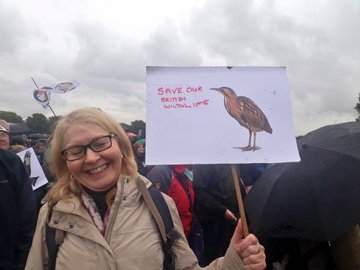
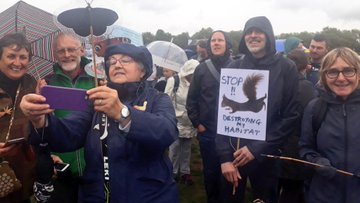
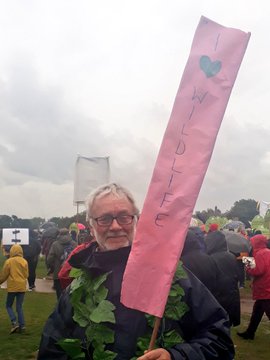
Hundreds of marchers demanded better protection for British wildlife at the People’s Walk for Wildlife in Hyde Park on Saturday. Many carried pro-nature and pro-animal banners and placards and some wore animal masks.

Organizers said the march was to raise awareness about the threat to species and habitats across the United Kingdom.

View image on TwitterView image on TwitterView image on TwitterView image on Twitter

Natalie Bennett

@natalieben

@ChrisGPackham – “our wildlife needs us more than ever”. And the people today have turned out to show they are here for it.

Singer Billy Bragg implored the crowd to put the environment “back on the agenda” despite the Conservative government’s preoccupation with its Brexit divorce from the European Union.

Organizer Chris Packham has unveiled proposals to help Britain’s natural environment, including linking elementary schools to farms so children learn about food production. He has also called for an end to grouse shooting and dredging for scallops.

B.C.’s approach to wildlife management needs major ethical reform

Kyle Artelle, Paul Paquet, Faisal Moola, Chris Genovali, and Chris Darimont are scientists and writers at the Raincoast Conservation Foundation. Kyle Artelle, Paul Paquet, and Chris Darimont are also at the University of Victoria, and Faisal Moola is also at the University of Guelph

British Columbia has begun an ambitious effort to review the province’s approach to managing wildlife, with $14-million committed so far. The province’s interest in reform is encouraging. As explained in a letter we recently published in the journal Science, this endeavour and its justification are laudable, and if done properly, have the potential for making B.C. a continental leader in wildlife management. Whether this happens, however, will depend largely on whether the reform embraces principles of science honestly and openly, while involving the varied interests of all citizens, rather than only consumptive users (hunters and trappers).

British Columbia is blessed with a remarkable diversity of wildlife. Many of the 3,800 known plant and animal species in B.C. live only here. The province is also critical for winged migrations that extend over thousands of kilometres. Unlike most places in North America, B.C. has additionally retained all of the large land animals that were present at the time of European colonization, including grizzly bears, wolves, caribou and cougars, making it among the last havens for the large animals left on the continent.

A sub-adult grizzly bear chases down a salmon near Klemtu, B.C. (File Photo).

JOHN LEHMANN

However, many might be surprised to learn that instead of the management of this wildlife being primarily focused on conservation of species and the ecosystems on which they depend, in B.C., as across much of North America, the focus is typically on the management of wildlife to allow for sustained exploitation by hunters and trappers.

This consumptive focus can overshadow broader concerns about wildlife, including ethical considerations. Although there are clearly ethical considerations in any decisions about the environment, wildlife management is one of the few fields for which ethics remain notably absent. This stands in contrast with other areas of public policy, such as criminal justice and health care, where the recognition of ethics is foundational. Such consideration has led to better outcomes, such as improved well-being of those affected by policy decisions.

The scale of wildlife exploitation can be difficult to comprehend. Although hunting and trapping might evoke visions of traditional, low-scale and low-impact endeavours, both undertakings currently comprise an enormous extractive activity: For many wildlife species, humans kill more adults than all other predators combined.

Given this reality, one might hope that wildlife management would have considerable oversight and rigour to protect against potential negative impacts on wildlife populations. And wildlife managers across North America usually do claim a scientific foundation for their activities. However, recent research in the journal Science Advances found that key hallmarks of science are often missing in management of species across North America. For example, of the 667 management systems that study examined, only 26 per cent had measurable objectives, only 11 per cent explained how hunting quotas or limits were set and only 9 per cent were subject to external review.

To reform management so that science can honestly and credibly support policy decisions will require incorporating key hallmarks of science: 1) Clear objectives are needed for the public to understand what government wildlife managers are trying to achieve. These objectives need to be clear enough to allow assessment of whether they have been met, and their ethical basis needs to be clearly described; 2) Strong evidence is needed to ensure that well-informed decisions are made. In cases with weak evidence, strong caution is warranted; 3) Full transparency to the public is required in how wildlife is managed, including how the funding the public provides for management is used, and; 4) External scrutiny, whereby independentbodies (that is, individuals who are neither part of government, appointed by government, nor too closely affiliated to be unbiased) scrutinize the approach used by government, to ensure approaches used are credible.

The B.C. government recently made the courageous decision to end the province’s ethically questionable, controversial and scientifically suspect grizzly bear trophy hunt, a decision that government leaders acknowledged was partly in response to changing societal values about wildlife management. These included considerations of cultural and other non-lethal values and activities, such as wildlife viewing. The current review of provincial wildlife management provides a tremendous opportunity to further demonstrate leadership for the province and the continent, by addressing the critical need for broader wildlife policy reform that is informed by science and reflective of societal attitudes and desires, including ethical concerns in wildlife management.

Waste Trapping More Wild Animals

https://sacramento.cbslocal.com/2018/08/15/waste-trapping-more-wild-animals/

PLACER COUNTY (CBS13) — There are new wildlife worries for local animal rescue workers after another wild animal was spotted with its head trapped inside a plastic jar.

This is the third time in recent months an animal has been found trapped in a container.

Cellphone video shows a fox with its head inserted inside a jar, leaving it disoriented, and struggling to survive.

ALSO: Deer With Mouth Stuck In Jar Tranquilized And Freed

The fox, found Sunday after being spotted by a person who lives in the Placer County hills, is the third rescue of its kind here in 6 months.

A coyote was caught with its head stuck in a jar in February. A deer was found in July. Now the fox this month.

Gregg Grimm works at Gold Country Wildlife Rescue, which has helped in each animal’s rescue and recovery.

In Grimm’s six years here he had never seen a single case like this. Now suddenly, this spike.

“The fact that people are seeing it is also interesting because a lot of times when this happens the animals goes off and hides and people won’t necessarily see them and so they die,” Grimm said.

Grimm attributes the trouble in part to more people living near Placer County wildlife, and more people not carefully discarding waste. But why the sudden spike? He isn’t sure.

“I don’t know what triggered it, to be honest,” Grimm said. “I really don’t know what triggered it.”

The fox most recently rescued is being treated for starvation and infections.

Gold Country Wildlife Rescue is hoping it will be healthy enough to release back into the wild in a few weeks.

Mindless Behavior, Sadistic Tactics Planned Against Alaska Wildlife

Here are C.A.S.H.’s Comments Re the proposed anti-animal tactics to be undertaken in Alaskan National Monuments:

As a wildlife photographer I’ve spent the better part of a decade in Alaska, photographing bears and wolves in addition to moose, Dall’s sheep and caribou in numerous locations throughout the region. Most of what I saw was in the State’s National Parks—Glacier Bay, Katmai and Denali. One thing that struck me right off was how comparatively little wildlife I came acrossin National Monuments such as Wrangle Saint Elias. Clearly, hunting and trapping had taken their toll in the unprotected lands and monuments that, unlike the parks, allowed wildlife “harvesting.”

But even if I wasn’t now president of the group C.A.S.H., the Committee to Abolish Sport Hunting, I’d be sickened, outraged and appalled by the new federal proposals to allow abusive treatment of some ofthe world’s most intelligent and charismatic animals who reside in our Alaskan national monuments. Among the shockingly sadistic tactics are such mindless behaviors as murdering bear cubs and wolf pups in their dens, targeting of animals like swimming caribou from boats and using bait to lure animals like bears in for the kill.

The Trump Administration, in their rush to undo any protections wildlife may have been afforded under the Obama Administration, must think they’ll score points with their friends in the NRA or the Safari Club. But their boss doesn’t need anything else to make him look bad at this point in his career—his sons are already doing a bang-up job at that.

Jim Robertson

President, Committee to Abolish Sport Hunting.

Comment on the new rules here: https://www.regulations.gov/searchResults?rpp=25&po=0&s=1024-AE38&fp=true&ns=true