Humboldt County Board of Supervisors Puts Contract Renewal With Wildlife Services on Hold

EUREKA, Calif.— One day after a broad coalition of national animal and conservation groups urged the Humboldt County Board of Supervisors to terminate its contract with the U.S. Department of Agriculture’s Wildlife Services, the board assented to a citizen request to delay consideration of contract renewal for at least a month in order to reevaluate the issues.

At its meeting on Tuesday, the board had scheduled a vote on the county’s annual renewal of its contract with Wildlife Services, a federal program that kills tens of thousands of native wild animals in California every year. But on a citizens’ request submitted by local wildlife rehabilitator Monte Merrick, the board decided to remove the renewal item from its consent calendar, delaying it at least another month as the county considers the issues raised by Merrick and the coalition.

Photo Courtesy Center for Biological Diversity
Dog caught in trap (Click on image to enlarge) – Photo Courtesy Center for Biological Diversity

“I am elated that the board has agreed to consider whether to renew its contract with Wildlife Services,” said Merrick. “Wildlife Services is increasingly controversial and there are better options to address wildlife conflicts.”

The coalition groups sent a formal letter asking the county to undertake an environmental review and ensure proper protections — as required under California state law — prior to hiring Wildlife Services to kill any additional wildlife. Last year, in response to a similar letter from the Animal Legal Defense Fund, Sonoma County’s Board of Supervisors opted not to renew the county’s contract with Wildlife Services and is now conducting a review of its wildlife policies. Marin County cancelled its contract with Wildlife Services 14 years ago and implemented a nonlethal predator-control program. As a result the county has seen a 62 percent decrease in livestock predation at one-third of the former cost.

Since 2000 Wildlife Services has spent a billion taxpayer dollars to kill a million coyotes and other predators across the nation. The excessive killing continues unchecked despite extensive peer-reviewed science showing that reckless destruction of native predators leads to broad ecological devastation. The indiscriminate methods used by Wildlife Services have killed more than 50,000 “nontarget” animals in the past decade, including endangered condors and bald eagles. The program recently released data showing that it killed over 4 million animals during fiscal year 2013 using a variety of methods, including steel-jaw leghold and body-crushing traps and wire snares. These devices maim and trap animals, who then may take several days to die. In 1998 California voters banned several of these methods, including leghold traps.

Trap - Az Russell files, COurtesy Center for Biological Diversity
Trap (Click to enlarge) – Az Russell files, Courtesy Center for Biological Diversity

“Humboldt County has a chance to be a leader in California wildlife management by eliminating their contract with Wildlife Services,” said Stephen Wells, executive director of the Animal Legal Defense Fund. “Nonlethal predator control has proven to be more humane, more cost-efficient, and more effective — it’s simply the right thing to do for the county.”

“We are glad to see that Humboldt County is pushing the ‘pause’ button on its relationship with Wildlife Services,” said Tim Ream of the Center for Biological Diversity. “We hope that the county will do the wise thing and terminate its relationship with Wildlife Services altogether.”

“Humboldt County has an opportunity to do what’s right here by reviewing their contract with Wildlife Services and shifting towards a nonlethal program that is ecologically, economically and ethically justifiable,” said Camilla Fox, Project Coyote founder and executive director, who helped develop Marin’s nonlethal program. “We pledge our assistance to the county toward this end and urge the Board of Supervisors to emulate the successful Marin County Livestock and Wildlife Protection Program that provides non-lethal assistance to ranchers.”

“The last thing the county that is home to such special places as the Lost Coast and Redwood National Park should be doing is allowing Wildlife Services to trap and kill its native wildlife,” said Elly Pepper, an NRDC wildlife advocate. “Using nonlethal methods to balance its incomparable natural beauty with its critters is a much better use of county residents’ money.”

“It is time to put aside the unchecked assumption that wildlife conflicts can only be solved via Wildlife Services’ draconian, outdated killing methods,” said Tara Zuardo, wildlife attorney at the Animal Welfare Institute. “We salute Humboldt County for stepping back to reevaluate its options — a move that will hopefully lead to more humane, less costly and more effective methods of wildlife management.”

http://www.theecoreport.com/green-blogs/area/usa/california/humboldt-county-board-of-supervisors-puts-contract-renewal-with-wildlife-services-on-hold/

HUMBOLDT AND MENDOCINO COUNTIES URGED TO VOID CONTRACT WITH SECRETIVE, INHUMANE WILDLIFE SERVICES

http://www.theecoreport.com/green-blogs/area/usa/california/humboldt-and-mendocino-counties-urged-to-void-contract-with-secretive-inhumane-wildlife-services/

Indiscriminate Killing, Environmental Destruction, and Legal Violations Spark Controversy

A joint Press Release from the organizations listed below 

Screen-shot-2014-01-08-at-2.36.48-AMSAN FRANCISCO – A broad coalition of national animal and conservation groups sent formal letters to the Humboldt County and Mendocino County boards of supervisors today urging them to terminate their contracts with the U.S. Department of Agriculture’s Wildlife Services, which indiscriminately kills tens of thousands of native wild animals in California every year, including coyotes, bears, foxes and mountain lions. The letters ask the counties to undertake appropriate environmental review and ensure proper protections prior to hiring Wildlife Services to kill any additional wildlife, as required under California state law. Last year, in response to a similar letter from the Animal Legal Defense Fund, Sonoma County’s Board of Supervisors opted not to renew the county’s contract with Wildlife Services; it is now conducting a review of its wildlife policies. Marin County cancelled its contract with Wildlife Services 14 years ago and implemented a nonlethal predator-control program. As a result, the county has seen a 62 percent decrease in livestock predation at one-third of the former cost.

Since 2000 Wildlife Services has spent a billion taxpayer dollars to kill a million coyotes across the nation. The excessive killing continues unchecked despite extensive peer-reviewed science showing that reckless destruction of native predators leads to broad ecological devastation. The indiscriminate methods used by Wildlife Services have killed more than 50,000 “non-target” animals in the past decade, including endangered condors and bald eagles. The agency deploys steel-jaw leghold and body-crushing traps and wire snares, which maim and trap animals, who then may take several days to die. These devices have also injured hikers and killed pets — not only in wilderness and rural areas, but often in populated suburban landscapes. In 1998 California voters banned several of these methods, including leghold traps.Last year Wildlife Services drew national public scrutiny when employee Jamie P. Olson posted pictures on social media of his hunting dogs mauling coyotes caught in leghold traps. Another agency trapper, Russell Files, was charged with animal cruelty for intentionally maiming his neighbor’s dog with multiple leghold traps.

“California taxpayers may be shocked to know their dollars are funding a rogue agency that recklessly kills predators, endangered animals, and pets,” said Stephen Wells, executive director of the Animal Legal Defense Fund. “We urge Mendocino and Humboldt to follow the example of counties that use more humane and more effective methods of predator control.”

“Despite growing public outcry, calls for reform by members of Congress and an ongoing investigation by the Agriculture Department’s inspector general, Wildlife Services poisoned, strangled and shot more than 2 million native animals last year, an increase of almost 30 percent over the year before,” said Tim Ream, a staff attorney with the Center for Biological Diversity’s endangered species program. “Taxpayers in Mendocino and Humboldt should follow the lead of Sonoma and Marin and stop the slaughter.”

“Marin County’s Livestock and Wildlife Protection Program demonstrates that killing wildlife is not necessary to reduce conflicts,” said Camilla Fox, Project Coyote founder and executive director, who helped develop Marin’s nonlethal program. “It has become a national model based on coexistence, community involvement and a recognition that coyotes and other predators are vital to healthy ecosystems.”

“Californians shouldn’t adopt the shoot-first, ask questions later approach taken elsewhere,” said Elly Pepper, a wildlife advocate with the Natural Resources Defense Council. “These letters call on the counties to make sure nonlethal efforts are used first to address wildlife conflicts.”

“Wildlife Services has long fostered a culture of cruelty among employees, overlooking glaring misconduct and ignoring readily available alternatives to its outdated wildlife management tools,” noted D.J. Schubert, a wildlife biologist at the Animal Welfare Institute.

Copies of the demand letters are available upon request.

ALDF was founded in 1979 with the unique mission of protecting the lives and advancing the interests of animals through the legal system. For more information, please visit aldf.org.
The Center for Biological Diversity is a national, nonprofit conservation organization with more than 775,000 members and online activists dedicated to the protection of endangered species and wild places.

Project Coyote is a North America coalition of wildlife educators, scientists, predator friendly ranchers, and community leaders promoting coexistence between people and wildlife, and compassionate conservation through education, science, and advocacy. For more information, please visit ProjectCoyote.org.

The Natural Resources Defense Council (NRDC) is an international nonprofit environmental organization with more than 1.4 million members and online activists. Since 1970, our lawyers, scientists, and other environmental specialists have worked to protect the world’s natural resources, public health, and the environment. Visit us at http://www.nrdc.org and follow us on Twitter @NRDC.

Since 1951, the Animal Welfare Institute has been dedicated to reducing animal suffering caused by people. We seek better treatment of animals everywhere – in the laboratory, on the farm, in commerce, at home, and in the wild. For more information, please visit AWIonline.org

Mountain Lion Foundation is a national nonprofit organization protecting mountain lions and their habit. Visit mountainlion.org


Wildlife Services: Stop slaughtering millions of wild animals

robert merrick
Arcata, California
Millions of animals are being killed every year by the federal agency that claims to have “leadership and expertise to resolve wildlife conflicts to allow people and wildlife to coexist.” Wildlife Services kills family pets, threatened and endangered species and other animals who were not targeted, but who are now dead all the same. This federal agency is funded by taxpayers to help protect property, natural resources, and reduce risks to humans, but it has unfortunately developed a reputation of carelessness and routine cruelty to animals.
As a wildlife rehabilitator, I have seen the horrifying trail of misery and death that’s left behind. Our first step to save animals at the mercy of this publicly funded agency is to petition to see exactly how Wildlife Services is using our money — so we can hold them accountable to do better.
As part of our rescue and rehabilitation work, we go to people’s homes to help resolve wildlife conflicts. Not too long ago, our rescue team found a horrible mess of maggot-eaten baby raccoon carcasses after a Wildlife Services trapper killed the mother. The person who called Wildlife Services for assistance at her home was incorrectly told this was a male adult raccoon with no babies. And so days later, they were left to deal with the traumatic and frustrating experience of rotting baby raccoons in their home.
Wildlife Services agents reveal next to nothing about their methods of resolving cases. In the field, they answer to no local authority. Agents act with impunity and without oversight. How are we to know why and how the animals were killed and the reasons that so many non-target animals suffer as a result of this agency’s work?
On June 7, the Washington Post published the latest statistics reported by Wildlife Services. In 2013 Wildlife Services agents killed over 4.4 million animals. Roughly half of those killed were native species. The article says those killed include “75,326 coyotes, 866 bobcats, 528 river otters, 3,700 foxes, 12,186 prairie dogs, 973 red-tailed hawks, 419 black bears and at least three eagles, golden and bald.” This a nearly 25% increase over 2012’s 3.4 million killed, about half which were also native species. Why the increase? No explanation for this increase is offered.
From the front lines of protection and rescue of injured or orphaned wild animals, I am petitioning the administrators of the secretive and controversial animal control program of the USDA Animal and Plant Health Inspection Services (USDA-APHIS) known as Wildlife Services. Specifically I am requesting that Administrator Kevin Shea, and Deputy Administrator William H. Clay, bring transparency and accountability to all of this agency’s wildlife damage control activities.
Against decades of scientific, practical and ethical recommendations, Wildlife Services continues to trap, shoot from helicopters, poison, even burn young mammals in their dens. These practices often seem to be the first course of action rather than a last resort. The first step to improving this is that Wildlife Services must publicly disclose how much it’s spending on each case it’s taking on and details on what methods are used.
Without oversight, Wildlife Services has been shown time and again to use excessive lethal methods, killing in any manner or number which they see fit – quite literally burying the evidence.
– Robert “Monte” Merrick (Co-founder and co-director of Bird Ally X, co-director of Humboldt Wildlife Care Center, member of Board of Directors of the California Council for Wildlife Rehabilitators (CCWR), and chair CCWR’s Advocacy committee.)

How Many Wolves Died for Your Hamburger?

528624c939a88_preview-620

http://www.huffingtonpost.com/stephanie-feldstein/how-many-wolves-died-for-your-hamburger_b_5535494.html

by

Population and Sustainability Director, Center for Biological Diversity

06/27/2014

When you bite into a hamburger or steak, you already know the cost to the cow, but what about the wolves, coyotes, bears and other wildlife that were killed in getting that meat to your plate?

There are a lot of ways that meat production hurts wildlife, from habitat taken over by feed crops to rivers polluted by manure to climate change caused by methane emissions. But perhaps the most shocking is the number of wild animals, including endangered species and other non-target animals, killed by a secretive government agency for the livestock industry.

Last year Wildlife Services, an agency within the Department of Agriculture, killed more than 2 million native animals. While wolf-rancher conflicts are well known, the death toll provided by the agency also included 75,326 coyotes, 3,700 foxes and 419 black bears. Even prairie dogs aren’t safe: They’re considered pests, blamed for competing with livestock for feed and creating burrow systems that present hazards for grazing cattle. The agency killed 12,186 black-tailed prairie dogs and destroyed more than 30,000 of their dens.

The methods used to kill these animals are equally shocking: death by exploding poison caps, suffering in inhumane traps and gunned down by men in airplanes and helicopters.

How many of the 2 million native animals were killed to feed America’s meat habit? No one really knows. This is where the secrecy comes in: While we know that they frequently respond to requests from the agricultural community to deal with “nuisance animals,” Wildlife Services operates with few rules and little public oversight. That’s why the Center for Biological Diversity, where I work, has called on the Obama administration to reform this rogue agency to make it more transparent and more accountable. Despite the growing outcry from the public, scientists, non-governmental organizations and members of Congress, the federal agency shows no signs of slowing its killing streak.

There are two important ways that you can help rein in Wildlife Services. First, sign our online petition demanding that the Department of Agriculture create rules and public access to all of the agency’s activities. Second, start taking extinction off your plate. Our growing population will mean a growing demand for meat and for the agency’s deadly services, unless we take steps to reduce meat consumption across the country. By eating less or no meat, you can reduce your environmental footprint and help save wildlife.

Targeting Wildlife Services

OUR CAMPAIGN TO SAVE SPECIES FROM A ROGUE FEDERAL AGENCY ACTING FOR PRIVATE INTERESTS

A little-known agency known as “Wildlife Services,” a unit of the U.S. Department of Agriculture, is secretive for a reason: Its actions are incredibly, unacceptably and illegally brutal and inhumane to animals, from familiar wildlife to endangered species — and even people’s pets.

This agency has been killing as many as 3 million native animals every year — including coyotes, bears, beavers, wolves, otters, foxes, prairie dogs, mountain lions, birds and other animals — without any oversight, accountability or requirement to disclose its activities to the public. The agency contributed to the decline of gray wolves, Mexican wolves, black-footed ferrets, black-tailed prairie dogs, and other imperiled species during the first half of the 1900s, and continues to impede their recovery today.

Many of these animals are carnivores at the top of the food chain and have a tremendous benefit to overall ecosystem health. They include endangered species and, largely, animals that agribusiness interests consider undesirable — as well as many animals that aren’t intended targets of the agency. The century-old Wildlife Services — which has reportedly killed 32 million native animals since 1996 — destroys these creatures on behalf of such interests without explaining to the public what it’s doing or where, the methods it’s using, on whose behalf it’s acting, or why. It frequently doesn’t even attempt to use nonlethal methods before shooting coyotes and wolves from airplanes, or laying out traps and exploding poison caps indiscriminately — including in public areas — without any rules. Stories about Wildlife Services consistently emerge describing an agency that routinely commits extreme cruelty against animals, leaving them to die in traps from exposure or starvation, attacking trapped coyotes, and brutalizing domestic dogs. Many people who know about the agency have criticized this dark, secretive entity as a subsidy for livestock interests.

We can’t stress enough that this agency’s practices have gone on for decades with little public oversight or rules requiring that it use the best available science or techniques to reduce the deaths of nontarget animals — or even the suffering of target animals.

The Center is working to end the secrecy and reform this rogue agency — or even suffering — for the good of wildlife, ecosystems and even domestic animals.

To protect defenseless wildlife from Wildlife Services and begin to restore the natural balance of ecosystems, in 2013 the Center filed a comprehensive petition for rulemaking with the Department of Agriculture, which is supposed to oversee the secretive agency’s actions. This legal petition demands the development of a regulatory code — something that every other agency maintains — to reform the agency and bring it in line with all of the nation’s laws, policies and values.

Info on Wildlife Services Sought‏

IDA_Coyote_Hill_JRobertson

Do You Have Information We Can Use?

June 11th, 2014 by Anja Heister

Call for Information from You about USDA Wildlife Services (USDA WS)

Wildlife Services (WS), a branch of the US Department of Agriculture (USDA) has a budget of more than $100 million and they use it – to kill millions of wild animals every year – at least 4 million animals in 2013, half of whom were native.  See graphics here.

Among the animal victims tortured and killed by USDA WS are tens of thousands of prairie dogs, coyotes, beavers, Canada geese; thousands of white-tailed deer; hundreds of black bears, great blue herons, bobcats, mountain lions, gray wolves, among many others.

How many articles exposing the cruel methods employed by this rouge agency, including aerial gunning, poisoning, gassing, shooting, and trapping wild animals, does it take to force this agency into using existing nonlethal methods for the management of wild animals?

How many leaked complaints about WS employees, including (but not limited to) trappers, like Jamie Olson, who encouraged his dogs to attack trapped, already-suffering coyotes, while on the clock, does it take to achieve substantive disciplinary actions against these rogue agents and achieve accountability for inhumane treatment of wild animals?

How many petitions by animal/wildlife protection organizations, and efforts by Representatives, like Rep. Peter DeFazio (D-OR), does it take to prompt a congressional review and reform of this atrocious agency that DeFazio has described as, “one of the most opaque and obstinate departments I’ve dealt with.”

What We Need From You:

If you have had any negative experiences with USDA WS agents, please let us know. For example, a woman in NYC told us last year that WS agents, who were rounding up geese in one of the city’s parks to either gas or send to a slaughterhouse, were trying to intimidate her verbally and through posturing. Please contact anja@idausa.org if you know (and have proof) of any cruel acts against animals USDA WS may have committed in your community, or if you have had any negative interactions with any of WS agents. We will start tracking this information to increase pressure for a reform of this taxpayer-funded, animal killing, government agency. We will keep your personal information confidential.

Thanks for your help!

“Sportsmen” donate $15,000 to Wildlife “Services”

http://ravallirepublic.com/news/local/article_2dcae02a-a419-11e3-83ec-0019bb2963f4.html

By Perry Backus

[While you and I hate Wildlife “Services with a passion…] The Montana Sportsmen for Fish and Wildlife recently contributed $15,000 to the federal agency focused on reducing damage to livestock caused by coyotes and wolves.

The sportsmen’s organization made its contribution to the U.S. Department of Agriculture’s Wildlife Services in hopes the funding will have some residual benefit to ungulate herds, said Keith Kubista, president of the sportsmen’s group.

“We are pleased to be able to participate in this way which results in reducing the burden of government on the taxpayer and at the same time is consistent with our policies and mission,” Kubista said. “Primary among them is to focus our efforts and funds to preserve our rights to hunt, trap and fish and to protect livestock and pets from predation.”

Kubista said the group recognizes the need to help landowners and livestock producers who suffer impacts from predators.

“These management actions by USDAWS which are focused on the removal of coyotes and wolves causing predation on livestock will also minimize the potential for predation on wildlife,” said the group’s press release.

Montana Wildlife Services State Director John Steuber views the contribution as a cooperative funding agreement similar to what it shares with livestock organizations, counties and others.

“This one may be a little different from others,” he said. “This sportsmen group apparently wants to show its support for the livestock industry.”

Other sportsmen’s groups – like the Rocky Mountain Elk Foundation – have signed cooperative funding agreements in the past.

With federal funding in decline, Steuber said the cooperative funding agreements have played an important role in augmenting the Service’s annual budget.

Steuber said Wildlife Services has evolved quite a lot in the 27 years that he’s spent with it.

“We encourage people to use more non-lethal methods for protecting their livestock from predators,” he said.

As an example, Steuber said the agency is doing a guard dog study in Montana using breeds that aren’t common to the state. The agency is also encouraging people raising chickens in their backyards to use electric fence as a deterrent to bears, he said.

“There are a lot of things that people can do to keep wildlife out of trouble,” he said. “We certainly encourage people to use those.”

____________________________

Wildlife “Services” in action on the Idaho/Montana border:

1920332_613143138754489_331154733_n

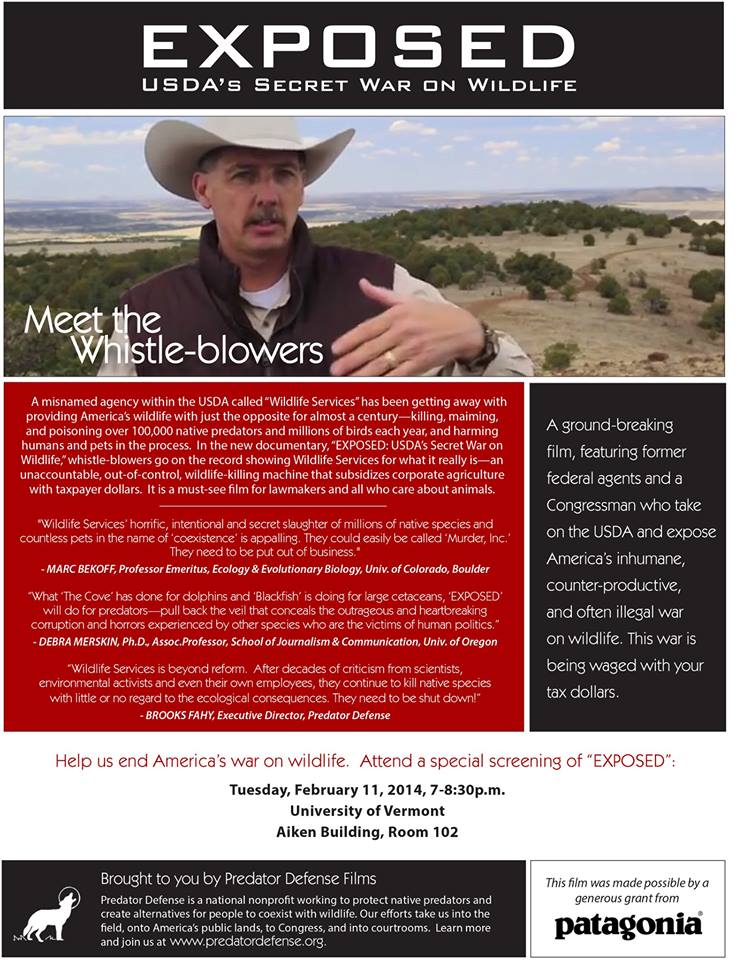
Interview on EXPOSED: The U.S. Secret War on Wildlife with Brooks Fahy

http://www.voiceamerica.com/episode/76044/exposed-the-us-secret-war-on-wildlife-with-brooks-fahy

February 24, 2014

Hosted by Eli Weiss

Wildlife Services-a barbaric, wasteful and misnamed agency within the US Department of Agriculture, has been having their way for almost a century, our government’s secret war on wildlife has been killing millions of native predators and birds as well as maiming, poisoning, and brutalizing countless non-targeted and endangered species, along with quite a few pets and seriously injuring people. Brooks Fahy, the man behind Predator Defense and the landmark film, “EXPOSED”, brings three former federal agents and a Congressman who blow the whistle on the atrocities committed under the guise of problem animal control, and proving Wildlife Services for what it really is: A barbaric, unaccountable, government sanctioned, out-of-control wildlife killing machine funded on our dime, which apparently thinks they will continue getting away with it. But, we can tell Congress to defund Wildlife Services, and after this program, you will.

http://www.voiceamerica.com/episode/76044/exposed-the-us-secret-war-on-wildlife-with-brooks-fahy

coyote contest kill

Wildlife Services: Leaked Audit Shows Fiscal Confusion

http://www.endangered.org/wildlife-services-leaked-audit-shows-fiscal-confusion/

by Mitch Merry

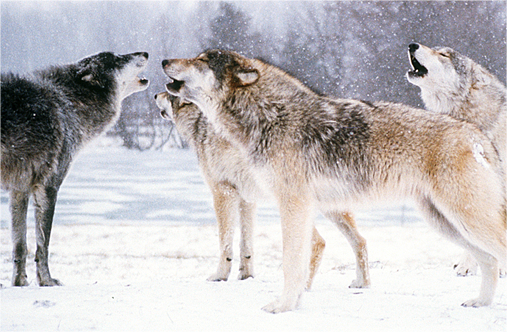
howlers

Via NRDC’s Melissa Waage:

An unreleased, internal audit at USDA’s secretive Wildlife Services division uncovered big accounting problems, including $12 million missing from its coffers, the LA Times revealed yesterday. This new information comes as USDA’s Inspector General prepares to conduct a congressionally-requested audit of the agency’s practices.

The Times reports that

The [internal Wildlife Services] audit found the agency’s accounting practices were “unreconcilable,” lacked transparency and violated state and federal laws. Further, the audit revealed that $12 million in a special account could not be found.*

On the one hand, this internal review is a responsible first step. For years, non-profit watchdogs and members of Congress have been trying to untangle Wildlife Services’ opaque funding stream. We know that a combination of federal tax dollars and payments directly from special interests like Big Agriculture enables USDA’s Wildlife Services division to kill hundreds of thousands of wild animals each year. But the agency has consistently resisted explaining how, exactly, it spends its budget, and who actually benefits from expensive tactics like shooting wolves from helicopters.

But on the other hand–why the continued secrecy? Rep. Peter DeFazio of Oregon, a long-time critic of Wildlife Services, has repeatedly been in contact with the agency about funding details. Yet he had to hear about the internal audit from the LA Times.

“The last time I tried to get more specific financial information, they just blew me off and said they couldn’t provide that,” DeFazio said in an interview. “Yet, at the same time, they were undertaking this audit. So, the managers were, at best, disingenuous, and at worst, undertaking a coverup.”

Wildlife Services told the Times that “the agency [has] already begun to carry out changes recommended in the audit.” Of course, Wildlife Services has released neither the audit results, nor a plan to remedy any failures identified. The public release of this information would be a laudable step towards improving the agency’s fiscal transparency.

Sacramento Bee reporter and Wildlife Services watchdog Tom Knudson has posted a leaked copy of the audit here. We’ll be taking a closer look at what it reveals about government wildlife killing in future posts.

*The leaked audit’s conclusions about Wildlife Services’ cost-benefit analysis problems echo those of an NRDC-commissioned report released in 2012. Our report found that “most economic analyses of predator control done by Wildlife Services …are inconsistent with economic analysis guidelines used by most federal agencies,” and often contain fundamental accounting errors.

Upon its release in 2012, NRDC shared this report with the director of USDA-Wildlife Services and expressed our interest in discussing the results and recommendations with agency staff. Wildlife Services hasn’t yet taken us up on this offer, but it still stands.

This post originally appeared on NRDC’s Switchboard blog: http://switchboard.nrdc.org/blogs/mwaage/wildlife_services_leaked_audit.html