Exposing the Big Game

Forget Hunters' Feeble Rationalizations and Trust Your Gut Feelings: Making Sport of Killing Is Not Healthy Human Behavior

Exposing the Big Game

Portland howls for the future of Oregon wolves (Guest opinion)

http://www.oregonlive.com/opinion/index.ssf/2017/05/portland_howls_for_the_future.html

A wolf pack is pictured earlier this year on a remote camera in Hells Canyon National Recreation Area.
A wolf pack is pictured earlier this year on a remote camera in Hells Canyon National Recreation Area.(Courtesy of ODFW)

By Quinn Read

Wolves were once abundant throughout Oregon, but by the 1940s they were wiped out by hunters, poisoning campaigns and bounties. Thanks to conservation efforts by a variety of local, state and federal agencies and organizations, wolves are making a comeback in Oregon. Yet a draft plan threatens to turn back the clock on wolf recovery by weakening protections and opening the door to hunting and trapping.

At a public hearing in Portland on May 19, Oregonians can weigh in on the draft Oregon Wolf Conservation and Management Plan, which will guide how wolves are managed in the state for at least the next five years. Since wolves were removed from Oregon’s endangered species list a year ago, the wolf population appears to have stagnated. This year’s Oregon wolf count shows three fewer breeding pairs and one fewer pack in the state, though severe weather made surveying difficult. These numbers show we cannot take wolf recovery in Oregon for granted.

The draft Wolf Plan is heading in the wrong direction. It ignores the impacts of wolf poaching in the state and includes terms requested by hunting proponents as “a foot in the door” for a future general wolf hunting season. The draft would allow private hunters and trappers to carry out state-sanctioned killings of wolves to address so-called chronic livestock depredations. This means three or more livestock deaths caused by wolves within a year, but the new policy would also include a lower standard for determining whether livestock deaths were caused by wolves. Moreover, the state could issue permits to kill wolves if there are declines in elk and deer populations, even when wolves are not the primary reason for these declines. This is a clear departure from what the majority of Oregonians want for wolves in our state.

The draft Wolf Plan does have some promising components, including expanded descriptions of non-lethal tools such as livestock-guarding dogs and fencing to minimize wolf-livestock conflicts, detailed direction to reinitiate state protections when wolf populations decline, and the formation of a citizen advisory group to foster ongoing communication and collaboration among stakeholders.

The Oregon Fish and Wildlife Commission should reject proposals that make it easier for the public to kill wolves, and should instead focus on new data, scientific research and lessons learned in Oregon. Oregon is a national leader in wolf recovery and has documented fewer wolf-livestock conflicts than any other wolf-occupied state in the nation. The updated Wolf Plan should reflect our conservation leadership and strengthen – not weaken – requirements for the use of non-lethal coexistence tools. Oregonians have a unique opportunity to speak out on behalf of wolves. Let’s not slide backwards towards a culture that favors killing wolves over protecting them.

Quinn Read is a northwest representative for Defenders of Wildlife.
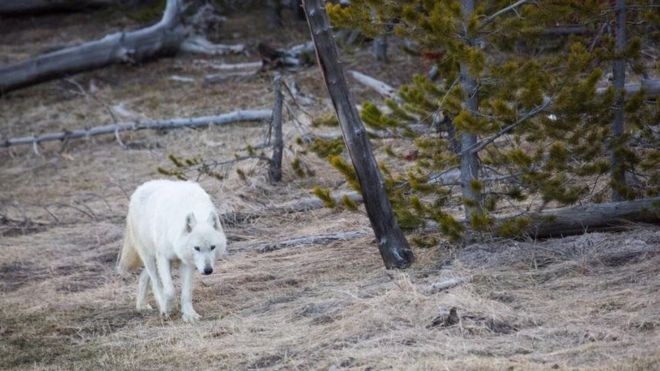
‘White Lady’ wolf shot dead prompts Yellowstone reward

http://www.bbc.com/news/world-us-canada-39930372

  • 15 May 2017
  • White LadyImage copyrightYELLOWSTONE NATIONAL PARK
Image captionThe so-called White Lady was a hit with tourists

A $5,000 (£3,900) reward has been put up for information on how a rare white wolf at Yellowstone National Park was shot dead.

The female was one of three white wolves in the park and had 14 living pups, wildlife officials say.

The reward comes after initial results of a necropsy show the so-called White Lady was shot around 10 April.

“She was one of the most recognisable wolves and sought after by visitors to view and photograph,” the park said.

“Due to the serious nature of this incident, a reward of up to $5,000 is offered for information leading to the arrest and conviction of the individual(s) responsible for this criminal act,” said Yellowstone National Park Superintendent Dan Wenk.

At 12 years old, she had lived for more than twice the average lifespan of a wolf in Yellowstone, officials say.

The Canyon Pack Alpha, as she was known to wildlife researchers (and as The White Lady to tourists), was found by hikers on 11 April.

Wildlife officials were not able to save its life, and the wolf was put down.

Her remains were brought to a US Fish & Wildlife Service Forensics Laboratory in Oregon for a necropsy, where officials determined that it had been mortally wounded by a hunter’s rifle.

As of 2014, researchers had documented at least 104 wolves in 11 packs located within the park.

White wolfImage copyrightYELLOWSTONE/ FACEBOOK
Image captionShe had birthed 20 cubs, 14 of which lived past the age of one

The wolves were reintroduced in Yellowstone in 1995, having been eradicated by hunters.

Advocates of wolves say the presence of predators helps balance the ecosystem, and leads to healthier populations of other wild animals.

Opponents say they are a threat to humans, pets and livestock.


Read more

Media captionHere’s how the bison have been reintroduced into the wild

Denmark gets its first wild wolf pack in 200 years

Arrival of a female wolf, that trekked 500km from Germany, means the pack could have cubs by spring

Three wolves in snow
Wolves are returning to well-peopled landscapes after centuries of persecution. Photograph: Fred van Wijk/Alamy Stock Photo

A wolf pack is roaming wild in Denmark for the first time in more than 200 years after a young female wolf journeyed 500km from Germany.

Male wolves have been seen in Denmark since 2012 and the new female could produce cubs this spring in farmland in west Jutland after two wolves were filmed together last autumn.

It is further evidence that the wolf is returning to well-peopled landscapes after centuries of persecution, with wolf packs also re-establishing themselves in France and Germany and individuals sighted in Holland and even Luxembourg. Before the new population, Denmark’s last wolf was killed in 1813.

“We expect that they will have cubs this year or the next,” said Peter Sunde, a senior researcher at Aarhus University.

“People were very surprised when wolves first appeared in Denmark but they are highly mobile and are just as adaptable to cultural landscapes as foxes are. The only problem historically is that we killed them.”

DNA from two faeces samples have confirmed that the female wolf came from a pack 25km south of Berlin in Germany before travelling to north-west Denmark, probably leaving her family group last spring to do so.

There is sometimes speculation that wolves are deliberately released into the countryside by unofficial rewilders but according to Guillaume Chapron, a researcher at the Swedish University of Agricultural Sciences, this female’s trek north was entirely natural. “The wolf went on its four legs, it makes complete biological sense,” he said. Wolves can walk 50km in 24 hours and have been recorded making journeys of more than 1,000km across Europe from Germany, where they re-established themselves in 1998. Germany’s wolf population is currently growing at 25-30% each year, with the young dispersing across central Europe.

Researchers have found wolves in some cases living in suburban areasalongside up to 3,050 people per square kilometre – higher than the population density of Cambridge or Newcastle.

“The wolf is a predator to the roe deer – if you can have roe deer, you can have wolves,” said Chapron. “As long as we don’t disturb them, they will be fine in these human-dominated landscapes. In Denmark there’s no reason wolves can’t thrive. But the question has to be asked, are people going to accept the wolves? The wolf will need to eat something. When they realise that Danish sheep don’t taste too bad that may be a little problematic. It will be interesting to see how far we can coexist with big predators.”

Denmark’s wolves have settled in a well-farmed area of heathland and small pine plantations with plentiful prey in the form of burgeoning populations of red and roe deer.

There have been reports of wolves killing several sheep in the area over winter but the Danish government has already established a wolf management plan with compensation for farmers and funding so livestock farmers can erect wolf-proof fencing. The management plan, drawn up in consultation with game hunters as well as farmers and conservationists, allows for wolves that become “habituated” and live too close to humans to be controlled.

“There is a tradition in Denmark of reaching compromises and reaching solutions,” added Sunde, who said he was optimistic that Danes could coexist peacefully with wolves. “Technically, we can relatively easily manage the wolf population but the challenge is the psychology of humans. There are so many feelings and opinions about wolves in Denmark, as everywhere. The wolf debate is very much value-driven rather than related to concrete problems.”

There are more than 12,000 wolves in continental Europe (excluding Russia, Ukraine and Belarus) and the wolf is a protected species under the EU’s habitats directive. According to Chapron, southern European countries have often been better at accepting new wolf populations than northern Europe. Several countries with relatively small wolf populations including Finland and Norway still pursue controversial annual culls of the animals.

Chapron said he would not like to predict how many wolves could live wild in Denmark. “Let the wolf decide and let people decide as well because we are sharing the landscape. It’s very positive news for nature conservation. It shows that attitudes have changed and when we let nature take care of itself, nature comes back.

“Forget Little Red Riding Hood – it’s not a myth that is back, it’s just a natural part of the European fauna.”

Researcher files complaint against WSU

WSU’s leading wolf expert Robert Wielgus filed a complaint today detailing harassment and threats from WSU administrators following his public statements about wolf killings in the fall.

Wielgus is a WSU professor and director of the Large Carnivore Conservation Laboratory. Wielgus’ research has been considered in the drafting and implementation of the Washington Department of Fish and Wildlife’s (WDFW) Gray Wolf Conservation and Management Plan and he is an adviser to the state’s Wolf Advisory Group, according to the complaint.

The 12-page complaint, sent to the WSU Faculty Status Committee by the Public Employees for Environmental Responsibility (PEER) on Friday, urges the Faculty Senate committee to investigate the actions of WSU administrators against the professor’s academic freedom and recommend disciplinary actions for the administrators.

Adam Carlesco, PEER staff counsel and the author of the complaint, said he has not yet received a response from the committee. Robert Rosenman, co-chair of the Faculty Status Committee, said all investigations by the committee are confidential, according to their bylaws.

Faculty Senate Chair A.G. Rud said he plans to talk to the Senate executive committee about this next week.

“I am not holding out a tremendous amount of hope that the Senate will do its job [in evaluating the complaint],” Carlesco said.

Carlesco said that according to the WSU Faculty Manual, there must initially be internal discussions in this process, which Wielgus already had with College of Agriculture, Human and Natural Resource Sciences (CAHNRS) Dean Ron Mittelhammer.

“[Wielgus’s] protestations fell on deaf ears,” Carlesco said.

WSU News Director Rob Strenge declined to comment and said this is a CAHNRS faculty issue.

Marta Coursey, CAHNRS communication director, said this is a personnel matter and, according to policy, the college doesn’t publicly discuss personnel issues in order to protect WSU faculty and staff confidentiality and privacy.

“CAHNRS administration is currently reviewing Dr. Wielgus’ communications and performance with respect to his roles and responsibilities as a WSU faculty member,” Coursey said.

Carlesco said WSU officials and the Washington Department of Fish and Wildlife (WDFW) researchers had a verbal agreement to shut down Wielgus’s lab and give the research funding to the University of Washington.

“Litigation is not out of the picture on this matter,” Carlesco said.

The official complaint alleges 10 violations committed by WSU President Kirk Schulz, Mittelhammer and CAHNRS Associate Dean Jim Moyer, mainly following two public statements Wielgus made in the past year about wolf pack killings in Northeast Washington.

The first statement was about the killing of a gray wolf pack by the WDFW at Profanity Peak in August. Wielgus criticized a rancher in the area, whom the professor said released his cattle on top of the Profanity Peak wolf pack’s den. Wilegus argued that the wolf pack’s death could have been avoided, and that the rancher refused to cooperate with his lab or the WDFW in avoiding such confrontations, according to the complaint.

Wielgus said his comments about this created a “firestorm,” according to a Daily Evergreen article. WSU disavowed his comments, stating the rancher did not release his cattle onto the wolf den, but four miles from it, and that the rancher cooperated with WDFW. The university publicly accused Wielgus of “inaccurate and inappropriate” statements in a news release.

Wielgus made the second statement when recommending wolf preservation pratices to the Wolf Advisory Group in March. The university alleged that this qualified as illegal lobbying activity because he sent it from his WSU email address.

One of the 10 violations listed in the complaint states that CAHNRS administrators and Schulz approved funding restrictions denying Wielgus summer funding or grant research money for his lab.

According to the complaint, there is no reasonable way under the Faculty Manual’s academic freedom policy to reconcile the administrators’ actions, which the complaint alleges were motivated by political pressure.

In 2013, Moyer made it clear that Wielgus was considered a political target of state Rep. Joel Kretz (R), the livestock industry, and possibly the WSU College of Agriculture, according to the complaint.

On Aug. 23, 2014, a female member of the Huckleberry wolf pack in Northeast Washington was shot and killed by a WDFW-hired marksman, as the pack had been preying on a flock of 1,800 sheep, according to the WDFW website.

According to the complaint, Gov. Jay Inslee then asked Wielgus for clarification on the inconsistencies in the reports published by the WDFW on the matter and others who were involved. In briefing Inslee’s office on his findings, Wielgus showed the misrepresentations the WDFW made in its reports, causing several of the department’s officials to resign.

After Wielgus presented his research to the legislature in 2015, Kretz told former WSU President Elson S. Floyd that he wanted to shut down Wielgus’ lab and stop its research, according to the complaint. Kretz introduced a provision to a bill that led to less funding for the lab, according to the complaint.

Brendon Wold, Kretz’s public information officer, declined to comment.

Carlesco said there is “ample precedent” for WSU suppressing a professor’s first amendment rights, bringing up a case filed in 2013, according to the case publication.

Wielgus stated in the complaint that he would like the matter settled amicably without resorting to litigation. For now, Wielgus said he is not commenting on the matter himself.

Also:

http://thehill.com/policy/energy-environment/331068-trump-starts-rollback-of-obamas-offshore-drilling-restrictions

Wolves can be shot on sight in most of Wyoming after state takes over management

Wyoming assumed management once again of wolves within its borders on Tuesday, and those apex predators wandering outside the northwest corner of the state can be shot on sight.

The Circuit Court of Appeals in Washington, D.C., entered its final order in favor of Wyoming in a lawsuit that landed wolves back on the endangered species list in 2014. The court announced in early March that it had upheld the state’s plan but had not issued its final order.

Tuesday’s decision is what Wyoming wolf managers hope is the last legal battle in a roller-coaster legal process.

“All indications are that this decision shows once again that Wyoming’s plan is a sound management plan,” said Brian Nesvik, chief of the Wyoming Game and Fish Department’s wildlife division. “They will remain in the hands of state management. For Wyoming this is, again, this is a time for us to celebrate. This is a good thing for Wyoming to be able to take on another wildlife resource.”

No changes were made to Wyoming’s wolf management plan from when the state oversaw the carnivores between 2012 and 2014, Nesvik said.

That means Wyoming will manage the 100 wolves and 10 breeding pairs outside of Yellowstone National Park and the Wind River Reservation.

Wolves in 85 percent of the state are considered a predator and can be shot on sight, similar to coyotes. They are classified as a trophy animal in the northwest corner of the state and subject to fall hunting seasons. Those seasons have not yet been set, Nesvik said, adding that wolves in those areas cannot be hunted right now. The Wyoming Game and Fish Commission will set those seasons after a public comment period.

A coalition of environmental groups sued Wyoming in 2012 over the state’s management plan. A representative for the group said in early March the coalition was disappointed with the D.C. court’s ruling, said Tim Preso, an attorney for Earthjustice, a nonprofit law firm representing Defenders of Wildlife and several other environmental groups who filed suit against the state.

Earthjustice’s lawyers argued, essentially, that Wyoming’s plan to maintain a buffer of more wolves than the required amount was not legally binding and insufficient under the Endangered Species Act. The court ruled that Wyoming’s plan was adequate, and environmental groups did not appeal the decision.

Preliminary estimates showed Wyoming had about 240 wolves at the end of 2016, Tyler Abbott, Wyoming field supervisor for the U.S. Fish and Wildlife Service, told the Star-Tribune in March.

The feds killed about 115 wolves in 2016 because of livestock depredations, he said. In 2015, the service killed about 54 wolves.

Because of the high number of wolves killed by the Fish and Wildlife Service, Nesvik estimates hunting season quotas this fall will be similar to those before wolves went back on the list.

In 2012, 42 wolves were killed by hunters in the state’s trophy area and 25 were killed in the rest of the state. The next year, 24 wolves were shot in the trophy area and 39 taken in the rest of the state.

Gov. Matt Mead expressed his satisfaction with the court’s decision in a news release sent Tuesday evening.

“I am delighted that the Circuit Court recognized Wyoming’s commitment to manage a recovered wolf population,” Mead said. “Our wolf management plan is a result of years of hard work by people across Wyoming. We recognize the need to maintain a healthy wolf population.”

Wolves were reintroduced into Yellowstone in 1995. They have been off the endangered species list in Montana and Idaho since 2011.

Wolf Pup Born in Missouri Offers Hope for Endangered Breed

https://www.usnews.com/news/us/articles/2017-04-24/wolf-pup-born-in-missouri-offers-hope-for-endangered-breed

A Mexican wolf born this month at a wildlife center in suburban St. Louis is offering new hope for repopulating the endangered species through artificial insemination using sperm that had been frozen.

| April 24, 2017, at 4:10 p.m.

Wolf Pup Born in Missouri Offers Hope for Endangered Breed
The Associated Press

Regina Mossotti, director of animal care and conservation at the Endangered Wolf Center, holds a Mexican wolf born April 2 at the facility Monday, April 24, 2017, in Eureka, Mo. The wolf was conceived by artificial insemination which is offering new hope for repopulating the endangered species by using sperm that had been frozen. (AP Photo/Jeff Roberson) THE ASSOCIATED PRESS


By JIM SALTER, Associated Press

EUREKA, Mo. (AP) — A Mexican wolf born this month at a wildlife center in suburban St. Louis is offering new hope for repopulating the endangered species through artificial insemination using frozen sperm.

The Mexican wolf population once roamed Mexico and the western U.S. in the thousands but was nearly wiped out by the 1970s, largely from decades of hunting, trapping and poisoning. Commonly known as “El Lobos,” the species, distinguished by a smaller, more narrow skull and its gray and brown coloring, was designated an endangered species in 1976.

Even today, only 130 Mexican wolves live in the wild and another 220 live in captivity, including 20 at the Endangered Wolf Center in Eureka, Missouri.

A litter of Mexican wolves was conceived by artificial insemination in Mexico in 2014. But the birth April 2 at the Missouri center was the first-ever for the breed using frozen semen.

Regina Mossotti, director of animal care and conservation at the center, learned for the first time Monday that the pup is a boy. He’s gaining weight — now at 4.7 pounds after being less than 1 pound at birth — and appears to be progressing well, she said after an exam of the wiggly pup, which has not yet been named.

“He’s big and strong and healthy!” Mossotti said as other wolves howled from a distance.

The center has collaborated with the other organizations for 20 years to freeze semen of Mexican wolves. The semen is stored at the St. Louis Zoo’s cryopreservation gene bank, established specifically for the long-term conservation of endangered species.

A procedure to inseminate the mom, Vera, was performed Jan. 27.

“The technology has finally caught up,” Mossotti said.

It’s a big deal, experts say, because using frozen semen allows scientists to draw from a larger pool of genes, even from wolves that have died.

Mossotti said it’s possible the new pup will eventually be moved to the wild, where it would feed largely on elk, deer and other large hoofed mammals. An adult Mexican wolf will weigh 60 to 80 pounds.

The Fish and Wildlife Service began reintroducing Mexican wolves in New Mexico and Arizona starting in 1998, though the effort has been hurt by everything from politics to illegal killings and genetics. Many of the wolves in the wild have genetic ties to the suburban St. Louis center.

The nonprofit was founded in 1971 by zoologist Marlin Perkins, a St. Louis native best known as the host of TV’s “Mutual of Omaha Wild Kingdom.” Perkins died in 1986.

Mossotti said wolves are a “keystone” species that play a vital role in a healthy ecosystem. She said the caricature of the “Big, Bad Wolf” is a myth about an animal that actually shuns humans.

Copyright 2017 The Associated Press. All rights reserved. This material may not be published, broadcast, rewritten or redistributed.

WA lawmakers OK new way to deter wolves

http://www.capitalpress.com/Washington/20170420/wa-lawmakers-ok-new-way-to-deter-wolves

Washington lawmakers thrust Department of Agriculture into new campaign to prevent wolves from killing cattle in Ferry, Stevens, Okanogan and Pend Oreille counties.
Don JenkinsCapital Press

Published on April 20, 2017 9:11AM

Washington lawmakers thrust Department of Agriculture into new campaign to prevent wolves from killing cattle in Ferry, Stevens, Okanogan and Pend Oreille counties.

U.S. FISH AND WILDLIFE SERVICE

Washington lawmakers thrust Department of Agriculture into new campaign to prevent wolves from killing cattle in Ferry, Stevens, Okanogan and Pend Oreille counties.

OLYMPIA — A bill creating a new program to prevent wolves from attacking livestock in northeast Washington has been sent by lawmakers to Gov. Jay Inslee.

House Bill 2126 directs the state Department of Agriculture and conservation district board members in Ferry, Okanogan, Stevens and Pend Oreille counties to oversee the awarding of money to nonprofit groups to protect herds, including by hiring range riders. The groups would be required to consult with resource agencies such as the Department of Fish and Wildlife and U.S. Forest Service.

HB 2126 proponents hope locally organized efforts to prevent depredations will be efficient and gain acceptance among producers.

“It needs to be a community-based approach where ranchers up here are largely steering the boat,” said Jay Shepherd of Conservation Northwest, an environmental group active in wolf recovery.

The program would be in addition to WDFW’s depredation-prevention program. Some ranchers have been reluctant to enter into formal agreements with WDFW.

The bill would assign to the state agriculture department for the first time a role in reducing livestock losses to wolves. WSDA stayed neutral on the bill because it wasn’t in the governor’s budget proposal, but will carry out the legislation if signed by Inslee, a department spokesman said.

The bill passed the House and Senate unanimously. It’s unknown how much money would be available to deploy new deterrence measures. The Legislature has not set aside money to fund the program. The bill creates an account in which grants, donations and state appropriations can be deposited.

“This is an important bill that will help us resolve the issue in wolf country,” said the bill’s prime sponsor, Aberdeen Democrat Brian Blake, chairman of the House Agriculture and Natural Resources Committee. “It creates a pot to put contributions into to help fund the efforts to keep wolves and people and livestock separate.”

Cattle Producers of Washington President Scott Nielsen, who’s also vice president of the Stevens County Cattlemen’s Association, said he liked the bill’s intent to involve local residents in making decisions.

But he said that he feared a new program could be used to justify delaying lethal removal of wolves in some cases. Ranchers who have lost livestock to wolves were using non-lethal deterrence measures, he said.

“We already know it has real limited effects,” Nielsen said. “I don’t know that there needs to be more money thrown at it.”

The Department of Fish and Wildlife, which manages wolves, supported the bill.

“We think this is a good approach because it is community based and will increase the uptake of these tools and help reduce the loss of livestock and ultimately the loss of wolves,” WDFW wolf policy coordinator Donny Martorello said.

Two wolves survive in world’s longest running predator-prey study

For 2 years in a row, a pair of wolves has managed to survive on Isle Royale, Michigan, the last of their kind on the wilderness island. Researchers continue to track the wolves and their moose prey, in the last installments of the world’s longest running predator-prey study.  They report today that although the wolves hunt successfully, they are too few to affect the moose population. Aquatic as well as terrestrial vegetation is taking a hit as moose numbers climb, according to the study’s 59th annual report.

After Canadian wolves colonized the island in 1949, the wolf population peaked at 50 in 1980, and as recently as a decade ago, 30 wolves prowled the island, a U.S. National Park. The island’s now-famous predator-prey study has tracked how wolf and moose numbers have risen and fallen in tandem over the decades, and left their mark on the island’s ecology.

In contrast to last year’s winter study, when wolf tracks were the only evidence of the predators, wildlife ecologist Rolf Peterson spotted both wolves sitting on lake ice on the January afternoon he arrived on the island.  Weeks later, Peterson and co-investigator John Vucetich, both of Michigan Technological University in Houghton, found the wolves feeding on a freshly-killed moose calf. “We were very lucky,” Peterson says. “There was no mystery left in terms of the wolf population,” or what they were eating.

The researchers also observed that, in what normally would have been the wolves’ breeding period, the 7-year-old female bared her teeth in response to the close interest of the 9-year-old male; he is both her father and half sibling.  Researchers don’t expect the highly inbred pair to reproduce.

The two wolves otherwise appeared healthy and still have all their canines, a key sign of well-being in the carnivores. The pair has already surpassed the average Isle Royale wolf lifespan of 4 years, dodging the main causes of death for their ancestors on the island: other wolves and starvation. “They are swimming in moose,” Vucetich says.

The four wolf-killed carcasses the researchers spotted made little dent in the overall moose population, estimated at 1600 in aerial surveys conducted this past winter.  The 20% increase from last winter is consistent with the population’s growth rate over the past 6 years, as the inbred wolf population dwindled and collapsed.  Both beaver and moose abundance have tripled since 2011, “undoubtedly because of lack of predation,” Vucetich says.

With moose density on the Guam-sized island already five to ten times higher than on the mainland–and with the numbers on track to double in three to four years—browsing on the island’s vegetation is intense. One aquatic plant, floating watershield (Brassenia  schreberi), which was abundant six years ago when moose were at historic lows, now thrives in ponds only where moose are excluded. “It’s the aquatic equivalent of deforestation,” says plant ecologist Eric Hellquist of SUNY Oswego, noting that moose’s effect on aquatic vegetation is not as well studied as that on terrestrial plants. Isle Royale’s ponds are demonstrating “how apex predators can have cascading effects on food webs.”

As the effects of the missing predators ripple through the island, the Park Service is assessing about 5000 public comments on its proposal to introduce 20 to 30 wolves to the island to establish a new population. The next steps on that plan are expected by the end of this year.

Wildlife advocates see wolves as ‘best natural defense’ against chronic wasting disease

http://trib.com/news/state-and-regional/wildlife-advocates-see-wolves-as-best-natural-defense-against-chronic/article_9ab09c2c-03f9-57cb-bda7-4453a1ab7a39.html

  • BRETT FRENCH For the Star-Tribune
  • Apr 17, 2017

BILLINGS, Montana – Wolves are the perfect animal to help reduce the spread of chronic wasting disease among elk, deer and moose, wolf advocates told the Montana Fish and Wildlife Commission last week during the board’s meeting in Helena.

“And it doesn’t cost us anything,” said Marc Cooke, president of Wolves of the Rockies.

Cooke’s comment Friday was later endorsed by former Fish and Wildlife Commissioner Gary Wolfe, who was once the program leader for the CWD Alliance, which tracks and provides information on the fatal disease.

“I would have to agree that wolves can be an effective control,” Wolfe said. “They are the best natural defense Montana has.”

Legislature

The comments come as the Montana Legislature is considering Senate Joint Resolution 9, introduced by Sen. Mike Phillips, D-Bozeman, that would request a study of the potential impacts of and methods to prevent chronic wasting disease in Montana. The measure already passed the Senate and is now moving through the House.

Phillips also introduced SJ8, which would have asked Wyoming to discontinue artificial feeding of elk, a place where diseases like CWD could quickly spread. That resolution was tabled in the House Fish, Wildlife and Parks Committee after clearing the full Senate with a 50-0 vote.

Spreading

Meanwhile, the disease continues to spread in Montana’s neighbor to the south. In late March the Wyoming Game and Fish Department reported officials had detected CWD in a female mule deer found dead near the Pinedale airport in February, the first case of CWD found in Sublette County, which is home to 13 elk feedgrounds.

CWD map

“This deer was found in Deer Hunt Area 139, where CWD has not been previously discovered, and is not adjacent to any other positive CWD deer, elk or moose hunt areas,” according to a WDGF news release.

The discovery prompted the Sierra Club Wyoming Chapter and to issue a public plea this week to “begin phasing out winter feeding of elk to prevent the rapid spread of disease among elk densely concentrated on feed lines for months each winter,” the groups wrote in a press release.

“It is incumbent upon state officials, as well as managers of the National Elk Refuge in Jackson, to implement a realistic plan to phase out artificial winter feeding now,” said Roger Hayden, WWA executive director. “Once CWD reaches feedgrounds we likely will have a more serious problem on our hands. We need to act now.”

Elk fears

CWD was first discovered in Wyoming in 1985 when a mule deer in the southeastern corner of the state tested positive. Since then the disease, which affects the animals’ brains and is always fatal, has slowly spread north and west.

“Over the past 20 years surveillance data has shown an increase in prevalence and distribution of CWD in Wyoming, particularly in deer,” according to the WGFD. “CWD is now found across the majority of the state, with new detections suggesting continued westward spread of the disease.”

CWD has never been detected in wildlife in Montana, except in a captive elk herd that was destroyed. However, the disease has been discovered in the Dakotas and Canada, as well as Wyoming, which all border Montana.

Could wolves become an unexpected ally in protecting Montana’s most popular big game animals? That would be a hard reality to swallow for some hunters and hunting groups who have long opposed the large canines’ reintroduction to Yellowstone and spread into Montana.

Bow Valley wolf pack down to 2 after male killed by hunters in B.C.

http://www.cbc.ca/news/canada/calgary/bow-valley-wolf-pack-male-killed-1.4071142

Wildlife specialist says he expects pack’s population near Banff will stabilize despite low numbers

CBC News Posted: Apr 14, 2017 10:40 AM MT Last Updated: Apr 14, 2017 10:40 AM MT

The Bow Valley wolf pack near the Banff townsite is down to two members after a two-year-old male was shot and killed by hunters in B.C. after leaving the park.

The Bow Valley wolf pack near the Banff townsite is down to two members after a two-year-old male was shot and killed by hunters in B.C. after leaving the park. (Parks Canada)

A wildlife specialist in Banff National Park has hopes the Bow Valley wolf pack will recover after one of its three members was shot and killed by a hunter in B.C. last month.

The two-year-old wolf, known as 1502, was equipped with a tracking collar when it left the park and headed west.

“It’s typical for a wolf around that age to go on a dispersal like that as they find a new territory for themselves and join another pack or form another pack on their own,” said Steve Michel, a Parks Canada human-wildlife conflict specialist.

Wolf 1502 travelled more than 500 linear kilometres until he reached the West Kootenay area where he was killed near Trout Lake, B.C., at the end of March.

There are now two wolves remaining in the Bow Valley pack — an alpha male and a two-year-old female, which would be the sibling to wolf 1502.

Last year, Parks Canada staff estimated the pack had at least nine wolves in the spring. A few months later, staff at the park were forced to put down an alpha female after it exhibited concerning behaviour.

Shortly after, four wolf pups were killed by trains in two separate incidents. Later in the summer, park staff shot a second wolf that had been acting boldly around people at campgrounds.

Wolf populations fluctuate

Michel said despite last year’s devastation of the pack, population numbers are constantly fluctuating and he expects the pack’s population will stabilize in some way in the future.

“Wolf populations are very dynamic,” he said. “The size of the pack is constantly changing, just as we talk about this wolf dispersing, there’s other wolves from other packs in other areas that are dispersing that might come and join in to the Bow Valley pack as well.”

Overall, Michel said, the wolf population in Banff National Park is healthy, but being so close to a busy developed area like the Banff townsite, the Bow Valley wolf pack is constantly under pressure.

“We’ve seen before, in this portion of the park and the Bow Valley, we’ve seen packs completely die out and then a short time later, new packs form and take over similar territorial boundaries. We’ve seen packs merge together, packs overtake other ones.”

“Wolf populations are very dynamic and they’re always in a state of flux.”