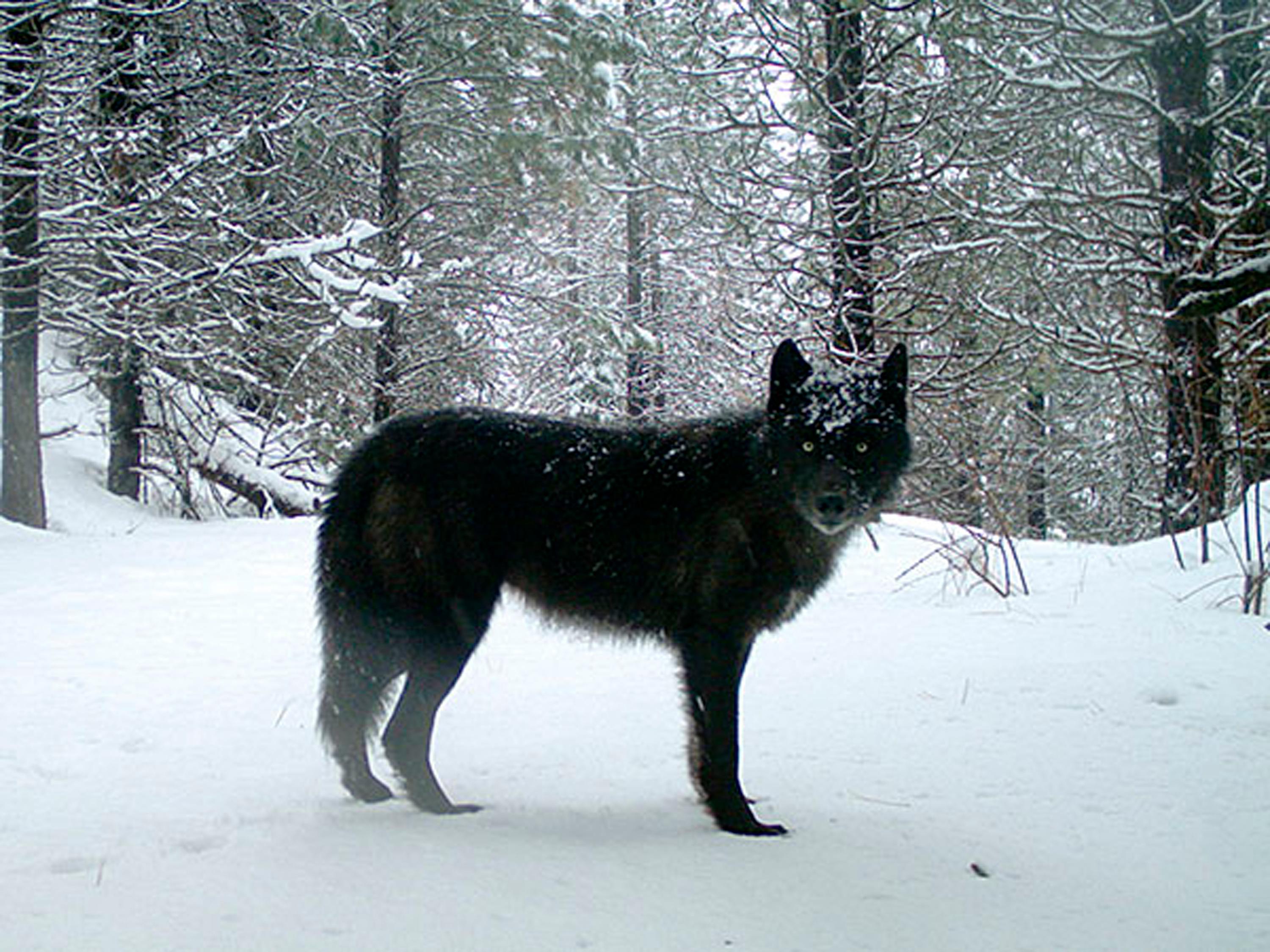
Conservation officers are working to determine whether a wolf that’s set to be released back into the wild after being tranquilized in downtown Victoria is Takaya, the lone wolf pictured here, who was featured on CBC’s The Nature of Things. (WILD AWAKE IMAGES)
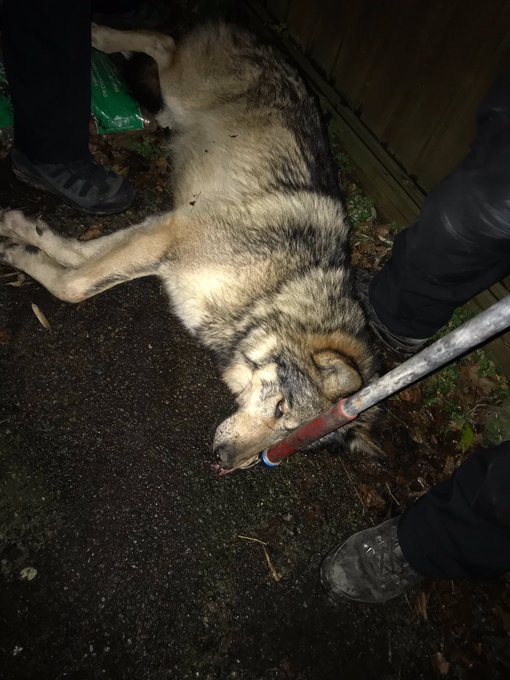
Conservation officers on Vancouver Island say they’re confident a wolf that was caught Sunday in the backyard of a Victoria residence is the same animal known to live alone on a group of small islands off the coast of the capital city.
According to a statement posted on the B.C. Conservation Officer Service’s Facebook page, the animal was assessed and is believed to be Takaya “due to several factors.”
The wolf was first spotted living on the Discovery and Chatham Islands in 2012 and was the subject of a recent Nature of Things documentary.
The service says the wolf is a mature male in good health with no apparent injuries. It was released back into the wild Monday, but not back to Discovery Island.
This is because officers believe it left the island for a reason — likely looking for food or resources.
Officers picked a wild, coastal habitat on the west side of Vancouver Island to give Takaya the “best chance possible” of survival.
The #JamesBayWolf2020 has been safely released back into the wild, in a coastal habitat on the west side of Vancouver Island. The #BCCOS would like to thank @vicpdcanada for their help & the public for calling the #RAPP line. More details here: http://tinyurl.com/qsafb8c
“I’m sure it is scared and hungry and it just wants to get into a solitary place,” B.C. Conservation Officer Scott Norris. Norris said in an interview on On The Island Monday.
The wolf was first spotted on Saturday trotting down a neighbourhood street in James Bay. It was tranquilized just after 6 p.m. Sunday in a residential yard in the 200 block of Michigan Street.
Norris said wolves do not generally venture into urbanized areas and this was “quite an anomaly.”
He thinks the animal likely followed the shoreline before ending up in the James Bay neighbourhood.
BC CO Service@_BCCOS
The #BCCOS safely tranquilized and captured the #JamesBay wolf. The wolf will be assessed by the provincial veterinarian tomorrow. It appears to be a healthy mature male wolf #JamesBayWolf2020
Chris Darimont, the Raincoast Research chair in Applied Conservation Science at the University of Victoria, said the wolf was much more likely scared of us than we were of it.
“The risks that the wolf accepted in running the gauntlet through town were much higher than any real risk to humans, maybe posing a serious threat to cats and dogs and the odd chicken along the way,” Darimont said.
“I’m glad things have seemed to transition without much harm to people or the wolf.”
Darimont says the wolf’s new, isolated west coast home will serve it well.
“Wolves tend to do much much better where human density, especially road access is limited,” he said.
And as a marine wolf, he should be able to find plenty to eat.
“He made most of his living off of [hunting] seafood things like harbour seals, sea lions, river otters and so on. So having some coastal habitat and resources to turn to now, particularly in an otherwise unfamiliar environment, is a really good strategy,” he said.
Anyone who spots a wolf should begin using scare tactics if it gets closer than 100 metres. This includes raising your arms and waving them in the air, using noisemakers and throwing sticks.
If a wolf displays aggressive behaviour, you should back away slowly and not turn your back on the animal.
Eyewitness account plus scavenged elk carcass indicates likely presence of multiple wolves in northwest Colorado
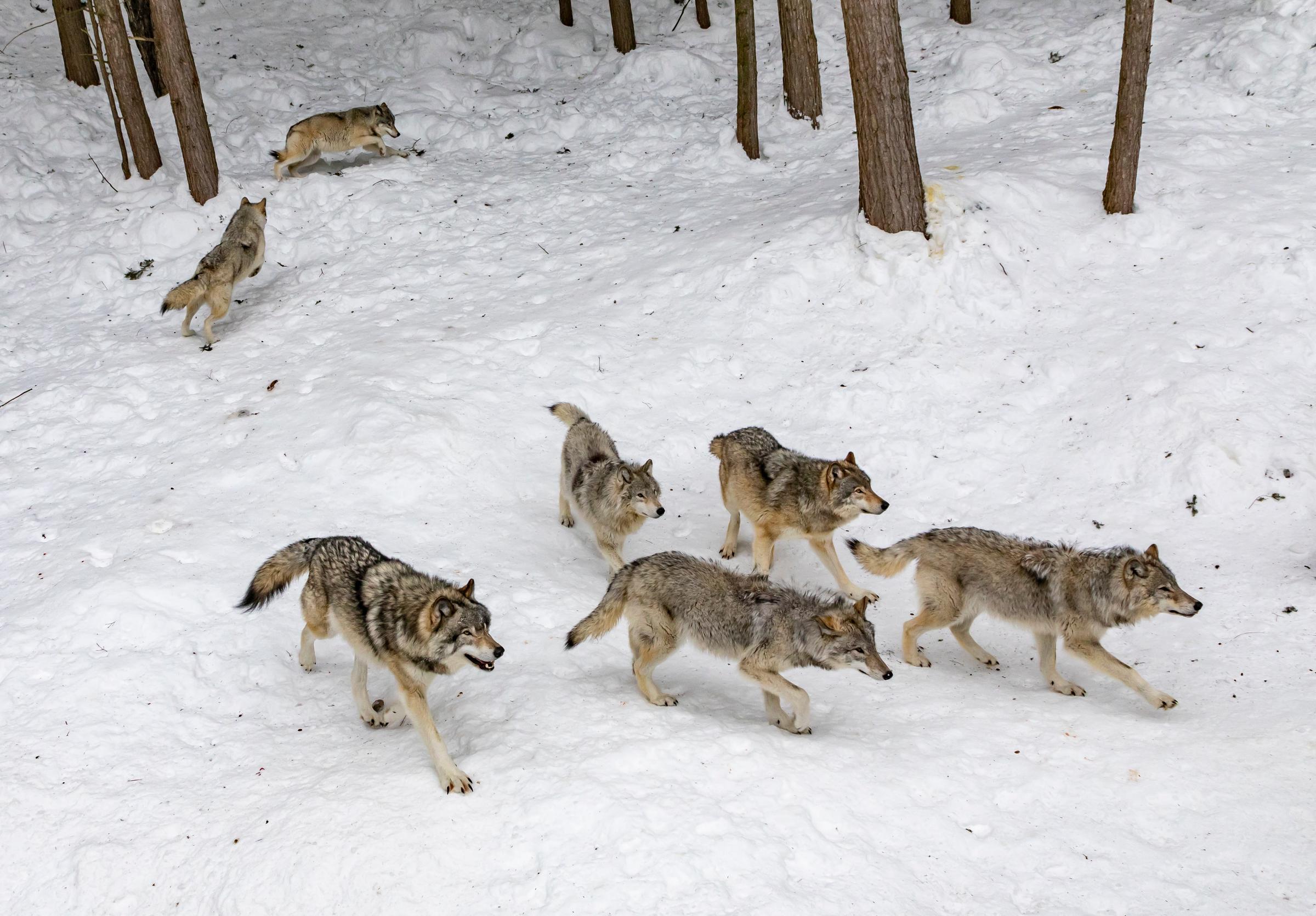
MOFFAT COUNTY, Colo. – Colorado Parks and Wildlife officials say an eyewitness report of six large canids traveling together in the far northwest corner of the state last October, in conjunction with last week’s discovery of a thoroughly scavenged elk carcass near Irish Canyon – a few miles from the location of the sighting – strongly suggests a pack of gray wolves may now be residing in Colorado.
“The sighting marks the first time in recent history CPW has received a report of multiple wolves traveling together,” said CPW Northwest Regional Manager JT Romatzke. “In addition, in the days prior, the eyewitness says he heard distinct howls coming from different animals. In my opinion, this is a very credible report.”
After learning about the scavenged elk carcass, CPW initiated an investigation which is still ongoing. At the site, the officers observed several large canid tracks from multiple animals surrounding the carcass. According to CPW wildlife managers, the tracks are consistent with those made by wolves. In addition, the condition of the carcass is consistent with known wolf predation. (Photos below)
“The latest sightings add to other credible reports of wolf activity in Colorado over the past several years,” said Romatzke. “In addition to tracks, howls, photos and videos, the presence of one wolf was confirmed by DNA testing a few years ago, and in a recent case, we have photos and continue to track a wolf with a collar from Wyoming’s Snake River pack.
Romatzke says from the evidence, there is only one logical conclusion CPW officials can make.
“It is inevitable, based on known wolf behavior, that they would travel here from states where their populations are well-established,” he said. “We have no doubt that they are here, and the most recent sighting of what appears to be wolves traveling together in what can be best described as a pack is further evidence of the presence of wolves in Colorado.”
Romatzke adds CPW will continue to operate under the agency’s current management direction.
“We will not take direct action and we want to remind the public that wolves are federally endangered species and fall under the jurisdiction of the US Fish and Wildlife Service. As wolves move into the state on their own, we will work with our federal partners to manage the species,” he said.
The public is urged to contact CPW immediately if they see or hear wolves or find evidence of any wolf activity. The Wolf Sighting Form can be found on the CPW website.
Wolves on Isle Royale have begun to hunt and travel as a group.
It’s part of a process park officials say could eventually lead to the formation of the island’s first new pack.
Three of the island’s 15 wolves have begun to travel together, the group is made up of two males and one female.
“It will take a little time to see if we would consider them a pack because they have to be traveling together, defending the territory, and then also we’ll see in the spring if they reproduce,” says Liz Valencia, Isle Royale National Park’s temporary superintendent. “Then we’ll have an established pack.”
Valencia says if a pack forms on the island, she’ll consider it a success. The goal is to keep moose populations in check.
“When a pack forms, then they can take down more moose and that really shows that we brought these wolves out there and so far that has been a success because they have grouped together and formed packs.”
The park has also noted that two wolf deaths from the fall of this year were caused by other wolves.
Valencia said aggression between wolves was not unexpected.
“Researchers did expect that would happen. So many wolves are on the island, they are trying to establish territories, they are trying to sort out the social hierarchy, so that will happen on the island as wolves do that.”
One of the wolves that died was an old male that was on the island before relocation efforts began.
The BC Government lied about how they use wolves to betray their family packs.
(GOLDEN, BC – Dec. 11, 2019) A gruesome detail about BC’s wolf-killing program has been revealed in a new government report titled South Peace Caribou Recovery following Five Years of Experimental Wolf Reduction. Individual wolves that are radio-collared to later reveal the location of their pack are exposed to repeated trauma in this highly disturbing practice…over and over again. Despite being denied by government in previous media enquiries, the Methods section of the 2019 experimental report describes how the collared wolf is left to watch as it’s entire family is gunned down from the air, and kept alive year after year, being forced to repeatedly witness the death of any wolf that befriends it.
“Knowing that wolves are highly sentient and dependent on each other for survival makes this practice unbearable to think about, yet we must. Imagine what these collared wolves experience. How many times do they have to suffer?” questions Sadie Parr, executive director of Wolf Awareness.
In 2016 the province reluctantly admitted that it net-guns individual wolves from helicopters to fit them with radio collars so that gunmen can be flown in at a later date to relocate the collared wolf with its family and kill them all. The animals collared in the practice described above are often referred to as “Judas Wolves” to portray a sense of ultimate betrayal; yet Judas made a deliberate choice.
The South Peace wolf-kill program, which encompasses an area larger than half of Vancouver Island, has killed more than 550 wolves and is proposed to continue for an indefinite period; until the landscape can no longer support sufficient elk, moose and deer to feed wolves. Inhumane tax- funded wolf kill programs are also underway in areas around Revelstoke and Nelson.
The province recommitted to transparent and fulsome consultation about caribou recovery planning after several heated community meetings elicited outrage in BC’s interior. However, the ministry then conducted a closed consultation in its proposal to expand the wolf kill program underway to three additional areas (Tweedsmuir-Entiako, Hart Ranges, and Itcha-Ilgachuz caribou herd ranges) and pay hunters to kill cougars in the Itcha-Ilgachuz caribou range. The consultation document was finally leaked to conservation groups, who immediately opposed the plans.
Conservation group Wolf Awareness maintains that wolves are being scapegoated for industrial and recreational interests, and that wolves, wildlife and ecosystems deserve better.
Says Parr. “The tax-funded unethical and inhumane wolf kill program coupled with secrecy and pitifully inadequate caribou habitat protection is a stain on the entire country. Ethical and ecological considerations are being ignored.”
Wolf Awareness is a team of conservationists and scientists whose primary goal is to foster awareness and appreciation of wolves, wolf ecology, conservation and co-existence.
“The radio-collared individuals were often left alive following the conclusion of the winter reduction efforts in order to facilitate the location of wolves the following winter.”
BC Ministry of Forests, Lands, Natural Resource Operations and Rural
Development
August 2019
Calls for conservation ethics falling on deaf ears in BC, will Canada ignore pleas too?
Caribou draft agreements ignore majority opposition to wolf kill programs.
May 28, 2019 (GOLDEN, BC) — Two jointly proposed recovery plans for some caribou herds in the province of BC are set to rely heavily on killing wolves for decades, ignoring input from wolf biologists and a majority of respondents who voiced opposition to wolf kill programs during a 2012 public comment period on BC’s wolf management plan.
Until May 31st , the BC government is accepting public comments on the plans which could lead to decades of publicly funded aerial wolf shooting, as well as the killing of moose and deer and potentially cougar, bear and wolverine. Each year, hundreds of animals will be killed in attempt to prevent further declines of the threatened caribou populations. Neither of the two plans explain how quality habitat (i.e. caribou-friendly climax forests that can support self-sustaining herds) will appear in light of continued climate change and habitat alteration by humans.
In 2012, serious concerns about BC’s draft wolf management plan were put forward during the short public comment period that followed its release. In less than 3 weeks, more than half of the >3,000 comments submitted expressed strong opposition to the draft plan which ultimately legitimized the systematic killing of wolves.
When the final plan was released in 2014, it ignored the public’s concerns about inhumane wolf killing practices and the impacts of killing programs on wolf social structure and ecosystem integrity. The draft plan was not peer reviewed by external ecologists.
From 2015 – 2018, caribou recovery programs have seen a minimum of 557 wolves shot from helicopters or slowly strangled in killing snares. A BC FOIP request has been delayed that would reveal the number of wolves killed during this past fiscal year. As each wolf family is wiped out, dispersing wolves will recolonize an area and perpetuate an annual cycle of killing.
“Thousands of individual wolves will suffer if this plan isn’t changed,” says Sadie Parr, Executive Director of conservation group Wolf Awareness. “The long-term repercussions this will have on the natural environment are being neglected, as are the consequences it will have on individual wolves and wolf populations. This is a slippery slope, wet with wolf blood.”
Aerial shooting is not an approved method under Canada’s current guidelines on Approved Animal Care. Biologists agree that neck killing snares, also used in tax-funded wolf kill programs underway, are also inhumane and lack the ability to bring about a swift death.
“The morality of causing harm to hundreds of animals for any reason should be questioned. Are we prepared to spend the next several decades shooting wolves from helicopters in a vain attempt to maintain small herds of caribou in degraded habitat? Is that what conservation biology has become?” asks Hannah Barron, Conservation Director at Wolf Awareness.
“Canada is being frowned upon internationally for its weak species at risk protection, dodging timely and adequate climate change legislation, and continuing recklessly with unsustainable forestry practices that contribute to both of the aforementioned. By accepting a caribou recovery plan that engages in an unethical and highly controversial wolf kill program, our country will become a leading example of how to break down Nature’s resiliency by destroying the very systems that provide ecological, economic and cultural benefits to those who call Canada home. Instead, we should embrace and protect what is one of the last remaining global strongholds for large apex predators, and all other species that rely on their ability to thrive,” states Elke van Breemen, Education Director at Wolf Awareness.
“Engaging now is about more than caribou and wolves. It’s also about how we relate to all non-human animals and the living environment that sustains us. It’s about the Natural legacy we are leaving, or perhaps stealing from future generations. We can, and must, do better,” says Parr.
— 30 —
Photos of wolves, caribou and habitat available upon request.
Wolf Awareness is a team of conservationists and scientists whose primary goal is to foster awareness and appreciation of wolves, wolf ecology, conservation and co-existence.
On November 20th, Wolf Awareness was one of two NGO’s from B.C.’s Columbia-River- Revelstoke constituency that saw a Petition to End the Wolf Kill Program submitted into Legislature during a meeting of the Assembly.
The petition was submitted in an appeal to prevent the inhumane program from re-starting this winter and ultimately to remove predator killing from the toolbox of options being considered as new recovery plans are being developed for caribou.
Killing is NOT conservation, states Sadie Parr, Executive Director of Wolf Awareness. It’s not just about whether it works, but whether it is even conscionable to begin with. Attempting to sanctify killing large numbers of predators for any reason is highly disturbing. I strongly believe that ‘Just because you can, doesn’t mean you should’.
Parr claims that there is a critical moral dilemma not being addressed regarding the killing of wolves (and other animals) under the guise of conservation, especially when humans have put caribou in this situation, and continue to wreak havoc for the species.
Tax Payers Petition B.C.’s Inhumane Wolf Kill Program
Millions of tax dollars have been spent since 2015 to kill more than five hundred wolves – sentient animals – using inhumane methods; namely aerial gunning and killing neck snares, both which lead to prolonged suffering before death. Petitioners from across the province don’t want to see their taxes funding this inhumane program, explains Parr.
Dr. Paul Paquet, an ecologist and recognized authority on mammalian carnivores’ states: The time has come to seriously examine our relation with top predators. The question is not whether killing wolves is “sustainable” as wildlife managers are always trying to assert. The question is whether it is ecologically, ethically, or even economically defensible to kill large numbers of predators anywhere. The answer on all counts is no.
The South Selkirk caribou herd became functionally extinct despite four years of killing wolves. The remaining animals are being moved to north of Revelstoke in Mountain Caribou Recovery Planning Unit 3A, where tax-funded wolf killing is slated to continue this winter as well as in the South Peace.
The petition is also seeking real protection for identified caribou habitat. 29 wolves were killed in the Revelstoke unit the past two winters, while industry and recreation continued to carve up caribou range, trumping species preservation and ecosystem health in a morally bankrupt display that may tarnish British Columbia’s “natural and wild” legacy forever.
Wildlife management and conservation practices should be ecologically and ethically sound. Wolf killing programs are neither and as such should be abandoned, Parr reflects, referring to the Policy Position on Experimental wolf reduction programs underway in western Canada the conservation group recently developed in light of this practice expanding.
– 30 –
Photos of wolves, caribou and habitat available upon request.
Key Information:
Lack of caribou habitat protected in Revelstoke leads to wolf killing:
New industrial development in area identified as caribou habitat:
Columbia Caribou Range: Imperial Metals mine developing in headwaters of Upper Seymour Provincial Park which is caribou migratory route and near the maternal pen project.
Before the wolf kill expanded to Revelstoke in 2017, scientists involved in caribou recovery admitted in a Government planning document: In Planning Unit 3A, forest harvesting still occurs in the critical habitat of Southern Mountain Caribou. Mechanized recreation is listed as an additional concern affecting caribou. Document also states there are no humane methods to directly reduce wolf numbers.
-Note: also details the plan to continue “primary prey reduction”…ie. killing moose, deer, etc. as well as wolves and cougars.
The BC Government lied about how they use wolves to betray their family packs
(GOLDEN, BC – Dec. 11, 2019) A gruesome detail about BC’s wolf-killing program has been revealed in a new government report titled South Peace Caribou Recovery following Five Years of Experimental Wolf Reduction. Although previously denied by government staff, individual wolves are exposed to repeated trauma in a highly disturbing practice…over and over again. Despite being denied by government in previous media enquiries, the Methods section of the 2019 experimental report describes how the collared wolf is left to watch as it’s entire family is gunned down from the air, and kept alive year after year, being forced to repeatedly witness the death of any wolf that befriends it.
In 2016 the province reluctantly admitted that it net-guns individual wolves from helicopters to fit them with radio collars so that gunmen can be flown in at a later date to relocate the collared wolf with its family and kill them all. The animals collared in the practice described above are often referred to as “Judas Wolves” to portray a sense of ultimate betrayal; yet Judas made a deliberate choice.
“Knowing that wolves are highly sentient and dependent on each other for survival makes this practice unbearable to think about, yet we must. Imagine what these collared wolves experience. How many times do they have to suffer?” questions Sadie Parr, executive director of Wolf Awareness.
The South Peace wolf-kill program, which encompasses an area larger than half of Vancouver Island, has killed more than 550 wolves and is proposed to continue for an indefinite period; until the landscape can no longer support prey such as elk, moose and deer to feed wolves. Conservation group Wolf Awareness maintains that wolves are being scapegoated for industrial and recreational interests, and that wolves, wildlife and ecosystems deserve better.
The province recommitted to transparent and fulsome consultation about caribou recovery planning after several heated community meetings elicited outrage in BC’s interior. However, the ministry then conducted a closed consultation in its proposal to expand the wolf kill program underway to three additional areas (Tweedsmuir-Entiako, Hart Ranges, and Itcha-Ilgachuz caribou herd ranges) and pay hunters to kill cougars in the Itcha-Ilgachuz caribou range. The consultation document was finally leaked to conservation groups, who immediately opposed the plans.
Says Parr. “The tax-funded unethical and inhumane wolf kill program coupled with secrecy and pitifully inadequate caribou habitat protection is a stain on the entire country. Ethical and ecological considerations are being ignored.”
WOLF AWARENESS is a conservation organization dedicated to promoting positive attitudes towards carnivores in general, the wolf in particular, and to fostering an appreciation for the environment of which we are all a part.
The South Peace wolf-kill program, which encompasses an area larger than half of Vancouver Island, has killed more than 550 wolves and is proposed to continue for an indefinite period; until the landscape can no longer support prey such as elk, moose and deer to feed wolves. Conservation group Wolf Awareness maintains that wolves are being scapegoated for industrial and recreational interests, and that wolves, wildlife and ecosystems deserve better.
The province recommitted to transparent and fulsome consultation about caribou recovery planning after several heated community meetings elicited outrage in BC’s interior. However, the ministry then conducted a closed consultation in its proposal to expand the wolf kill program underway to three additional areas (Tweedsmuir-Entiako, Hart Ranges, and Itcha-Ilgachuz caribou herd ranges) and pay hunters to kill cougars in the Itcha-Ilgachuz caribou range. The consultation document was finally leaked to conservation groups, who immediately opposed the plans.
Says Parr. “The tax-funded unethical and inhumane wolf kill program coupled with secrecy and pitifully inadequate caribou habitat protection is a stain on the entire country. Ethical and ecological considerations are being ignored.”
WOLF AWARENESS is a conservation organization dedicated to promoting positive attitudes towards carnivores in general, the wolf in particular, and to fostering an appreciation for the environment of which we are all a part.
With wolf pack supporters planning on Tuesday to submit more than 208,000 signatures supporting a November 2020 ballot measure calling for the reintroduction of wolves to Colorado, voters could soon hear a pitched howling over wolves for most of next year.
“This is our last opportunity to do it right and to restore the balance,” said Rob Edward, whose Rocky Mountain Wolf Action Fund has been collecting signatures since June for a 2020 ballot measure — now called Initiative 107 — that directs the Colorado Parks and Wildlife Commission to craft a plan to restore and manage gray wolves in Colorado by the end of 2023.
The group needs about 124,000 valid signatures to qualify for the 2020 ballot. Their deadline to collect them is Friday.
As the group transitions from harvesting signatures to swaying voters, opponents of wolf reintroduction are girding for battle. And it’s a new type of fight for opponents of wolf reintroduction, who in other states across the West and Great Lakes region have lobbied wildlife commissioners — not voters — to oppose reintroduction. The Colorado Stop the Wolf Coalition is strategizing a first-ever public campaign, seeking to educate voters on potential negative impacts of introducing the wolf to the state.
“There are a lot of people who don’t want wolves brought into Colorado. We just can’t sustain another predator in this state,” said Denny Behrens, co-chair of the Stop the Wolf Coalition.
The coalition has gathered resolutions from 10 counties opposing reintroduction of wolves in the state. It has found high-profile supporters like Greg Walcher, the former head of the Colorado Department of Natural Resources.
In a statement announcing his support for the coalition and its fight against Initiative 107, Walcher said seeded wolves in Colorado could “decimate other important wildlife, and their impact on rural areas could be devastating.”
Colorado is the last battleground for restoring wolf populations after more than 40 years of federal and state efforts to introduce wolves in the Southwest, Northern Rockies and Great Lakes regions.
In Montana, Wyoming, Idaho, New Mexico, Arizona and around the Great Lakes, wolf reintroduction was directed by wildlife officials following the federal Endangered Species Act that has protected gray wolves since 1983. A ballot measure in Colorado — the missing link connecting wolf populations between Mexico and Canada — would mark the first time that voters, not federal laws, directed state wildlife officials to restore wolves.
“Conservationists and biologists have been working with the Fish and Wildlife Service and different agencies for years, trying to convince them to do this in Colorado, and we keep running up against a brick wall,” said Edward of the direct-to-voters appeal for wolves.
There are about 5,500 wolves spread across nine U.S. states right now, according to the U.S. Fish and Wildlife Service. The Department of the Interior in March proposed removing the gray wolf from protection, citing its growing population.
The proposal has drawn the ire of wolf advocates who fear delisting could lead to more wolf hunting and trapping in some areas. Advocates submitted more than a million comments opposing the suggested removal of endangered species protection for wolves.
This 1924 photo from Routt County shows one of the last wolves shot and killed in Routt County. (Provided by Jay Fetcher)
Wolves last roamed Colorado in the 1940s, but they have wandered into Colorado from neighboring states, even as recently as last July.
Opponents don’t care about wandering wolves. They do not like the wolf advocates’ plan to introduce at least 20 to 30 predators to Colorado, which could grow to a population of 250 or more wolves over the course of a decade. Behrens said the idea that wolves would remain on the West Slope “is pretty absurd.”
“They will travel great distances. You will have wolves in Woodland Park and Estes Park. You are going to have wolves all over the place in a matter of years,” he said. “Why would you take a wolf from Canada where it roams free and bring it down to Colorado and turn it loose with almost 6 million people and think there’s not going to be any conflict? There will be conflict from day one, and it’s not fair to the wolf to do that.”
A photo of a possible wolf sighted in northern Colorado in July. (Provided by Colorado Parks and Wildlife)
Edward, with the wolf fund, points to growing wolf populations in places like Yellowstone National Park, where millions of annual visitors have not had conflicts with wolves since reintroduction there in the 1990s.
“This is just not an issue. Western Colorado is 70% public land, so it’s not going to be developed and full of people,” Edward said.
Opponents of the wolf reintroduction plan say the flow of out-of-state money into the wolf reintroduction effort shows “this is not a Colorado campaign,” Behrens said.
California’s Tides Center — which supports progressive causes — has given the wolf campaign about $264,000. The Colorado Sierra Club gave more than $10,000, according to reports the campaign filed with the Colorado Secretary of State. Between July and October this year the Rocky Mountain Wolf Action Fund reported $625,000 in contributions and about $653,000 in expenses, most of that going toward Landslide Political, a Utah-based signature gathering firm.
“Less than 1% of the money they’ve raised has come from Coloradans. That’s pretty telling,” Behrens said.
Edward said since most of western Colorado is federal land, it’s not surprising that people from all over the country support efforts to restore wolf populations on public lands.
“It is perfectly appropriate for people from across the country to donate to this campaign,” said Edward, who served on a wolf advisory group in 2005 that ultimately recommended that the state’s wildlife commission oppose reintroducing wolves.
Colorado Parks and Wildlife has not voiced support or opposition to the ballot proposal, but in 2016 the Colorado Parks and Wildlife Commission adopted a resolution affirming the wolf advisory group’s recommendation opposing the intentional release of any wolves in Colorado.
A fiscal note from Colorado Parks and Wildlife — obtained via an open records request by the Stop the Wolf Coalition — shows that after planning costs, implementation of the wolf reintroduction plan would cost $4.1 million, including new wildlife biologists and payments to ranchers who lose livestock to wolves. The cost for the first eight years of the reintroduction effort, which CPW estimated would involve 45 released wolves over a five-year span, would be $5.7 million.
With what could be the country’s final battle over wolves now shifting toward Colorado voters, both sides say they have the support to win.
“As far back as 1993 and 1994, we have polling showing that people on the Western Slope support recovery by a majority margin,” Edward said.
Once “a full-blown education campaign” reaches voters, Behrens said, “we will see a huge input of funding from Coloradans who don’t want this.”
On Wednesday, Oct. 23, 2019, biologist Mike Phillips presented “Wildness Restored: The Wolf’s Return to Colorado” at the University of Colorado Denver, the latest lecture in the Chancellor’s Distinguished Lecture Series. He comes to Colorado at a pivotal moment — as state residents consider a proposed 2020 ballot measure to initiate a wolf restoration plan.
Wolf biologist and Montana state Senator Mike Phillips
Phillips is currently a Montana State Senator and Director of the Turner Endangered Species Fund. A biologist who previously worked on both the Red Wolf Recovery Program and the Wolf Restoration project at Yellowstone National Park, Phillips has conducted extensive wildlife research, though he specializes in large carnivores. Besides many articles in both peer-reviewed journals and popular magazines, Phillips is the author of “The Wolves of Yellowstone.” In other words, he is a well-recognized wolf expert.
As such, Phillips has to contend with our country’s troubled history with wolves. Europeans settlers virtually eradicated wolves, first through independent hunting and trapping, and later through government-sanctioned wolf extirpation programs (involving mass poisoning, among other inhumane killing methods) that left the species almost extinct. Why? “Manifest destiny,” Phillips explains, “which demanded a zealous embrace of the determination to tame the land and its wild inhabitants.”
But the large-scale destruction of wild animals, including bison, grizzlies, wolves, and elk, eventually prompted a call to action. “The entire science of wildlife management grew out of a need for things to shoot because the great game herds had been destroyed,” Phillips said. Once the U.S. realized it needed to reverse the trend toward species extinction, it passed the Endangered Species Act, which protected threatened and endangered plants and animals and their habitats. This ushered in a new era of conservation — and the wolf once again became a central metaphor for how we view wildness.
The real wolf vs. the mythic wolf
In addition to history, Phillips has to contend with popular culture, which has largely depicted the wolf as a vicious predator. In this regard, the United States is not alone. For centuries, and across continents, the wolf has been at the center of stories and fables, serving as a convenient symbol. And many wolf myths are aimed at children, which prompted the Rocky Mountain Wolf Project (RMWP) to produce a video titled “Meet the Real Wolf” (see above).
Phillips is forced to discuss the wolf in this context, acknowledging the mythic wolf while providing information about the real wolf: “The real wolf has been studied exhaustively over many decades. The real wolf is one of the most studied large mammals in the world. The real wolf is not even a shadow of the mythical wolf — it’s the mythical wolf that gets in the way of restoration,” Phillips said.
It’s important to change the narrative about the real wolf, especially in regards to social structure and survival. For wolves, family is of paramount importance, as explained in the RMWP video. Another misconception is that wolves are supreme killers, which is incorrect: “The real wolf — oh, my heavens. Life is a daily struggle. Starvation is a common cause of death. Puppies suffer the most of all. Most efforts to hunt end up with gray wolves coming up empty-pawed,” Phillips said.
“There are very good, successful models from the northern Rocky Mountains,” said Mike Phillips. “Reintroducing gray wolves is a certain affair.”
Initiative 107: restoration of gray wolves
Currently, the Rocky Mountain Wolf Action Fund (RMWAF) is collecting signatures for a proposed 2020 ballot measure that would restore the gray wolf to Colorado. Rob Edward, president of RMWAF, summarized the petition: “Initiative 107 directs the Colorado Department of Wildlife & Parks to initiate a science-based wolf restoration plan, to include public input into the process, and to ultimately begin reintroducing wolves to designated lands west of the Continental Divide in Colorado no later than 2023.”
The final written version of Initiative 107 is available at the Colorado Secretary of State website. The measure does not establish its own plan for wolf reintroduction but rather asks the Colorado Parks and Wildlife Commission to “Develop a plan to restore and manage gray wolves in Colorado, using the best scientific data available.”
That is one of the strengths of the initiative, according to Phillips. “Initiative 107 does not aim to be a strong statement of wildlife management. 107 acknowledges the expertise of Colorado state and of wildlife biologists; it acknowledges the expertise of the state assembly. It is specifically written to take advantage of that expertise and those authorities,” he said.
Edward and the RMWAF team are in the process of collecting the required number of signatures for Initiative 107 to appear on the 2020 ballot (approximately 124,500 by Dec. 13, 2019). He hopes to gather at least 200,000 signatures. That may be the hardest part in the campaign to reintroduce wolves to Colorado, particularly since the state requires signatures to be collected in person. If Initiative 107 gets on the ballot, Edward said he is confident Colorado voters will approve the measure: “We have over two decades of polling data showing support for wolf restoration standing at over 70% statewide and 65% on the Western Slope.”
According to the Wolf Conservation Center, Gray Wolves (Canis lupus) were once among the most widely distributed wild mammals. They inhabited most of the available land in the northern hemisphere. Due to the destruction of their habitat and persecution by humans, they now occupy only about 10 percent of their historic range in the continental 48 United States.
Colorado is critical link in wolf range
According to Phillips, “Western Colorado represents the last great wolf restoration campaign.” This is because of Colorado’s geographic location —in between two wild wolf habitats. To Colorado’s north, wolf populations inhabit the northern Rocky Mountains and Pacific Northwest. To Colorado’s south, wolves inhabit the Southwest.
Renowned wolf expert L. David Mech, PhD, biologist and senior research scientist for the U.S. Department of the Interior, has been studying wolves since 1958. He writes: “Re-establishing wolves in western Colorado could connect the entire North American wolf population from Minnesota, Wisconsin and Michigan through Canada and Alaska, down the Rocky Mountains into Mexico. It would be difficult to overestimate the biological and conservation value of this achievement.”
The state of Wyoming, however, poses a threat to a continuous Rocky Mountain wolf habitat since it delisted wolves from the Endangered Species list on April 25, 2017. Wolf management is now in the hands of the Wyoming Game and Fish Commission, which defined wolves as predatory animals in a large majority of the state. Wyoming’s policy will negatively influence wolf movement. “But with a population in Colorado, at least there will be animals that can move both from the south to the north and from the north to the south. With more animals involved, the prospect of connectivity improves,” Phillips said.
Map of Wolf Management Area from the Wyoming Game and Fish Department.
And connectivity is important because wolves, like other large predators, help maintain healthy ecosystems. This is one of the important arguments for wolf reintroduction to the state. In a 2001 article titled “The Importance of Large Carnivores to Healthy Ecosystems,” Phillips and his co-authors write, “The impacts of carnivores thus extends past the objects of their predation. Because herbivores eat seeds and plants, predation on that group influences the structure of the plant community. The plant community, in turn, influences distribution, abundance, and competitive interaction within groups of birds, mammals, and insects.”
When asked to put this concept into everyday language, Phillips said: “Let’s assume that life is a most powerful force in the universe. If that’s true, then death has to be equally important … Life matters and death matters. Prey matters and predators matter … Gray wolves just happen to be good at moving life in the direction of adaptation—good at shaping life because they’re good at picking out those that are predisposed to die.” He explained what decades of wolf research has established: wolves prey on the weak.
Wolves could potentially mitigate chronic wasting disease
According to a Colorado Parks and Wildlife (CPW) report from Dec. 2018, chronic wasting disease (CWD), a neurological illness similar to mad cow disease, is a growing concern: “As of July 2018, at least 31 of Colorado’s 54 deer herds (57%), 16 of 43 elk herds (37%), and two of nine moose herds (22%) are known to be infected with CWD.” And the incidence of CWD is growing quickly: the same report cites “greater than a tenfold increase in CWD prevalence” in some mule deer herds since the early 2000s.
People cannot easily detect animals with CWD. For example, CPR News recounted the experience of Eric Washburn, an experienced hunter who shot and killed a mule buck in Northern Colorado. The animal had a “thick coat and massive rack of antlers,” but mandatory testing found it had CWD. Washburn, who was forced to throw away “all of that beautiful meat” instead of using it to feed his family, learned an important lesson: “It just showed me you can’t tell by looks which deer are diseased and which are not.”
This incident turned Washburn into an unlikely ally for the pro-wolf-reintroduction movement, as a hunter working for the RMWAF in the hopes that wolves would help curb CWD. Biologist Gary Wolfe, a former Montana Fish, Wildlife and Parks commissioner, points out that wolves target diseased animals. While there is no direct evidence that wolves mitigate CWD — only past studies related to wolves hunting animals with other diseases and a study on mountain lions preying on CWD-infected mule deer— Wolfe cites the inverse relationship between wolf population distribution and CWD-infected herds in the Mountain West. “That’s circumstantial evidence, but to me that’s a piece of circumstantial evidence that says that wolf predation can help slow the spread of the disease,” he states.
Opposition to wolves in Colorado
Other hunters, as well as ranchers and concerned citizens, strongly oppose Initiative 107. Some of them believe that wolves might increase the CWD problem by spreading it throughout prey herds. But there is no evidence that wolves increase the occurrence of CWD.
Stop the Wolf, an organization firmly against wolf reintroduction, has published a fact sheet titled “Wolves & Chronic Wasting Disease” that counters: “Wolves … act as an agent of dispersion and displace big game herds from their traditional habitat.” While their fact sheet does include accurate data concerning CWD from the Centers for Disease Control, the organization also disseminates misinformation and promotes fear. For example, another fact sheet titled “Wolves & Human Safety” claims “Now environmentalists teach children that it is safe to pet a wild wolf.”
There are more reasonable arguments that could be made against wolf reintroduction to Colorado, including the following: wolves will kill cattle and other livestock, wolves will kill prey animals like deer and elk, hunters could kill wolves, and wolves could harm humans. In response to many of these arguments, it’s fair to state that wolves are predators: Their presence or absence needs to be considered within the context of ecosystems and within the context of competing species, including humans.
Phillips addressed three of the counter-arguments in his lecture at CU Denver, anticipating the concerns of ranchers, hunters, and fearful citizens. Under Initiative 107, ranchers would be paid for any livestock killed by wolves. He also reviewed the current estimated elk and deer herd populations in Colorado and used figures from Montana, Wyoming, and Idaho to illustrate that wolves would make only a minor impact on Colorado’s hunting seasons. “Coexisting requires only a modicum of accommodation,” he concluded.
Elk population and harvest data across the northern Rocky Mountain states in years before and after wolf reintroduction. Data from state game departments, courtesy of Mike Phillips.
History of human–wolf interactions
The last point—that wolves might kill humans—might be the most important argument to address, given the complex history between humans and wolves in the United States (and elsewhere). European settlers and their descendants took a very common species and virtually exterminated it. Phillips said, “The gray wolf was destroyed relentlessly … killed for no great reason.”
Fear, of course, was at least part of the reason humans killed wolves. A report titled “The Fear of Wolves: A Review of Wolf Attacks on Humans,” published by Norway’s Ministry of the Environment in 2002, examined literature and first-hand accounts of wolf attacks on people from Scandinavia, continental Europe, Asia, and North America, including written documents from as far back as the fifteenth century. The report lists 18 authors and more than 90 contributors from more than 30 countries. Have there been wolf attacks on humans? Yes. But they dramatically decreased in the 20th century and the majority of attacks involved rabid wolves. The report concludes: “Unprovoked attacks by non-rabid wolves on people are very rare, and the vast majority of wolves do not regard people as being prey.”
Norman A. Bishop, who worked for the National Park Service for 36 years, addressed the issue of human safety closer to home. In an email, he wrote: “I served as a park ranger in Yellowstone from 1980 to 1997, and I led hundreds of people afield to view and study wolves between 1999 and 2005. I never saw anything that gave me a hint of concern about my safety or that of my companions.”
Bishop also provided data from Yellowstone. “From 1995 to 2018, Yellowstone hosted 101,070,722 visitors, none of whom was injured by a wolf.” For people who argue that it’s the backcountry campers who might be in greatest danger, Bishop cited 2.7 million tent campers in Yellowstone from 1995 to 2018—and “no camper was injured by a wolf.”
Mike Phillips explains that with a good wolf reintroduction plan, “Within a decade, you could easily imagine 100 gray wolves or more free-ranging across the woodlands of Colorado.”
Direct democracy and wolf restoration
During a Q&A after his lecture, Phillips addressed concerns raised by two opponents to wolf restoration. Ultimately, he returned to the exact language that begins Initiative 107: “Be it enacted by the people of the state of Colorado.”
This echoes what he said in an earlier interview with CU Denver. “It’s left to Coloradans to decide, based on the nature of their heart.”
An ever more interesting conversation, this discussion of wolves and their status, behavior, and management here in our state. There seems almost no action ranchers in now-wolf-country, and the wildlife managers of the Washington Department of Fish and Wildlife (DFW), can propose or take to deal with livestock depredation that doesn’t trigger protest and a court battle. The conflict over DFW policy has been bubbling over the past decade and more.
Over the years since the 2009 Draft Environmental Impact Statement (DEIS), titled “Wolf Conservation and Management Plan for Washington” was released, a number of wolves and entire packs have been killed after persistently preying upon domestic livestock. Nearly all of the lethal removals have been in and around the Colville National Forest in northeast Washington. The removals took place following one or another DFW policy — each of which required that stockmen carry out some extensive level of non-lethal means of separating livestock and wolves over some time period. The latest removal in the Colville area was in August, just before a restraining order was issued in a Seattle courtroom.
As a geographer and lifelong wildlife nut, the management goals for wolves in our state — in the context of other western state wolf recovery goals — seemed to me so unrealistic that conflicts were inevitable. Consider the following bit of western state geography (areas suitable wolf habitat are from the Federal Register (02/08/07, Vol. 72, Num. 26), and the human populations are from the 2007 U.S. Census Bureau.
Montana held 958,000 humans (6.6 per square mile) and 40, 924 square miles of suitable wolf habitat. Wyoming had 523,000 people (5.4 per square mile) with 29, 808 square miles of wolf ground. Idaho, with its 1,499, 000 people (18.1 per square mile), has wolf habitat totaling 31,586 square miles. Washington’s population was 6,468,000 (97.2 people per square mile). Our wolf habitat: 297 square miles in the eastern one-third and “scattered habitat in small isolated areas of the Okanogan, marginal habitat both north and south of Mount Rainier, and a large area of habitat in and around the Olympic National Park,” adding up to something around 4,500 square miles.
Thus, in Washington we have a human population of four to thirteen times the other “wolf” states, a population density of five to nineteen times theirs, and “suitable habitat” only eleven to 15 percent of theirs. Yet, in each of the other states, the goal for delisting was 100 wolves (10 breeding pairs), while Washington’s goal was 15 breeding pairs/packs of wolves (about 150 animals) before delisting. The clock has been ticking ever louder over the past decade.
At last 2018 population survey, DFW biologists estimated Washington’s wolf population at a minimum of 126 individuals, 27 packs, and 15 successful breeding pairs.
The number of wolves across the state has reached a point that many are pushing for delisting of wolves from any statethreatened or endangered list, and turning wolf management over to DFW — similar to management in other western states. To that end, DFW officials have begun a broad public outreach effort.
In late summer wildlife officials scheduled a series of 14 open public meetings across the state to begin assessing possible changes to the state’s wolf-management policy. Within a week or two, officials changed those meetings to online discussions, citing a fear of violence rising from a number of unspecified threats of both violence and disruption.
Those online meetings (and the face to face meetings formerly scheduled) were integral to the multi-year State Environmental Policy Act (SEPA) process DFW has underway to develop a post-recovery wolf management and conservation plan. The plan development includes an extensive public outreach component, and you will find abundant information on wolf post-recovery planning on DFW’s website. Fact sheets, summaries and frequently asked questions are at wdfw.wa.gov/sites/default/files/2019-10/20190920_wolf_post-recovery_plan_faq.pdf. An online comment form is available at wdfw.wa.gov/sites/default/files/2019-10/wolf_post-recovery_plan_scoping_comment_form_0_0.pdf. Note that the form can be printed and mailed (as can general comments) to Lisa Wood, SEPA/NEPA Coordinator, WDFW Habitat Program, Protection Division, P.O. Box 43200, Olympia, WA 98504. (Mailed comments must be postmarked by Nov. 15.)
After the Nov. 15 deadline, your next opportunity will come once the agency drafts an Environmental Impact Statement (EIS) in late 2020. That draft will evaluate actions, alternatives, and impacts related to long-term wolf conservation and management.
Want to know about the wolves here in Paradise? This coming Monday evening (Nov. 11) Steve Wetzel (DFW Wildlife Conflict Specialist), with DFW Statewide Wolf Biologist Ben Maletzke will be speaking of the Wolves of Kittitas County. This is the program for the monthly meeting of the 100-year-old Kittitas County Field & Stream Club, at the Hal Holmes Center, 7:00 p.m. You and your friends are welcome for what promises to be a very interesting Veteran’s Day evening.
Jim Huckabay is retired from the Department of Geography at Central
Garfield County commissioners on Monday unanimously approved a resolution opposing reintroducing wolves to Colorado. But the county’s resolution may not matter when voters head to the ballot box next year.
“I’m amazed that people want to do something like this, because I don’t think it would be good for anyone, in any way,” Commissioner Mike Samson said of efforts to bring wolves into the state.
But in fact, many people in Colorado want wolves here, according to one 2019 poll.
Paid for by the Rocky Mountain Wolf Action Fund, the poll showed that 67% of Coloradans support wolf introduction.
With so many supporting wolves in Colorado, Rob Edward, founder and president of the Rocky Mountain Wolf Action Fund backing the initiative, says it’s high time to get started.
“The bottom line is, we have so much information now about how important wolves are to the landscape, and we know we have the people behind us both on the Front Range and the Western Slope. It’s time to get this done,” Edward said.
Edward is behind the effort of putting wolf introduction on the ballot for Colorado’s November 2020 general election. The initiative requires creating plans and bringing wolves into Colorado by the end of 2023.
Edward is confident that volunteers have collected enough signatures to put it on the ballot.
He’s also convinced of broad support for wolf introduction.
“We have the Western Slope with us, it’s just a matter of helping people understand the nuances of living with wolves,” Edward said.
On the Western Slope, where the wolves would be introduced if Initiative 107 passes, 61% of respondents favored wolf introduction, according to the poll.
Those opposed to wolf reintroduction have a number of concerns.
“Not only do (wolves) kill the cattle, but they bother them, they chase them around and stir them up,” and as a result, there are fewer cattle pregnancies, Garfield County rancher Frank Daley told the commissioners.
Based on his experience with coyotes, Daley also worries that the cattle made anxious by wolves will break fences and injure calves.
“We definitely don’t need to add in another predator,” he said.
The impact on wildlife is another concern.
“We do not want to have wolves reintroduced into the state of Colorado for many reasons, one of which is that it would be devastating for the moose, elk and deer populations of our state, not to mention domestic livestock such as cattle and sheep,” Samson said.
The effect of wolves on elk and deer where they have been reintroduced in isn’t completely settled.
Wolves appear to be a factor in declining elk herds in Yellowstone National Park, but elsewhere, like Montana, elk herds are increasing.
In 2004, the Colorado Department of Wildlife, which has since been renamed Parks and Wildlife, commissioned the wolf working group, recommended managing wolves that came into the state, but tabled reintroduction efforts.
Garfield County commissioners see their opposition as continuing that management plan.
“The wolves are kind of introducing themselves and they are getting into Colorado from Wyoming and the southern part from New Mexico,” Jankovsky said.
According to Edward, who was a member of the wolf working group, going to the voters is appropriate.
“It’s not circumventing the DOW or the Wildlife Commission. It very explicitly involves them. It simply says, ‘The people want you to do this, so do it,’” Edward said.
The chance to comment on how Washington’s gray wolves should be managed once they are no longer a state endangered species has been extended until Nov. 15.
This gives people more time to submit input, especially those in rural areas without internet service, according to a news release from the Washington Department of Fish and Wildlife.
The postrecovery management plan requires public comment before the state can move forward.
The public can provide input through 5 p.m. on Nov. 15. After that, the next opportunity will be in late 2020 when WDFW evaluates actions, alternatives and impacts related to long-term wolf conservation and management.
“The current plan the department uses to guide wolf conservation and management was started in 2007 and developed over five years, specifically to inform wolf recovery. Because wolves are moving toward recovery in Washington, it is time to develop a new plan,” WDFW wolf coordinator Julia Smith said in a news release. “This is just the start of the process, so if you don’t get your input to us by Nov. 15, there will be more opportunities in 2020.”
An online survey and online commenting are also available online. There is also a comment form that can be printed and mailed to the department or general comments can be mailed to Lisa Wood, SEPA/NEPA Coordinator, WDFW Habitat Program, Protection Division, P.O. Box 43200, Olympia, 98504. Comments submitted via mail must be postmarked by Nov. 15.


 BC CO Service@_BCCOS




 Exposing the Big Game