Support Denali Wolves

During their Region III meetings February 17-25 in Fairbanks, the Alaska Board of Game will take up Proposal 142, authored by Denali Citizens Council and the Alaska Wildlife Alliance. This proposal brings back to the Board the idea of precluding hunting and trapping of wolves on distinct areas of state land adjacent to Denali National Park and Preserve, game management units 20A and 20C.
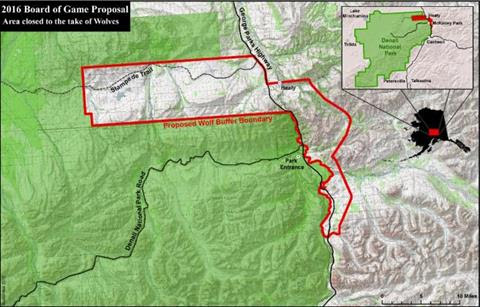
Proposal 142 is on the agenda at the Region III Alaska Board of Game meeting, scheduled for February 17-25, 2017. This is the first time since 2010 that a proposal supporting closed areas next to the national park will be heard by the Alaska Board of Game.

The Board previously approved no-take areas for wolves in these same locations in 2001 and 2002 when the Park wolf population was much higher than the record-low numbers that have persisted in recent years. While research has shown that hunting and trapping do have a real affect on the park’s wolf population, it is, of course, one of many factors that contribute to changes in population size.

We, the owners of Camp Denali and North Face Lodge, fully support Proposal 142. Whether or not increased protection from human predation will right away result in a higher wolf population in Denali and increased view-ability of park wolves is unknown. We do know, however, that the buffer zone will ease one of the known human-caused factors for wolves’ population decline. And we know that the experience of viewing wolves in the wild is a powerful and meaningful one for park visitors. It is an opportunity that ought to be in the best interest of all Alaskans.

Read Proposal 142 here.

Please consider sending your written comments—brief or lengthy—to the Alaska Board of Game for the Region III meeting before February 3, 2017. Identify your interest in the issue, your familiarity with Denali National Park, and your support for increased protection of wolves through the measures identified in Proposal 142.

HOW TO SEND A COMMENT
Click on the link below to visit the Board of Game Comment Page, where you can submit a short or long comment for the Region III meeting by February 3, 2017. Be sure you choose the Interior/Northeast Region meeting from the dropdown menu.

http://www.adfg.alaska.gov/index.cfm?adfg=process.comments

Below are some additional suggested talking points from Denali Citizens Council:

– Highlight the vulnerability of wolves to hunting and trapping when they cross the park boundary onto state land.

– Identify the international importance of Denali’s wolves to tourism and science.

– Identify the importance of intact, diverse animal populations to the regional and state economy. Of greater benefit to the State of Alaska are the revenues from tourism to Denali National Park than the hunting and trapping licenses sold for the take of wolves on adjacent state lands.

– Remind the Alaska Board of Game that it is their responsibility and authority to conserve the wilderness and wildlife in this region.

– Include any relevant personal expertise or experience you have.

Even Idaho has laws against Wolf Hunting and Trapping


With Idaho Fish and Game winter feeding big game in areas of southern Idaho, hunters are reminded that mountain lions and gray wolves may not be hunted or pursued within one-half mile of any active Fish and Game big game feeding site.  In addition, wolves cannot be trapped within the same distance. 

Additional details on seasons and rules for wolf hunting and trapping, as well as mountain lion hunting rules can be found in the 2015 & 2016 Big Game Seasons and Rules brochure available at all Fish and Game license vendors and online at https://idfg.idaho.gov/hunt/rules/big-game.

copyrighted wolf argument settled

Political shots fired as American lawmakers renew war on wolves

image

http://blog.humanesociety.org/wayne/2017/01/political-shots-fired-american-lawmakers-renew-war-wolves.html

by Wayne Pacelle     January 19, 2017

Just days after the newly constituted Congress commenced its work in the new year, some legislators from the West and the Great Lakes region showed that they have their fangs out for wolves and other animals. They are threatening not just to enable a massive kill of the ecologically and economically beneficial native carnivores, but also to open the floodgates for a host of bills and riders to target other endangered species in the crosshairs of special interests. These legislators have introduced two bills, H.R. 424 and S. 164, dubbed the “War on Wolves Act,” designed to remove federal Endangered Species Act protections for gray wolves in Wyoming and the northern Great Lakes states of Michigan, Minnesota, and Wisconsin, and to prevent federal courts from intervening to ensure wolf management is consistent with principles of sound conservation science. They will almost certainly deliver on that promise if Congress passes them and President Donald Trump signs a final bill.

The War on Wolves Act strips the U.S. Fish and Wildlife Service of its management authority over wolves and hands it off to state agencies whose past actions have shown a bias toward the bloodthirsty. These agencies have treated non-lethal co-existence measures as a sort of management oddity rather than the core of a sound strategy that balances the needs of wolves with the interests of wolf-country residents.

Lawmakers, quick to cater to the vocal minority that wants to hunt and trap wolves, are ignoring the best available science, which reveals that these apex carnivores occupy just a fraction of their original range and number only 5,000 across the entire lower 48 states. That science also shows that random killing of wolves – by trophy hunters and trappers – may actually lead to conflicts between wolves and livestock by disrupting and dispersing stable packs.

When the federal government delisted wolves in 2012 — and before federal lawsuits from The HSUS restored protections — trophy hunters and trappers, along with other causes of mortality, killed nearly a quarter of Minnesota’s wolves. Humans killed nearly one in every five wolves in Wisconsin that same year, including 17 entire family units, and half of the wolves killed in that state’s first season were pups. Michigan also conducted an ill-advised hunt, over the objections of the state’s own voters, in areas where common-sense measures would have prevented the few conflicts that had occurred with livestock and hunting dogs. In fact, between 2012 and 2014, 500 wolves had been killed in the Great Lakes states alone. Wyoming declared that over 80 percent of the state was a wolf “predator zone” — meaning that trophy hunters, trappers, and wildlife services agents had no restrictions on the manner of take, season for the killing, or even the age of pups or yearling animals. That policy is a prescription for local extinction.

This is not a sensible or conservation-minded plan and most definitely not a humane one – it is an all-out, barbaric assault on the forebears of the domesticated dog.

In 2014, two separate federal court decisions returned wolves in the Great Lakes region and Wyoming to protections afforded to them under the ESA. Because of this, the sponsors of the War on Wolves Act included an insidious provision that would prevent citizens from challenging wolf protections through the courts, removing judicial review and putting Congress squarely in charge of making a listing decision. As the Chicago Tribune pointedly remarked when this same attempt was made in 2016: “The only reason to bar court challenges, of course, is to avoid having the legal weakness of your case exposed.”

A study last year showed that most Americans hold positive or even “very positive” associations with wolves. A 2014 statewide survey of nearly 9,000 Wisconsin residents showed most residents believe that wolves are important members of the ecological community who keep deer in balance and should be enjoyed by future generations. Wisconsinites surveyed said they were proud they were “one of the few places in the United States with wolves” and most did not want to see their wolves hunted or trapped.

Upon their reintroduction to Yellowstone, wolves moderated elk from congregating and stripping away vegetation from life-bearing riparian areas. These effects are documented in a popular video called “How Wolves Change Rivers,” based on a lecture by journalist and environmental advocate George Monbiot. The video has attracted more than 31 million views on YouTube. Wolves are also an enormous draw in the Upper Great Lakes, generating millions in commerce, while providing ecological benefits that are incalculable.

If Democrats in Congress, such as Sens. Tammy Baldwin and Amy Klobuchar, continue to align with Republicans on this issue, they will not only destroy wolf families and produce enormous pain and suffering for individual wolves, but they will also cripple defensive efforts to protect other endangered species targeted by special interests who want to remove federal protections for them. This is dangerous stuff, at a time when the ESA is likely to face its most serious and sustained assault ever because of Republican majorities in both chambers and now with Trump in the White House.

Democrats should come to their senses, embrace active management of the occasional problem wolf, and defend both the decisions by scientists and judges to honor the provisions of the ESA. If they do not, we’ll see an emptying of the ark in the United States in this Congress, starting with wolves. We need to send a signal that the American public won’t go for this species-by-species gutting of our nation’s most important wildlife protection law.

Ranching groups challenge gray wolf’s endangered status in California

http://www.sacbee.com/news/politics-government/article129837699.html


Wolf that escaped from Idaho wildlife park killed by owner

image

A wolf that escaped from a drive-thru wildlife tourist attraction in southeastern Idaho has been shot and killed by the owner of the business, Idaho officials said.

Courtney Ferguson, the owner of Yellowstone Bear World near Yellowstone National Park, tracked the wolf through snow and shot it about an hour after it escaped from the facility that also has bears, elk, bison and deer.

“Courtney saw the tracks in the snow, tracked the wolf down and shot it,” Doug Peterson of Idaho Fish and Game told the Standard Journal in a story published Monday. “He took care of it all by himself and relatively quickly and easily.”

Peterson said the wolf was owned by Ferguson so the state’s hunting rules did not apply to the killing of the wolf.

“The wolves we hunt belong to the citizens of Idaho,” Peterson said. “This particular wolf of Courtney’s belonged to him.”

All the animals at the facility that is now closed for the winter were born and raised there, the company said.

Yellowstone National Park has drawn a record of more than 4 million visitors this year, many hoping to spot wolves and grizzly bears in the wild. Ferguson’s wildlife park sits on one of the major routes into the park, with a selling point that visitors can see the animals up close.

“It’s a different setting than the park but they do get to see what those animals look like,” said Jim White, regional supervisor for Idaho Fish and Game.

Yellowstone Bear World operates with a license issued by the Idaho Department of Agriculture and its animals are permitted by Idaho Fish and Game.

White called the escape of the wolf “an unusual, isolated incident.”

Ferguson did not immediately respond Tuesday to telephone and email messages seeking comment.

Rebounding California gray wolf holds onto protection

SF Chronicle

December 7, 2016

FRESNO, Calif. (AP) — The California gray wolves will keep their endangered species protections even once the rebounding animal hits a population of at least 50, state wildlife officials said Wednesday.

The California Department of Fish and Wildlife published its plan for managing wolves late Tuesday, setting its policy for the species that is making a comeback to the state after it was killed off in the 1920s.

“Wolves returning to the state was inevitable,” said Charlton Bonham, director of the California Department of Fish and Wildlife in a statement. “It’s an exciting ecological story, and this plan represents the path forward to manage wolves.”

The plan marks a shift in course, dropping language from an earlier draft that directed officials to remove wolves from the list of animals protected once they reached the critical mass.

Wolves in California were hunted to extinction nearly a century ago, but a lone wolf called OR-7 crossed the northern border from Oregon in 2011. OR-7 and his mate have had a litter for each of the last three years, and cameras caught another family pack in Northern California, but it hasn’t been spotted in several months, wildlife advocates say. Officials say it’s hard to say how many wolves roam the state today, but their numbers remain small.

In response, state officials in 2014 granted the wolf protections under the state’s endangered species act, despite opposition from hunting and livestock groups who fear the predator will kill deer and valuable cattle. Under California’s protections, gray wolves can’t be killed or hunted.

U.S. law also protects wolves in most of the nation, except for Idaho, Montana and parts of Washington, Oregon and Utah, but there is a pending proposal to strip federal protections from most of the Lower 48 states, including California.

Kirk Wilbur of the California Cattlemen’s Association said ranchers in California are prohibited from taking meaningful steps against the predator that kills their livestock. They can’t throw a rock in their general direction — let alone shoot one that’s killing cattle, he said.

“The options are very limited to the way a rancher can protect his livestock,” Wilbur said. “That can be absolutely devastating for a rancher who is a small business owner.”

Wolf advocates, however, praise the plan. Amaroq Weiss of the Center for Biological Diversity said wolves are in the early stage of making a historic comeback, and it’s too soon to consider stripping away protections.

“It’s one of those conservation moments you don’t know if you’re going to get in your lifetime,” she said. “We’re getting it in California, and it’s really exciting.”

Wolves are coming; Regional meeting held in Quincy to alert ranchers

First ‘official’ wolf kill confirmed on Colville Reservation

First wolf kill on Colville Reservation

First wolf kill on Colville Reservation

November 21, 2016 9:21 am | Updated: 1:15 pm, Mon Nov 21, 2016.

NESPELEM—After three hunting seasons without harvesting a wolf, a Colville Tribal member has taken the first.

Duane Hall, 37 of Omak, brought a gray wolf into the Colville Tribal Fish & Wildlife office for sealing on Friday, CTFW confirmed Monday.

Just three of the estimated 18 to 20 wolves—spread out among at least three packs—are allowed to be taken, per CTFW’s predator hunting regulations.

“I didn’t really have a reaction,” CTFW director Randall Friedlander said.

Hunting group Rez Bucks, Bulls & Predators, operated by tribal member Sean Gorr, published the news on Nov. 17 at 12:45 p.m.

A share to Tribal Tribune’s Facebook was met with mixed reviews.

“Terrible,” tribal member Lorin Hutton said.

“Nice kill,” tribal member Ted Piccolo added.

“Wildlife management is a must,” Gorr stated in the conversation. “Predator control is a must. Regulated hunting seasons is a must. All that needs to happen to sustain enough big game to feed our families for generations.”

Wolf hunting season started Aug. 1 and ends Feb. 28. Three known packs exist on the Colville Reservation: The Strawberry, the Whitestone and the Nc’icn. A collared wolf was accidentally slain on the Colville Reservation during a recapturing effort by CTFW in January 2015.

Friedlander said the amount of wolves harvested—by way of rifle or trap hunting—are determined by the number of wolves.

“We try to manage for the total population,” he said, “and that’s why we allow three per year. That’s based on a percentage of the overall population (of wolves).”

He reiterated the right to hunt is an ancestral right.

“We try to create opportunities for tribal members to practice their traditional, cultural way of life,” Friedlander said. “That includes the harvesting of some predators for some tribal members. Not all tribal members harvest predators, but some do.”

In May, CTFW reduced the number of wolves that could be taken from 12 to three each season, but allowed traps to be used for the first time.

Last month, a Washington wolf from the Huckleberry Pack, which was thought to range from the Spokane Reservation north, was killed after a 700-mile trek from Washington to Idaho, Canada and then central Montana.

The Tribune has reached out to Hall for an interview.

http://www.tribaltribune.com/news/article_fc9452fc-b00e-11e6-9e94-3f2bece5e94b.html

MONTANA WOLF HUNT NUMBERS SHOW SLIGHT INCREASE

 Nov 29, 2016

MISSOULA –

Although big game hunting season has ended in Montana, the wolf hunting season continues.

Through the end of the general deer and elk season on Nov. 27, hunters in Northwest Montana FWP Region One have taken 34 wolves. The statewide total sits at 106 wolves taken, up slightly from last year at the end of the general deer and elk season.

The wolf hunting season continues until March 15. Hunters can still purchase a wolf hunting license, but there is a 24-hour waiting period before it is valid.  Wolf trapping begins on December 15. 

Montana Fish, Wildlife and Parks officials point out the wolf trappers must purchase a furbearer trapping license and have completed the wolf trapping certification course to trap wolves. 

The bag limit is five wolves per hunter/trapper in any combination of hunting or trapping. FWP reports that 210 wolves were taken in 2015.

Click here for more information about the wolf hunt in Montana.

 
(MTN News file photo)

MICHIGAN WOLVES STAY PROTECTED

http://www.gohunt.com/read/news/michigan-wolves-stay-protected


Wolf in snow
Photo credits: Shutterstock

Michigan’s wolf hunting law was ruled unconstitutional by the Michigan Court of Appeals last week. This ruling means that the 2014 law that previously permitted wolf hunting within the state (should the animals ever be officially delisted from Michigan’s Endangered Species List) is no longer valid.

Gray wolves have managed to maintain a sustainable number within the state despite the first and only wolf hunt held in late 2013 where 23 wolves were killed; there are approximately 3,700 wolves in the Western Great Lakes population and 630 of them reside in Michigan, according to MLive.com. Last week’s decision was met with great approval by the group Keep Michigan Wolves Protected (KMWP) that had argued that the hunting law was misleading and the language stressed to those asked to sign in support promoted free licenses for veterans and protection against invasive species. KMWP say that signers did not know that wolf hunting was part of the package.

Because of the way the law was promoted, the judges on the panel agreed with KMWP, writing that “we cannot presume that the Legislature would have passed PA 281 without the provision allowing free hunting, trapping, and fishing licenses for active members of the military.” Misleading language in a law is good cause for termination of the entire law and the rationale behind labeling the act as unconstitutional.

“We are delighted the court has rejected the legislature’s outrageous attempt to subvert the will of the people of Michigan, and declared unconstitutional the legislature’s attempt to force a wolf hunt,” KMWP director Jill Fritz told MLive.com. “This ruling restores the people’s decision, in two statewide votes, overwhelmingly rejecting the trophy hunting and commercial trapping of the state’s small population of wolves.”

KMWP supports the downsizing of wolves, which would allow for lethal removal of problem animals without an open hunting season. Current protections only allow for killing a wolf if it attacks a human.