Exposing the Big Game

Forget Hunters' Feeble Rationalizations and Trust Your Gut Feelings: Making Sport of Killing Is Not Healthy Human Behavior

Exposing the Big Game

Cattle kills rare in wolf-occupied areas

copyrighted-wolf-argument-settled

http://methowvalleynews.com/2016/02/18/wsu-study-shows-wolves-favorite-prey-is-deer-but-moose-are-also-on-the-menu/

WSU study shows wolves’ favorite prey is deer — but moose are also on the menu

by on

By Ann McCreary

An ongoing, state-funded study of interactions between wolves and livestock shows that — no big surprise — wolves primarily eat deer, according to a researcher involved in field studies conducted over the past two summers.

The study is documenting, among other things, the types and numbers of animals killed and eaten by wolves, said Gabe Spence, a graduate student at Washington State University (WSU), which is leading the scientific investigation.

The goal of the $600,000 study, which was authorized and funded by the Washington Legislature, is to provide accurate data about wolf depredations on livestock and evaluate ways to prevent conflicts between livestock and wolves.

Spence discussed the research and preliminary findings during a presentation at the North Cascades Basecamp in Mazama last week.

The Methow Valley’s Lookout Pack is one of seven packs in north central and northeast Washington that have been studied during the past two years to develop a more accurate picture of the prey taken by wolves, Spence said. Researchers monitored four packs last year.

A team of WSU researchers conducted field studies during grazing seasons, from May through October, when cattle are turned out on public grazing allotments known to overlap with the territories of gray wolf packs.

Researchers placed radio and GPS devices on calves, cows and wolves to track their locations, determine where wolves and livestock occupy same area, and locate wolf kills to document what wolves are eating.

Over the past two years the researchers have documented 285 “probable wolf kills” by the packs they have studied. Four of the 285 animals killed by wolves were cattle, and involved three different packs.

No cattle were killed in 2014 by the packs being monitored, and none of the four cattle killed last year were in the Methow Valley, Spence said.

Spence said that about 940 cows and calves occupied the same territory as the wolf packs during the 2015 grazing season. That means that the four cattle killed equal .4 percent of the cattle in wolf-occupied areas.

“I don’t know if people realize how often wolves and cows are in the same place at the same time. All the time. Every day,” Spence said.

“Livestock deaths on the range are really small. Of the ones that die, only a tiny fraction are killed by predators, and of those a tiny fraction are killed by wolves,” Spence said.

The cattle kills account for 2.3 percent of the all the prey killed by wolves in 2015, Spence said.

Preliminary results show that over the past two summers deer accounted for almost half the prey killed by wolves. Researchers documented 137 deer that were among the probable wolf kills.

“Deer are by far the most common prey,” Spence said. The second-most common prey is moose, which account for about 22 to 28 percent of the animals killed by wolves.

By tracking wolf kills, researchers determined that the average kill rate for wolves in the Cascades area is about .3 kills per pack per day during the summer grazing season, Spence said.

That equals one kill every 3.3 days, or about 110 kills per year if the kill rate stays the same year round.

Even if kill rate is higher, for instance .5 kills per pack per day — to account for possible error or winter kill rates — it would add up to 183 kills per year, Spence said.

“To put this into perspective, roughly 350 deer are killed on the highway in the Methow Valley every year,” he said.

The study is expected to continue another two to three years and will likely include more packs, including the Methow Valley’s Loup Loup pack, if a collar can be placed on one of the wolves in that pack.

Researchers lost contact with a radio-collared female in the Lookout Pack last fall, and are not sure whether the collar failed or the wolf died or was killed. Spence said wildlife officials would try to capture and collar another Lookout pack wolf in spring or summer.

“Both packs overlap quite a bit with livestock,” Spence said.

One of the biggest challenges in conducting research into wolves and livestock “is how excited people get about this topic, on both sides. It makes it about the politics, not the biology,” Spence said.

“Having large predators on the landscape is really a social issue. The biology is pretty clear. It comes down to what we want for ourselves and our children,” Spence said.

Protect Wolves and Bears on National Refuges

Protect Wolves and Bears on National Refuges

The U.S. Fish and Wildlife Service (USFWS) recently proposed a new rule sharply restricting certain controversial wolf and other predator control measures on 77 million acres of federal wildlife refuges in Alaska – measures promoted by Alaska state wildlife managers like:

  • Killing wolves and coyotes (including pups) during the animals’ denning season.
  • Taking black bears with artificial light at den sites.
  • Taking brown or black bears attracted to bait.
  • Targeting bears with snares, traps, etc.
  • Using dogs in black bear hunts. State law currently prohibits using dogs to hunt big game, with an exception for black bears. The park service will no longer honor this exception on national preserves.
  • Shooting swimming caribou, a practice primarily used in the Noatak National Preserve in Northwest Alaska.

Federal public hearings are now underway across Alaska to gather public input prior to adopting the final rule. The draft rule, published in the Federal Register, aligns with a similar National Park Service rule that was finalized in October and would formally establish a goal of “biodiversity as the guiding principle of federal management of wildlife refuges.”

That stands in contrast to the goal of the Alaska Board of Game, which is to ensure maximum sustained populations for hunting. Increasingly over the last decade, the Game Board and the federal agencies have clashed over managing predators, largely over the idea that the state manages for “abundance” of moose and caribou. Under state law, the Board of Game focuses on sustaining populations of moose, caribou and deer for hunting and consumption.

The Wolf Conservation Center commends the USFWS for following the law, for managing the refuges as Congress intended, and for excluding extreme measures that are in direct conflict with preserving biological integrity, natural diversity and environmental health. To do anything less would violate public trust in the agency responsible for managing the national wildlife refuges — “special places that belong to all of us.”

The USFWS is accepting until March 8th. Comments can be submitted online through the Federal Register [using docket number FWS-R7-NWRS-2014-0005]

Please Comment Now

Red Wolf Population Plunges to as Few as 50 as Feds Gut Recovery Program

For Immediate Release, February 16, 2016

Contact: Brett Hartl

 Anti-wildlife Groups Spur Halt to Recovery Efforts, Poaching Investigations

WASHINGTON— The nation’s only population of red wolves is in an alarming free-fall, declining by 27 percent from 2014 to 2015 to as few as 50 individuals, according to new population counts released by the U.S. Fish and Wildlife Service.

Red wolf population graphThe total estimated population has declined by about 50 percent since 2012, from 100 to 120 individuals to just 50 to 75 in 2015. The declines have occurred since the Service bowed to political pressure from the state of North Carolina, eliminating the program’s recovery coordinator in 2014 and stopping the introduction of new red wolves into the wild in July 2015.  The agency also ended a coyote-sterilization program to prevent hybrid animals from harming the gene pool, drastically reduced law-enforcement investigations of wolf deaths, and stopped publicizing cases where poaching was determined to be the cause of deaths.

“Director Ashe and the U.S. Fish and Wildlife Service are deliberately condemning the red wolf to extinction,” said Brett Hartl, endangered species policy director at the Center for Biological Diversity. “The red wolf recovery program was once a shining example of successful conservation. Under the direction of Dan Ashe, the program has been quietly dismantled to appease a few anti-wildlife zealots. It’s disgraceful.”

Red wolf releases in North Carolina’s Alligator River National Wildlife Refuge began in the mid-1980s and pushed the population to more than 100 wolves by the mid-2000s. The population stopped growing in 2011 as gunshot mortalities increased. Red wolf mortality skyrocketed after North Carolina authorized nighttime hunting of coyotes because red wolves and coyotes are nearly indistinguishable in the dark. Following a successful lawsuit to stop nighttime hunting, the Fish and Wildlife Service faced increased political pressure to curtail the red wolf recovery program.

“Conservation scientists have shown that recovering the red wolf is completely achievable and know what steps need to be taken next,” said Hartl. “Rather than following the science, the red wolf program is in disarray because the Service won’t stand up to this political pressure.”

A 2014 report from the independent Wildlife Management Institute concluded that if the red wolf is going to recover, two additional populations need to be established in the wild, and additional resources need to be invested to build local support for red wolf recovery.

There is strong local and national support for red wolves. Recently 100 citizens who live in the red wolf recovery area in North Carolina sent a petition to the Fish and Wildlife Service expressing their support for keeping endangered red wolves in the wild. In addition, 110,000 people from around the United States, including more than 1,500 North Carolina residents, submitted letters in support of the red wolf program.

The Center for Biological Diversity is a national, nonprofit conservation organization with more than 990,000 members and online activists dedicated to the protection of endangered species and wild places.

ALERT: Stop the Senate sneak attack on wolves‏

from Defenders.org:

Anti-wildlife senators in Washington, D.C. have introduced a series of amendments to the Energy Bill that would cripple wolf conservation and set wildlife protection back by decades.

Urgent – Tell your senators to oppose anti-wildlife amendments to the Energy Bill when it comes up for a vote.

These amendments would undermine protections for individual species like wolves and tear away at the very fabric of the law by limiting citizens’ ability to enforce essential protections of the Endangered Species Act (ESA) in court.

There are three amendments in particular that must be defeated:

The “let’s throw wolves under the bus” amendment – would delist wolves in Wyoming and the Western Great Lakes. We’ve seen what delisting looks like in Wyoming, where it was open season on wolves every day of the year in 80% of the state before the courts put a stop to it;

The “leave bats in the dust” amendment – would prevent the U.S. Fish and Wildlife Service from protecting the highly imperiled northern long-eared bat as an endangered species under the Endangered Species Act; and

The “forget your day in court” amendment – tries to block citizens from going to court to hold the government accountable when it does not properly enforce the ESA. This amendment would bar recovery of legal fees otherwise available under the law and allow local governments to veto a federal court’s decision to enforce the law with regard to certain species.

In the past year alone, anti-wildlife forces have introduced over 90 legislative measures aimed at crippling America’s commitment to restoring and protecting imperiled wildlife.

Tell your senator to oppose these lethal amendments!

Thank you for all you do.

Black female wolf 831f Yellowstone National Park_2012 NPS

Petition on BC Wolves

http://action.sumofus.org/a/stop-wolf-cull/?sub=fb

Nearly 200 wolves are going to be shot from helicopters over the next few weeks — a bloody attempt to save an endangered caribou herd in western Canada. And these killings are likely to go on for five years.

Oil, gas, mining, and logging companies have been trashing the mountain caribou’s habitat for decades — but instead of curtailing this industrial habitat destruction, the British Columbia (BC) provincial government is scapegoating wolves, condemning them to a gruesome death.

This cull is just a stopgap measure and not a viable long-term solution to the caribou’s problems. It will, however, cause immense suffering to the wolves, who are highly social and intelligent creatures.

Tell the BC government to stop the industrial encroachment of the caribou’s and wolves’ territory!

Decades of habitat destruction and human encroachment have led to this tragic situation. The BC government needs to be protecting the caribou’s critical food and natural habitat, such as lichen-rich interior forests.

Part of the problem is the caribou’s natural protection from wolves has been undermined by commercial activity. Normally, thick winter snow is enough to keep them safe from most predators, but the wolves have been using the industrial infrastructure of pipeline corridors, roads, railways and snowmobile trails to move through the landscape and hunt. Some feel the cull is awful but necessary to save the caribous, and others feel the cull should be canceled outright — but fundamentally, the BC government should never have let the problem get to this point.

We need to stand up for nature against profit-making companies who are destroying our wildernesses all over the world. These innocent wolves, who are right now being hunted from the skies, are a powerful symbol of how the long-term future of the natural world is being sacrificed for short-term profit.

Please add your voice to ask BC to place responsibility at the feet of the oil, gas, mining and logging companies who are causing the real damage to caribou and wolves.

Sign the petition asking the BC government to protect caribous and wolves from industrial encroachment.

********** More information:

B.C. wolf cull will likely last 5 years, assistant deputy minister says, CBC News,

‘Carnivore cleansing’ is damaging ecosystems, scientists warn

http://www.theguardian.com/environment/2014/jan/09/carnivore-cleansing-damaging-ecosystems?CMP=share_btn_fb

Extermination of large predators such as wolves and bears has a cascading effect on delicate ecological balance

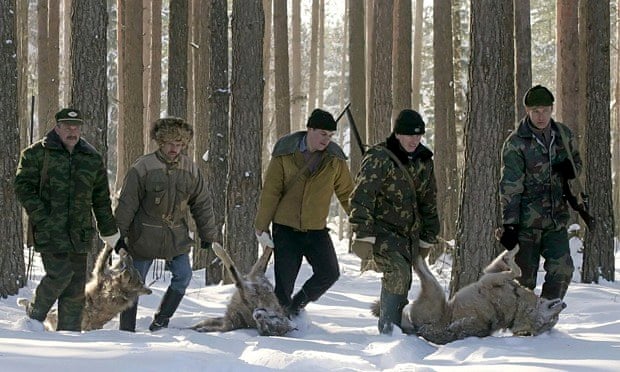
Carnivore extermination damaging ecosystems : hunters drag wolves they killed, Belarus
Belarus hunters drag wolves they killed overnight near village Pruzhanka, some 110 km south-east of Minsk February 8, 2005. Hunting for wolfs in Belarus is legal throughout the whole year with a hunter getting 168,000 Belarus roubles ($77 US dollars) for every wolf killed. Photograph: Vasily Fedosenko/Reuters

Oregon Groups Sue to Reinstate Protected Status for Gray Wolves

The wolves were removed from the protected list in November.

Who will speak for the gray wolves? Oregon Wild, Cascadia Wildlands and the Center for Biological Diversity, that’s who.

That means, according to the National Wildlife Federation, they are no longer protected from anyone who would “harass, harm, pursue, hunt, shoot, wound, kill trap, capture, or collect, or to attempt to engage in any such conduct,” as well as “interfering in vital breeding and behavioral activities or degrading critical habitat” and “being traded or sold.”

But this morning, three conservation groups filed a legal challenge to that removal, saying in a press release by Oregon Wild that the Oregon Fish and Wildlife Commission “violated the law by failing to follow best available science and prematurely removing protections before wolves are truly recovered.”

There are 85 wolves in Oregon, which is four more than in 2014. But Noah Greenwald, endangered species program director at the Center for Biological Diversity, says in the press release: “It’s simply too soon to remove protections for Oregon’s wolves. The gray wolf remains endangered, and protections should never have been removed.”

Rob Klavins, a conservation advocate for Oregon Wild in Wallowa County, adds: “We look forward to the day we can celebrate the recovery of wolves in Oregon, but in a rush to declare ‘Mission Accomplished,’ the state caved to political pressure. If there were fewer than 100 elk or salmon or eagles left in the state, the agency would be scrambling to protect them. Wolves are being treated differently.”

Not everyone thinks the Oregon Fish and Wildlife Commission made the wrong call, though. Last year, we wrote about hostilities between conservationists and ranchers over the return of wolves in Oregon. €In rural parts of the state, many people are angry that wolves have been reintroduced at all, let alone protected. In that story, rancher and head of the Wolf Task Force said: “We didn’t want wolves here to begin with because we knew what the outcome was going to be, and that’s been realized now. So anything that has to do with a wolf being here at all is a compromise.”

As for when we can expect some sort of ruling on the challenge, Nick Cady of Cascadia Wildlands says it could be a while.

“Oregon Court of Appeals sometimes takes a very long time to complete cases, up to two years,” Cady told us over the phone. “We’re not sure when they’ll come out with an opinion on the matter.”

Ruling bars federal Wildlife Services Program from killing wolves

528624c939a88_preview-620

by on • 5:53 pm

Plaintiffs applaud judge’s conclusions

By Ann McCreary

A federal judge has barred the federal Wildlife Services program from participating in lethal removal of gray wolves in Washington, and rejected an Environmental Assessment (EA) prepared by the agency.

In response to a challenge brought by a coalition of conservation organizations, U.S. District Judge Robert Bryan said last week that Wildlife Services should have prepared a more in-depth environmental analysis of the effects of its proposed wolf management activities.

The lawsuit filed by five conservation organization earlier this year claimed that Wildlife Services, a federal program involved in wildlife management and conflict resolution, violated federal law by not preparing an adequately detailed environmental analysis of the effects of killing wolves that attack livestock in Washington.

An agency of the U.S. Department of Agriculture, Wildlife Services has worked under contract with Washington Department of Fish and Wildlife (WDFW) on lethal and non-lethal approaches to wolf-livestock conflict.

In 2014, Wildlife Services killed one wolf in the Huckleberry pack after state wildlife officials linked the pack to sheep kills. In 2012, Wildlife Services provided technical information to WDFW when the department killed seven wolves from the Wedge Pack following attacks on cattle.

In his ruling, Bryan said that “although Wildlife Services may have taken a hard look at the effects of lethal removal on non-target species, Wildlife Services did not take a hard look at the ecological effects of lethal removal or its effect on gray wolf populations” in its environmental analysis.

Bryan said the agreements on wolf management activities between WDFW and Wildlife Services left “the potential for substantial mismanagement of the Washington gray wolf population in the hands of Wildlife Services without the benefit of an EIS (Environmental Impact Statement).”

He said Wildlife Services failed to meet federal environmental policy requirements by not preparing an EIS and not taking a hard look at significant issues.

“Wildlife Services repeatedly but erroneously falls back on the position that it need not do so because it only intends to act at WDFW’s direction,” Bryan wrote.

Arbitrary action

The EA describes Wildlife Services’ intent to be bound to the state’s Wolf Conservation and Management Plan, which “is subject to changes or additions by WDFW, giving the public scant recourse,” Bryan wrote.

“Wildlife Services acted arbitrarily and capriciously and contrary to law by not preparing an EIS,” Bryan said. “Although aspects of Wildlife Services’ consideration under the Environmental Assessment and FONSI (finding of no significant impact) were sufficiently thorough, Wildlife Services misjudged the scope of its responsibility by deferring to WDFW, rather than diligently considering issues that may arise under the potentially broad scope of involvement in the Wolf Conservation and Management Plan.”

The judge ordered Wildlife Services to “not take any further wolf management actions in Washington” beyond the status quo that was in place prior to the Environmental Assessment and its finding of no significant impact.

The judge’s ruling was applauded by conservation groups that brought the case.

“The court made a wise and prudent decision that safeguards the legal right of citizens to know what their government is doing in their name,” said Timothy Coleman, executive director of the Kettle Range Conservation Group. “Wildlife Services cannot just grant itself authority to execute an endangered species absent the public interest or best available science.”

“We have been working for over a decade to hold Wildlife Services accountable for its blind, reckless lethal control programs,” said Nick Cady, legal director of Cascadia Wildlands. “This decision paves the way for meaningful analysis of the program’s impacts and hopefully a meaningful look at whether or not this wolf killing is worth it.”

“Wildlife Services has long asserted that it need not comply with our nation’s federal environmental laws, such as the National Environmental Policy Act, but this decision rejects those arguments and requires Wildlife Services to comply with all federal laws, not just those it finds convenient to comply with,” said John Mellgren, an attorney with Western Environmental Law Center, which represented the environmental organizations in court.

WDFW’s involvement

Donny Martorello of WDFW said that although Wildlife Services is now barred by the ruling from participating in lethal removal of gray wolves in Washington, the agency may continue to work on non-lethal management as requested by WDFW.

“Those activities have included trapping and collaring wolves, investigating reports of wolf-livestock depredations, and implementing non-lethal measures,” Martorello said in an email to members of the state’s Wolf Advisory Group.

WDFW filed a brief in support of Wildlife Services and Martorello said the two agencies are now considering their legal options for responding to the ruling.

In his order, Bryan said, “The decision on how to proceed — whether to prepare and EIS, renegotiate a narrower cope of involvement with WDFW, or abandon assistance efforts entirely — rests with Wildlife Services.”

Because the case is ongoing, WDFW would not discuss further details, Martorello said.

Organizations that brought the case are Cascadia Wildlands, WildEarth Guardians, Kettle Range Conservation Group, Predator Defense, and the Lands Council.

Gray wolves are protected as an endangered species throughout Washington under state law, and in the western two-thirds of the state — which includes the Methow Valley — under federal law.

There were at least 68 wolves in 16 packs in Washington according to a 2014 wolf census by WDFW. Two wolf packs have been confirmed in the Methow Valley.

The wolves that survived the night

December 22, 2015, 05:00 pm

By Tim Preso

 On a December day in 2012, a collared female wolf known by wildlife biologists as 832F wandered beyond the boundaries of Yellowstone National Park into Wyoming where she was shot and killed. She would be among the first wolves shot in Wyoming since the U.S. Fish & Wildlife Service removed federal protections from the species and turned over their management to the state earlier that fall.

At the time, 832F was called the “most famous wolf in the world,” the alpha female of the Lamar Canyon pack, wildly popular among tourists to Yellowstone National Park. She was known for her agile hunting ability, able to take down an elk singlehandedly, a dangerous feat usually undertaken by a whole pack. Unusually large with a thick gray and white coat, 832F was a queen among wolves, leader of her pack, beautiful, lethal, a living expression of what it means to be wild.he move by the Fish and Wildlife Service to take away federal protections for wolves was controversial, but the shooting of this particular wolf unleashed a firestorm of criticism of the Service and shined a harsh light on the state of Wyoming’s wolf management program, which included a hostile shoot-on-sight policy across the vast majority of the state and one wolf-killing loophole after another in the remainder.

Earthjustice took the Fish and Wildlife Service to court over the decision to hand over wolf management to a state with a history of extreme anti-wolf policies and a management program that failed to include essential protections for wolves. Last year, a judge ruled in our favor and restored protections to wolves throughout Wyoming.

But just this past week, the fate of wolves in Wyoming and in three other states in the Western Great Lakes region again hung in the balance. Earlier this year, a cadre of anti-wildlife members of Congress slipped a policy rider into House and Senate versions of government spending bills that would have overridden two federal court decisions (including our 2014 victory for wolves in Wyoming). This rider would have stripped wolves of federal protections and would have prevented any further judicial review of the legality of that decision.

If enacted, that rider would have given Wyoming the green light to resume its hostile management program, including shoot-on-sight management of wolves, with no limit or regulation whatsoever, across 85 percent of that state. Just as a fragile recovery is within reach for wolves in the northern Rockies, Wyoming would have again subjected them to the same unregulated killing that nearly wiped them out in the first place.

In the end, wolves survived the night. Last week, President Obama signed into law an omnibus spending package that did not include the wolf delisting rider. That rider, along with 12 other anti-Endangered Species Act riders and dozens of other anti-environmental riders, were excluded from the final omnibus deal.  The fact that wolves and the Endangered Species Act emerged from the omnibus deliberations and deal-making relatively unscathed is in no small part due to the thousands of Americans who wrote in to their members of Congress, or called the White House, or took to social media to demand that their leaders follow through on the American promise to safeguard the natural world for the sake of our children and grandchildren.  The message of these constituents was heard loud and clear by 25 senators and 92 members of the House who wrote letters to the president urging him to reject any policy riders that undermine the Endangered Species Act, an Act that  serves as a critical safety net for the nation’s imperiled plants and animals.

Today, we celebrate that wolves in Wyoming remain protected. We thank the members of the House and Senate who stood strong for the protection of wolves and recognized that a spending bill is no place to make life-and-death policy decisions for our nation’s wildlife. We will remain steadfast in our commitment to fight for the wolves and other species under threat of extinction. And we will think of the wolf somewhere in the mountains south of Wyoming’s Teton Range that will not be shot this winter, but instead will climb through the snow to a ridge-top at night under a winter sky filled with stars and will throw back her head to send a wild howl across the forest.

Preso is an Earthjustice attorney based in Bozeman, Montana.

US carnivore hunting policies are scientifically lacking

1384140_564330240283396_857016214_n

http://conservationmagazine.org/2015/12/us-carnivore-hunting-policies-are-scientifically-lacking/

0 Comments

By now you probably know the arguments for the monitored, controlled, legalized forms of wildlife hunting. It has the potential to reduce conflict with humans and can provide much-needed revenue to be put toward conservation efforts. But not all populations are created equal; applied to the wrong ecosystem, hunting can also drive population declines, the echoes of which will reverberate throughout its landscape. In this week’s issue of Science Magazine, a group of researchers led by Montana State University wildlife biologist Scott Creel argue that wolf hunting policies in the US don’t align with the best evidence that science has to offer.

After wolves were reintroduced to the Northern Rocky Mountains (NRM) in the mid-1990s, the carnivore population grew stronger. But that trend stopped in 2009. That’s because in 2008, the population lost its protection under the ESA and hunting became legalized.

Reviews by the USFWS say that hunting “has not increased any risk” to the NRM wolf population, but Creel and his colleagues aren’t so sure. “Current policies state that half of a wolf population can be shot annually without causing the population to decline,” said Creel in an official statement. “On the basis of ecological theory, this suggestion is not likely to be correct for the wolf, or indeed for any large carnivore.”

Fully-grown, mature large carnivores usually have low mortality rates. They are the kings of their jungles, after all. Hunting doesn’t substitute for other causes of wolf death, as is more likely the case for ungulates like deer. For animals like wolves, hunting pressures instead add to the mortality rate. After hunting was legalized in Montana and Idaho in 2008, wolf pack size there declined by nearly a third. And hunting doesn’t just impact group size – it also affects a group’s social order, which impacts the likelihood that juveniles will grow to reproductive age. Indeed, in 2013, five years after hunting was legalized, hunters took 25% fewer wolves – despite an extended hunting season!

How can the scientific evidence and the USFWS review be so contradictory? Creel’s group suggests that there can be a mismatch between the animals that provide the data to inform policy decisions and the animals to which that policy applies. “Carnivore distributions do not follow political borders, but hunting policies do,” they say. Just because the overall Northern Rocky Mountains population has been relatively stable under pressure from hunting doesn’t mean that the packs in any given state are equally so. Idaho’s annual wolf counts declined by nearly a quarter between 2008 and 2013.

More importantly, Creel’s group says the studies on which the USFWS based their review focused on wolf populations that could recruit immigrant wolves from other, nearby populations. Those local losses to hunting could be replaced by the influx of new individuals from elsewhere. It’s not that wolves are able to compensate for local losses, but it might appear that way if you’re not looking very closely. By analogy, while African lions may be protected within national parks, legalized hunting just outside of parks can still destabilize the overall lion population. Harvesting lions outside of parks creates a “vacuum,” drawing in the otherwise protected lions from inside of parks – leaving them vulnerable to hunting.

There can be a sustainable way forward for carnivore hunting. The future of wildlife management in most parts of the world probably includes at least some carefully controlled harvest. But if legalized hunting is to occur, the researchers say that policies need to be based on rigorous, empirical science, which requires “clearly defined, quantitative” goals.

Current wolf hunting policies in the NRM simply aim to avoid a population crash so severe that it would require re-listing under the ESA, but that’s too hand-wavy a target. Instead, policies should specify things like maximum harvest rates or goals for population size or growth from year to year. According to Creel, “the North American model of wildlife management works very well for species like ducks or elk, but becomes much more complex for species like wolves that compete with hunters.” – Jason G. Goldman | 18 December 2015

Source: Creel, S., Becker, M., Christianson, D., Dröge, E., Hammerschlag, N., Haward, M.W., Karanth, U., Loveridge, A., Macdonald, D.W., Wigganson, M., M’soka, J., Murray, D, Rosenblatt, E, Schuette, P. (2015) Questionable policy for large carnivore hunting. Science. DOI: 10.1126/science.aac4768.